

User Consent in 2026: 7 Checks Before You Trust It in Production
If you are searching user consent on August 8, 2026, the main mistake to avoid is treating consent like one generic yes-or-no field.
That is too small for how privacy programs work now. In real systems, user consent has to answer narrower questions: what exactly the person agreed to, whether consent was even the right legal basis to use, how refusal or withdrawal changes live behavior, and what proof the business can still show later.
Official guidance across Europe, the UK, and California still pushes in that direction. The European Commission says consent must be “freely given, specific, informed and unambiguous.” It also says it should be “as easy to withdraw as to give consent.” California’s Department of Justice frames a different but related operational problem by describing Global Privacy Control as a “stop selling or sharing my data switch.”
If you want the adjacent implementation detail first, start with our guides to user consent management, cookie consent requirements, and GDPR vs. CCPA. This article stays tighter. It is the seven-check review I would use before trusting user consent on a live site or app.
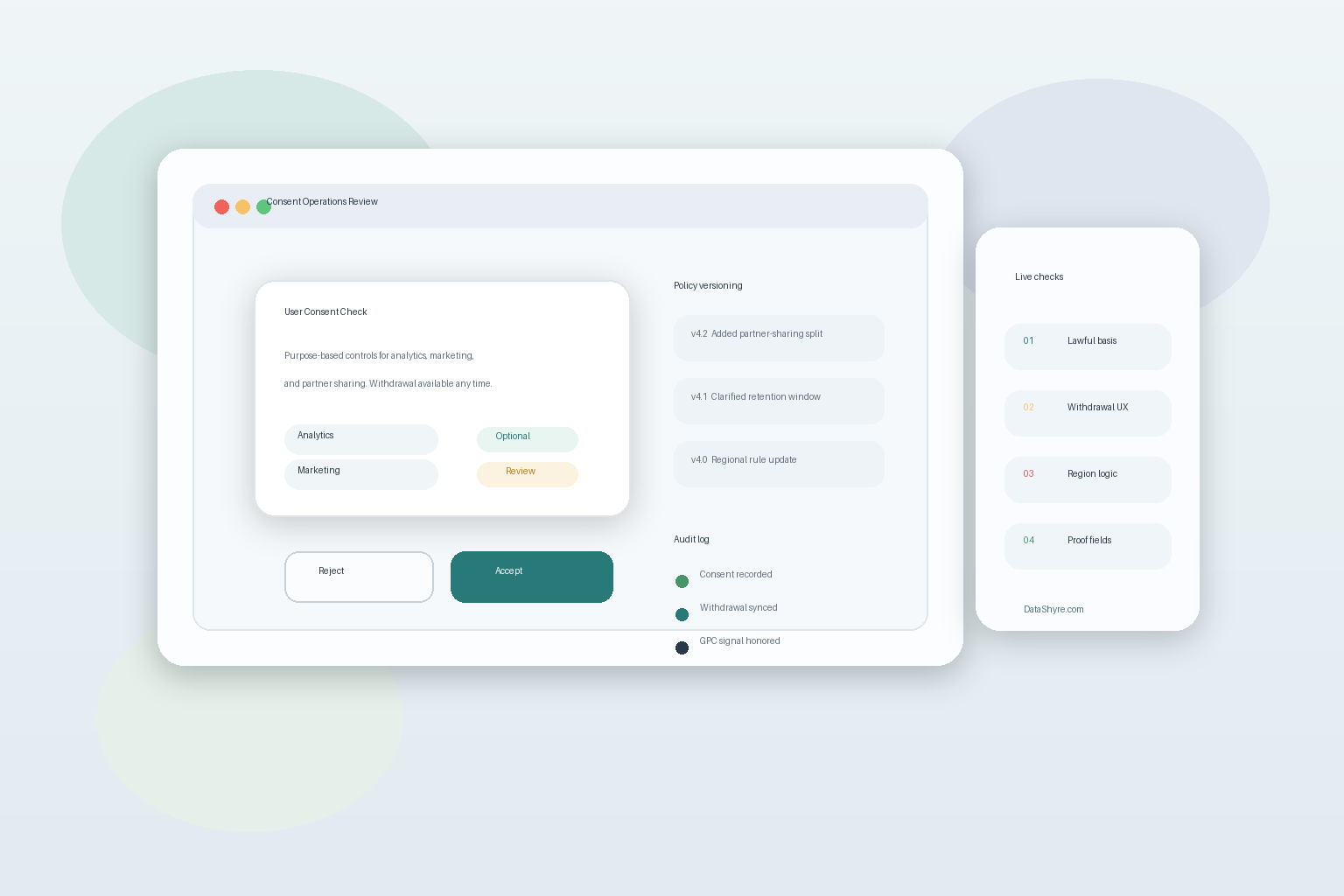
The short answer on user consent
The fastest useful summary of user consent in 2026 is this:
- consent is not the right legal basis for every data use;
- when consent is used, it has to be specific to the purpose and based on a real choice;
- withdrawal has to be easy and has to change actual system behavior;
- California often requires opt-out handling instead of the same consent flow used in Europe;
- records need enough context to prove what the person saw, chose, and changed later.
That is why the hard part of user consent is rarely the checkbox. It is the model behind the checkbox.
1. Check whether consent is actually the right basis
This is the first review many teams skip.
The European Commission’s current legal-grounds guidance still lists six possible bases for processing personal data, and consent is only one of them. That means a product team can get into trouble by collecting user consent everywhere when the real question should have been whether the processing depended on consent at all.
The UK ICO makes the same point from another angle. Its lawful-basis guidance says you should choose the basis that most closely reflects the true nature of the relationship and purpose. If consent feels forced or awkward, that is often a sign another basis may be more appropriate.
So before you design a prompt, check whether the flow is truly consent-dependent or whether you are mixing together:
- consent;
- contract-based processing;
- legal obligations;
- objection rights;
- California opt-outs;
- deletion or correction requests.
The cleaner your separation is here, the less fragile your user consent model becomes later.
2. Make the request specific enough to mean something
Consent fails quickly when one click is stretched across unrelated purposes.
The European Commission’s current individual guidance says a consent request must be presented clearly and concisely, in language that is easy to understand, and distinguishable from terms and conditions. Its business guidance adds that, for consent to be freely given, the person must have a free choice and be able to refuse or withdraw without disadvantage.
That makes user consent a specificity problem, not just a UI problem. A person agreeing to product updates is not automatically agreeing to ad targeting. A person agreeing to optional analytics is not automatically agreeing to partner sharing. A person accepting one mobile permission is not consenting to every later use of the data that permission exposes.
For live systems, that usually means checking whether each consent event is tied to:
- a defined purpose;
- a narrow enough category;
- the version of the notice shown;
- the place where the choice was made;
- the systems expected to react afterward.
If one Accept button silently covers too much, the click is stronger than the consent.
3. Test refusal and withdrawal as seriously as acceptance
This is where many polished experiences still break.
The European Commission says it should be “as easy to withdraw as to give consent.” The ICO’s current storage-and-access-technologies guidance also says that, as a general guideline, six months is a suitable timeframe to request fresh consent again after a user has declined, unless the purposes or activities have changed and new consent is needed sooner.
That matters because weak user consent designs often behave like this:
- acceptance works immediately;
- refusal takes more clicks;
- withdrawal is buried in settings or the footer;
- the prompt reappears too aggressively after a decline;
- changing the choice later does not reliably propagate through the stack.
If refusal and withdrawal feel harder than acceptance, the system is telling you something important. The consent layer may be present, but the user’s control is not yet credible.
4. Separate website tracking consent from broader privacy rights
This distinction matters more in 2026 than it did in older consent articles.
The ICO finalized its storage-and-access-technologies guidance on April 29, 2026, and the guidance expressly reaches cookies, tracking pixels, fingerprinting, and similar techniques. That makes user consent for websites more operational than cosmetic. Teams now need to review what fires before any click, what relies on an exception, what is blocked by default, and what changes after the person updates preferences.
But website tracking is still only one part of the larger user consent picture. Marketing permissions, account settings, mobile app permissions, health-data handling, and vendor sharing controls can all follow different rules.
That is why it is risky to compress everything into one generic preference center. The better pattern is to separate:
- tracking consent where it is legally required;
- marketing consent where channel rules require it;
- account or feature permissions inside the product;
- statutory rights flows such as delete, correct, or opt out.
When those flows are mixed together, teams tend to overstate what their user consent record actually proves.
5. Treat California opt-outs and GPC as different from consent
This is one of the most common design errors on global properties.
California’s Department of Justice still says a valid Global Privacy Control signal must be honored by covered businesses as a request to stop the sale or sharing of personal information. Its GPC page describes the signal as a “stop selling or sharing my data switch.” The CPPA FAQ also continues to frame California around rights handling, including response timelines for delete, correct, and know requests.
So a California flow may involve privacy choices without being the same kind of user consent flow a GDPR-oriented team expects.
That means your model should distinguish between:
- a consent event;
- an opt-out request;
- a browser-level preference signal;
- a later withdrawal;
- a rights request with a statutory deadline.
If all of those are stored as one flat preference, your program may look tidy while hiding meaningful legal and operational differences.
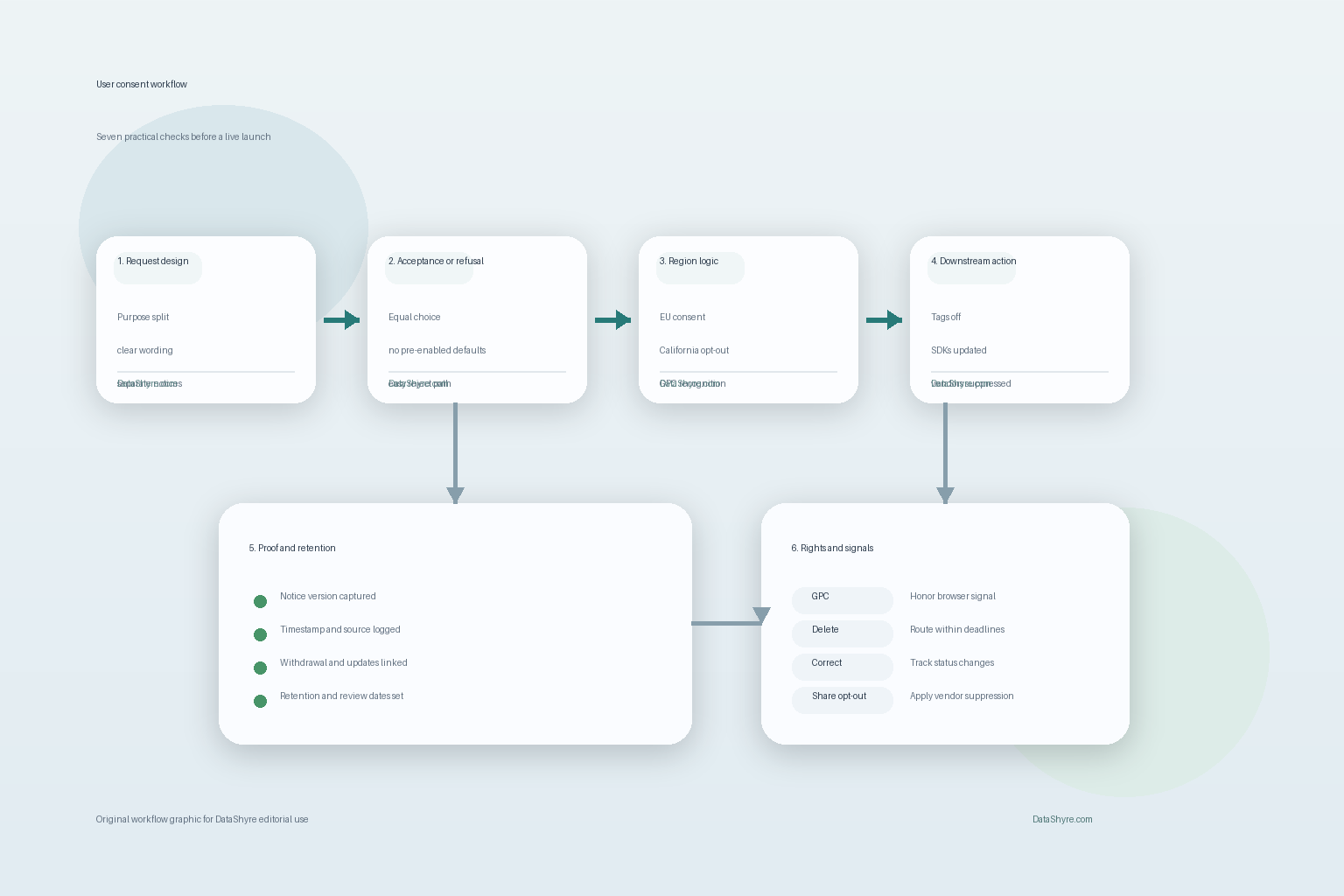
6. Follow the choice into downstream systems
The visible prompt is only the front edge of user consent.
The more important test is what changes after the choice. If someone refuses optional analytics, do tags stay off? If someone withdraws marketing consent, do automations stop? If a California user sends a valid GPC signal, do sale-or-sharing pathways actually shut down? If a person narrows one purpose but leaves another in place, can the stack represent that without flattening everything to one global yes or no?
This is where weak implementations usually fail. They log the event but do not enforce it consistently across:
- tag managers;
- mobile SDKs;
- CRM and marketing automation tools;
- data warehouses and audience exports;
- vendor-sharing workflows;
- support-facing audit views.
If the downstream systems keep acting like nothing changed, the business has collected a preference event, not reliable user consent control.
7. Keep proof that explains context, not just the click
A timestamp by itself is not much evidence.
Stronger user consent records usually preserve enough context to answer the questions that come later: what the person saw, what they chose, what region logic applied, what policy or banner version was active, and what changed afterward.
The ICO’s direct-marketing checklist says organizations should archive the text of the website, leaflet, contract, telephone script, and similar materials used to inform the individual at the time consent was given. That is practical advice because it turns a bare event into something a reviewer can understand.
For most teams, the useful proof set is not fancy. It is just complete:
- the request text or notice version;
- the timestamp and source;
- the purpose or category involved;
- the region or rule logic applied;
- the downstream status after the choice;
- the later withdrawal, change, or expiry event if one happened.
That is what turns user consent from UI telemetry into operational evidence.
A short review sequence for this week
If I were reviewing user consent on a live product right now, I would use this order:
- List the flows where the business currently asks for consent or records a privacy choice.
- Separate true consent flows from California opt-outs, browser signals, and rights requests.
- Check whether each consent request is specific enough to map to one real purpose.
- Test refusal, withdrawal, and preference changes with the same care as acceptance.
- Trace whether the choice actually changes tags, SDKs, messaging tools, and vendor behavior.
- Review the evidence kept for each material event.
- Recheck whether any prompt is being reused for a purpose it was never narrow enough to cover.
That sequence usually exposes the difference between decorative compliance and trustworthy user consent operations.
Bottom line
The practical lesson of user consent in 2026 is that consent is not a design ornament and it is not a universal answer.
It is one specific control among several privacy controls. When it is the right control, it has to be meaningful, narrow enough to match the purpose, easy to refuse, easy to withdraw, and strong enough to change live behavior. When it is not the right control, teams should stop forcing every privacy action into the same consent-shaped box.
If your current stack can tell those states apart and prove what happened afterward, your user consent program is in much better shape than most. If it cannot, the fix probably starts in the data model before it starts in the banner.
Sources
- European Commission: Legal grounds for processing data
- European Commission: Information for individuals
- European Commission: When is consent valid?
- European Commission: What if somebody withdraws their consent?
- UK ICO: Guidance on the use of storage and access technologies
- UK ICO: How do we manage consent in practice?
- UK ICO: A guide to lawful basis
- UK ICO: Direct marketing checklist
- California Department of Justice: California Consumer Privacy Act (CCPA)
- California Department of Justice: Global Privacy Control (GPC)
- California Privacy Protection Agency: Frequently Asked Questions
This post was updated on August 8, 2026 using current official regulator and government materials available at publication time.