

What Is Consent Management in 2026? The Control Layer Behind Privacy Choices
If you are asking what is consent management in 2026, the shortest useful answer is this: it is not just the banner.
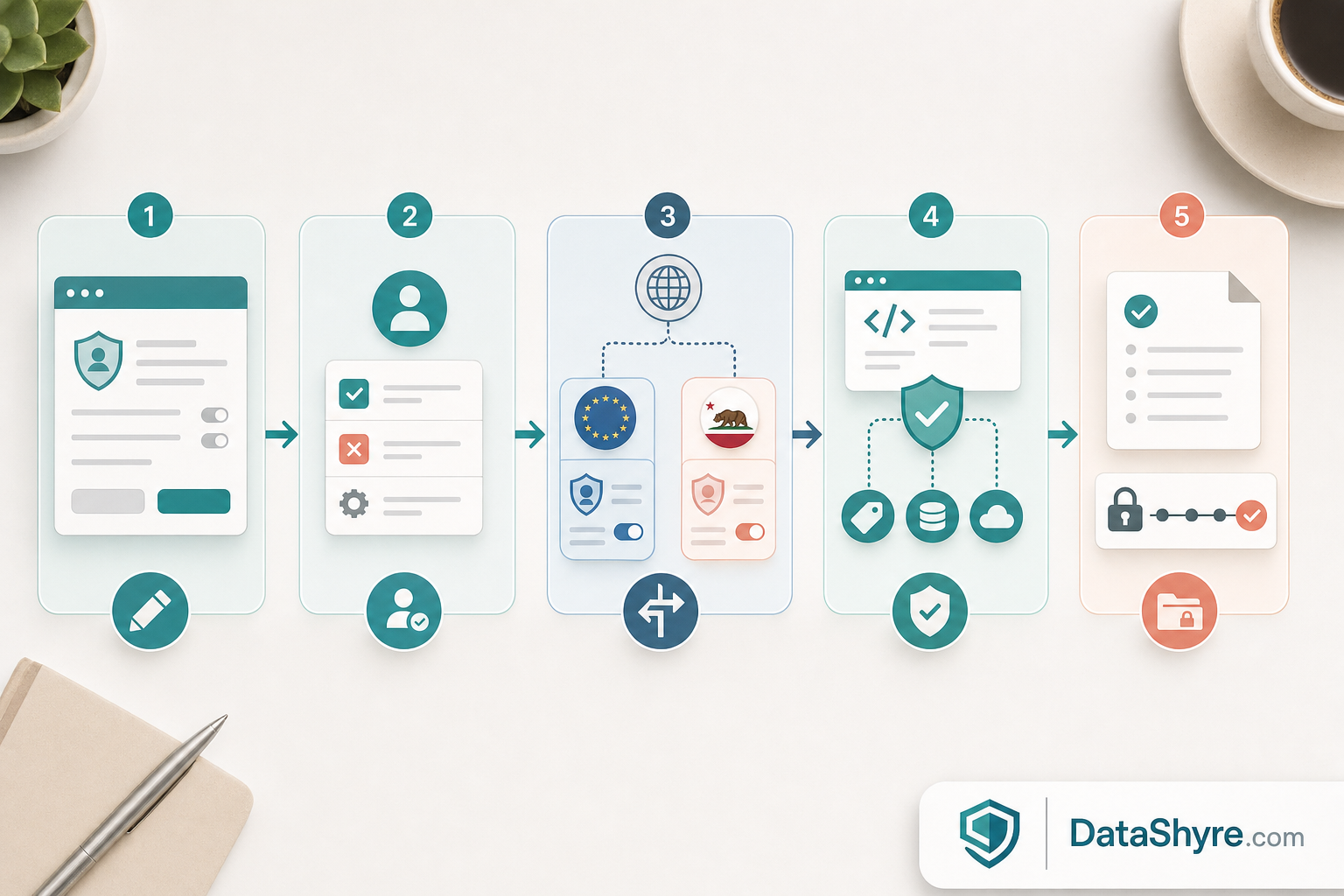
Consent management is the operating layer that decides when a privacy choice is needed, how that choice is presented, where the resulting signal travels, and what proof your team can still show later. On a live site or app, that usually means connecting the front-end notice to tags, SDKs, embeds, marketing systems, and regional rules.
That broader definition matters because official guidance keeps pushing the same direction. The European Commission says valid consent must be freely given and tied to a specific purpose. The UK ICO says its April 29, 2026 storage-and-access technologies guidance is meant to give people “meaningful control” over how their data is used online. California’s Department of Justice says a valid Global Privacy Control signal “must be honored” by covered businesses.
If you want the buying or implementation angle next, start with our guides to consent management platform, user consent management, and cookie consent manager. This article stays at the foundation: what consent management actually is and what it has to control.

The short answer
Consent management is the system your organization uses to:
- decide when consent is the right legal mechanism and when it is not;
- collect a specific choice in a way the user can understand;
- pass that choice into the tools that actually process data;
- honor related signals such as opt-outs and browser-level privacy controls;
- keep a record strong enough to explain what happened later.
That is the practical answer to what is consent management now. It is a control problem, not a design ornament.
1. It starts before the banner appears
Many teams still treat consent management as the moment a banner pops up. That is too late.
The European Commission’s current guidance for businesses says consent is only one legal ground for processing personal data, and that for consent to be valid it must be informed, specific, clearly presented, and given through an affirmative act. In other words, a team first has to decide whether consent is actually the right model for the data use in question.
That means real consent management begins with questions like:
- What purpose are we asking about?
- Is the person free to refuse without disadvantage?
- Is this actually a consent flow, or should it be handled as contract, legitimate interests, unsubscribe, or a statutory rights workflow?
- Will the request stay narrow enough to mean something later?
If the legal model is wrong, the interface usually becomes misleading no matter how polished it looks.
2. It has to turn a choice into live system behavior
This is where many implementations fail.
A visitor can click reject, but if analytics, ad tags, chat widgets, or audience tools still fire, the organization is not managing consent. It is only recording a preference. The ICO’s final 2026 guidance makes the scope broader than classic browser cookies alone, reaching storage and access technologies such as pixels, fingerprinting, and similar techniques.
So consent management has to connect the user’s choice to the real runtime stack:
- website tags and tag managers;
- mobile SDKs;
- third-party embeds and pixels;
- CRM and marketing systems;
- downstream partner sharing where it applies.
If someone asks what is consent management on a modern site, this is the most important part of the answer. It is the mechanism that makes optional processing wait, continue, or stop.
3. It has to separate regions and rule types
Consent management is not one global yes-or-no switch anymore.
EU and UK tracking rules often require prior consent for non-essential storage or access technologies. California can require a different branch that recognizes an opt-out preference signal rather than using the exact same consent flow. The California DOJ’s GPC page says the signal must be treated as a valid request to stop the sale or sharing of personal information by covered businesses.
That means a serious program separates:
- EU and UK prior-consent logic;
- California opt-out logic, including GPC where applicable;
- marketing permissions by channel;
- rights workflows such as access, correction, or deletion.
When those paths are collapsed into one generic preference center, the record may look tidy while the obligations stay blurry.
4. It needs proof, not just collection
Good consent management does not end when the click is captured. It has to preserve evidence.
The European Commission says the person must be able to withdraw consent without disadvantage. The ICO’s consent guidance says organizations should be able to demonstrate who consented, when, what they were told, and whether they later withdrew. In practice, that means keeping more than a yes-or-no field in a database.
Useful proof usually includes:
- the notice or banner version shown;
- the purpose or category involved;
- the timestamp and identifier;
- the region or rule set applied;
- the downstream state after the choice;
- any later withdrawal or update.
That is what lets privacy, legal, support, and engineering teams reconstruct the event later without guessing.
5. For publisher ads, it may also mean certified-CMP requirements
Some teams need an extra layer beyond general consent handling.
Google’s current Ad Manager help says publishers and developers using AdSense, Ad Manager, or AdMob to serve personalized ads in the EEA, the UK, or Switzerland must use a Google-certified CMP that integrates with the IAB Transparency and Consent Framework. Google also says its certification review does not check CMPs for full compliance with applicable privacy laws.
So if ads are in scope, consent management may include:
- a certified CMP requirement for certain Google publisher workflows;
- TCF and Additional Consent handling where relevant;
- separate testing for legal fairness, runtime enforcement, and record quality.
That is another reason the phrase is bigger than banner copy.
FAQ
Is consent management the same as a cookie banner?
No. A banner can be one surface inside consent management, but the wider job includes legal-basis decisions, regional routing, runtime enforcement, and audit-ready records.
Does every privacy choice belong in consent management?
No. Some actions are consent flows, others are opt-outs, unsubscribe events, or statutory rights requests. Mature programs keep those lanes distinct.
Why do teams get consent management wrong?
Because they optimize for the visible prompt and underinvest in the system behind it. The recurring failure is not usually the button text. It is the gap between the promise on screen and what the stack actually does.
Bottom line
The cleanest answer to what is consent management is that it is the control layer between privacy policy and runtime behavior.
It decides when a choice is needed, collects that choice fairly, routes it into the real systems that touch data, respects regional differences, and keeps evidence another human can still understand later. If your program only changes the banner and not the behavior behind it, your consent management is not finished.
Sources
- European Commission: Legal grounds for processing data
- European Commission: Information for individuals
- UK ICO: Final storage and access technologies guidance published
- UK ICO: How should we obtain, record and manage consent?
- California Department of Justice: Global Privacy Control
- Google Ad Manager Help: Google consent management requirements for serving ads in the EEA, the UK, and Switzerland (for CMPs)
This post was updated on October 8, 2026 using current official sources available at publication time.