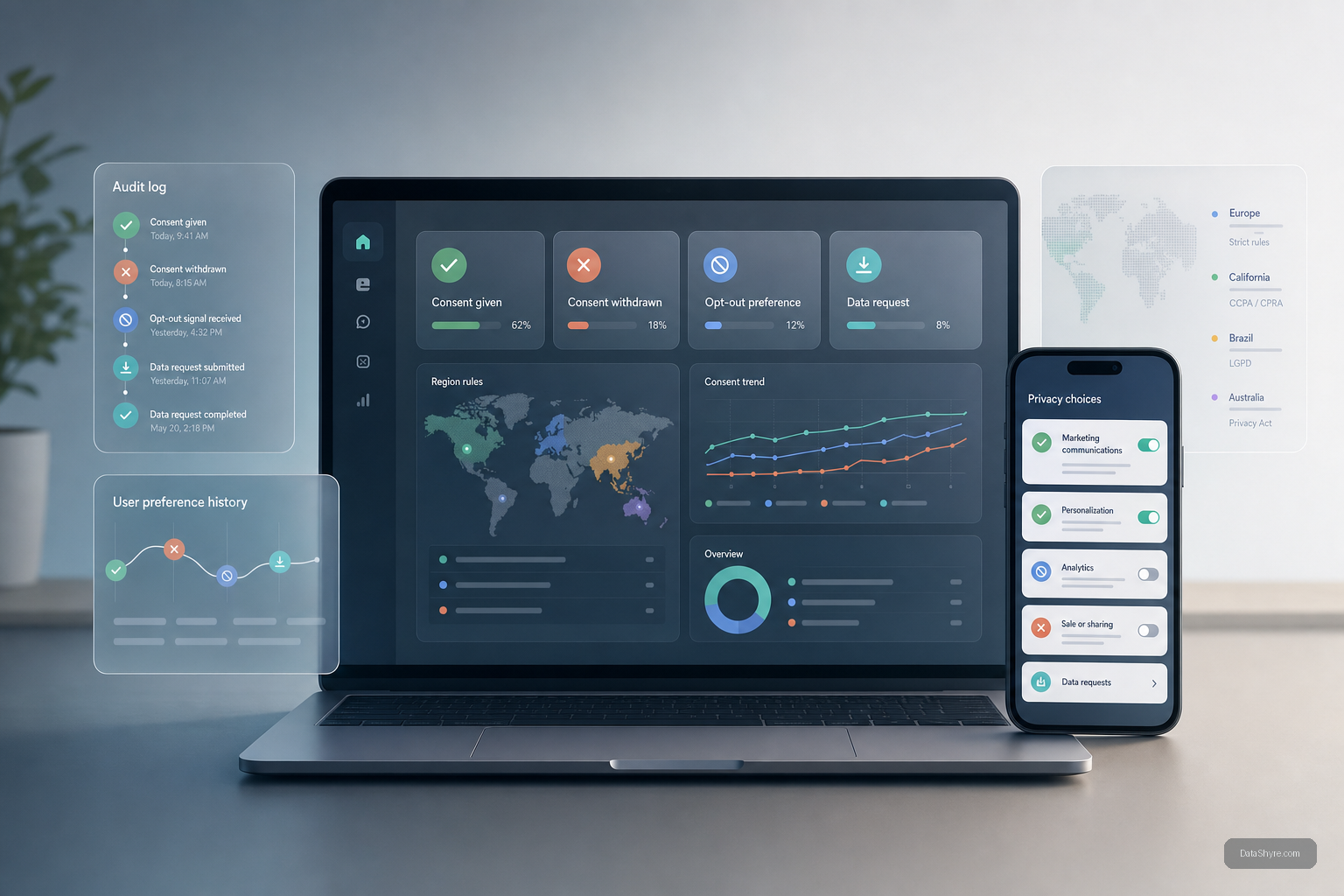
User Consent Management in 2026: What It Actually Has to Control
DataShyre StaffAug 3, 2026
7 min read
User Consent Management in 2026: What It Actually Has to Control
If you are searching for user consent management on August 3, 2026, the useful question is not which popup tool to buy. It is whether your stack can tell the difference between consent, an opt-out, a later withdrawal, a browser-level signal, and a rights request, then prove what happened when someone asks.
That is the real operating problem in 2026. The European Commission’s current GDPR guidance says personal data can be processed only on a recognized legal ground, and consent is just one of those options. When consent is the legal ground, it must be “freely given,” informed, specific, and given through a clear affirmative act. California pulls the workflow in a different direction: the CPPA’s current materials describe six major privacy rights for California residents, and the California Department of Justice says a valid Global Privacy Control signal “must be honored” as a request to stop sale or sharing by covered businesses.
If you want the platform-buying angle first, start with our guides to consent management platform, consent management solutions, and CCPA compliance platform. This article is narrower. It is about user consent management as an operating model, not just as a front-end component.
Why user consent management is bigger than a banner
Many teams still use user consent management as shorthand for cookie banners. That is too small.
Under the GDPR, consent is only one lawful basis. Some processing may rely on contract, legal obligation, legitimate interests, public interest, or vital interests instead. That means the real job is not “collect consent everywhere.” The job is to know which action you are asking the user to take, why you need it, which law or rule applies, and what must happen later if that user changes their mind.
California makes the distinction even more obvious. Some flows are not opt-in consent flows at all. They are opt-out, limit, access, correction, or deletion flows. The CPPA FAQ says businesses must respond to delete, correct, or know requests within 45 calendar days, with one possible 45-day extension if they notify the consumer. For online sale-or-sharing flows, the CPPA and California DOJ both point to browser-level signals like GPC as valid requests that must be respected.
So user consent management is really a control layer across collection, notices, choices, proof, and downstream enforcement.
What strong user consent management has to control
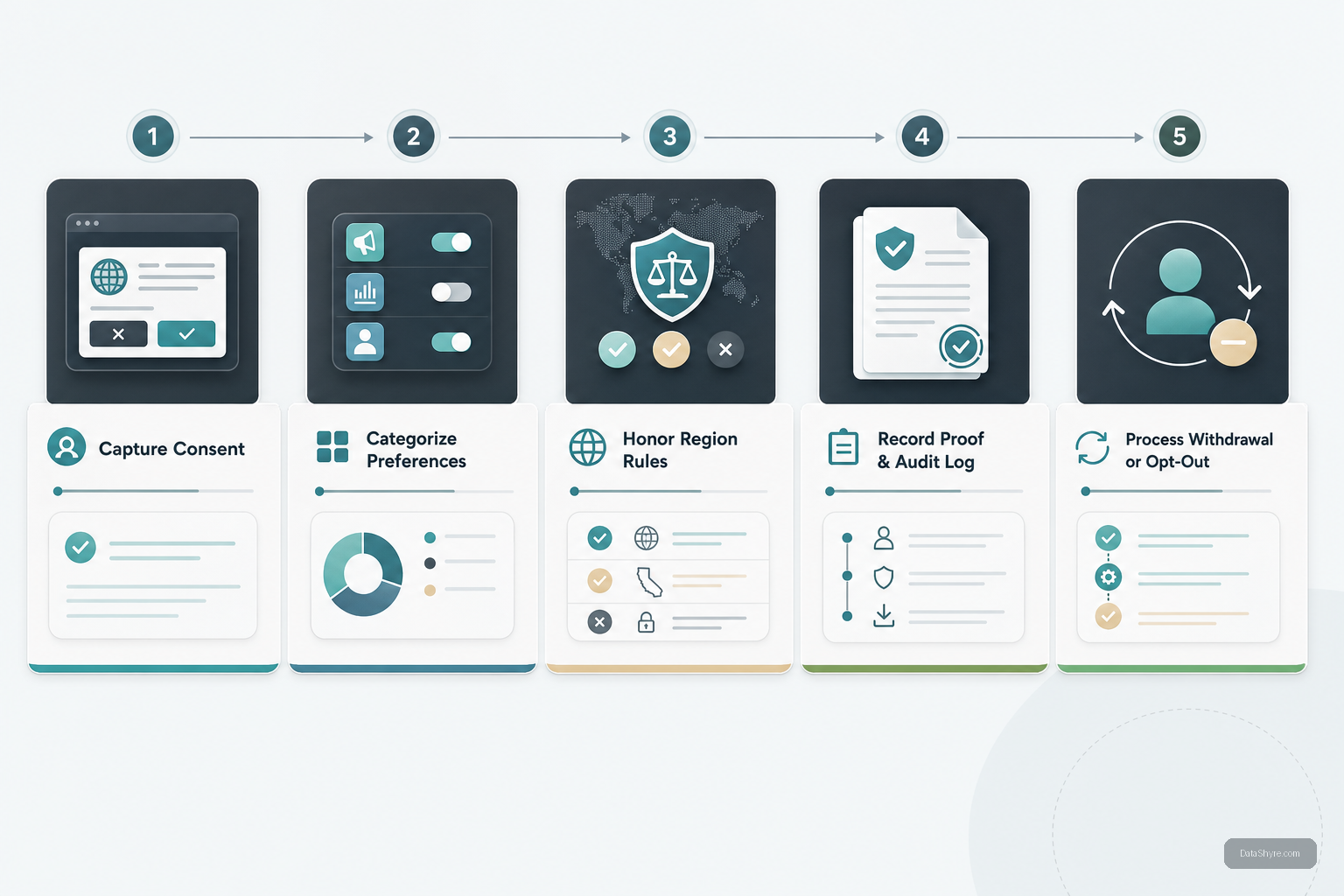
The best user consent management setups keep these layers separate instead of collapsing everything into one preference center.
Legal basis by purpose, channel, and region.
Notice text shown at the moment of collection or tracking.
The exact user action taken, including timestamp, source, and version of the notice.
Whether the action was consent, objection, opt-out, limit request, or withdrawal.
Downstream vendor and system behavior after the choice.
Rights-request handling and response deadlines.
A durable audit trail that support, legal, and engineering teams can all read.
That separation matters because a person can agree to one thing, refuse another, and later withdraw part of what they allowed. The European Commission’s current guidance says it should be “as easy to withdraw as to give consent.” If your implementation stores only one generic yes or no field, it usually breaks the minute regulators, enterprise buyers, or internal auditors ask for specifics.
Where teams still get user consent management wrong
1. Treating every privacy choice like consent
This is the most common modeling mistake.
GDPR consent, California opt-out of sale or sharing, a limit request for sensitive personal information, and a deletion request are not interchangeable. If your data model stores them in one table without clear type, scope, and trigger logic, you are setting up future failures.
2. Recording the click but not the context
A log that says a user clicked Accept is not enough. Mature user consent management records also tie that event to the notice version, policy version, region logic, categories involved, and downstream systems affected.
That is what turns a preference event into evidence instead of just UI telemetry.
3. Letting downstream systems ignore the choice
This is where many programs look compliant in the interface and fail in production.
If a user withdraws analytics consent, the tracking layer, tag manager, SDKs, warehouse ingestion rules, and marketing audiences may all need to change. If a California consumer sends an opt-out preference signal, web and advertising workflows cannot continue as if nothing happened.
4. Mixing rights handling into a dead-end inbox
The CPPA FAQ is explicit about response timing, which means user consent management cannot stop at preference capture. It needs routing, verification, ownership, and proof that the request moved.
5. Forgetting the new California data-broker pressure
As of January 1, 2026, the CPPA’s law and regulations page shows the current CCPA and CCPA Regulations as effective. California also launched the DELETE Act’s request framework, and the CPPA Data Broker Registry says California residents can use DROP to send one deletion request to active data brokers. Data brokers are required to begin processing those requests on August 1, 2026.
That does not apply to every business, but it does show where user consent management is heading: less manual friction, more verifiable operational handling, and less tolerance for orphaned rights workflows.
GDPR and California do not ask for the same thing
This is the distinction I would explain to any team redesigning user consent management this quarter.
Under the GDPR, the first question is often: what is your lawful basis? The European Commission lists six possible grounds, and consent is only one. If you rely on consent, it has to meet a high validity standard and remain easy to withdraw. GDPR also gives individuals rights including access, rectification, erasure, portability, and objection.
Under California’s CCPA framework, the operational question is often: what right is the consumer exercising right now? The answer may be know, delete, correct, opt-out of sale or sharing, limit the use of sensitive personal information, or use an opt-out preference signal such as GPC.
That is why a single global “privacy preferences” toggle is usually too blunt. Better user consent management separates:
consent collection;
cookie or tracking controls;
opt-out preference signals;
rights-request intake and deadlines;
proof of enforcement across systems.
If your stack cannot represent those as different events with different rules, the interface may still look polished while the underlying program stays fragile.
A practical user consent management checklist
If I were auditing user consent management on a live site this week, I would check these items in order:
Map each data use to a real legal basis or statutory right, not just a UI label.
Confirm that consent, opt-out, objection, withdrawal, and deletion are stored as different event types.
Verify that notice text, policy version, timestamp, region, and category are attached to each material user action.
Test whether downstream tools actually change behavior after a refusal, withdrawal, or valid GPC signal.
Check whether rights workflows have owners, timers, and evidence of completion.
Review whether the preference center can be reopened without friction and whether withdrawal is genuinely easy.
For California programs, verify current handling of OOPS or GPC and any applicable delete-request routing.
That short review does more for user consent management than most vendor demos do.
Bottom line
In 2026, user consent management is not a decorative layer and it is not only about cookies. It is the system that decides what kind of choice a person is making, what legal rule applies to that choice, which systems must react, and what proof the company keeps afterward.
The official materials all point in the same direction. The European Commission emphasizes valid legal grounds, real consent standards, and easy withdrawal. California emphasizes actionable rights, response timing, and browser-level opt-out signals that covered businesses must respect. The CPPA’s live 2026 updates also show the state moving toward more operational, less manual rights handling.
If your current stack still treats every privacy action as one generic preference, your user consent management program is probably overdue for a redesign.