CCPA Compliance Platform in 2026: 7 Checks Before You Choose One
DataShyre StaffAug 3, 2026
8 min read
CCPA Compliance Platform in 2026: 7 Checks Before You Choose One
If you are evaluating a ccpa compliance platform on August 3, 2026, the useful question is not whether the dashboard looks enterprise-ready. It is whether the platform can help your team deliver the rights California residents actually have, prove those rights were honored, and keep pace when the website, app, vendors, and business rules change underneath it.
That is the right frame because the current official baseline is still active. California’s Department of Justice says consumers can ask businesses to know, delete, correct, opt out of sale or sharing, and limit the use of sensitive personal information. The DOJ also says businesses subject to the CCPA have responsibilities that include responding to those requests and giving consumers required notices about their privacy practices.
If you want the broader California backdrop first, start with our guides to California consumer privacy, GDPR vs. CCPA, and CCPA audit checklist. This article is narrower. It is the shortlist review I would use before choosing a ccpa compliance platform this week.
Why the category still matters in 2026
The pressure is not only theoretical.
California’s DOJ still says a user-enabled Global Privacy Control can serve as an acceptable opt-out method for businesses that collect personal information online. Its GPC page describes the signal as a:
“stop selling or sharing my data switch”
>
California DOJ
The California Privacy Protection Agency’s current regulations page also shows that the CCPA, the CCPA Regulations, and the September 2025 package covering CCPA updates, risk assessments, cybersecurity audits, and automated decisionmaking remain part of the live regulatory picture in 2026. On the same page, the CPPA shows that preliminary 2026 work has already focused on notices and disclosures, reducing friction in the exercise of privacy rights, and opt-out preference signals.
Enforcement signals are equally clear. On January 8, 2026, the CPPA highlighted recent CCPA actions against Tractor Supply Company, Todd Snyder, and American Honda Motor Co. The California Attorney General also announced a January 27, 2026 sweep focused on surveillance pricing and said those practices may trigger obligations under the CCPA’s purpose-limitation principle. In 2025, the Attorney General announced a $1.55 million Healthline settlement tied to online tracking and opt-out failures, and a $1.4 million Jam City settlement tied to missing opt-out methods in mobile apps.
That is why a ccpa compliance platform cannot be judged only by whether it has a request form. It has to function as an operating layer for rights, disclosures, vendor controls, and evidence.
What a CCPA compliance platform should actually help you do
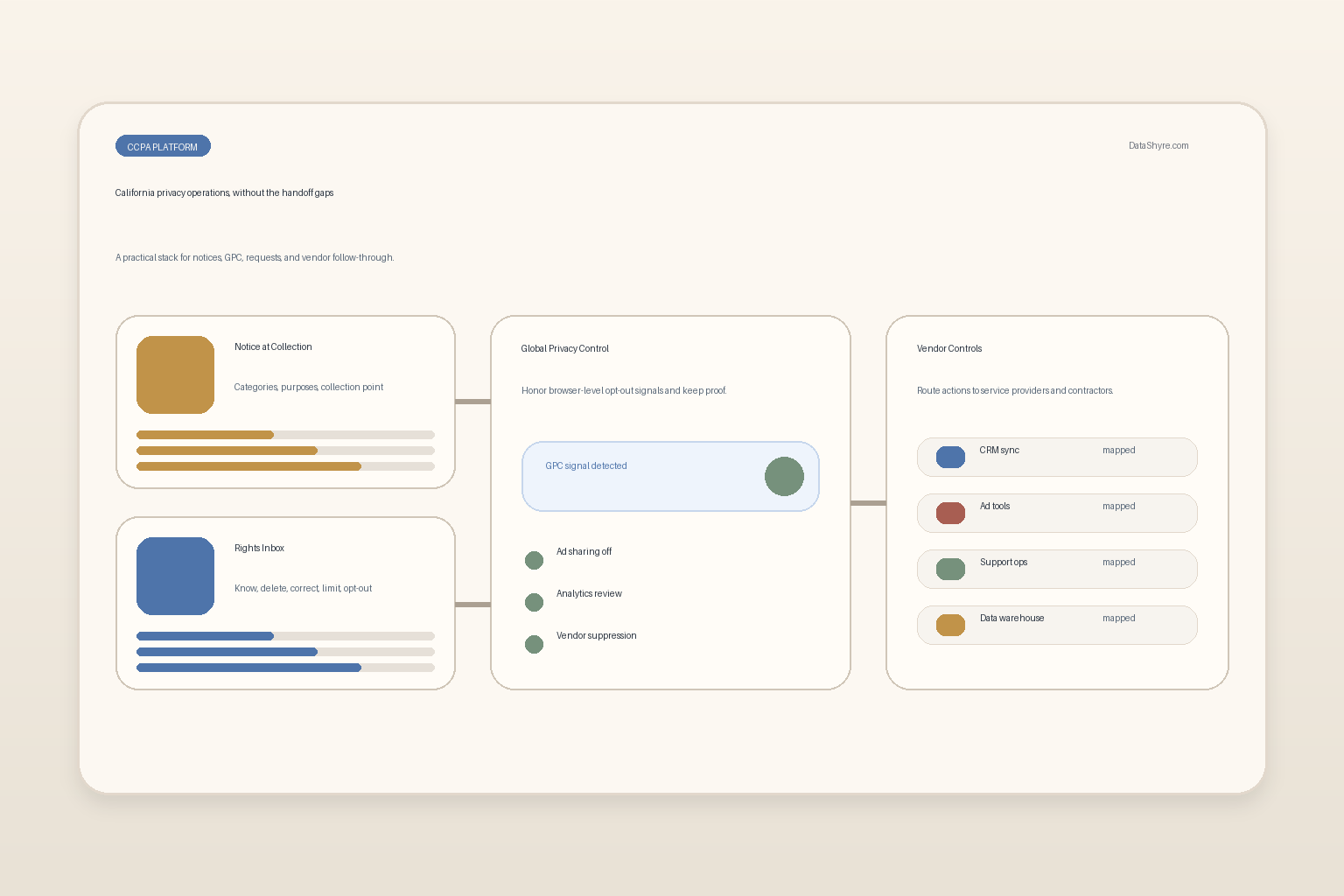
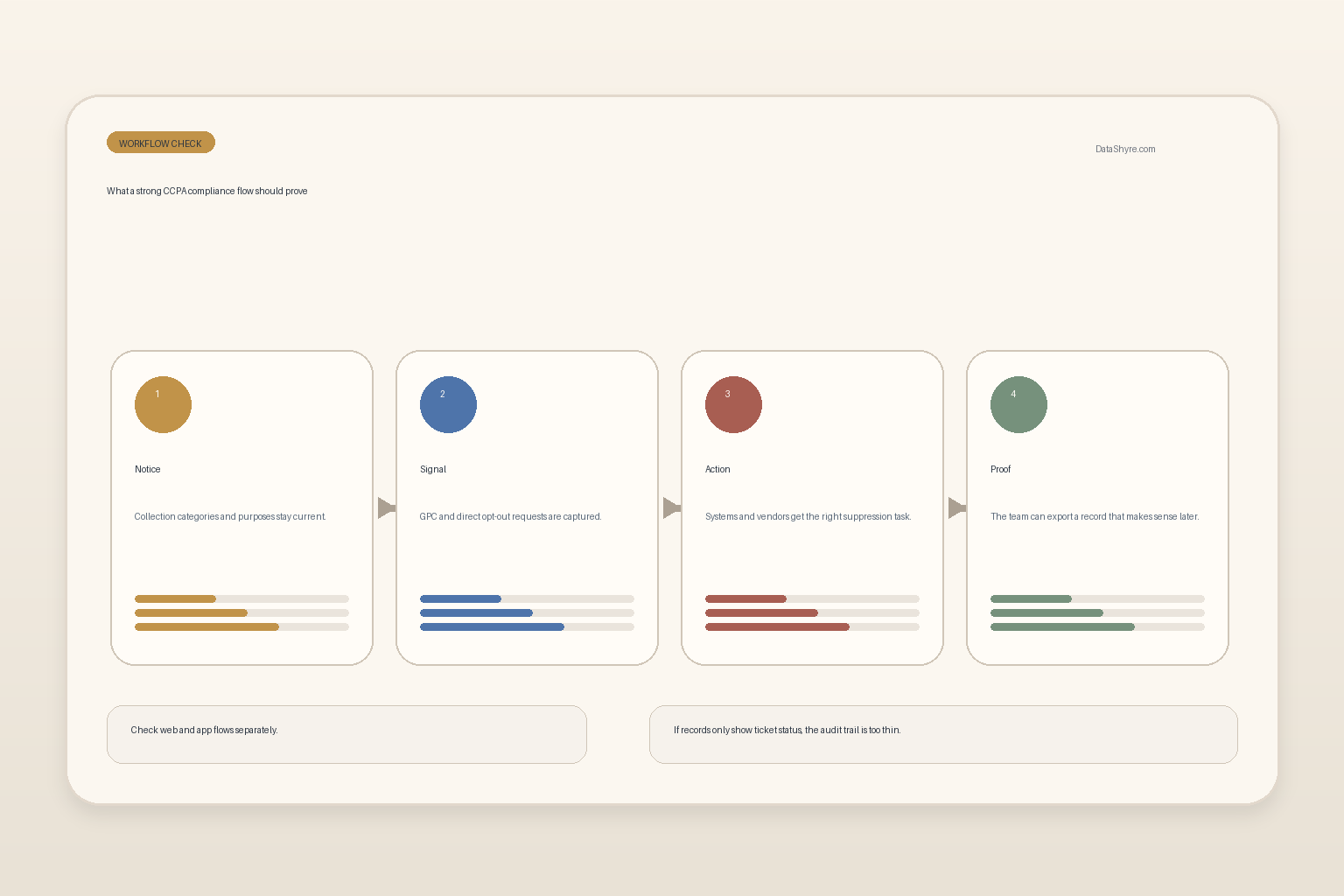
A real ccpa compliance platform should help connect four things that often drift apart:
the notice people see before or at collection;
the requests they submit later;
the systems and vendors that hold or use the data;
the records your team needs when someone asks what happened.
That matters because California rights are broader than one opt-out link. The DOJ’s CCPA page makes the rights list explicit, and the regulations page shows California is still refining how notices, preference signals, and low-friction rights exercise should work in practice.
7 checks before you choose a CCPA compliance platform
1. Make sure it covers the full California rights set, not just deletion
Some tools still feel like upgraded intake forms. That is not enough.
The DOJ’s CCPA overview highlights rights to know, delete, correct, opt out of sale or sharing, and limit the use and disclosure of sensitive personal information. A serious ccpa compliance platform should support intake, routing, tracking, and completion for all of those paths that matter to your business.
If the tool is strong on deletion but weak on correction, opt-out, or sensitive-data limits, the platform is narrower than the sales demo suggests.
2. Treat GPC handling as a first-class requirement
This is still one of the fastest filters.
California’s DOJ says that for businesses collecting personal information online, one acceptable opt-out method is a user-enabled Global Privacy Control signal. That means a ccpa compliance platform should do more than host a footer link. It should help detect the signal, apply the correct downstream suppression logic, and preserve evidence that the preference was honored.
If GPC treatment is unclear, manual, or split across three unrelated systems, your process is more fragile than it looks.
3. Check whether notice-at-collection and purpose mapping are built into the workflow
The DOJ says businesses must provide a notice at collection listing the categories of personal information collected and the purposes for which those categories are used.
That matters because many privacy tools focus on the request portal and barely touch the intake side. But the Attorney General’s January 27, 2026 surveillance-pricing announcement shows why purpose discipline matters: data uses that consumers would not reasonably expect may create CCPA exposure.
The better ccpa compliance platform setups connect:
data categories;
collection points;
purposes of use;
system owners;
the notice language shown to the consumer.
Without that mapping, requests may be handled correctly while notices quietly go stale.
4. Follow the workflow into vendors, service providers, and contractors
The platform should not stop at your own CRM.
The CCPA framework distinguishes businesses from service providers and contractors, and California’s rules still expect the business to respond to consumer requests even when outside vendors are involved. In practice, that means a ccpa compliance platform needs to help identify where personal information lives, who receives it, and which vendors need instructions or confirmations when a right is exercised.
This is often where polished tools disappoint. They log the ticket internally but leave legal, engineering, and vendor-management teams to do the real work in email or spreadsheets.
5. Test web and app experiences separately
A desktop website demo can hide a mobile gap.
That is not hypothetical. In the November 21, 2025 Jam City settlement, the Attorney General said the company failed to offer consumers methods to opt out of the sale or sharing of personal information across its mobile apps. The settlement also required in-app opt-out methods and, for certain teens, affirmative opt-in before sale or sharing.
If your business operates both websites and apps, the ccpa compliance platform review should ask:
does the platform support web and app collection points cleanly;
can it route rights by product surface;
can it respect age-related logic where relevant;
can it prove the user experience is available where the data is actually collected.
Attorney General Bonta described the expected experience well:
“simple, transparent, and easy to navigate.”
>
Attorney General Bonta
6. Demand audit-ready records, not just case counts
Sooner or later, someone will ask what the consumer submitted, how the business interpreted it, what systems were affected, and when the workflow was completed.
That is why the better ccpa compliance platform tools keep records that show:
what request or signal was received;
how the consumer or browser was identified;
which systems or vendors were checked;
what action was taken;
when the action finished;
what notices, preferences, or account states changed afterward.
If all you can export is a ticket status and a timestamp, your audit trail is thinner than it needs to be.
7. Check whether the platform will still work after your stack changes
The hard part is rarely launch week. It is drift.
Marketing adds another tag. Product launches a new app flow. Procurement signs a new enrichment vendor. Legal updates the notice but the intake logic still follows the old categories. A strong ccpa compliance platform helps your team re-test these changes instead of assuming the first configuration will stay accurate forever.
The CPPA’s 2026 preliminary work on notices, friction, and opt-out preference signals is a useful reminder that California expectations keep tightening around the quality of the real user experience, not just the presence of a privacy page.
A practical review sequence for this week
If I were comparing a ccpa compliance platform right now, I would do this in order:
Confirm which CCPA rights the platform actually supports end to end.
Test GPC handling in a clean browser session.
Review whether notice-at-collection language is tied to actual data categories and purposes.
Follow one deletion, one correction, and one opt-out request into downstream systems and vendors.
Test the experience separately on web and mobile app surfaces.
Export records and decide whether legal, engineering, and support could all understand them later.
Re-test the shortlist against your next six months of stack changes, not only the current implementation.
That short sequence usually tells you more than a long procurement spreadsheet.
Bottom line
The right ccpa compliance platform in 2026 is not the one with the longest feature grid. It is the one that helps your team deliver California rights cleanly across collection, requests, vendors, app and web surfaces, and audit records.
If the tool treats GPC as an edge case, separates notices from data reality, or leaves downstream vendor work outside the system, it is probably giving you a nicer dashboard instead of a stronger privacy program.