

Consent Management Solutions in 2026: 7 Checks Before You Choose One
If you are comparing consent management solutions, the first useful move on August 1, 2026 is to stop thinking only about banner design. The real question is whether the solution can collect a fair choice, turn that choice into real technical behavior, and leave your team with proof that still makes sense later. That is a sharper question now because current official guidance is still moving the category. On April 29, 2026, the UK ICO published final storage-and-access technologies guidance that expressly reaches cookies, tracking pixels, device fingerprinting, and similar tools. On July 14, 2026, the European Data Protection Board required the Belgian DPA to assess the merits of a cookie-banner complaint involving broadcaster VRT instead of ending it on procedural grounds. In California, the Department of Justice still says a valid Global Privacy Control signal must be honored by covered businesses, and the CPPA’s current law-and-regulations page lists both the CCPA and CCPA Regulations as effective on January 1, 2026. If you want the broader baseline first, start with our guides to consent management platform, cookie consent manager, and cookie consent tool. This article is narrower. It is the buyer checklist I would use to compare consent management solutions this week.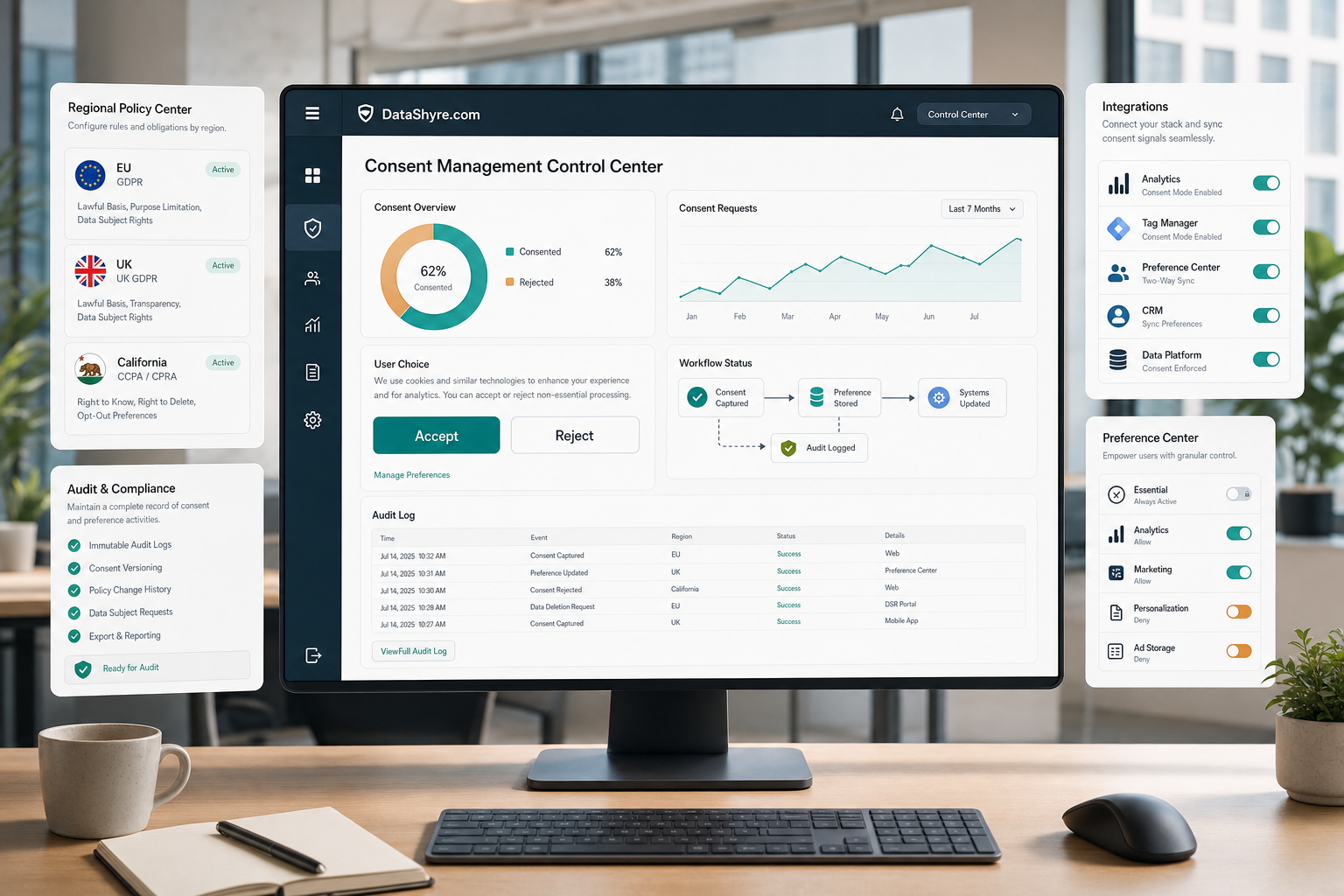
What consent management solutions should include
The phrase is broader than a CMP alone. Good consent management solutions often combine several layers:- first-layer consent and preference collection;
- category, purpose, or vendor-level controls;
- region-specific workflows;
- consent-state handoff into tags, analytics, ad tech, and embedded tools;
- records, exports, and change history;
- adjacent preference or rights workflows where the stack needs them.
7 checks before you choose a consent management solution
1. Decide whether you need a CMP, a broader privacy workflow, or both
Some teams only need a strong website consent layer. Others need a wider system that can coordinate consent, preferences, rights requests, and downstream data handling across multiple tools. Before demos begin, write down the real job:- website or app consent only;
- ad-tech and publisher workflows;
- CRM and marketing preference sync;
- multi-brand or multi-region governance;
- evidence for support, legal, and incident review.
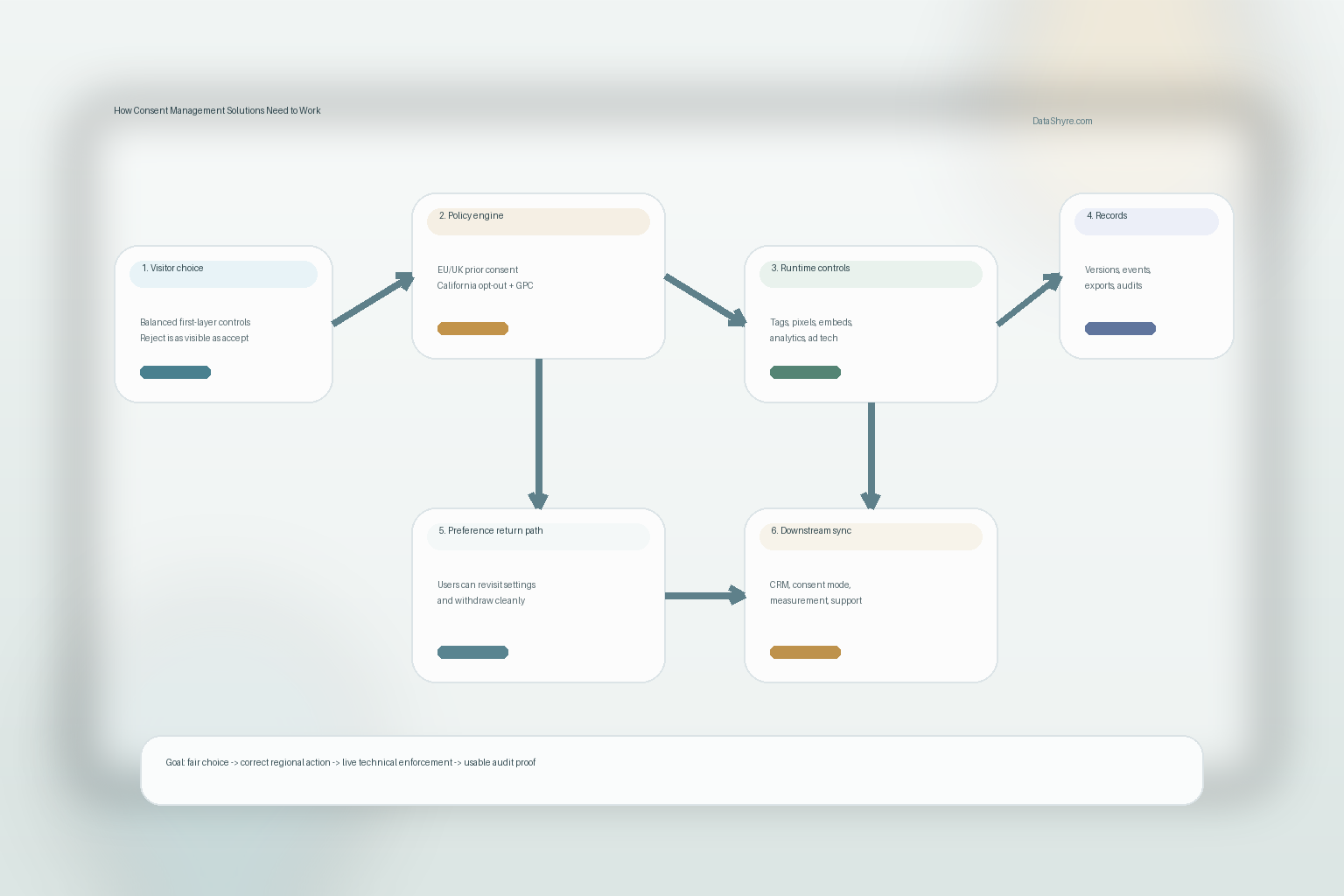
2. Check whether refusal is truly as easy as acceptance
This is still one of the fastest practical filters. In its December 12, 2024 dark-pattern notice, France’s CNIL said:“Rejecting cookies should be just as easy as accepting them.”>
CNILIf a product makes
Accept all immediate but hides Reject all, weakens its contrast, or pushes it behind another layer, the interface is already creating risk. A solution that captures biased choices is not solving much.
3. Test prior blocking and signal timing on a real page
The ICO’s current guidance matters because it makes the scope broader than traditional cookie talk. The review can reach tracking pixels, device fingerprinting, and similar storage-or-access technologies, not only a visible cookie list. So the main technical test is simple: what fires before the user acts, what changes after refusal, and how early the signal reaches your stack. If optional technologies still run before consent where prior consent is required, the solution is weaker than the sales deck suggests.4. Separate EU and UK prior-consent logic from California opt-out logic
One global flow is rarely enough. In the EU and UK, the main question is often whether non-essential technologies remain off until valid consent exists. In California, the review often shifts toward sale-or-sharing opt-out handling and browser-level preference signals. The California Department of Justice says GPC must be honored as a valid request to stop sale or sharing, so a useful product should not pretend a European-style consent layer answers the full California workflow. This is where stronger consent management solutions separate themselves. They support different legal actions without forcing the team into manual workarounds.5. Follow the consent signal into the real systems that matter
A consent tool is not finished when it stores a preference in its own interface. The harder question is whether the decision reaches the systems that actually collect or activate data. For most teams, that means checking:- tag managers;
- analytics tools;
- advertising pixels;
- chat, video, and embedded tools;
- experimentation and personalization systems;
- CRM or marketing automations that depend on the state.
6. Demand records that non-technical teams can actually use
Sooner or later, someone asks what happened on a specific date, to a specific visitor flow, under a specific banner version. Your team should be able to answer:- What did the user see?
- What categories, purposes, or vendors were enabled?
- What did the user choose and when?
- Could the user return and change the decision later?
- Did the site’s actual behavior match the recorded preference?
7. Treat publisher and ad-stack requirements as a separate checkpoint
If your site depends on personalized advertising, you may have one more layer to test. Google’s current publisher guidance says partners using AdSense, Ad Manager, or AdMob must use a Google-certified CMP integrated with the IAB Transparency and Consent Framework when serving personalized ads to users in the EEA, the UK, or Switzerland. Google also says its certification review does not check CMPs for full compliance with the TCF or applicable privacy laws. That means publisher fit is important, but it is not the whole review. The right solution still has to pass your legal, UX, and implementation checks.A short buyer sequence I would use this week
If I were comparing consent management solutions right now, I would do this in order:- Write down the exact systems and regions the solution must cover.
- Load a clean browser session and inspect what fires before any choice.
- Click
Reject alland confirm optional technologies stay off where they should. - Test granular choices and later withdrawal from the normal return path.
- Check California-facing handling for GPC and sale-or-sharing opt-out logic.
- Inspect how the product records events, versions, and downstream effects.
- If ads matter, run the Google-certified CMP check separately.
Bottom line
The best consent management solutions in 2026 are not the ones with the nicest banner template. They are the ones that can support fair choice, real technical control, regional differences, and usable proof without constant manual cleanup. If a product cannot do those things, it may still improve your website’s appearance. It just will not remove enough privacy or operational risk to justify the decision.Sources
- UK ICO: Final storage and access technologies guidance published
- UK ICO: Guidance on the use of storage and access technologies
- European Commission: When is consent valid?
- European Data Protection Board: Belgian DPA must handle the merits of a NOYB cookie-banner complaint
- CNIL: Dark Patterns in Cookie Banners: CNIL issues formal notice to website publishers
- California Department of Justice: Global Privacy Control
- California Privacy Protection Agency: Laws & Regulations
- Google Ad Manager Help: Google consent management requirements for serving ads in the EEA, the UK, and Switzerland (for CMPs)
This post was updated on August 1, 2026 using current official regulator, government, and platform materials available at publication time.