Cookie Consent Banner in 2026: 8 Live Checks Before You Trust the Setup
DataShyre StaffAug 2, 2026
7 min read
Cookie Consent Banner in 2026: 7 Checks Before You Put It Live
If you are reviewing a cookie consent banner, the useful question on August 2, 2026 is not whether the banner looks clean. It is whether the visitor gets a fair choice, whether optional technologies stay off until that choice is made where required, and whether the result still holds up once your real tag stack starts running.
That is the right lens because the regulatory and platform baseline is still active. On April 29, 2026, the UK ICO published final guidance on storage and access technologies that expressly reaches cookies, tracking pixels, device fingerprinting, and similar tools. On July 14, 2026, the European Data Protection Board required the Belgian DPA to assess the merits of a cookie-banner complaint involving broadcaster VRT instead of dismissing it on procedural grounds. In California, the Department of Justice still says a valid Global Privacy Control signal must be honored by covered businesses, while the CPPA’s current laws-and-regulations page lists both the CCPA and the CCPA Regulations as effective on January 1, 2026.
If you want the surrounding context first, start with our guides to cookie consent, cookie consent message, and consent management platform. This article is narrower. It is the launch review I would use before trusting a cookie consent banner on a live site this week.
What a cookie consent banner has to do now
A modern cookie consent banner is not just copy plus buttons.
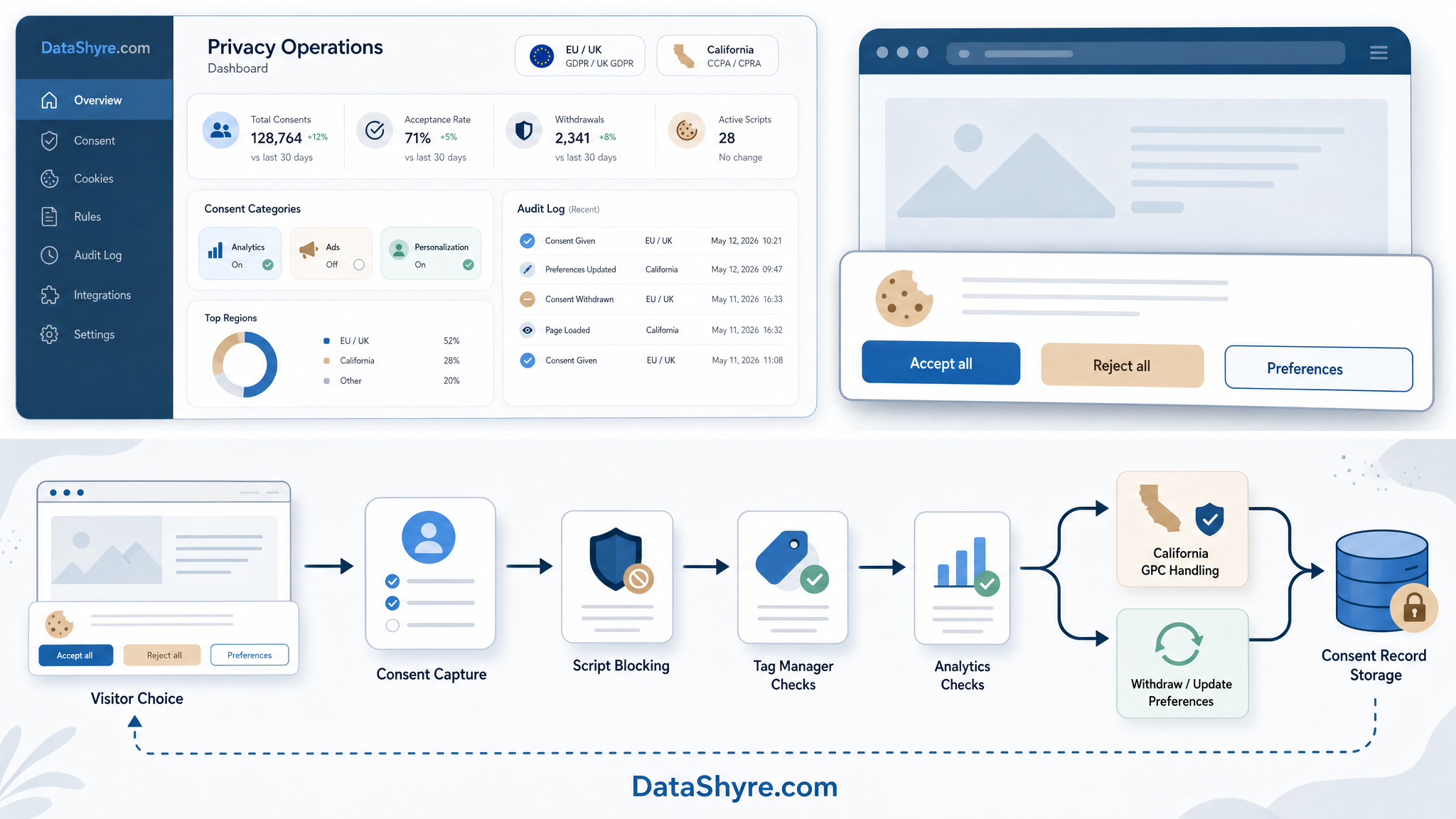
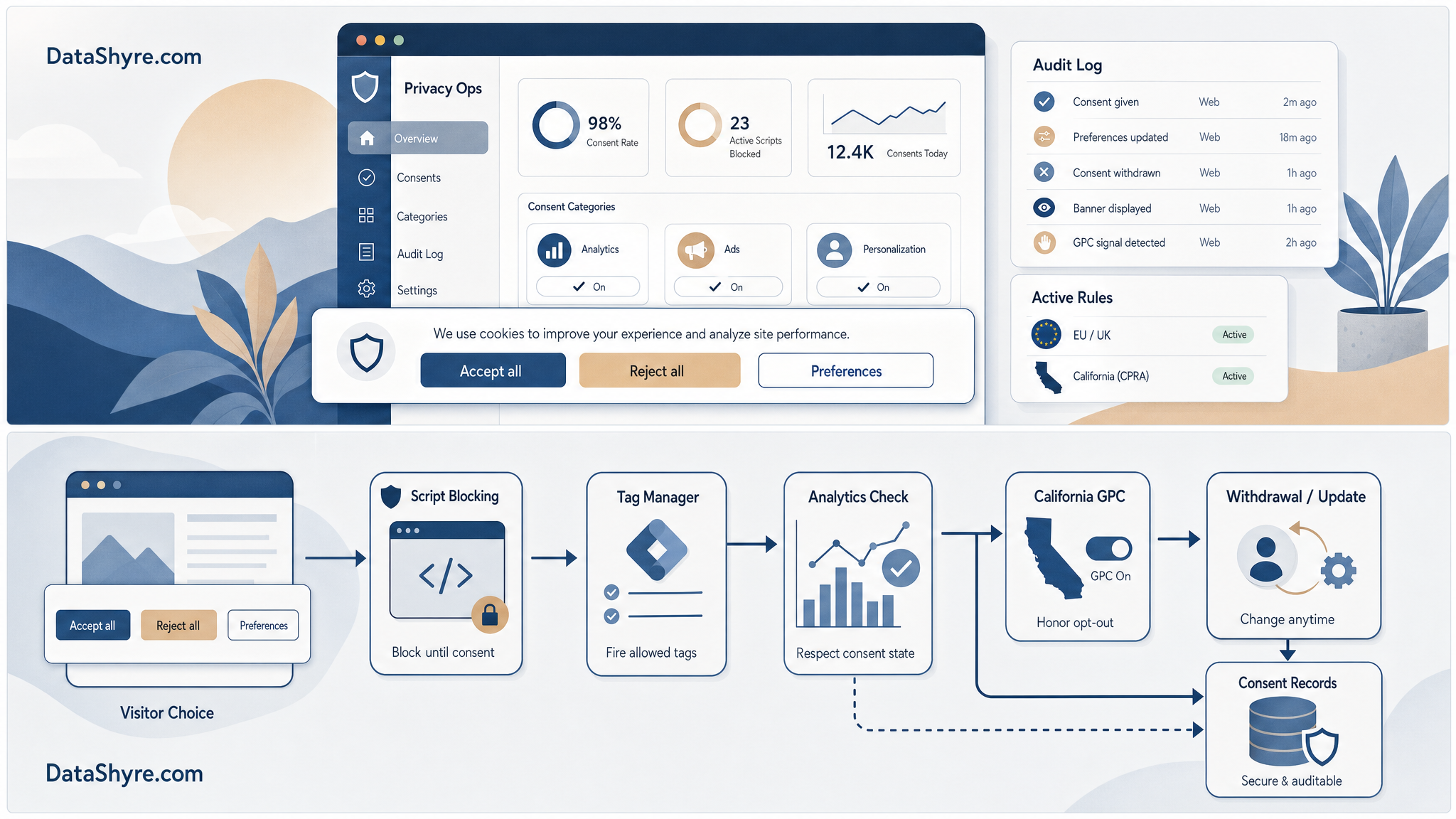
It is the front door to a broader control system that may need to govern:
analytics and advertising scripts;
pixels, tags, and device-level identifiers;
embedded media and chat tools;
region-specific privacy flows;
later withdrawal or revision of user choices;
downstream records your team may need to explain later.
The ICO’s 2026 guidance is useful because it makes the scope explicit. The compliance question can reach beyond old cookie-only thinking into other storage and access technologies. That means a cookie consent banner cannot be judged only by its wording. It has to be checked against live technical behavior.
The European Commission still provides the cleanest consent baseline: when consent is required, it must be freely given, specific, informed, and expressed clearly. It also says:
“It should be as easy to withdraw as to give consent.”
>
European Commission
That is a banner rule as much as a legal rule. If the first layer promises later control, the later control has to work.
7 checks before you trust a cookie consent banner on a live site
1. Make rejection as usable as acceptance
This is still the fastest first test.
France’s CNIL said it directly in its current dark-pattern enforcement messaging:
“rejecting cookies should be just as easy as accepting them.”
>
CNIL
If Accept all is obvious but Reject all is visually downgraded, hidden behind another layer, or softened into ambiguous language, the banner is steering the decision rather than collecting it fairly.
For a cookie consent banner, that often means the real problem is not the legal copy. It is the interface hierarchy.
2. Test whether optional technologies stay off before consent where they should
This is where polished demos often fail.
The banner may look compliant while analytics, ad, or personalization technologies still initialize too early on the real page. The ICO’s current guidance matters here because it explicitly reaches cookies, tracking pixels, device fingerprinting, and similar technologies, not only one narrow file type.
A strong cookie consent banner should be tested on templates that actually matter:
the homepage;
landing pages with analytics and campaign tags;
pages with video, maps, chat, or forms;
ecommerce flows or logged-in areas if they use optional tools.
If non-essential technologies activate before consent in regions where prior consent is required, the visible banner is not the real control.
3. Check whether the banner logic matches the region
One global banner layout does not mean one global legal workflow.
In the EU and UK, the core issue is often prior consent before non-essential technologies are used. In California, the flow often shifts toward sale-or-sharing opt-out handling. The California Department of Justice says GPC is a valid consumer request to stop sale or sharing and that covered businesses must honor it.
That means a cookie consent banner should be reviewed for real regional behavior, not only translated text. A site can look globally polished while still failing to:
block optional tracking where prior consent is required;
honor browser-based opt-out signals where relevant;
keep downstream ad or analytics logic aligned with those choices.
4. Follow the choice into Google tags and other downstream tools
Banner UX is only the first layer.
Google’s current consent mode guidance says you should set the default consent state before a user grants consent, update the state based on the user’s interaction, and make sure the update is tracked on the page where it occurs before any page transition.
That makes a practical cookie consent banner review very different from a design review. You should verify whether:
default consent is set before measurement commands run;
downstream tools receive the updated state at the right time;
granular choices behave differently from Accept all;
revocation later changes the same downstream systems cleanly.
If the banner stores a preference but the actual tags keep running as before, the site has a recording tool, not a working consent control.
5. Treat ad-supported sites as a separate banner checkpoint
If the site depends on personalized ads, you need one more test layer.
Google’s current publisher guidance says publishers need a certified CMP integrated with the IAB Transparency and Consent Framework when serving personalized ads to users in the EEA, the UK, or Switzerland. Google also says its CMP certification does not verify full compliance with the TCF or applicable privacy laws by itself.
That matters because a cookie consent banner can look fine to the user while still missing a publisher requirement behind the scenes.
6. Verify that changing or withdrawing consent causes a real behavior change
Many implementations pass the first click and fail the second.
Accept optional categories, continue browsing, reopen the settings, withdraw them, and inspect what the site does next. The European Commission’s guidance is still the right standard here: withdrawal should be as easy as giving consent.
If analytics, advertising, or embedded third-party tools keep behaving as if consent never changed, your cookie consent banner is only documenting a preference instead of enforcing it.
7. Re-test after updates, embeds, and performance changes
The most reliable banner on launch day can drift a week later.
New vendors, tag-manager changes, delayed-script optimizers, cache plugins, CDN settings, experimentation tools, and embedded media can all alter timing and behavior. The banner may still look identical while the stack underneath it has changed materially.
That is why a cookie consent banner should be treated as an ongoing release check, not a one-time design task.
A short review sequence I would run this week
If I were checking a cookie consent banner today, I would do this in order:
Open the site in a clean browser session.
Inspect what runs before any banner interaction on key templates.
Use Reject all and confirm optional technologies stay off where they should.
Allow only one optional category and verify the downstream behavior changes accordingly.
Reopen preferences and test withdrawal on the same visit.
Check California-facing behavior for GPC handling where relevant.
If the site serves personalized ads, run the certified-CMP and publisher checks separately from the visual review.
Review the resulting consent records and decide whether another team member could understand them later.
That sequence is short, but it reveals more real risk than most banner comparison lists.
Why this keyword still matters in 2026
The recent signals all point in the same direction.
The ICO’s final 2026 guidance broadened the practical review from classic cookies to a wider set of storage-and-access technologies. The EDPB’s July 2026 VRT decision shows cookie-banner disputes are still active at the supervisory level. In California, the DOJ’s GPC guidance and the February 11, 2026 Disney settlement both reinforce that opt-out controls have to work across connected products and devices in practice.
That is why a cookie consent banner should be treated as an operating control, not just a notice.
Bottom line
The best cookie consent banner in 2026 is not the one with the nicest layout. It is the one that gives people a fair choice, keeps optional technologies aligned with that choice, handles regional differences without confusion, and still makes sense when someone audits the result later.
The ICO captured the wider goal well in its April 2026 launch note when William Malcolm said people need:
“meaningful control over how their data is used.”
>
William Malcolm, ICO
If your current banner cannot do that on the live site, the work is not finished yet.