

Consent Manager in 2026: 6 Live-Site Questions Before You Trust the Setup
If you are evaluating a consent manager on August 20, 2026, the useful question is not whether the banner looks modern. It is whether the system can collect a fair choice, change live behavior at the right moment, and leave behind evidence your team can still explain later.
That framing still matches the official baseline. The European Commission continues to say valid consent must be “freely given, specific, informed and unambiguous,” and that it should be “as easy to withdraw as to give consent.” The UK ICO finalized its storage-and-access technologies guidance on April 29, 2026 and made clear the review is broader than old cookie-only thinking, reaching technologies such as tracking pixels, scripts, tags, and device fingerprinting. In California, the Department of Justice still describes Global Privacy Control as a “stop selling or sharing my data switch,” and the CPPA’s law-and-regulations page lists the governing CCPA materials as effective on January 1, 2026.
If you want adjacent context first, start with our guides to what is a consent management platform CMP, Google Tag Manager cookie consent, and WordPress cookie consent. This article is narrower. It is the live-site review I would run before trusting a consent manager in production this week.

Why a consent manager should be reviewed as a control system
A real consent manager is not just the first layer people see on screen. It is the control layer between a user’s choice and the technologies that want to store, access, or act on data.
That means the review should follow the choice into:
- tag managers;
- analytics tools;
- advertising and retargeting scripts;
- chat, video, map, and scheduling embeds;
- consent logs and later withdrawal flows;
- regional logic for EU, UK, and California paths.
The visible banner still matters. But a polished banner with weak runtime behavior is still a weak setup.
6 live-site questions before you trust a consent manager
1. What technologies are actually in scope on the pages that matter?
The ICO’s 2026 guidance is useful because it resets the scope. The review is not only about browser cookies. It can reach tracking pixels, scripts or tags, device fingerprinting, web storage, and other storage-and-access technologies.
So the first practical step is not banner copy. It is inventory. On a live site, you should know which optional technologies can start on:
- the homepage;
- landing pages;
- checkout or lead-generation flows;
- blog posts with embeds;
- support pages with chat or scheduling tools.
If your team cannot answer that, you are not really reviewing a consent manager yet. You are reviewing only the visible message.
2. Is rejecting as usable as accepting on desktop and mobile?
This remains one of the fastest quality checks.
The Commission’s consent guidance is built around genuine choice, and the ICO’s April 2026 launch note said its interventions are aimed at giving people “meaningful control over how their data is used.” In practice, that means Reject all should not become weaker than Accept all because of styling, placement, or an extra click path.
A simple review catches a lot:
- Is
Reject allvisible in the first layer where the law or your design requires it? - Does mobile collapse or downgrade the reject path?
- Can users find settings again later without hunting through the footer or legal pages?
If the live design makes refusal slower, dimmer, or more confusing, your consent manager is collecting a less reliable choice than it appears to be.
3. Does prior blocking hold on the real templates, not just the homepage?
This is where many teams get false confidence.
The homepage may look clean while optional technologies still start on product pages, region-specific landing pages, embedded-video posts, or lead forms. For EU and UK traffic, that matters because prior consent remains the baseline for many non-essential storage-and-access technologies unless a narrow exception applies.
The useful test is not, Did the banner load? It is, What fired before any choice on the templates people actually use?
That is the difference between a decorative layer and a consent manager that actually changes runtime behavior.
4. Does the user’s choice reach Google tools before measurement begins?
For many sites, the banner is only half the implementation.
Google’s current consent mode guidance still says you should set the default consent state before measurement commands run, and it warns: “Make sure that consent updates are tracked on the page where they occur, before any page transition.”
That matters because a consent manager can store the preference correctly while Google tags still behave incorrectly if:
- defaults are set too late;
- updates land after navigation;
- GTM loads earlier than the consent layer expects;
- SPA behavior changes page state before the update reaches Google.
If Google tools are in scope, this timing check should be treated as a separate validation step, not as a detail hidden inside banner styling review.
5. Does California handling run as its own path, including GPC?
A global banner can blur two different jobs.
In the EU and UK, the operational focus is often prior consent for non-essential technologies. In California, the workflow often turns on notice, opt-out rights, sale-or-sharing analysis, and preference-signal handling. The California DOJ’s GPC page still says covered businesses must honor the signal as a valid request to stop the sale or sharing of personal information. The CPPA and California Attorney General also announced a joint investigative privacy sweep on September 9, 2025 focused on businesses that appeared not to be processing GPC requests.
So for a consent manager, do not assume a clean EU flow means the California path is finished. Test:
- whether GPC is detected on arrival where relevant;
- whether downstream sale-or-sharing suppression actually follows;
- whether the records show the signal clearly enough to explain later.
6. Could another stakeholder reconstruct what happened six months from now?
This is the question that turns a privacy tool into an operational control.
If support, legal, product, or security needs to investigate later, they should be able to answer:
- What banner or message did the user see?
- What categories or purposes were presented?
- What did the user choose and when?
- Could the user later withdraw or change that choice?
- Did the live site behavior align with the recorded state?
If your setup cannot answer those questions, the consent manager may be visually polished but operationally thin.
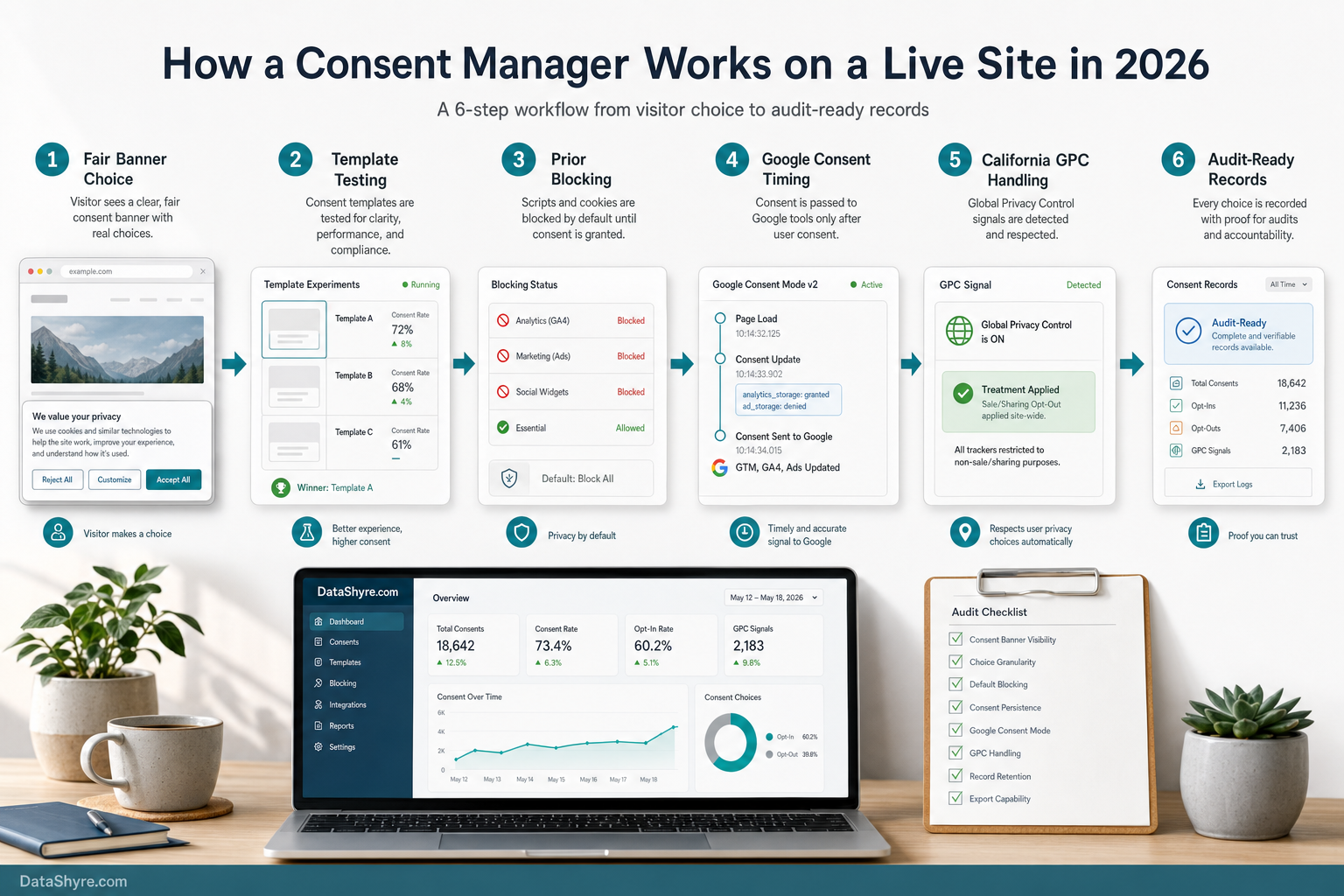
A short review sequence I would run this week
If I had ten minutes to pressure-test a consent manager before launch, I would do this in order:
- Map the pages, embeds, scripts, and tags that can start optional behavior.
- Test the first-layer reject path on desktop and mobile.
- Inspect what fires before any choice on the templates that matter most.
- Verify consent defaults and updates if Google tags are in scope.
- Run a California scenario with GPC enabled where sale or sharing could apply.
- Reopen settings later and confirm withdrawal changes live behavior.
- Save evidence another stakeholder could understand without replaying the whole test.
That sequence usually reveals more risk than another pass through a vendor feature matrix.
Bottom line
The best way to evaluate a consent manager in 2026 is not as a banner purchase. It is as a live control system that must preserve fair choice, technical enforcement, regional honesty, and usable records at the same time.
If the setup gives people a clear refusal path, keeps optional technologies off when it should, passes timing-sensitive signals correctly, treats California handling as a real branch, and leaves behind evidence your team can use, you are in much stronger shape. If it cannot do those things, the banner may be live while the control layer behind it is still fragile.
Sources
- European Commission: When is consent valid?
- European Commission: What if somebody withdraws their consent?
- UK ICO: Guidance on the use of storage and access technologies
- UK ICO: Final storage and access technologies guidance published
- Google for Developers: Set up consent mode on websites
- California Department of Justice: Global Privacy Control
- California Privacy Protection Agency: Law & Regulations
- California Privacy Protection Agency: Joint investigative privacy sweep on GPC
This post was updated on August 20, 2026 using current official regulator, government, and platform materials available at publication time.