

What Is a Consent Management Platform (CMP) in 2026? A Practical Definition
If you are searching what is a consent management platform cmp on August 19, 2026, the useful answer is not “a cookie banner tool.” A real CMP is the control layer that turns a visitor’s privacy choice into actual behavior across tags, scripts, embeds, regions, and records.
That distinction matters more now, not less. The UK ICO finalized its storage-and-access technologies guidance on April 29, 2026 and made clear the review reaches beyond classic browser cookies into tracking pixels, device fingerprinting, scripts, tags, and similar technologies. The European Commission still says consent must be freely given and that people must be able to “refuse or withdraw consent without being at a disadvantage.” In California, the Department of Justice still describes Global Privacy Control as a “stop selling or sharing my data switch” that covered businesses must honor where the law applies.
If you want the adjacent buying detail first, start with our guides to consent management platform, cookie consent manager, and Google certified consent management platform CMP. This article is narrower. It answers the plain-language question behind what is a consent management platform cmp and explains when teams usually need one.
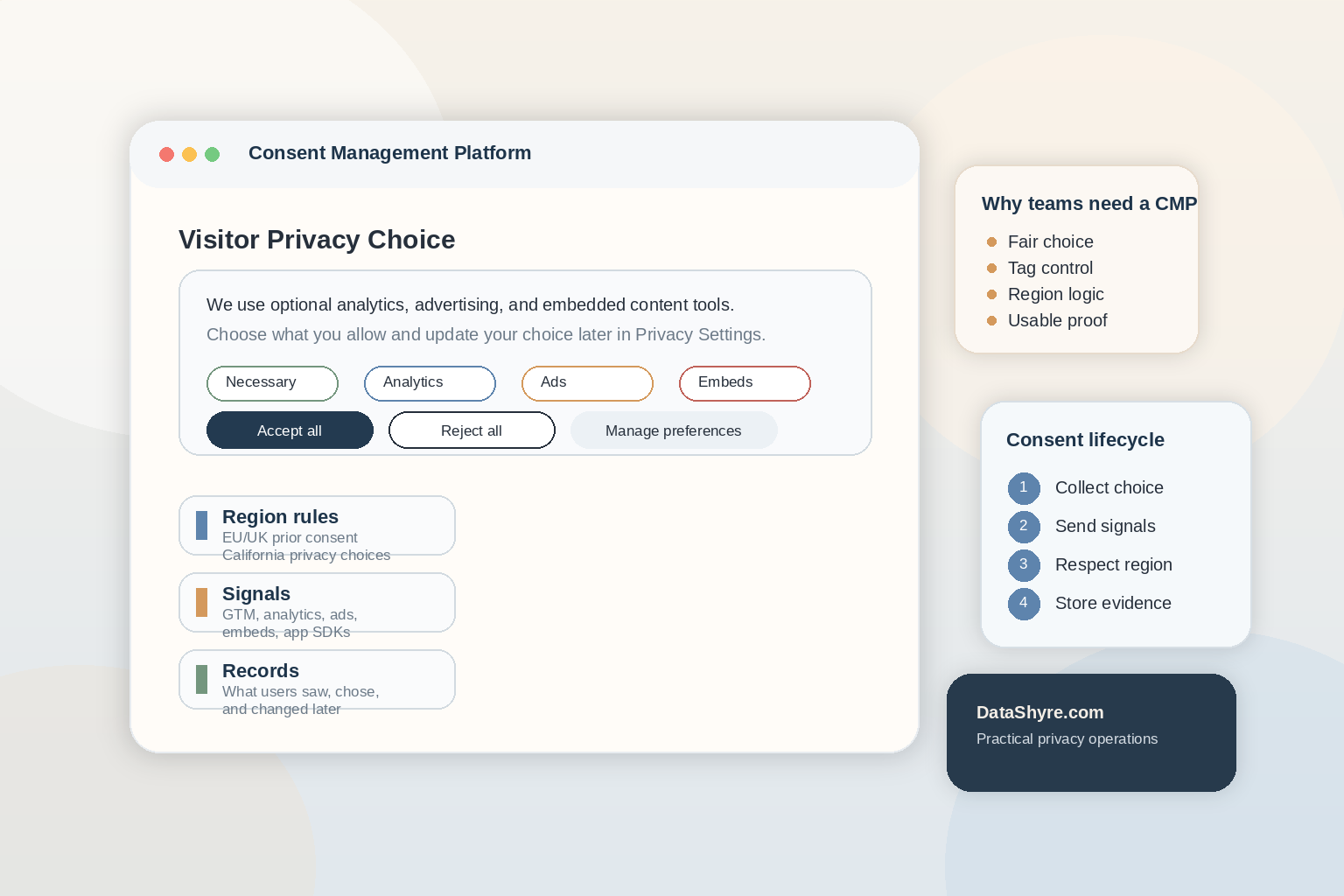
What a consent management platform actually is
A consent management platform (CMP) is software that collects a user’s privacy choice, stores that choice, and helps enforce it across the technologies that want to collect, store, access, or share data.
In practice, that usually means a CMP helps manage:
- the first-layer banner or privacy prompt;
- category or purpose-level choices;
- prior blocking of optional technologies where required;
- downstream signals to tag managers, analytics, ad systems, and embedded services;
- regional logic for different legal paths;
- records showing what the user saw, chose, and changed later.
So if someone asks what is a consent management platform cmp, the shortest accurate answer is this: it is not just the message on the screen. It is the operating system behind that message.
A CMP is not the same thing as a cookie banner
This is where a lot of confusion starts.
A cookie banner is the visible interface. A CMP is the broader control layer behind it. A site can display a banner and still have no reliable consent-management system at all.
That happens when the banner:
- looks balanced but optional tags still fire too early;
- stores a preference but never passes it to downstream tools;
- treats every region the same when the legal path differs;
- makes withdrawal hard even after promising later control;
- produces weak records that nobody can explain later.
The ICO’s April 2026 launch note captured the real objective in one phrase when William Malcolm said people need “meaningful control over how their data is used.” That is a better definition than any vendor category page.
What a CMP should do in 2026
The live baseline is broader than many teams assume.
The ICO’s final 2026 guidance explicitly covers storage-and-access technologies beyond old cookie-only thinking. CNIL still says:
“rejecting cookies should be just as easy as accepting them.”
And the European Commission still frames valid consent around free choice, specific information, and the ability to refuse or withdraw without disadvantage.
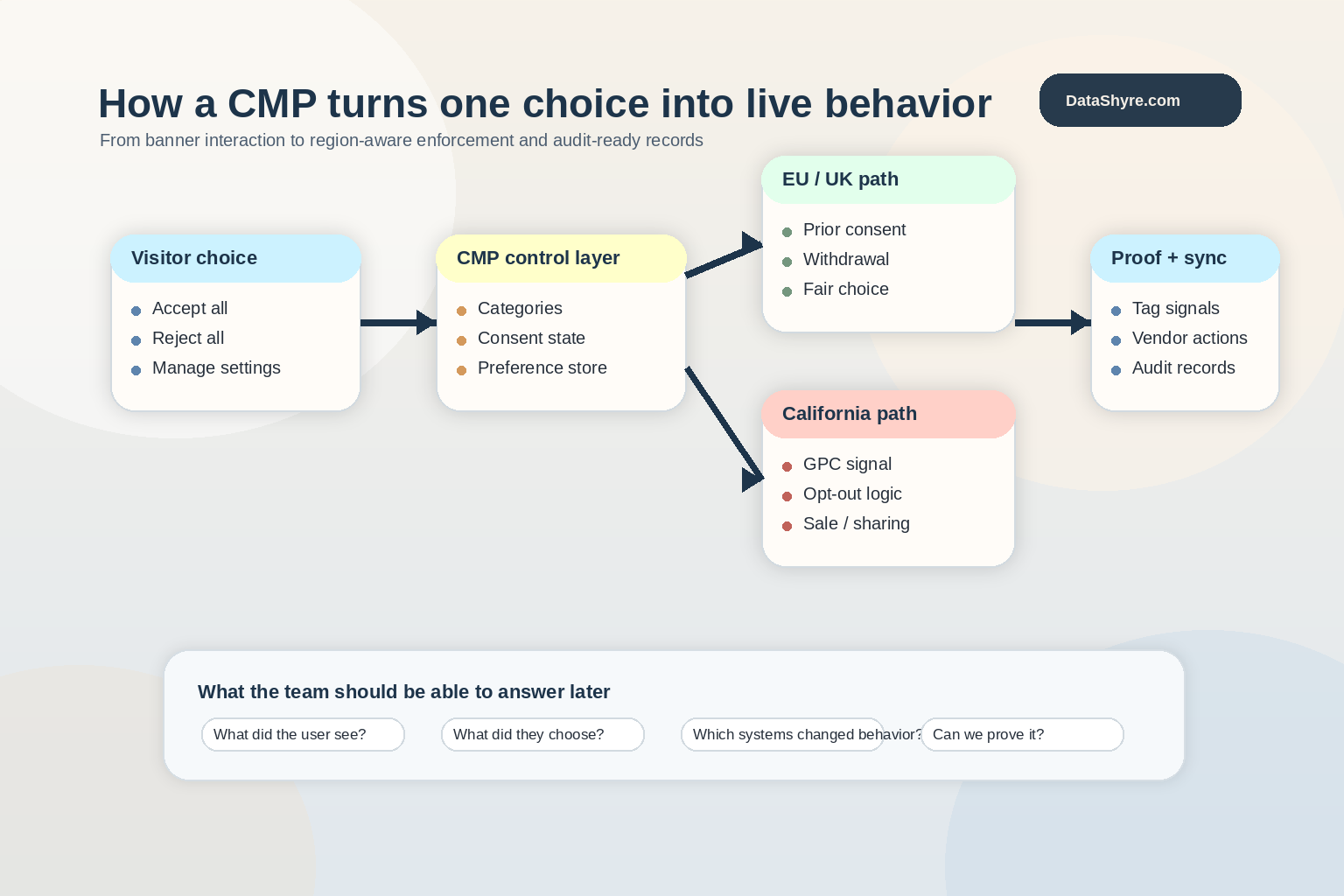
That means a working CMP in 2026 should usually help your team do five things:
1. Present a fair first choice
The interface should not nudge people toward one outcome simply because it is more commercially convenient.
2. Control optional technologies before or after choice as the applicable rule requires
This is the technical heart of the tool. If analytics, advertising, personalization, or embedded tools behave the same before and after a user choice, the CMP is not doing much.
3. Pass the choice to the systems that actually act on data
Google tags, tag managers, analytics tools, ad systems, video players, chat widgets, and third-party embeds all need to receive and honor the signal.
4. Support regional privacy logic
EU and UK consent flows, California opt-out and preference-signal handling, and publisher-specific ad-tech requirements do not always map to one identical experience.
5. Leave behind proof
Your team should be able to understand what the user saw, what they chose, and whether the site behaved accordingly.
When a simple banner is no longer enough
The phrase what is a consent management platform cmp usually comes up when a team has outgrown a basic banner plugin or script.
That point often arrives when you have:
- multiple tags or marketing vendors;
- Google Tag Manager or another tag layer;
- embedded media, chat, maps, or scheduling tools;
- traffic from both Europe and California;
- ad-supported publishing requirements;
- multiple brands, domains, or languages;
- a legal or security team asking for clearer records.
If your site only needs a basic notice and has almost no optional technologies, you may not need a large CMP product immediately. But once consent choices need to change what several tools actually do, a banner alone usually stops being enough.
Why California and Europe often force a more serious setup
This is another reason the keyword keeps showing up.
In the EU and UK, the practical review often focuses on whether optional technologies stay off until valid consent exists where prior consent is required. In California, the practical review often shifts toward notice, opt-out, sale-or-sharing analysis, and browser-based privacy signals. The California DOJ’s GPC guidance still says businesses subject to the law must honor qualifying signals as valid requests to stop sale or sharing. The CPPA’s law-and-regulations pages still show 2026 as an active compliance year for current California privacy rules and related updates.
So when people ask what is a consent management platform cmp, part of the answer is that it helps teams avoid pretending one generic banner solves every jurisdiction.
Publisher and Google requirements are a separate layer
For some businesses, the CMP question is not only legal. It is operational.
Google’s current publisher help still says that publishers serving personalized ads to users in the EEA, the UK, or Switzerland need a certified CMP integrated with the IAB Transparency and Consent Framework. Google also says that certification does not amount to full legal compliance by itself.
That is an important distinction. A CMP can be necessary because:
- your regulator-facing privacy design needs stronger control; and
- your ad stack or publisher program has separate platform requirements.
Those are related, but they are not the same test.
A short test for deciding whether you need a CMP
If you are still asking what is a consent management platform cmp in a practical sense, use this short test:
- Does the site use more than one optional tracking or advertising tool?
- Do choices need to flow into GTM, analytics, ads, embeds, or app SDKs?
- Do you serve users in regions with different privacy-choice models?
- Do you need to honor browser signals like GPC?
- Would another team member be able to reconstruct what happened from your current records?
If several answers are yes, you are probably not looking for a prettier banner. You are looking for a real consent-management layer.
Bottom line
The best answer to what is a consent management platform cmp in 2026 is simple: it is the system that makes a privacy choice real.
If the tool only shows a banner, it is not enough. If it helps collect a fair choice, enforce that choice across your live stack, adapt by region, support platform requirements, and preserve usable records, then it is doing the work people usually mean when they say CMP.
Sources
- UK ICO: Final storage and access technologies guidance published
- UK ICO: Guidance on the use of storage and access technologies
- European Commission: When is consent valid?
- California Department of Justice: Global Privacy Control
- California Privacy Protection Agency: Law & Regulations
- California Privacy Protection Agency: CCPA Updates
- CNIL: Dark Patterns in Cookie Banners: CNIL issues formal notice to website publishers
- European Data Protection Board: Belgian DPA must handle the merits of a NOYB cookie-banner complaint
- Google Ad Manager Help: Google consent management requirements for serving ads in the EEA, the UK, and Switzerland
This post was updated on August 19, 2026 using current official regulator, government, and platform guidance available at publication time.