

Cookie Consent in 2026: What It Means, Where It Applies, and What to Check
If you are searching for cookie consent, you probably are not looking for a prettier banner. You are trying to work out whether your site actually needs prior consent, whether California expects something different, and how to tell if the first click changes what your tags and vendors do afterward.
That is still a live issue on July 31, 2026. On April 29, 2026, the UK ICO finalized its storage-and-access technologies guidance. On July 14, 2026, the European Data Protection Board said the Belgian DPA must assess the merits of a NOYB complaint about a broadcaster’s cookie banner. A few months earlier, on November 27, 2025, the CNIL announced a EUR 750,000 cookie-related fine involving vanityfair.fr. Cookie controls are still active compliance territory.
If you want narrower guides before the broad overview, start with our GDPR cookie consent guide, Cookie Consent Message Examples: 7 Banner Patterns That Still Work in 2026, and Consent for Data Collection in 2026: When You Actually Need It. This article stays wider. It is the baseline review I would use before trusting a cookie consent setup in production.
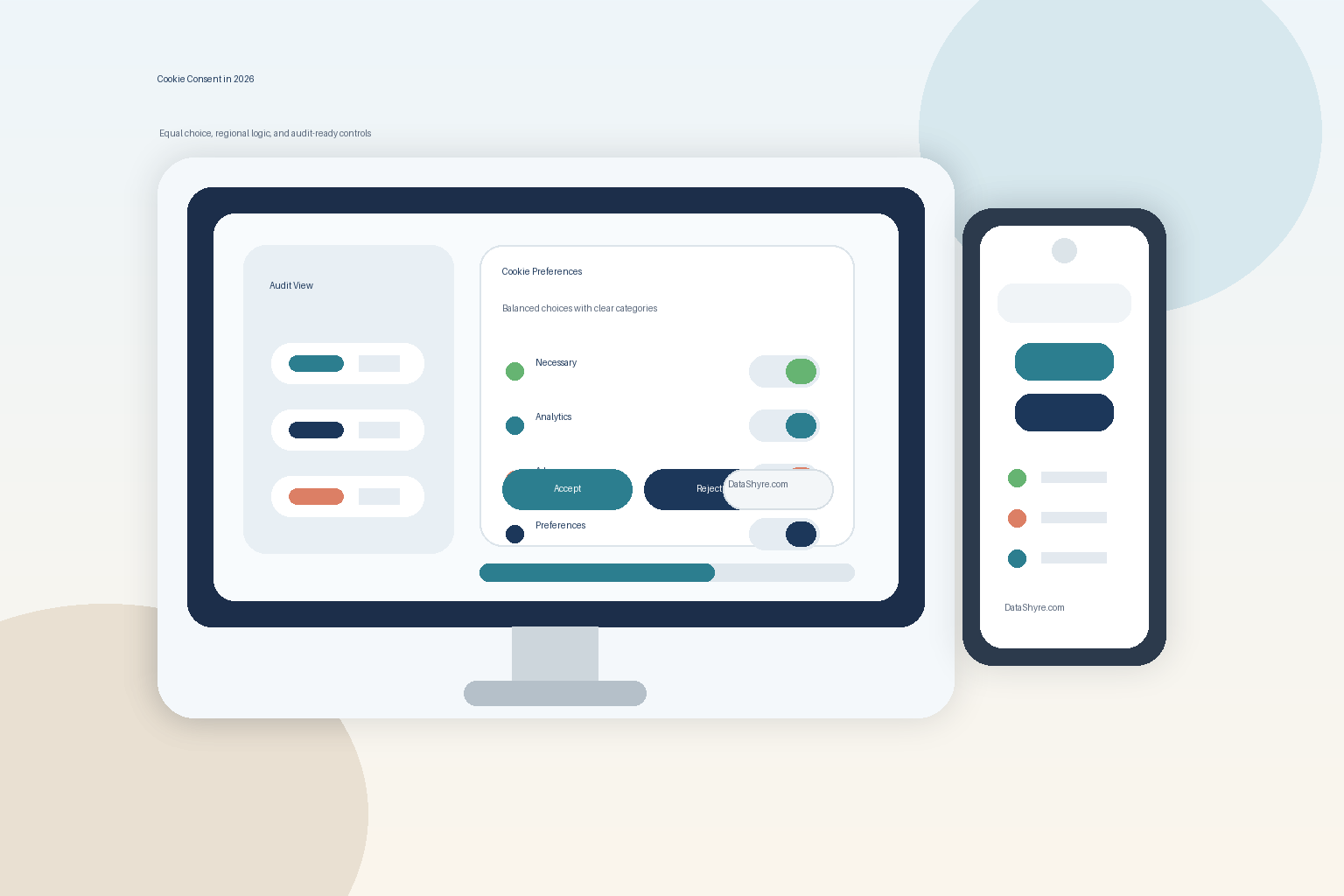
What cookie consent covers now
The label cookie consent is now too narrow for the technical problem most teams are actually trying to control.
The ICO’s final 2026 guidance makes that plain. Its storage-and-access technologies guidance is not limited to classic browser cookies. It also reaches tracking pixels, link decoration and navigational tracking, web storage, fingerprinting techniques, and scripts or tags. That matters because a site can pass a banner design review and still fail the live behavior test if optional analytics, advertising, or personalization tools start running before the user chooses.
For Europe-facing implementations, the legal baseline is still the same: consent must be freely given, specific, informed, and expressed through a clear affirmative act. The European Commission also keeps the usability standard simple:
“It should be as easy to withdraw as to give consent.”
>
European Commission
That line still does a lot of practical work. A setup that is easy to accept but awkward to reopen, revise, or withdraw is already weaker than it looks.
Where cookie consent actually applies
The answer depends on jurisdiction, your business model, and what your site is doing behind the interface.
EU and UK
For most EU and UK website use cases, the operational rule is straightforward: if the technology is non-essential, do not let it start before the person has made a valid choice.
That usually puts analytics, advertising, retargeting, personalization, and many third-party embeds into scope. The ICO’s 2026 guidance also matters because it broadens what teams should review. Do not test only cookie files. Test the actual tracking layer.
California
California is different enough that teams should not clone an EU banner and assume the work is done.
The California Department of Justice says a user-enabled Global Privacy Control must be honored by covered businesses as a valid request to stop the sale or sharing of personal information. The California Privacy Protection Agency also says its current CCPA updates became effective on January 1, 2026. For many ad-supported or identity-linked websites, that means the practical review is not just about a consent modal. It is also about whether sale or sharing stops when a valid signal or opt-out is received.
That does not turn California into a simple mirror of EU consent law. It does mean a broad cookie consent review in 2026 has to include regional behavior, not just one universal banner layout.
Publishers and ad-supported properties
There is also a platform layer that matters commercially even when it is not the same thing as legal compliance.
Google’s current publisher help says personalized ads for users in the EEA, the UK, and Switzerland require a Google-certified CMP integrated with the IAB Transparency and Consent Framework. That is best treated as a separate check: platform eligibility can affect revenue, but it does not replace legal or technical validation.
6 checks that expose weak cookie consent
1. Prior blocking where consent is required
This is still the fastest way to find the real gap between policy and implementation.
If optional analytics, advertising, or profiling tools fire before the visitor chooses, the rest of the banner design does not rescue the setup. Test live pages, not only staging screenshots. Watch requests, browser storage, and the behavior of embeds or tag-manager rules that teams often forget are part of the same consent flow.
2. Reject must be as easy as accept
The CNIL put the principle in plain language in its December 12, 2024 notice on dark patterns in cookie banners:
“Rejecting cookies should be just as easy as accepting them.”
>
CNIL
That is one of the best screening tests you can use. If Reject all is missing, visually weakened, buried in a second layer, or materially slower on mobile than on desktop, the design is steering the choice.
3. Purposes must be understandable
People should be able to tell what they are agreeing to without decoding internal jargon.
For most sites, the safer pattern is to explain categories such as:
- strictly necessary;
- analytics;
- advertising;
- functional preferences;
- embedded third-party content where relevant.
That is usually stronger than vague labels such as experience, improvements, or partners. The first layer can stay short. The second layer still has to explain what those purposes mean in practice.
4. Withdrawal has to be a real product behavior
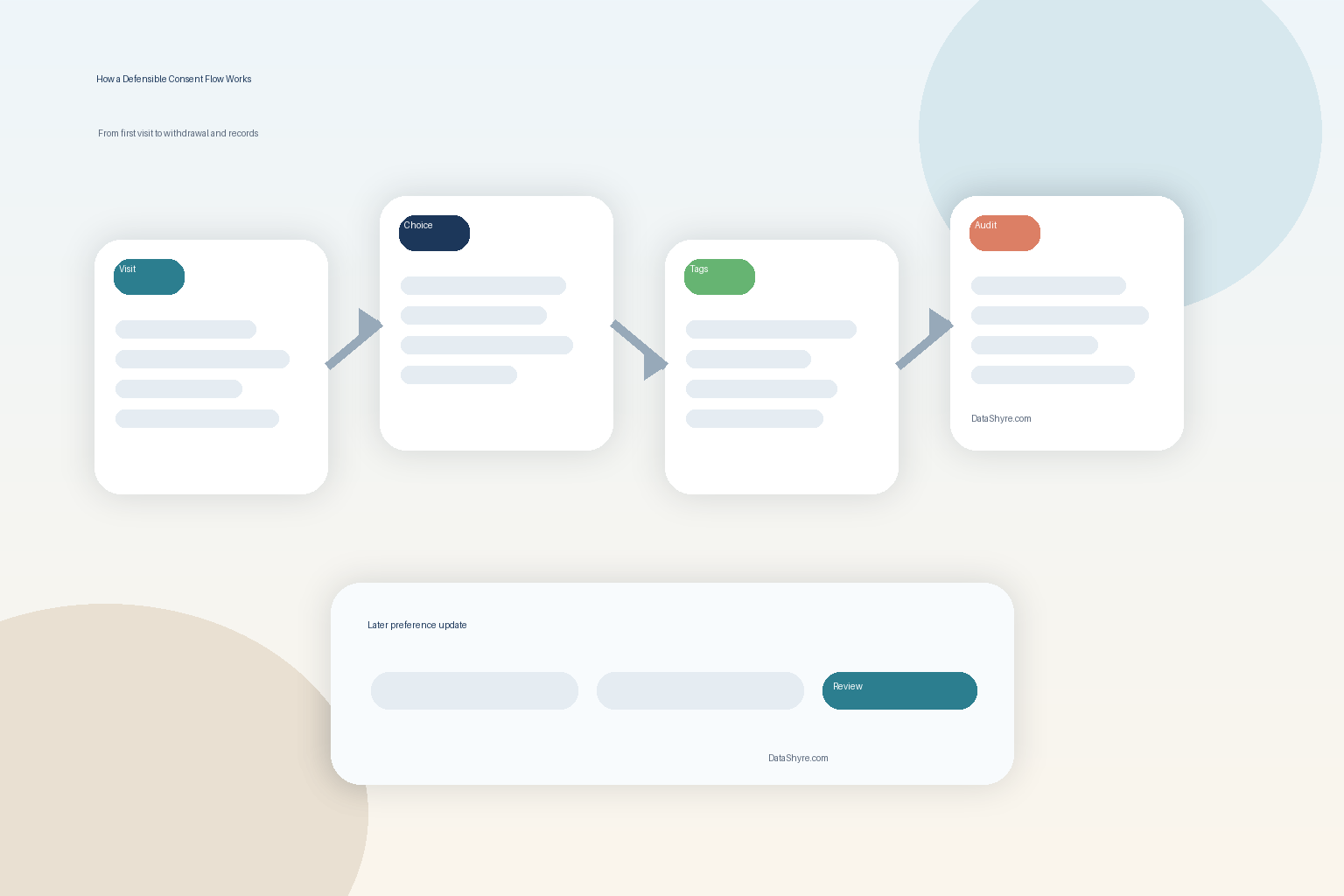
You should be able to accept, come back later, reopen the settings, change the preference, and confirm that the technical behavior changes as well.
If analytics or advertising keeps running after withdrawal, then the interface is performing compliance rather than delivering it. This is one reason the European Commission’s withdrawal standard matters so much in practice.
5. Regional logic has to reach the tracking stack
This is where a lot of broad cookie consent programs break down.
The visible interface may differ by region, but the important question is whether the signal reaches the systems that matter:
- tag managers;
- analytics tools;
- advertising vendors;
- embedded third-party services;
- sale/share logic and Global Privacy Control handling where applicable.
For California-facing traffic, that means validating that opt-out or GPC handling changes downstream behavior instead of just changing what a settings panel displays.
6. Records have to connect the choice to the live configuration
Sooner or later, someone will ask what happened on a specific date.
A mature setup can usually show:
- which banner version was live;
- which categories or vendor disclosures were shown;
- what the visitor chose and when;
- later changes or withdrawals; and
- whether downstream behavior matched the stored preference.
That matters because a screenshot is not enough. Good cookie consent is partly an evidence problem.
Common mistakes that still create avoidable risk
The same failures keep appearing:
Accept allis a button while refusal is reduced to a text link or second-layer path;- optional categories are enabled by default;
- teams test the banner but not the tag behavior;
- withdrawal exists in theory but is hard to find later;
- California handling ignores a valid Global Privacy Control signal;
- records exist, but cannot be matched to the actual banner version or downstream action.
Those are not cosmetic issues. They go directly to whether the user’s choice is meaningful.
A quick review sequence
If I had ten minutes to review cookie consent on a live property, I would do this in order:
- Open a clean browser session.
- Check whether optional tracking technologies fire before any choice is made.
- Click
Reject alland retest. - Open the settings panel and confirm optional categories are off by default unless exempt.
- Accept only selected categories and confirm downstream behavior changes.
- Reopen the controls later and withdraw or revise the choice.
- For California traffic, verify how the site handles Global Privacy Control and sale/share opt-out logic.
- Check whether the logs or consent records reflect each step.
That sequence is simple, but it usually surfaces the real problems faster than any feature checklist.
Bottom line
In 2026, good cookie consent is not a pop-up project. It is a promise that the interface, the tags, the vendors, and the records all line up with the same user choice.
If your setup blocks optional technologies before consent where required, makes refusal as easy as acceptance, honors regional preference signals where applicable, and leaves behind evidence your team can trust later, you are much closer to a control layer that still holds up under real scrutiny.
Sources
- UK ICO: Guidance on the use of storage and access technologies
- UK ICO: Final storage and access technologies guidance published
- European Commission: When is consent valid?
- European Commission: What if somebody withdraws their consent?
- European Data Protection Board: Belgian DPA must handle the merits of a NOYB cookie-banner complaint
- CNIL: Dark Patterns in Cookie Banners: CNIL issues formal notice to website publishers
- CNIL: Cookies placed without consent: the company that publishes the website “vanityfair.fr” fined 750,000 euros by the CNIL
- California Department of Justice: Global Privacy Control
- California Privacy Protection Agency: CCPA Updates, Cybersecurity Audits, Risk Assessments, Automated Decisionmaking Technology, and Insurance Companies
- Google Ad Manager Help: Google consent management requirements for serving ads in the EEA, the UK, and Switzerland
This post was updated on July 31, 2026 using current official regulator and platform guidance available at publication time.