

Cookie Consent Tool in 2026: What It Must Actually Control
If you are evaluating a cookie consent tool, the real question is usually not which banner looks nicest. It is whether the tool can turn one user choice into real technical behavior across tags, vendors, regions, and audit records.
That is still the right test on August 1, 2026. On April 29, 2026, the UK ICO published final guidance on storage and access technologies covering cookies, tracking pixels, device fingerprinting, scripts, and similar technologies. On July 14, 2026, the European Data Protection Board required the Belgian DPA to assess the merits of a cookie-banner complaint involving broadcaster VRT instead of closing it on procedural grounds. In California, the Department of Justice still says a valid Global Privacy Control signal must be honored by covered businesses as an opt-out of sale or sharing, and the CPPA’s current CCPA law-and-regulations page lists the governing CCPA materials as effective on January 1, 2026.
If you want the surrounding context first, start with our guides to cookie consent, cookie consent manager, and cookie consent message. This article is narrower. It is about what a practical cookie consent tool should actually control before you trust it on a live site.
Why a cookie consent tool is broader than a banner
The label cookie consent tool is now smaller than the job.
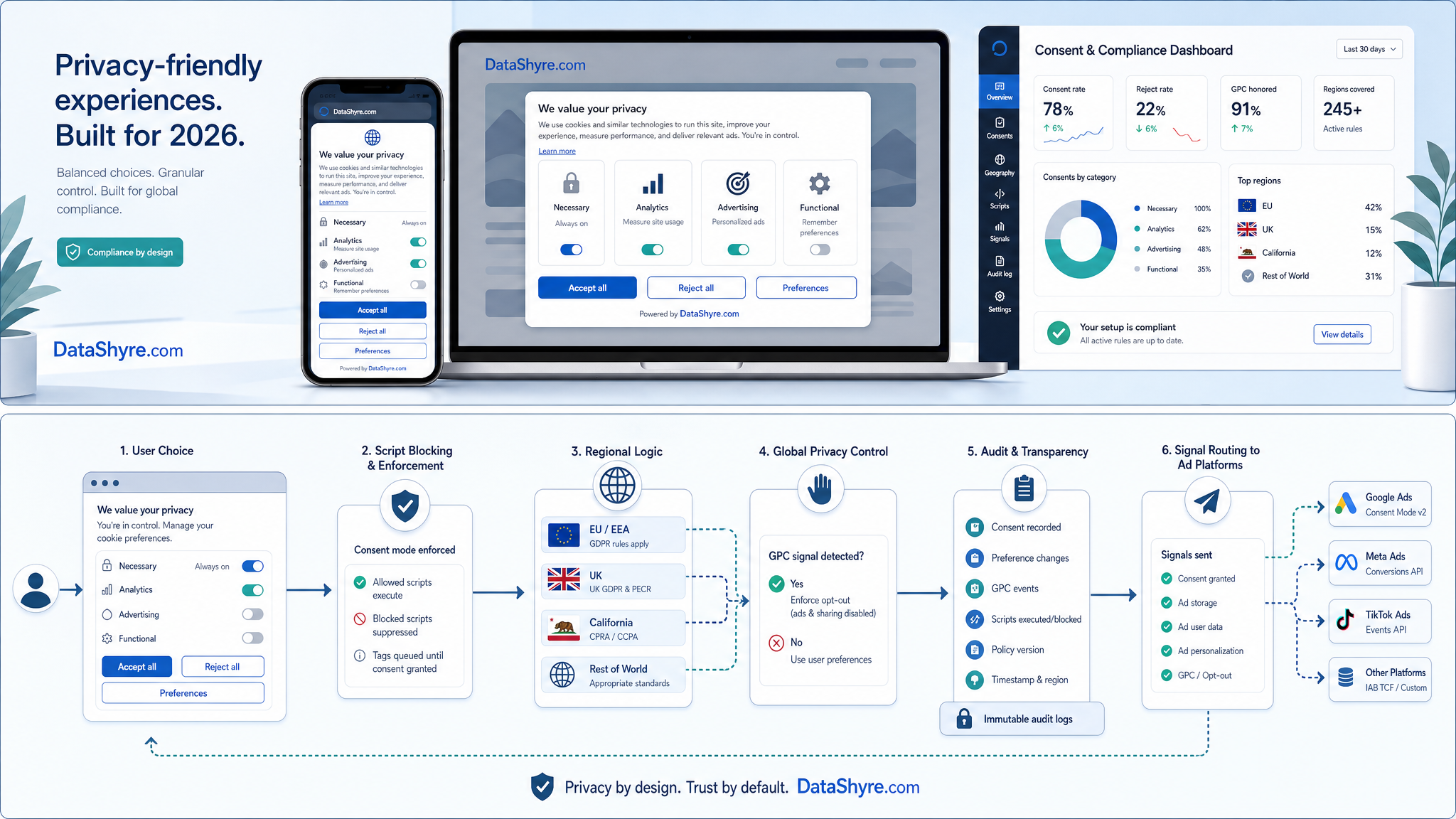
The ICO’s final storage-and-access technologies guidance makes clear that compliance review is not limited to classic browser cookies. It reaches tracking pixels, link decoration and navigational tracking, device fingerprinting, web storage, and scripts or tags. That means a tool can pass a design review and still fail the real test if optional analytics, advertising, or personalization technologies start before the visitor has made a valid choice.
The European Commission’s GDPR guidance also keeps the consent standard simple. Consent must be freely given, informed, specific, and expressed through a clear affirmative act. The same guidance says people must be able to refuse or withdraw consent without disadvantage, and:
“It should be as easy to withdraw as to give consent.”
>
European Commission
That is not just a legal phrase. It is a product requirement. A cookie consent tool that makes acceptance instant but turns withdrawal into a scavenger hunt is weaker than it looks.
What the best cookie consent tools actually do
At minimum, a serious cookie consent tool should coordinate five layers at once:
- first-layer banner choice;
- granular purpose or category settings;
- prior blocking of non-essential technologies where required;
- downstream signaling to tags, vendors, and ad platforms;
- records that show what the user saw, chose, and changed later.
If a product mainly changes colors, button text, or banner placement, it is not doing the full job. It may still help with notice design, but it is not the control layer most teams think they are buying.
The ICO’s April 2026 launch statement is useful here because it frames the outcome instead of the widget. Executive director William Malcolm said users should have:
“meaningful control over how their data is used.”
>
William Malcolm, ICO
That is the most practical filter I know for a cookie consent tool demo. If the interface looks polished but the user cannot actually stop optional tracking, the tool is selling presentation instead of control.
6 checks before you trust a cookie consent tool
1. Test prior blocking, not just banner appearance
This is still the first thing to verify.
If optional analytics, advertising, session replay, or personalization tools fire before the user chooses, the rest of the interface does not rescue the setup in jurisdictions that require prior consent. Test live requests, browser storage, and tag-manager behavior, not just static screenshots.
2. Confirm that rejection is as easy as acceptance
CNIL’s December 12, 2024 notice on dark patterns in cookie banners remains one of the clearest usability standards:
“Rejecting cookies should be just as easy as accepting them.”
>
CNIL
For a cookie consent tool, that means Reject all should not be hidden behind a second layer, softened into a low-contrast link, or made materially harder on mobile. If the design steers people toward acceptance, the tool is creating avoidable risk.
3. Make sure the signal reaches the real tracking stack
A banner is only the front end. The harder question is whether the user’s choice reaches:
- Google Tag Manager or other tag managers;
- analytics tools;
- advertising platforms;
- embedded media and chat tools;
- CRM or downstream enrichment flows where applicable.
This is also where publisher workflows need a separate check. Google’s current publisher guidance says personalized ads for users in the EEA, the UK, and Switzerland require a Google-certified CMP integrated with the IAB Transparency and Consent Framework, and Google also says that certification does not verify full compliance with privacy law. Treat that as a platform requirement layered on top of legal and technical review, not a substitute for either.
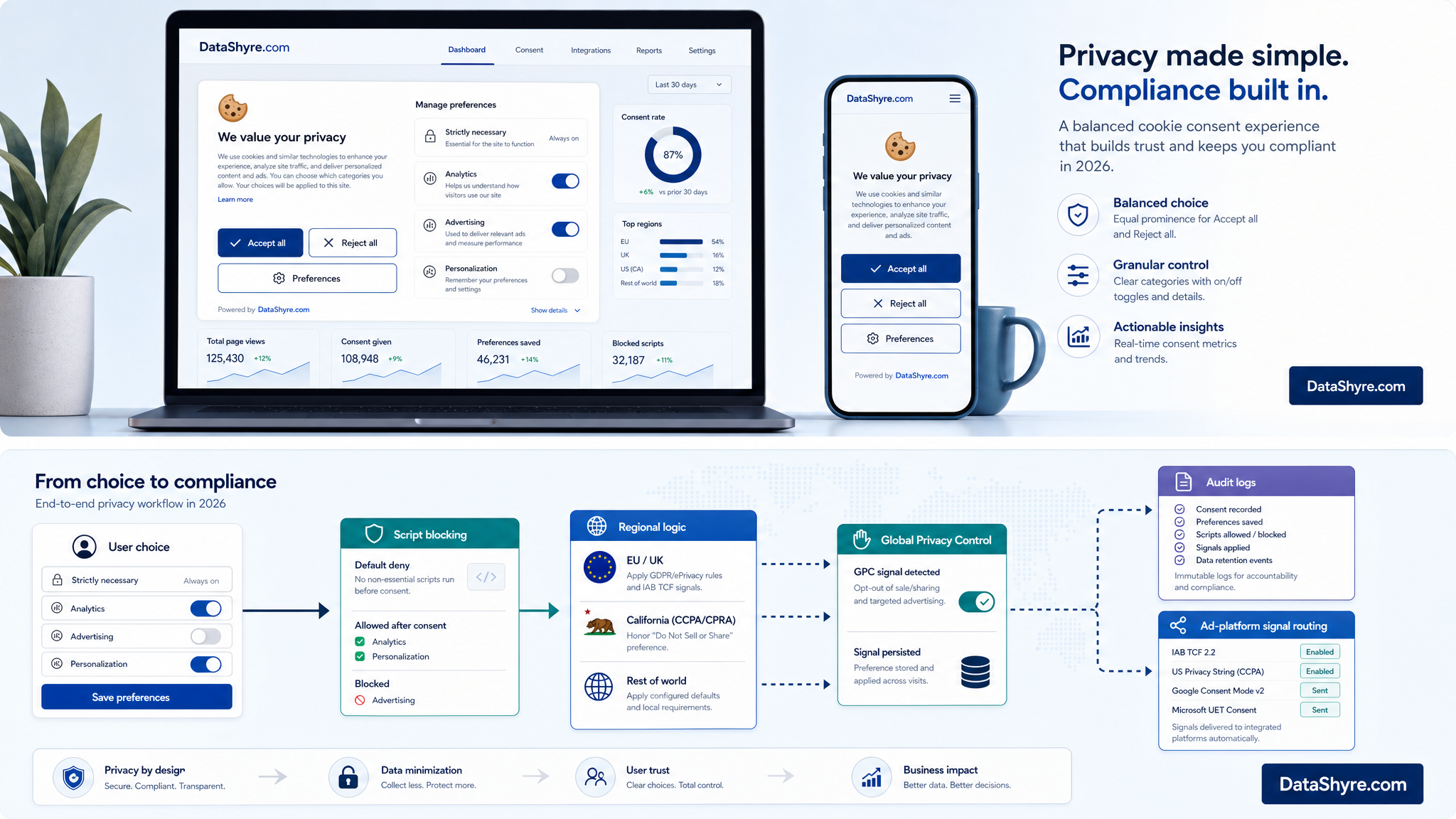
4. Separate EU or UK consent logic from California opt-out logic
One cookie consent tool may support multiple regions, but one legal model does not.
In the EU and UK, the core question is often whether non-essential technologies stay off until valid consent exists. In California, the question often shifts toward sale-or-sharing opt-out handling and preference signals. The California Department of Justice says a user-enabled Global Privacy Control must be honored by covered businesses as a valid request to stop the sale or sharing of personal information.
That means regional controls should reach the behavior layer, not just the wording layer. A good tool should support different defaults, messages, and downstream actions based on jurisdiction.
5. Check whether the records are actually usable
Sooner or later, someone will ask what happened on a specific date.
A mature cookie consent tool should usually help you answer:
- Which banner or settings version was live?
- Which purposes or categories were shown?
- What did the visitor select, and when?
- Was the choice later changed or withdrawn?
- Did the site’s behavior match the stored preference?
That matters because a screenshot is not evidence by itself. The control layer needs a usable record trail.
6. Re-test after tags, vendors, or templates change
Consent setups drift faster than teams expect.
New tags get added. A marketing team republishes a container. A third-party video appears only on one landing page. A new analytics script gets bundled through a plugin update. The banner still looks right while the actual behavior changes underneath it. If a cookie consent tool cannot help your team catch drift and re-test efficiently, the tool will age poorly in production.
Common buying mistakes
The same mistakes keep showing up:
- treating banner design as the main buying criterion;
- assuming a CMP integration automatically blocks every optional tag;
- using one global rule for every region;
- trusting certification or vendor marketing without live testing;
- collecting records that cannot be matched to real site behavior;
- forgetting to re-test after stack changes.
Those are not cosmetic misses. They are the gap between a visible banner and a trustworthy consent control.
A fast live-site review sequence
If I had ten minutes to review a cookie consent tool, I would do this in order:
- Open the site in a clean browser session.
- Check what optional technologies fire before any interaction.
- Click
Reject alland test again. - Open preferences and confirm optional categories are off by default unless exempt.
- Accept selected categories only and confirm downstream behavior changes.
- Reopen the settings later and test withdrawal.
- For California traffic, verify how the site handles Global Privacy Control and sale/share opt-out logic.
- Check whether logs or consent records reflect each step.
That sequence is simple, but it usually reveals the real quality of the tool faster than a long feature list.
Bottom line
In 2026, the best cookie consent tool is not the one with the nicest banner template. It is the one that turns a visitor’s choice into consistent site behavior across tags, vendors, regions, and records.
If the tool blocks optional technologies before consent where required, makes rejection and withdrawal genuinely usable, honors California preference signals where applicable, and leaves behind evidence your team can trust, you are much closer to a setup that will hold up under real scrutiny.
Sources
- UK ICO: Final storage and access technologies guidance published
- UK ICO: Guidance on the use of storage and access technologies
- European Commission: When is consent valid?
- European Commission: What if somebody withdraws their consent?
- European Data Protection Board: Belgian DPA must handle the merits of a NOYB cookie-banner complaint
- CNIL: Dark Patterns in Cookie Banners: CNIL issues formal notice to website publishers
- California Department of Justice: Global Privacy Control
- California Privacy Protection Agency: Law & Regulations
- Google Ad Manager Help: How the Google Consent Management Platform (CMP) works
- Google Ad Manager Help: Google consent management requirements for serving ads in the EEA, the UK, and Switzerland
This post was updated on August 1, 2026 using current official regulator and platform guidance available at publication time.