

Truendo Consent Management Platform (CMP) in 2026: 7 Checks Before You Rely on It
If you are evaluating the truendo consent management platform (cmp) on August 18, 2026, the useful question is not whether the banner looks neat. It is whether Truendo can actually stop non-essential tracking before choice, carry the right signals into ad and analytics systems, and leave behind evidence your team can still understand after the next site change.
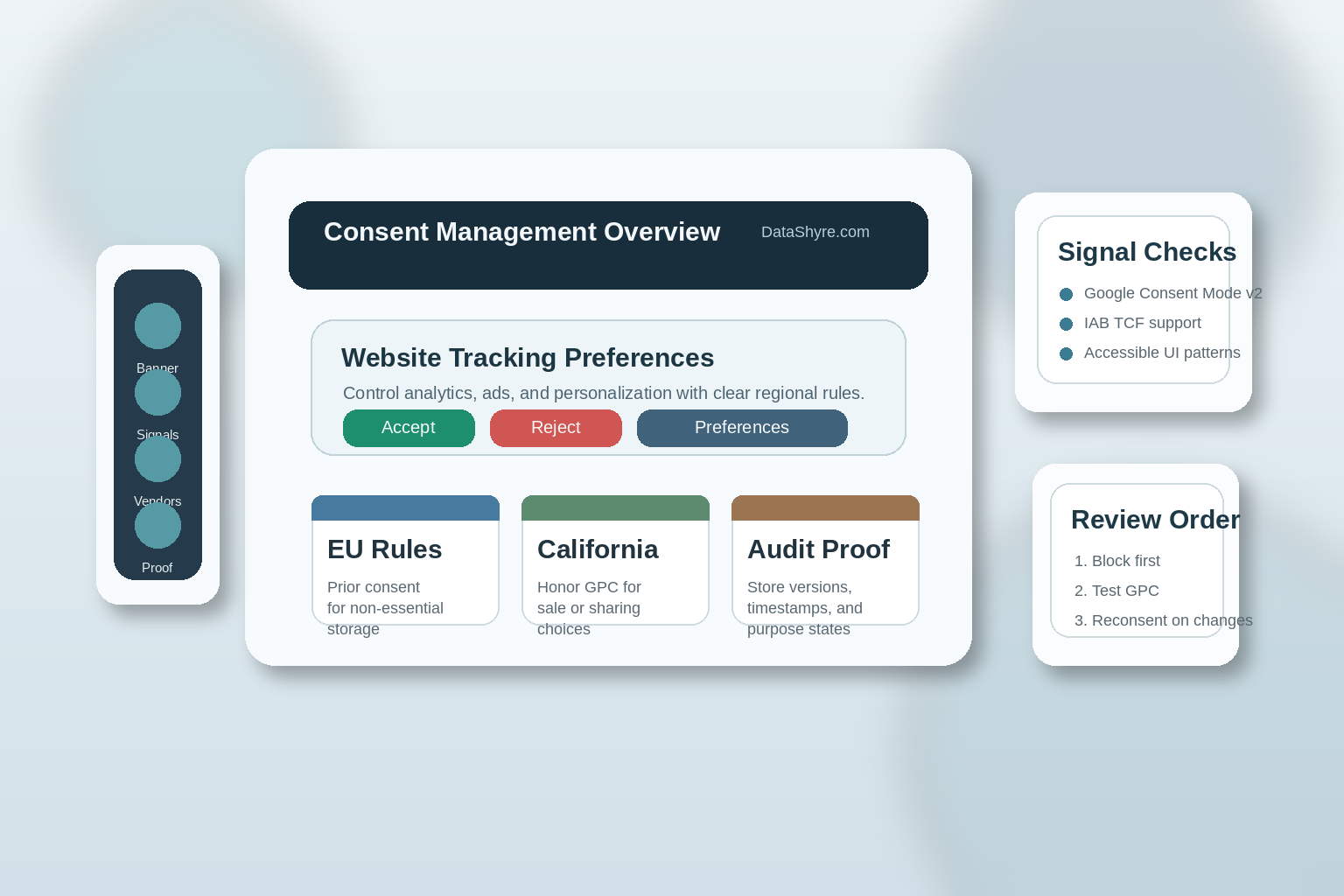
That is the right frame now because Truendo positions its CMP as more than a cookie notice. Its live product pages say the platform supports region-specific banners, Google Consent Mode v2, IAB TCF v2.2, accessibility features, and automated blocking of third-party tracking until users provide explicit consent. Its current materials also emphasize monthly scans, built-in policy support, and broad coverage for U.S. and global privacy requirements.
The legal baseline is still active too. The European Commission says consent must be freely given, informed, specific, and based on a clear affirmative act, and it also says “It should be as easy to withdraw as to give consent.” California’s Department of Justice still describes Global Privacy Control as a “stop selling or sharing my data switch” that covered businesses must honor where the law applies. The UK ICO’s final 2026 storage-and-access guidance says prior consent is needed for non-exempt technologies and that a consent mechanism should make it “as easy to refuse consent as it is to accept.”
If you want the broader category context first, start with our guides to consent management platform, consent management platform best practices, and Google certified consent management platform CMP. This article stays narrower. It is the seven-check review I would run before trusting a truendo consent management platform (cmp) on a live site.
What Truendo says its CMP does now
Truendo’s current public materials describe a fairly specific product shape:
- region-specific consent banners;
- automatic blocking of third-party tracking technologies before explicit consent;
- Google Consent Mode v2 support;
- IAB TCF v2.2 support;
- accessibility features;
- monthly compliance scans and integrated policy pages.
Those claims are useful, but they also define the real review. If the platform is sold as both a consent interface and an enforcement layer, then the real question is whether those controls still hold up when tags, scripts, pixels, embeds, and privacy signals all collide on the same page.
1. Check whether blocking really happens before optional tracking acts
This is still the first thing to verify.
Truendo’s live product messaging says it automatically blocks third-party tracking until users provide explicit consent. That sounds strong, but the practical review is simple: does the site actually prevent non-essential cookies, pixels, scripts, iframes, or tags from acting before the visitor makes a valid choice?
For a real rollout review, I would test:
- first page load on a clean browser;
- a no-click path where the visitor ignores the banner;
- a
Reject allpath; - a category-specific grant path;
- embedded tools such as video, chat, ad-tech, and analytics scripts.
The ICO’s current guidance is useful here because it is technical, not just theoretical. It says if prior consent is required, you must obtain it before using non-exempt storage and access technologies, and your mechanism must function as intended so that user choices are respected. If Truendo is the control layer, this is the first promise it has to keep.
2. Treat Google Consent Mode v2 as a runtime check, not a box-tick
Truendo’s live site and documentation still position Google Consent Mode v2 as part of the product. That matters for teams that rely on Google tags, consent-aware measurement, or publisher monetization flows.
But this is where many CMP reviews become too shallow. Saying a platform supports Google Consent Mode v2 is not the same as proving your setup sends the right default and update states at the right time on the live page.
A practical review should ask:
- where the consent defaults are set;
- whether the Google tag path stays denied until the user’s choice is known where that is required;
- whether updates happen immediately on the same page where the person acts;
- whether reject paths and withdrawal paths are tested as seriously as accept paths.
That review matters even more if your stack mixes direct Google tags, Tag Manager, and vendor tags outside the Google path. Truendo may support the signal model, but your production setup still has to prove the runtime order.
3. Separate IAB TCF and publisher needs from general website compliance
Truendo also advertises IAB TCF v2.2 support, and its documentation includes an IAB integration path. That is relevant if you are a publisher or depend on ad-tech partners that require TCF signals.
But this is where teams often merge two different reviews into one:
- the publisher or ad-tech review, where signal compatibility matters;
- the broader privacy review, where valid consent, blocking behavior, and regional logic matter.
Those overlap, but they are not identical. A truendo consent management platform (cmp) setup can satisfy a vendor integration checklist and still fail on the website’s real reject path, embedded services, or clarity of user choice.
If ad monetization matters, run a separate branch of testing for TCF behavior, Google requirements, and vendor-list accuracy instead of assuming the general banner setup covers it all.
4. Review California signal handling separately from EU-style consent
This is another place where loose implementations drift into trouble.
California’s model is not identical to the EU consent model. The California DOJ’s GPC page still says GPC is a “stop selling or sharing my data switch” and that covered businesses must honor it as a valid request to stop the sale or sharing of personal information.
That means a truendo consent management platform (cmp) review should not flatten everything into one generic banner question. Instead, test:
- whether GPC is detected on first visit;
- what the user sees after detection;
- whether the signal changes only the relevant sale-or-sharing path or broader purposes by design;
- whether later manual preference changes remain understandable.
Truendo’s U.S. positioning makes this especially important. If the product is being used to support CCPA or CPRA-facing experiences, your California logic should be explainable on its own terms, not hidden inside an EU-style narrative about cookies.
5. Decide how and when to trigger reconsent
One of the more practical checks is whether the CMP gives you a defensible way to ask again when your purposes, vendors, or data uses materially change.
Truendo’s documentation includes a reconsent function. That is useful because many teams roll out a banner once, then change scripts, vendors, embedded tools, or data-sharing relationships without revisiting whether prior choices still map to the actual data flow.
For a live review, ask:
- what changes should force reconsent in your environment;
- who decides that threshold;
- how quickly the new setup ships after a change is made;
- whether old consent records remain interpretable after the reconsent cycle.
This is where governance matters more than design. A polished interface is not much help if the consent history no longer reflects what the site actually started doing later.
6. Check whether the platform’s monthly scans and service inventory are enough for your stack
Truendo promotes monthly scans and service-management controls. Those are useful features, but they should not become a false sense of coverage.
Monthly detection can miss short-lived campaign tags, recently added scripts, hard-coded embeds, or vendor behaviors that happen only under specific journeys, geographies, or logged-in states. The question is not whether Truendo scanned the site. The question is whether the scan plus your own QA actually saw the technologies that matter.
I would want clear answers to:
- how new services are discovered;
- how manual additions are handled;
- whether first-party scripts that still create optional downstream tracking are modeled correctly;
- how regional variations are validated before rollout.
If the inventory is incomplete, the enforcement logic is usually incomplete too.
7. Make sure you can reconstruct proof later
This is the last check, and it is often the most important.
Consent is not only a banner event. It is also a recordkeeping problem. Truendo’s current materials talk about consent records and policy support, which is helpful, but the operational question is whether your team can later explain what happened for a given person, page, region, and purpose.
The European Commission’s current explanation of valid consent still centers informed, specific, affirmative choice and easy withdrawal. The ICO also says you must give users clear information about third parties and ensure the mechanism actually respects their choices. So for a real production review, I would want to know:
- what the visitor saw on first load;
- which purposes were available;
- which technologies were blocked before the choice;
- whether a browser signal such as GPC changed the initial state;
- how later changes, withdrawals, or reconsent events are recorded.
If you cannot answer those questions later, the platform may still be useful, but the implementation is not yet audit-ready.
A practical review sequence for this week
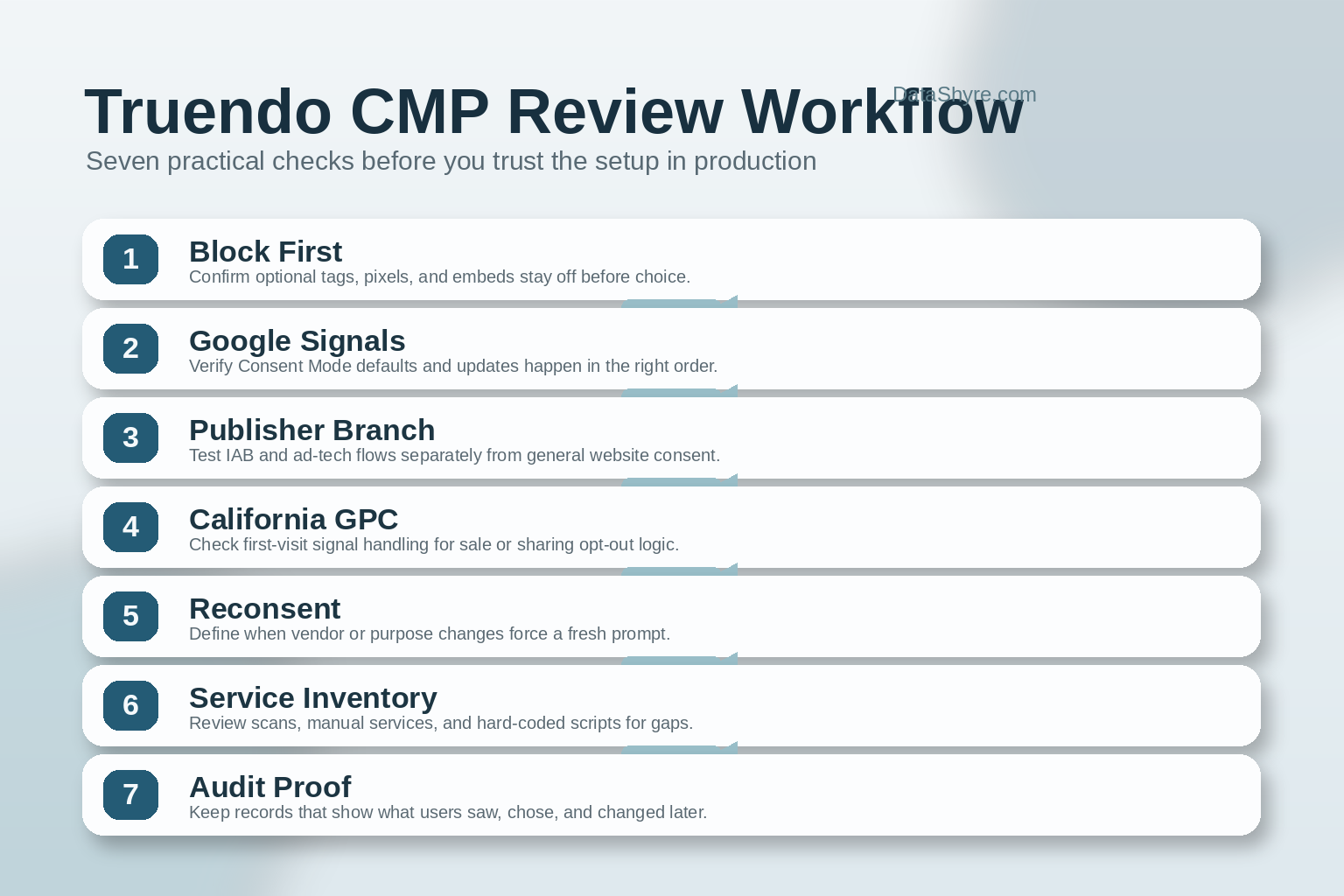
If I were validating a truendo consent management platform (cmp) rollout right now, I would do it in this order:
- confirm the exact regional experiences you need to support;
- test first-load blocking on the pages that matter most;
- verify Google Consent Mode v2 timing on live pages;
- run a separate IAB and publisher branch if ad-tech is in scope;
- test California GPC handling on first visit and on return;
- define what changes require reconsent;
- review whether consent records stay understandable after changes.
That sequence usually reveals more than a long feature matrix does.
Bottom line
The right truendo consent management platform (cmp) setup in 2026 is not the one with the cleanest banner animation. It is the one that actually blocks optional technologies before choice where required, handles Google and publisher signals without race conditions, separates California opt-out logic from EU-style consent, re-prompts when the rules change, and leaves behind proof your team can use later.
Truendo’s live materials suggest it can be a strong fit for teams that want an accessible CMP with regional banner controls, Google Consent Mode v2 support, IAB TCF support, and built-in automation. But I would still require runtime testing, regional branching tests, reconsent governance, and auditable records before I would trust the rollout in production.
Sources
- TRUENDO home page
- TRUENDO product page
- TRUENDO U.S. page
- TRUENDO documentation: Google Consent Mode v2
- TRUENDO documentation: Integrating TRUENDO CMP with Any Website
- TRUENDO documentation: Using the Reconsent Function
- TRUENDO documentation: Integrating IAB TCF 2.3 with Your Website Using TRUENDO CMP
- European Commission: Legal grounds for processing data
- California Department of Justice: Global Privacy Control
- ICO: Final storage and access technologies guidance published
- ICO: How do we manage consent in practice?
This post was updated on August 18, 2026 using current vendor, government, and regulator materials available at publication time.