

Healthcare Consent Management Platform: 7 Checks That Matter in 2026
If you are evaluating a healthcare consent management platform, the hard part is not collecting one more signature. It is deciding whether the platform can turn patient choices, privacy rules, sensitive-data restrictions, portal activity, and downstream sharing into behavior your teams can actually trust.
That is the right frame on August 1, 2026. HHS still draws important distinctions between consent, authorization, and allowed HIPAA uses for treatment, payment, and health care operations. HHS guidance on online tracking still matters for regulated websites and apps. ONC’s patient-consent materials still emphasize technology that can capture consent decisions, identify restricted information, and communicate those restrictions electronically. And for health apps that fall outside HIPAA, the FTC’s updated Health Breach Notification Rule still changes the review.
If you want the broader category baseline first, start with our guides to consent management platform, consent management provider, and consent for data collection. This article is narrower. It is the review I would run before trusting a healthcare consent management platform in production.
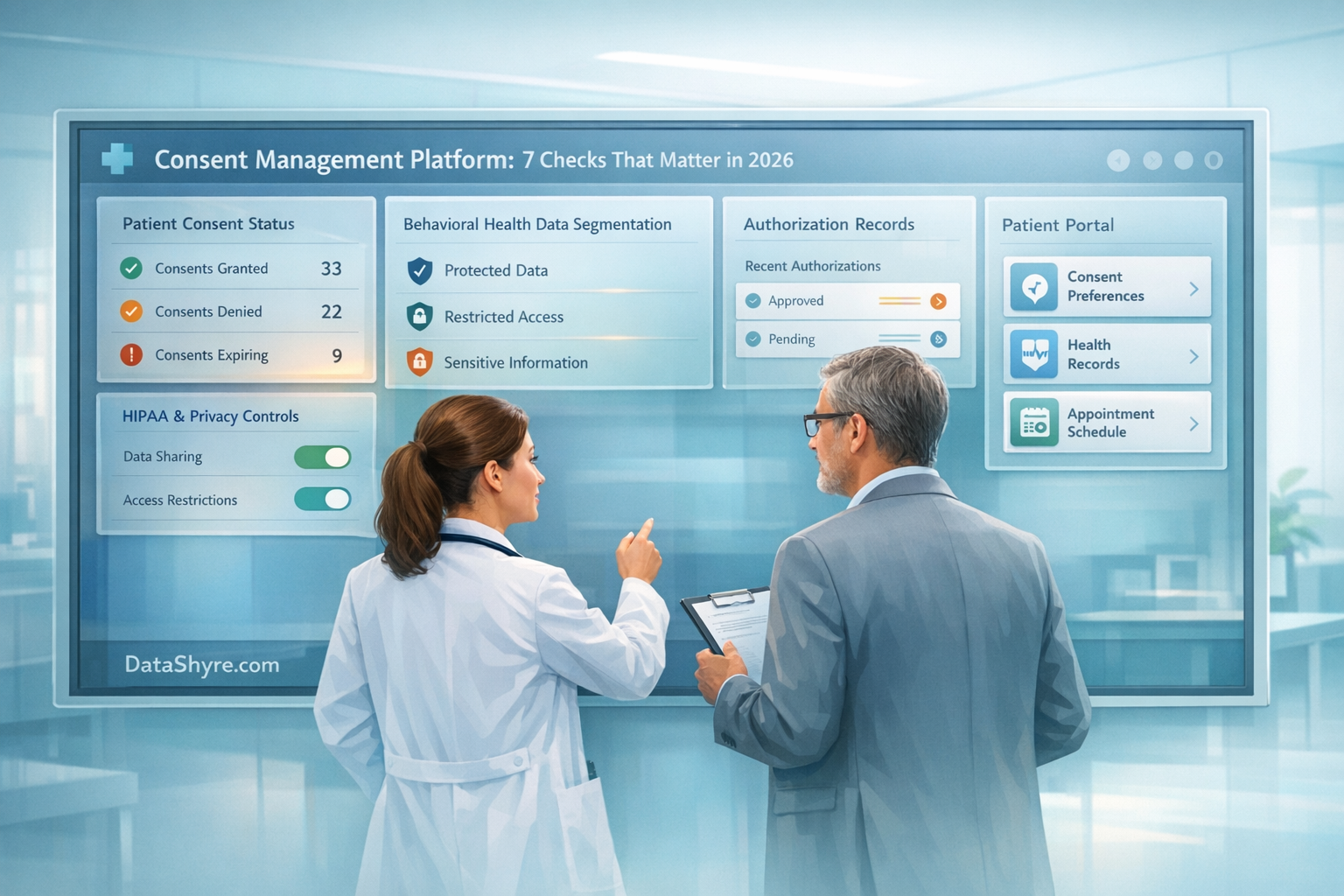
What a healthcare consent management platform actually has to manage
In healthcare, “consent” is rarely one thing.
Some workflows involve acknowledgments and notices. Some involve written authorizations. Some involve stricter state-law or specialty-data limits. Some involve patient sharing preferences across portal, registration, call-center, and referral workflows. Some involve digital properties where tracking and marketing create a separate privacy risk entirely.
That is why a serious healthcare consent management platform should be evaluated as a control layer, not a form library. It has to help the organization answer four questions clearly:
- What decision is the patient actually making?
- Where does that decision need to be honored?
- Which data or systems should be restricted because of it?
- Can someone prove later what rule was in effect and what happened?
If the platform cannot answer those four questions, it will struggle as soon as the workflow gets more complicated than a single intake form.
7 checks before you choose a healthcare consent management platform
1. Separate HIPAA-permitted use from true authorization workflows
This is the first filter because weak platforms create confusion at the legal-model level.
HHS says the HIPAA Privacy Rule permits covered entities to use and disclose protected health information for treatment, payment, and health care operations, with limits and protections, without requiring patient consent. That does not mean consent never matters. It means your platform should distinguish between:
- workflows where HIPAA allows use or disclosure without patient consent for TPO;
- workflows where your organization still chooses to collect consent;
- workflows where HIPAA requires written authorization, including many marketing uses;
- workflows where state law or specialty rules impose tighter limits.
A useful healthcare consent management platform should model those differences cleanly. If it treats every privacy event like the same checkbox, it can create bad data and bad expectations.
2. Handle sensitive and segmented data, not just general PHI
Healthcare organizations often need more than one privacy rule on the same stack.
ONC’s behavioral-health consent resources highlight how privacy and confidentiality concerns still limit the inclusion of behavioral health data in electronic exchange. HHS’s current 42 CFR Part 2 fact sheet also matters here. It says the rule now allows a single consent for future treatment, payment, and health care operations uses and disclosures in certain circumstances, while still requiring separate consent for SUD counseling notes and prohibiting certain consent combinations.
That means a stronger healthcare consent management platform should support:
- segmentation or labeling for more sensitive records;
- consent logic that can differ by data type or workflow;
- separate handling where a specific consent is still required;
- policies that can reflect stricter state-law or specialty-program limits.
If the product is built only for general website-style consent capture, it is usually too shallow for this layer of healthcare work.
3. Capture and maintain patient choices across the real journey
ONC’s patient-consent guidance stays practical here: technology should help organizations capture and maintain patient consent decisions, identify restricted portions of information, and communicate restrictions electronically.
That standard matters because patient choice is rarely gathered in one place. The decision may start during intake, move into a portal flow, change after a support call, and need to be reflected later in referrals, records requests, or data-sharing workflows.
A practical healthcare consent management platform should let teams:
- record who made the choice and when;
- store the exact form or policy version shown at the time;
- update the decision later without losing history;
- sync the result across the patient-facing and operational systems that depend on it.
If revisions are hard, staff will work around the tool. That is usually where consent records stop matching reality.
4. Pass the restriction into EHR, HIE, and API workflows without creating new bottlenecks
This is where many buyers stop too early. They confirm the signature or portal experience, but they do not test the exchange path.
ONC’s information-blocking materials are useful because they frame the bigger operational risk. Health IT developers, HIEs, HINs, and providers all operate in a legal environment that is sensitive to practices likely to interfere with access, exchange, or use of electronic health information unless a law or exception applies.
The point is not that every consent control becomes an information-blocking problem. The point is that your healthcare consent management platform needs to communicate allowed restrictions precisely instead of creating vague friction around all exchange. A stronger product should help your team do both:
- honor the patient’s valid restriction or preference where required; and
- keep permitted exchange moving without manual confusion.
If a platform cannot explain how its rules propagate into downstream systems, interfaces, APIs, or exchange partners, the implementation risk is high.
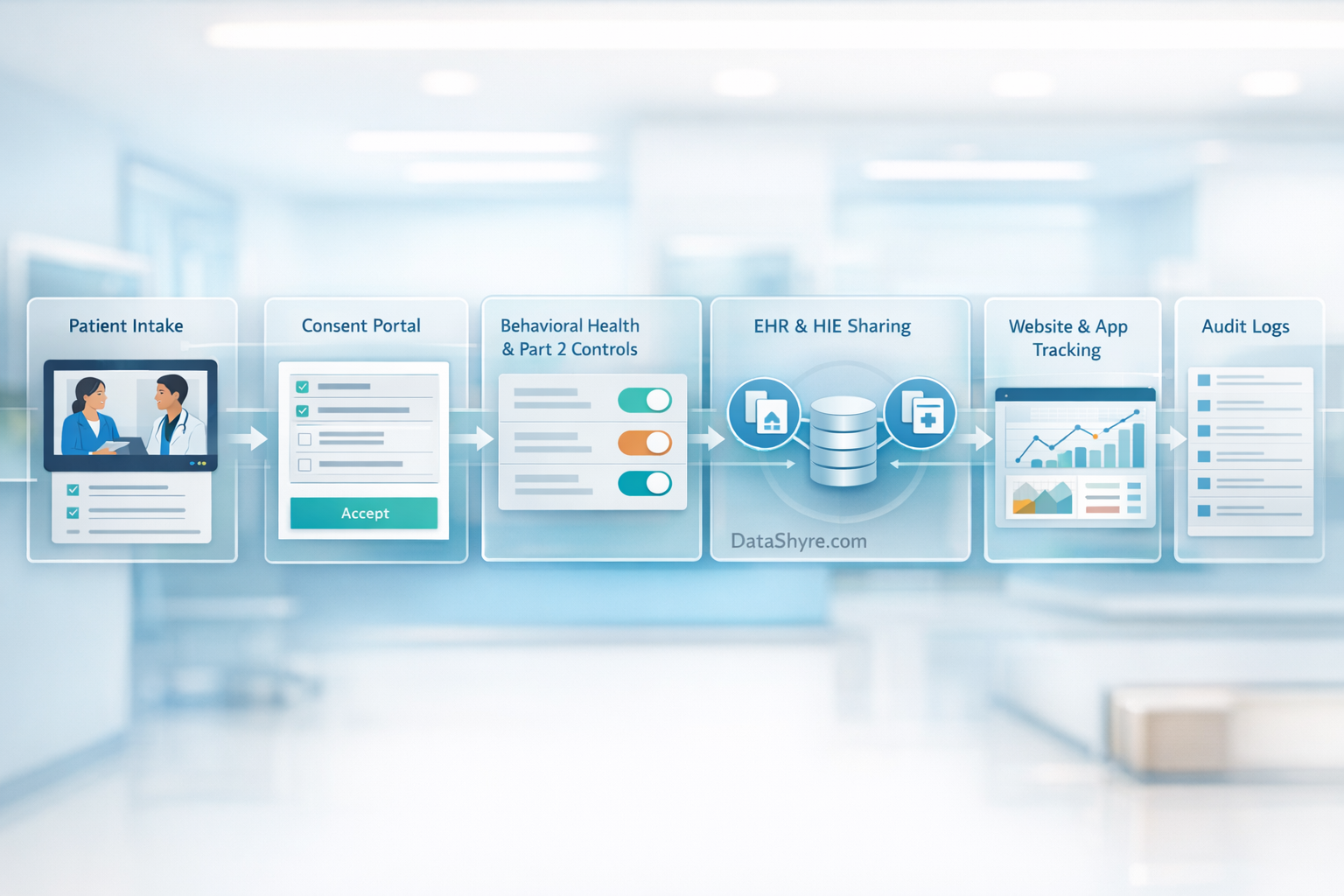
5. Cover websites, portals, apps, and marketing handoffs too
Healthcare consent is not only an EHR problem.
HHS guidance on online tracking technologies says regulated entities use tracking tools on websites and mobile apps, and that alone should widen the review. If your patient portal, appointment flow, symptom checker, billing flow, or marketing pages are connected to the broader patient journey, the platform should help the organization understand what data is being collected, what permissions apply, and where that choice needs to flow next.
There is also a second layer for health apps outside HIPAA. The FTC says the Health Breach Notification Rule requires certain entities not covered by HIPAA to notify consumers, the FTC, and sometimes the media after a breach of unsecured individually identifiable health information, and the FTC says the July 2024 amendments make clear the rule reaches health apps, connected devices, and similar products.
That means a better healthcare consent management platform review should ask whether the product can support both clinical privacy workflows and digital product workflows instead of assuming one control model fits both.
6. Keep audit-ready proof, not just the latest status
Sooner or later, someone asks for evidence.
In healthcare, that can come from compliance, legal, an internal investigation, a patient complaint, a partner review, or a regulator. Your team should be able to answer basic questions quickly:
- What policy, notice, or authorization language was shown?
- Which patient choice was recorded?
- Which user or system recorded or changed it?
- Which systems received the updated rule?
- What happened after the patient changed or revoked the decision?
The stronger healthcare consent management platform products keep version history, timestamps, source-channel context, and downstream event history. If all you can retrieve is the latest current-state flag, you do not really have proof.
7. Support governance for state-law and notice updates
HHS’s current model notice materials for providers still remind covered entities to describe state or other laws that impose greater limits on disclosures when those laws apply.
That is a useful buying lens because healthcare privacy rarely stays static. State laws evolve. Program rules change. Intake language gets updated. Digital teams introduce new tools. Behavioral-health or reproductive-health workflows may need extra review. A durable healthcare consent management platform should help the organization update language, route approvals, and retire old versions cleanly without corrupting the historical record.
If the product makes policy change hard, the compliance problem does not stay small for long.
A practical review sequence before you buy or renew
If I were reviewing a healthcare consent management platform this week, I would do this in order:
- Map the major consent and authorization workflows instead of starting with the software demo.
- Separate HIPAA TPO, HIPAA authorization, specialty-data, and state-law-driven scenarios.
- Test how the platform handles segmented or restricted data in one realistic use case.
- Confirm whether the rule can move from patient-facing capture into downstream EHR, HIE, or API behavior.
- Review portal, website, and app flows for tracking, marketing, and digital-data implications.
- Export the audit trail and confirm it is understandable to someone outside the implementation team.
- Run one change-management test to see how policy revisions are versioned and communicated.
That sequence usually tells you more than a feature checklist.
Common buying mistakes
The same mistakes show up repeatedly:
- buying a general e-signature or form product and calling it consent management;
- failing to distinguish HIPAA-permitted use from workflows that require authorization or stricter controls;
- ignoring behavioral-health, SUD, or other segmented-data requirements;
- treating portal and app tracking as somebody else’s problem;
- verifying the intake form but not the downstream exchange path;
- keeping only the latest consent status instead of a usable history.
Those mistakes create operational risk because healthcare consent is not only about collection. It is about how the decision travels.
Bottom line
A useful healthcare consent management platform in 2026 does four things well: it models the right legal and operational workflow, carries the patient’s choice into the real systems that matter, supports sensitive-data edge cases, and leaves behind evidence another team can actually use.
If a platform can do that, it is much more than a digital signature store. If it cannot, the implementation will start drifting the moment privacy rules, specialty data, or digital channels get more complicated.
Sources
- HHS: Summary of the HIPAA Privacy Rule
- HHS: Marketing
- HHS: Use of Online Tracking Technologies by HIPAA Covered Entities and Business Associates
- HHS: Fact Sheet 42 CFR Part 2 Final Rule
- HHS: Model Notice of Privacy Practices for HIPAA Covered Health Care Provider
- ONC: Patient Consent for Electronic Health Information Exchange
- ONC: Behavioral Health Consent Management
- ONC: Information Blocking
- FTC: Complying with FTC’s Health Breach Notification Rule
This post was updated on August 1, 2026 using current official healthcare privacy and health IT guidance available at publication time.