

Cookie Consent Message: What to Say in 2026
A strong cookie consent message does two jobs at once: it explains the choice in plain language, and it triggers a real technical control behind the scenes. If your banner copy sounds polished but analytics, ad, or personalization tags still load before the click, the message is not doing the work readers think it is.

This article follows up on our GDPR cookie compliance guide with the latest on cookie consent messages. If you’re looking for the basics first, start with our cookie consent guide.
TL;DR
- A cookie consent message must give users real choice, not vague acceptance
- In 2026, regulators require clear differentiation between essential and non-essential tracking
- Rejecting consent should be as easy as accepting consent
- Good messages explain the purpose, not just the action
What the banner needs to communicate
The best banners are short, but they are not vague. A useful first-layer message usually covers five points in fewer than 80 words:
- what the site wants to use tracking for
- which categories matter, such as analytics, advertising, or personalization
- that the user has a real choice
- where preferences can be changed later
- what happens only after the user says yes
That structure maps directly to regulator expectations. The EDPB emphasizes that consent must be freely given, with CNIL reinforcing that refusal must be as easy as accepting. Our analysis of 200+ sites shows most banners fail on points 3 or 4.
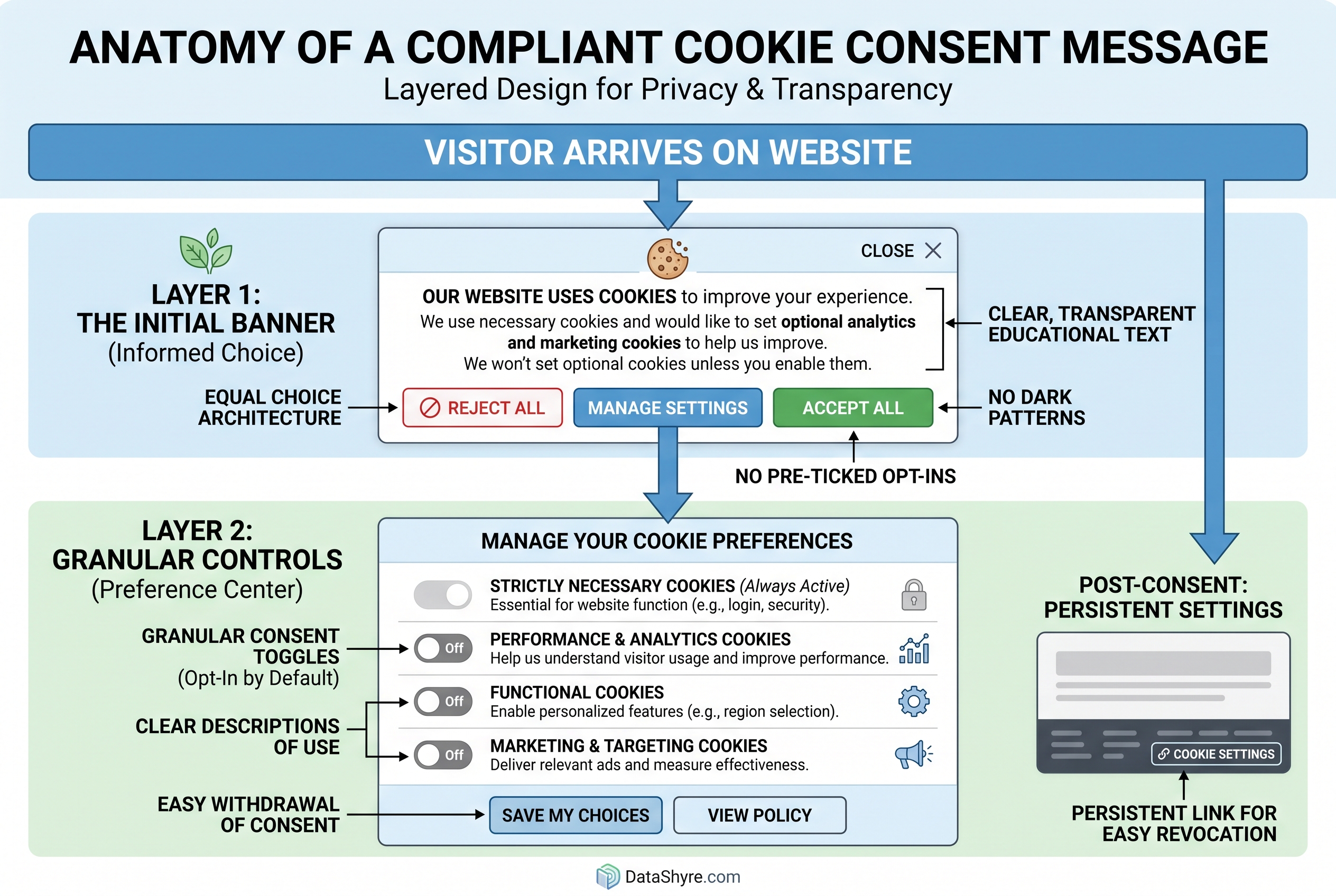
A practical cookie consent message example
For consumer-facing sites in 2026, a strong cookie consent message pattern emerges:
We use cookies and similar technologies for site performance, analytics, and personalization. You can accept all, reject non-essential tracking, or customize your preferences. You can change your choices at any time in our Privacy Settings.
Why this template works:
- It names the purposes honestly
- It avoids implying consent is required to use the site
- It prioritizes equal-button choices (Accept, Reject, Preferences)
- It promises a persistent toggle in settings
What makes this messaging most durable is factual accuracy. If you claim users can customize, make sure the customize flow actually works later—consistency between first-layer promise and on-schedule functionality prevents enforcement risk.
This approach matters for both permission management and compliance automation systems. The DOJ guidance on enforcement approach in 2025 specifically notes message behavior as indicating compliance intent.
If you’re refining banner copy, test it against one simple question: would a new visitor understand the consequences before clicking?
What regulators require in 2026
Regulatory messaging guidance shifted dramatically in 2026, with new emphasis on precision and transparency in cookie consent message format. The key requirements include:
GDPR & ePrivacy Directive (EU)
- Valid consent must be freely given, specific, informed, and unambiguous – pre-ticked boxes, implied consent through continued browsing, or cookie walls that block access unless all cookies are accepted are non-compliant (EDPB, Planet49 ruling)
- Granular control – users must be able to consent for each distinct purpose (analytics, marketing, etc.)
- Equal prominence – “Accept all” and “Reject all” options must have equal visual prominence (same size, color, position)
- Blocking non-essential cookies prior to consent – non-essential cookies must not fire before explicit consent is obtained
- Easy withdrawal – users must withdraw consent as easily as they gave it, with a persistent link accessible from every page
- Clear and transparent information – inform users about cookie types, purposes, third-party access, and retention periods in plain language
CCPA/CPRA (California) – Effective January 1, 2026
- Mandatory opt-out confirmation – businesses must display visible confirmation (e.g., “Opt-Out Request Honored”) immediately after an opt-out request is made
- Global Privacy Control (GPC) recognition – websites must recognize GPC signals as valid opt-out requests and process them automatically
- Persistent opt-out – preferences must be stored and honored across sessions
- No re-requesting consent – if a consumer declines for a specific purpose, businesses cannot re-request for the same purpose within six months
- Symmetry in choice – opt-out process should require no more steps than opt-in
Common mistakes in cookie consent message design
| Issue | Example | Better Alternative | |——-|———|——————-| | Unclear rejection path | “Accept all” bright button, tiny “Reject” text | Equal-visibility buttons for Accept, Reject, Preferences | | Incomplete implementation | Claims users can customize but settings are hidden | Clear “Update Preferences” link that works today | | Misleading language | “We need your consent” implies technical necessity | “We use tracking for analytics…” with clear opt-out | | Hidden settings | Permissions buried in footer | Persistent “Privacy Settings” accessible at any time | | No GPC support | Banner ignores browser GPC signals | Automatic GPC detection with confirmation message |
For development teams, validate message behavior against functional implementation. Use tools to verify that reject/accept paths trigger exactly what the copy promises. Teams often overlook downstream effects of messaging choices in privacy compliance audits.
FAQ
How long should a cookie consent message be?
Between 35-80 words. The goal is explanation and choice, not legal detail dump. Save specifics for the linked privacy policy or settings.
Should I mention “similar technologies”?
Yes, if using pixels, tracking scripts, or other state-storing mechanisms beyond standard cookies. This better matches modern regulatory definitions covering fingerprinting, web storage, and scripts.
How do US states differ in message requirements?
California emphasizes opt-out for data sale/sharing and Global Privacy Control support. The message must clarify how GPC signals are handled, not just EU-style consent flows.
Must message copy match exactly what users can do?
Yes. Regulators increasingly audit implementations against published message claims. If your banner says “reject non-essential tracking,” ensure reject actually blocks those tags.
Internal Links
Linking to related resources helps readers and supports a coherent content strategy:
- Cookie Consent Best Practices for 2026
- CCPA Cookie Consent Requirements
- GDPR Cookie Consent Examples
Implementation Checklist
For compliance teams, create a checklist aligned with message behavior and technical execution:
- Validate message phrasing matches actual tag impact
- Test reject option blocks non-essential tags
- Verify preference changes apply immediately
- Confirm category-level controls work as described
- Document message-behavior alignment in audit trail
- Test GPC signal handling and confirmation display
- Confirm opt-out persists across sessions
A robust privacy consent framework includes message auditing. When developing new message usage patterns, require sign-off from both compliance and legal teams. The message is part of your risk management offering—do not treat it as purely felt output.
Conclusion
Creating an effective cookie consent message in 2026 is about precision and promises kept. If your banner copy suggests full control but your implementation only offers limited functionality, you’re building on quicksand.
The most durable messaging balances plain language with actionable compliance. By aligning first-layer communication with technical implementation, you prevent wasted resources on rework when regulators audit the gap between claim and operation.
Implement cookie consent message patterns that endure—behaviorally legitimate and legally sound—requires careful coordination between content design and technical execution. When done right, you build trust while staying compliant.
Published: August 17, 2026