

CCPA Cookie Consent Requirements in 2026: 7 Website Checks That Still Matter
If you are checking ccpa cookie consent requirements on August 12, 2026, the most important reset is this: California usually does not start with a GDPR-style rule that every adult visitor must click Accept before any non-essential cookie can exist.
For most covered California scenarios, the live compliance job is narrower and more operational. It is about notice, a working right to opt out of sale or sharing, honoring Global Privacy Control, handling minors correctly, and making sure the tracking stack actually changes when a consumer says no.
If you want the adjacent guides first, start with our articles on CCPA cookie consent, California consumer privacy, and cookie consent requirements. This piece is narrower. It is the checklist I would use before telling a team their California cookie setup is covered on a live site.

The short answer on CCPA cookie consent requirements
The quickest useful summary of ccpa cookie consent requirements in 2026 is:
- adult California traffic usually triggers an opt-out and notice review, not a blanket opt-in rule;
- if cookies, pixels, or similar trackers support sale or sharing, the site needs a real way to stop that flow;
- covered businesses must honor qualifying opt-out preference signals such as Global Privacy Control;
- minors under 16 move the analysis closer to actual opt-in for sale or sharing;
- and recent California enforcement keeps focusing on friction, broken choice paths, bad privacy notices, and weak vendor controls.
That is why a California cookie banner can look similar to an EU banner while doing a different legal job under the hood.
1. Start with opt-out and notice, not a universal adult opt-in rule
This is the first thing most teams still get wrong.
The California Consumer Privacy Act gives consumers the right to direct a business that sells or shares personal information not to sell or share it. The current statute also says a business that has received that direction cannot keep selling or sharing unless the consumer later consents again.
That matters because this question usually comes up around ad-tech, remarketing, audience-building, and analytics-adjacent tracking. In California, the first website question is often not, Did we wait for an accept click? It is, Are we clearly telling people what is collected and giving them a real path to stop sale or sharing where that right applies?
The CPPA’s current FAQ also says consumers have the right to be notified of the types of personal information a business is collecting and what it may do with that information. So even before you reach banner mechanics, the notice layer still matters.
2. Put the privacy choice where users can actually use it
California’s current consumer guidance is very practical on this point.
The CPPA FAQ says businesses must honor opt-out preference signals and, in most instances, must also provide a clear and conspicuous link labeled “Do Not Sell or Share My Personal Information,” “Your Privacy Choices,” or “Your California Privacy Choices” in the header or footer. The same FAQ says businesses subject to these rights must explain how to exercise them in the privacy policy.
That means the California website requirement is not satisfied by hiding the choice inside an account screen, a support form, or a hard-to-find legal page.
On a live site, I would check:
- whether the link is easy to find from the pages where tracking happens;
- whether the privacy policy matches the actual tracker stack;
- whether the opt-out path works without requiring a scavenger hunt;
- and whether mobile visitors get the same usable path as desktop visitors.
If the link exists but the practical route is confusing, the requirement is not really being met.
3. Treat GPC as a live technical requirement
The California Department of Justice still describes Global Privacy Control as a “stop selling or sharing my data switch.”
That short phrase is one of the most important clues in the whole California workflow. It means the job is not just about what your banner says. It is also about what your systems do when a browser-level signal arrives.
The DOJ says covered businesses must honor GPC as a valid request to stop the sale or sharing of personal information. The CPPA FAQ says the same thing in consumer-facing language and adds that opt-out preference signals are a simple way to exercise that right.
Recent California enforcement keeps reinforcing that point. In September 2025, the CPPA, California DOJ, and regulators in Colorado and Connecticut announced a joint investigative sweep focused on businesses that appeared not to be processing GPC-based opt-out requests as required by law.
So if you are reviewing a California cookie implementation, do not stop after clicking your own site banner. Test a clean browser session with GPC enabled and see whether the relevant advertising or sharing behavior actually changes.
4. Friction and asymmetry are still enforcement magnets
This is where many privacy interfaces fail even when they look polished.
In March 2025, the CPPA said Honda used a privacy management tool that failed to offer Californians their choices in a symmetrical or equal way, and it also alleged Honda required excessive information for certain privacy requests. In March 2026, CalPrivacy announced a Ford settlement after Ford required an email-verification step before consumers could opt out. The agency’s enforcement lead put it plainly:
“Opting out is supposed to be easy.”
>
CalPrivacy
That line should be read as a design requirement as much as an enforcement quote.
For a live California cookie flow, it means you should check whether:
- the privacy-protective path is as visible as the permissive one;
- users are not pushed through extra verification just to stop sale or sharing;
- the site does not ask for more information than it actually needs to process the request;
- and the preference flow does not quietly steer people back toward acceptance.
California has become much clearer that friction is not a small UX bug. It can be the violation.
5. Separate minors and sensitive-personal-information issues from the adult default
This is the point where actual opt-in comes back into the picture.
The current CCPA statute says a business with actual knowledge that a consumer is under 16 cannot sell or share that consumer’s personal information unless there is affirmative authorization. For ages 13 to under 16, that authorization can come from the consumer. For a child under 13, it must come from a parent or guardian.
The CPPA FAQ also says businesses that use or disclose sensitive personal information beyond the statutory purposes must provide a clear and conspicuous link allowing the consumer to limit that use or disclosure.
So the right way to think about this topic is not as one single banner flow for every California user. A team may need one path for ordinary adult opt-out, another for under-16 sale or sharing, and another for sensitive-personal-information limitations if those are in scope.
6. Follow the cookie decision into vendors and contracts
This is one of the most useful enforcement lessons from the last eighteen months.
The Honda matter said the company shared personal information with ad-tech companies without producing contracts containing the necessary privacy terms. The September 30, 2025 Tractor Supply decision likewise said the retailer failed to provide an effective opt-out mechanism, including through Global Privacy Control, and disclosed personal information to other companies without contracts containing required privacy protections.
That is a reminder that the requirement does not end at the front-end widget.
If trackers route data to outside platforms, I would check:
- which vendors receive the data;
- whether the data flow is still active after opt-out or GPC;
- whether the privacy notice accurately names the categories and purposes involved;
- and whether the underlying contracts match the role each vendor is actually playing.
A banner can look clean while the downstream ad-tech path stays messy.
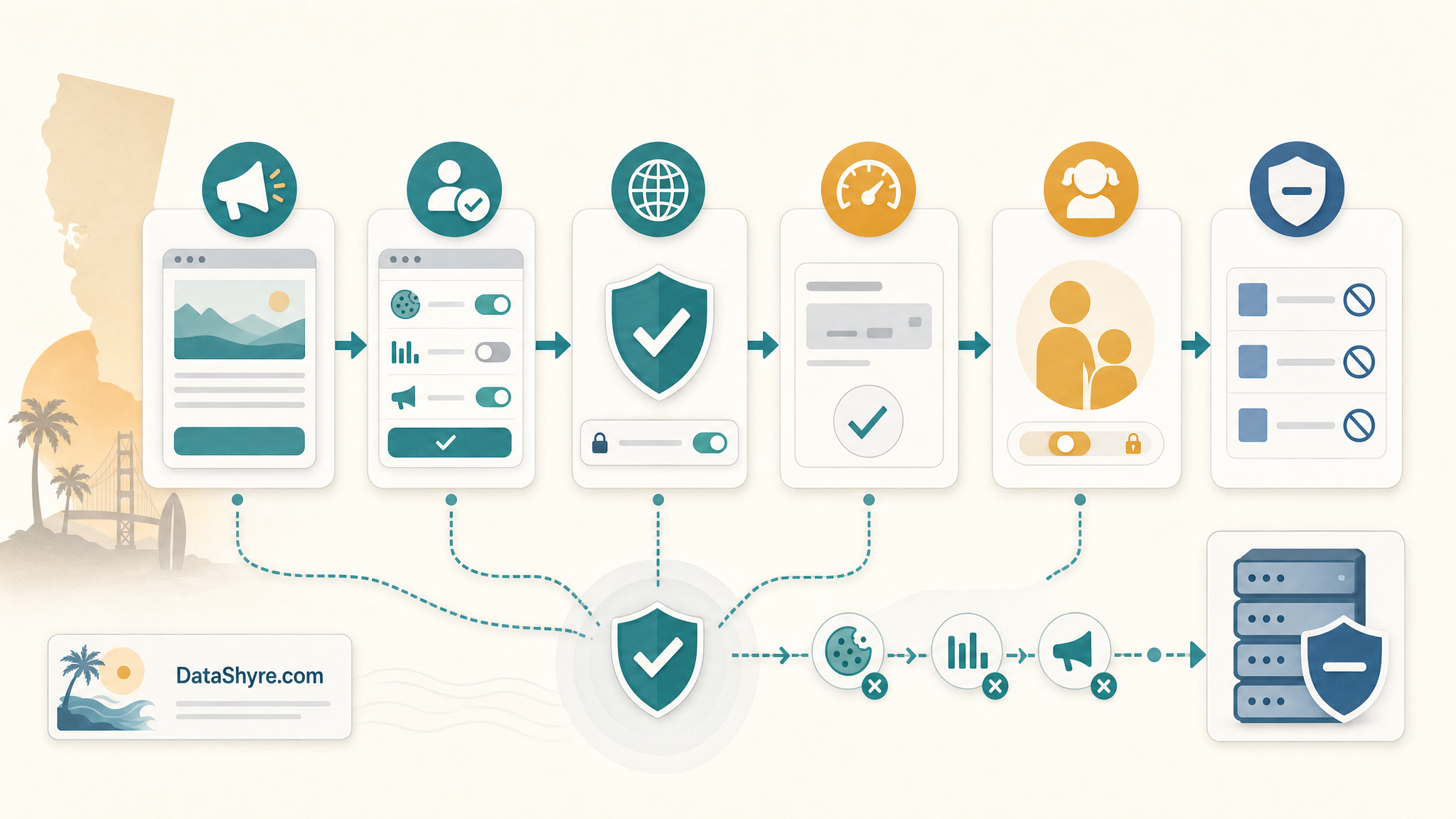
7. Re-test the live site against the 2026 rule set
California’s current ruleset is not frozen in older 2023 assumptions.
The CPPA’s current law-and-regulations page shows both the California Consumer Privacy Act and the CCPA Regulations as effective on January 1, 2026. The CPPA FAQ also says opt-out or limit requests must be complied with as soon as feasibly possible, up to a maximum of 15 business days from receipt.
That makes this a release-management issue, not a one-time legal memo.
If I were auditing a site this week, I would use this order:
- map the cookies, pixels, SDKs, and tags tied to advertising or sharing;
- confirm the notice and policy describe those practices clearly;
- test the visible opt-out path on desktop and mobile;
- test GPC in a clean browser session;
- test any minors or sensitive-information branches if they apply;
- verify the decision reaches vendors and suppression logic downstream;
- confirm the whole flow still works inside the current 2026 California rule set.
That review usually surfaces the real problems faster than rewriting banner copy in isolation.
Bottom line
The practical meaning of ccpa cookie consent requirements in 2026 is not show a cookie banner and hope for the best.
It is: give clear notice, expose a real privacy-choice path, honor GPC, keep opt-out easy, branch correctly for minors and sensitive personal information where needed, and make sure the tracking stack and vendor relationships actually follow the consumer’s decision.
If your team can prove those things on a live site, you are much closer to California’s current standard. If not, the banner may be visible, but the requirement still is not truly met.
Sources
- California Privacy Protection Agency: Frequently Asked Questions
- California Department of Justice: California Consumer Privacy Act (CCPA)
- California Department of Justice: Global Privacy Control (GPC)
- California Privacy Protection Agency: Laws & Regulations
- California Legislative Information: Civil Code Section 1798.120
- CalPrivacy: Ford to Change Practices, Pay Fine for Adding Unnecessary Friction to Opt-Out Process
- California Privacy Protection Agency: Honda Settles With CPPA Over Privacy Violations
- California Privacy Protection Agency: California Privacy Protection Agency Announces Joint Investigative Privacy Sweep
- California Privacy Protection Agency: Nation’s Largest Rural Lifestyle Retailer to Pay $1.35M Over CCPA Violations
This post was updated on August 12, 2026 using current official California law, regulator, and government materials available at publication time.