

Cookie Consent Text in 2026: 7 Wording Rules That Still Hold Up
If you are rewriting cookie consent text on August 9, 2026, the real job is not making a banner sound more polished. It is making the first layer specific enough to explain the choice, balanced enough to support refusal, and accurate enough to match what the site really does after the click.
That is still the right editorial frame in 2026. The European Commission’s current consent guidance still says valid consent must be freely given, specific, informed, and unambiguous. The UK’s ICO finalized its storage-and-access-technologies guidance on April 29, 2026 and made clear that the same scrutiny reaches cookies, tracking pixels, device fingerprinting, and similar tools. In California, the Department of Justice still says a recognized Global Privacy Control signal must be honored by covered businesses as a valid request to stop the sale or sharing of personal information, while the CPPA’s current law-and-regulations page shows the operative CCPA statute and regulations as effective on January 1, 2026.
If you want the closest companion reads first, start with our guides to cookie consent message, cookie consent message examples, and cookie consent requirements. This article is narrower. It focuses on the wording and microcopy choices that make cookie consent text more credible on a live site.
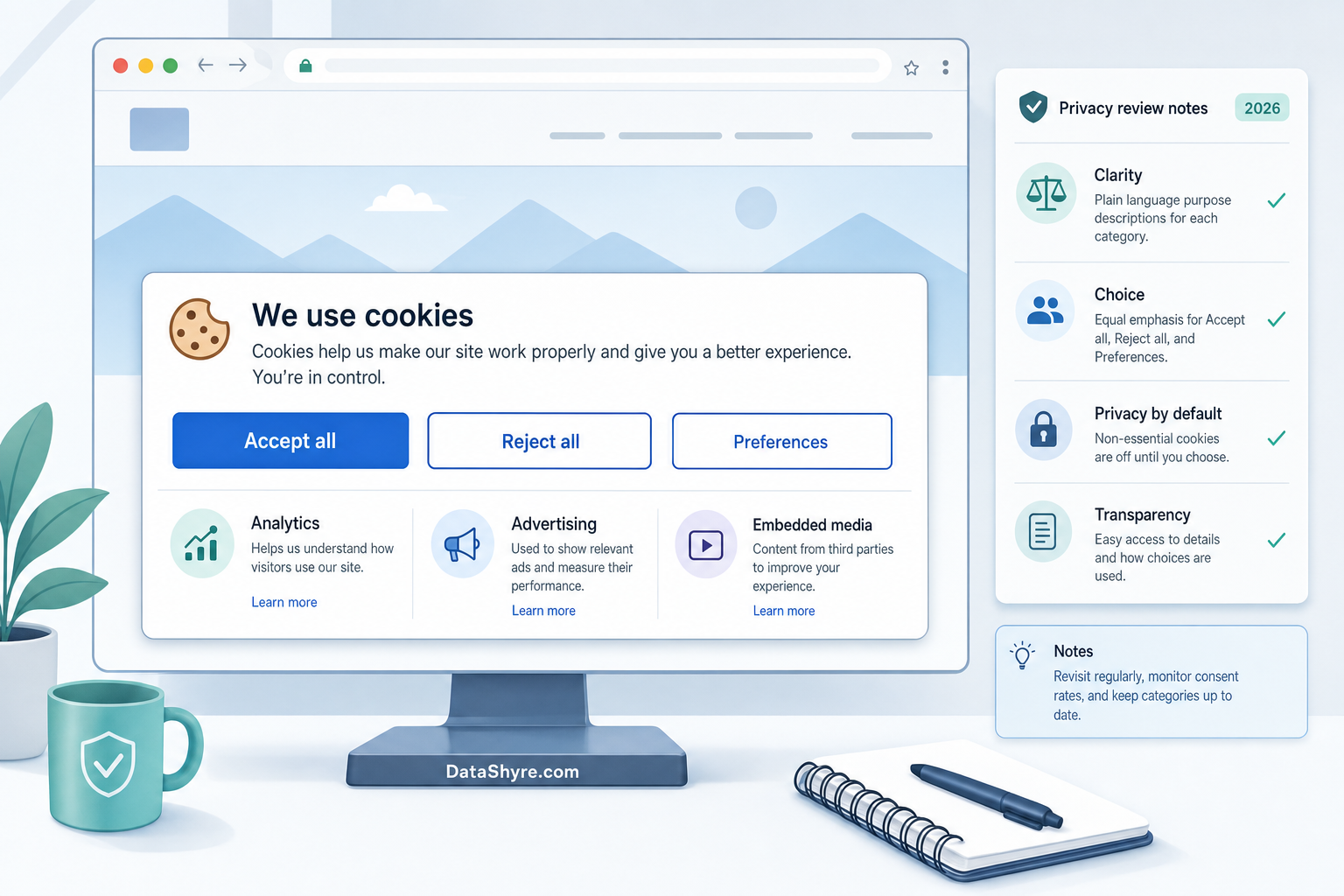
What good cookie consent text has to do now
The phrase cookie consent text sounds small, but the first layer is doing several jobs at once.
It has to explain the purpose of optional technologies in plain language. It has to show a real choice instead of steering people by friction. It has to avoid implying that passive browsing counts as consent. And it has to fit the regional legal model the user is actually seeing, because an EU or UK prior-consent flow is not the same thing as a California opt-out flow.
The ICO’s current practical guidance is especially useful here. It says consent requests should be specific to the purpose, users should have granular options where needed, silence or inactivity does not qualify as consent, and any consent mechanism should let users withdraw with the same ease they gave consent. The CNIL’s 2024 dark-patterns notice says the same issue even more bluntly:
“rejecting cookies should be just as easy as accepting them.”
>
CNIL
That line is not just a design note. It is a copy note too. If the words, labels, and button hierarchy make refusal sound secondary, the banner is already drifting away from valid choice.
7 wording rules for stronger cookie consent text
1. Name the real purposes, not a vague benefit
Avoid copy such as we use cookies to improve your experience when the real purposes are analytics, advertising, personalization, embedded media, or measurement. Strong cookie consent text tells people what optional technologies are for without forcing them to decode marketing language.
If you use more than classic cookies, say cookies and similar technologies rather than pretending everything fits one narrow label. The ICO’s 2026 guidance is broader than older cookie-banner articles, and your wording should not hide that reality.
2. Keep the first sentence informational, not persuasive
The first line of banner copy should explain the request, not sell the brand.
That usually means shorter copy is better because it is trying to do less. A calm sentence about analytics, advertising, or embedded media is easier to defend than a cheerful paragraph about personalization, seamless experiences, and helping you serve users better.
3. Make Reject all sound like a real first-layer option
Many teams treat wording as separate from layout, but users do not experience it that way.
If Accept all is a prominent button, Reject all should be a prominent button too. The ICO’s current consent-mechanism examples show equally prominent accept and reject choices as good practice, and show banners without a Reject all first-layer option as bad practice. Your cookie consent text should reinforce that symmetry instead of softening the refusal path into a less direct phrase.
4. Do not rely on implied-consent language
Phrases such as by continuing to browse, you agree still create risk because they blur the affirmative-action standard.
The ICO’s current guidance says that if users do not interact and simply continue through the site, you must not treat that silence or inactivity as consent. So good cookie consent text should be built around explicit actions such as Accept all, Reject all, or Choose preferences, not around browsing by implication.
5. Tell people what happens if they say no
This is one of the clearest ways to reduce pressure in the banner.
Often the answer can be simple: the site still works, but optional analytics, advertising, or personalization stays off unless the user changes the setting later. That explanation makes the choice easier to understand and helps prevent the banner from feeling like a forced gateway.
The European Commission’s current withdrawal guidance still puts the usability test plainly:
“It should be as easy to withdraw as to give consent.”
>
European Commission
If your text promises a later settings path or choice reversal, the live site should really provide it.
6. Keep EU or UK consent copy distinct from California opt-out copy
One global banner often has to serve more than one legal model, but one generic sentence rarely does the whole job.
For EU or UK traffic, the operational question is often whether non-essential technologies stay off until valid consent exists. In California, the issue often centers more on notice, opt-out rights, and recognized preference signals when sale or sharing is in scope. The California DOJ’s GPC page describes the signal as a:
“stop selling or sharing my data switch”
>
California DOJ
That means cookie consent text should not quietly imply that a California visitor is simply making the same kind of choice as an EU visitor. The surface may look similar, but the action behind it can be different.
7. Keep the banner copy synchronized with the second layer and the live stack
Good first-layer text does not help much if the second layer falls back into vendor jargon or if new tracking gets added without the wording being reviewed.
The ICO’s current guidance says fresh consent is needed when storage or access technologies are introduced for a different purpose than the one originally stated. That makes cookie consent text a maintenance issue, not a one-time launch task. When purposes, vendors, categories, or regional logic change, the wording needs a re-check too.
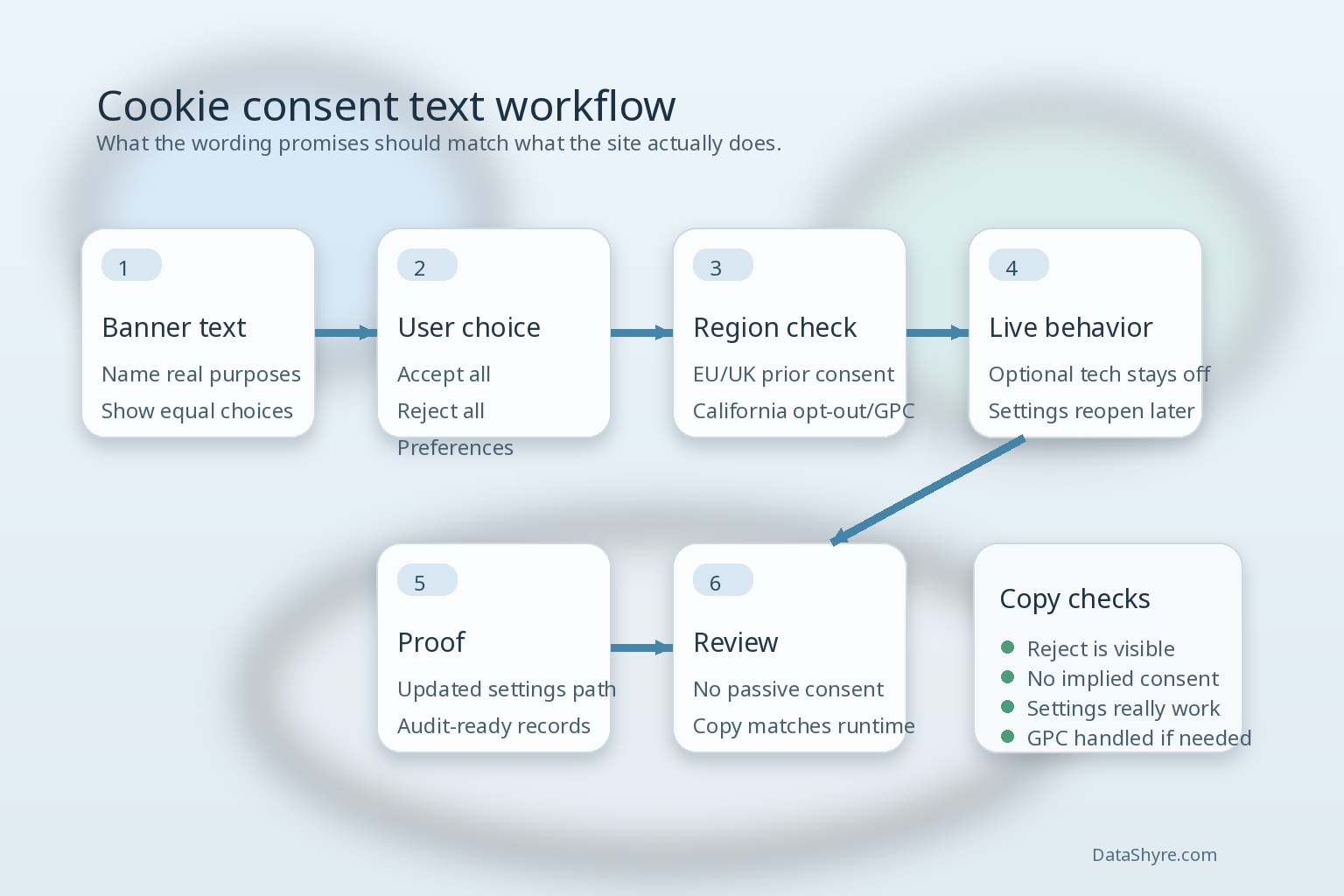
Three reusable cookie consent text examples
These are not universal legal templates, but they are practical starting points when you need plain-language copy that lines up with current official guidance.
Example 1. EU or UK first-layer banner text
We use cookies and similar technologies for analytics, advertising, and embedded media. You can accept all, reject non-essential use, or choose your preferences. You can update your choice any time in Privacy Settings.
Why it works: it names real purposes, shows refusal clearly, and promises a later control only if that control exists.
Example 2. Embedded-media or feature-led text
This video uses cookies or similar technologies from our media provider. Select Play and Accept to enable it, or keep it off and continue browsing without this feature.
Why it works: it ties the request to the feature the user actually wants, which is often a clearer pattern than asking for every possible permission up front.
Example 3. California-facing privacy-choice text
We use cookies and similar technologies for analytics, advertising, and personalization. California visitors can use this control or a recognized browser signal to opt out of sale or sharing where applicable.
Why it works: it reflects the California rights model more honestly than pretending every state-facing visitor is seeing a classic consent request.
A fast review before you publish
Before approving new cookie consent text, run this short check on the live site:
- Read only the first layer and ask whether the purposes are understandable without translation.
- Confirm
Reject allis as visible and direct asAccept allwhere prior consent is required. - Test whether no optional technologies fire before an explicit choice in opt-in regions.
- Reopen the settings path later and verify that withdrawal actually changes behavior.
- For California-facing traffic, verify how the site handles Global Privacy Control and any sale-or-sharing opt-out flow.
That sequence catches more real banner problems than a long copy debate in a document ever will.
Bottom line
The best cookie consent text in 2026 is short, specific, and honest about what the site wants to do. It names real purposes, avoids implied consent, shows a visible refusal path, and stays aligned with the actual controls behind the banner.
If the text is clear but the live behavior is weak, the banner is still weak. If the text and the runtime behavior line up, you are much closer to a consent experience that reads credibly and holds up after launch.
Sources
- European Commission: When is consent valid?
- European Commission: What if somebody withdraws their consent?
- UK ICO: Final storage and access technologies guidance published
- UK ICO: Guidance on the use of storage and access technologies
- UK ICO: How do we manage consent in practice?
- CNIL: Dark Patterns in Cookie Banners: CNIL issues formal notice to website publishers
- California Department of Justice: Global Privacy Control (GPC)
- California Department of Justice: Privacy Enforcement Actions
- California Privacy Protection Agency: Law & Regulations
This post was updated on August 9, 2026 using current official regulator and government materials available at publication time.