

Consent Management Platform Best Practices in 2026: 7 Rules That Still Catch Real Risk
If you are searching for consent management platform best practices on August 20, 2026, the useful starting point is not banner styling. It is whether your CMP can collect a fair choice, turn that choice into live technical behavior, and leave behind records another stakeholder can still explain later.
That baseline is still visible in current official materials. The European Commission says valid consent must be “freely given, specific, informed and unambiguous,” and that it must be “as easy to withdraw as to give consent.” The UK ICO finalized its storage-and-access technologies guidance on April 29, 2026 and made clear the review is broader than old cookie-only thinking, reaching tracking pixels, scripts, tags, fingerprinting, and similar techniques. In California, the Department of Justice still says Global Privacy Control must be honored by covered businesses as a valid request to stop the sale or sharing of personal information. And if you serve personalized ads in Google publisher products, Google’s current help still says a certified CMP integrated with the IAB Transparency and Consent Framework is required for users in the EEA, the UK, and Switzerland.
If you want the adjacent category context first, start with our guides to consent management platform, Google Tag Manager cookie consent, and California consumer privacy. This article is narrower. It is the live implementation checklist I would use before trusting a CMP rollout this week.

Why this topic is really about control, not cosmetics
A consent management platform is only partly a front-end experience. The harder job starts after the visitor acts.
Your CMP has to control what really happens across:
- analytics and measurement tags;
- advertising and remarketing pixels;
- embedded tools such as chat, video, maps, or schedulers;
- region-specific logic for EU, UK, and California traffic;
- later withdrawal, re-prompting, and audit trails.
That is why the strongest consent management platform best practices now look more like release engineering and privacy operations than like copywriting.
The EDPB’s July 14, 2026 decision requiring the Belgian DPA to handle the merits of a cookie-banner complaint involving broadcaster VRT is a useful reminder here. Cookie-banner scrutiny is still active, and a polished interface does not end the analysis.
7 rules that still hold up on live sites
1. Inventory every storage-and-access technology before you tune the banner
The ICO’s updated guidance is a helpful reset because it widens the scope. The review is not limited to traditional cookies. It can include tracking pixels, scripts or tags, fingerprinting techniques, and other technologies that store information or access information on a user’s device.
That means the first implementation question is not, What should the banner say? It is, What must the CMP actually control on the pages that matter?
Before launch, your inventory should cover:
- homepage and campaign pages;
- product, checkout, or lead-gen templates;
- embedded tools and media players;
- tag-manager driven scripts and hardcoded scripts;
- downstream tools that react to consent state.
If you cannot name those technologies, you are not yet reviewing a real CMP implementation. You are only reviewing the visible layer.
2. Make refusal as usable as acceptance
This is still one of the fastest reality checks.
CNIL’s wording remains the clearest short design test: “Rejecting cookies should be just as easy as accepting them.” The ICO’s April 2026 launch note framed the wider goal similarly when Executive Director William Malcolm said people need “meaningful control over how their data is used.”
In practice, that means:
Reject allshould not disappear into a weaker second click where your implementation and legal path require it.- Mobile should not make refusal harder than desktop.
- Reopening settings later should be easy enough that withdrawal is not theoretical.
If refusal is slower, dimmer, or more confusing than acceptance, your CMP is collecting a less reliable choice than the interface implies.
3. Test prior blocking on real templates, not just in the admin panel
A polished configuration dashboard can hide weak runtime behavior.
Where prior consent is the rule for non-essential technologies, the practical test is simple: what starts before the user chooses anything on the actual templates people visit? The homepage may behave correctly while optional tools still start on video-heavy blog posts, marketing landing pages, or embedded booking flows.
This is one of the core consent management platform best practices because many failures are timing or placement failures, not policy failures. The banner loads. The settings look right. But an early tag, plugin, or embed still starts optional behavior first.
4. Run separate legal-operations branches for EU or UK traffic and California traffic
One flow rarely does every job well.
For EU and UK users, the key operational question is often whether optional storage-and-access technologies stay off until valid consent exists. In California, the practical review often turns on opt-out rights, sale-or-sharing analysis, and browser-level preference signals such as GPC.
The mistake is forcing those issues into one shallow global experience and assuming the rest of the stack will sort itself out later.
For a live review, test separately:
- EU or UK first visit with no interaction;
- EU or UK rejection and later withdrawal;
- California arrival with GPC enabled where sale or sharing could apply;
- California downstream suppression behavior after that signal is received.
That branch logic is not extra polish. It is core implementation discipline.
5. Push consent defaults and updates into Google and downstream systems at the right moment
Many CMP projects succeed visually and fail in signal timing.
Google’s current consent mode guidance still says the default consent state should be set before measurement commands run, and it says you should make sure consent updates are tracked on the page where they occur before any page transition.
That matters because a CMP can store a preference correctly while analytics or advertising tools still behave incorrectly if:
- defaults are set too late;
- updates land after a navigation event;
- GTM or another loader fires ahead of the consent layer;
- SPA behavior changes state before the update reaches the tool that needs it.
If you depend on Google tooling or consent-aware measurement, timing review is not a detail. It is a separate checkpoint.
6. Keep evidence with version context and a usable withdrawal path
Good records are not just timestamps in a log table.
Another stakeholder should be able to answer six months later:
- What banner or settings version did the user see?
- What categories, purposes, or vendors were presented?
- What did the user choose and when?
- Could the user later reopen settings and change the choice?
- Did the live site behavior align with the recorded state?
The European Commission’s withdrawal guidance matters here because “as easy to withdraw as to give consent” is not just interface copy. It is an operational requirement. If the user can consent in one obvious step but withdrawal later requires hunting through a footer, account area, or help article, the implementation is weaker than it looks.
7. Re-test after releases, and treat publisher requirements as a separate branch
Launch is not the finish line. Drift is.
New plugins, new vendors, changed script order, revised templates, or another marketing embed can quietly change what your CMP actually controls. That is why the best teams re-test after:
- tag-manager publishes;
- major CMS or plugin updates;
- new embeds or marketing tools;
- CMP configuration changes;
- site-performance rewrites that alter load order.
And if publisher monetization is in scope, treat that as its own branch. Google’s current help distinguishes the certified-CMP requirement for serving personalized ads in the EEA, UK, and Switzerland from the broader legal question of whether your implementation is actually compliant. Those are related checks, but they are not the same check.
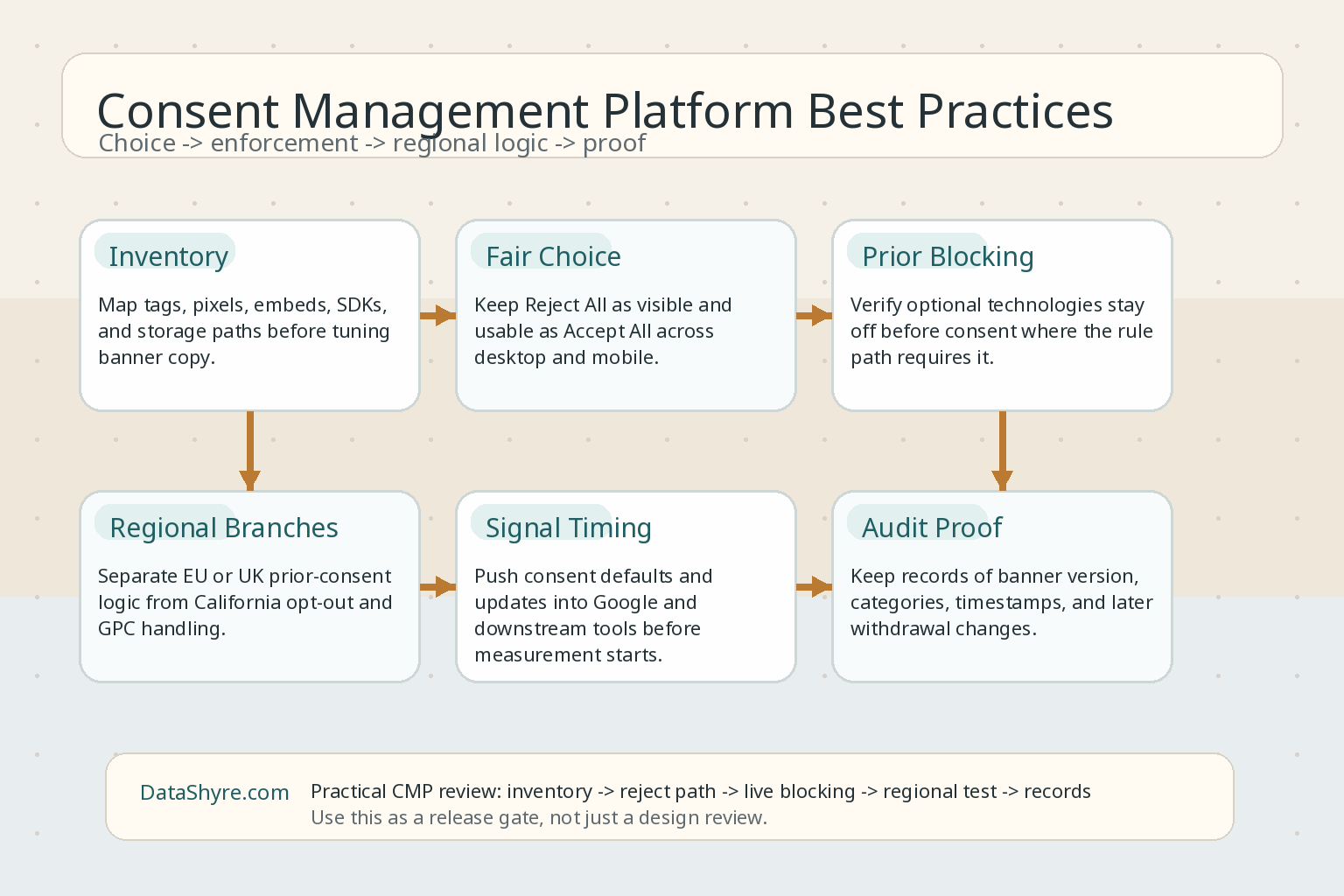
A short implementation sequence I would run this week
If I had ten minutes to pressure-test a live CMP, I would do this in order:
- Map the scripts, pixels, embeds, and tools that can start optional behavior.
- Test the first-layer refusal path on desktop and mobile.
- Inspect what fires before any choice on the templates that matter most.
- Verify consent defaults and updates reach Google and other downstream systems in time.
- Run a California scenario with GPC enabled if sale or sharing could apply.
- Reopen settings later and confirm withdrawal changes live behavior.
- Save evidence another stakeholder could understand without replaying the whole event.
That short sequence usually reveals more risk than another vendor demo or another polished screenshot review.
Bottom line
The most useful consent management platform best practices in 2026 are not about making the banner look modern. They are about making the choice fair, the technical enforcement real, the regional logic honest, and the evidence usable later.
If your CMP can give visitors meaningful control, keep optional technologies off when it should, handle California signals deliberately, push consent changes into downstream tools at the right moment, and leave behind proof your team can actually use, you are in much stronger shape. If it cannot do those things, the interface may look compliant while the control layer behind it is still fragile.
Sources
- European Commission: When is consent valid?
- European Commission: What if somebody withdraws their consent?
- UK ICO: Final storage and access technologies guidance published
- UK ICO: Guidance on the use of storage and access technologies
- CNIL: Dark Patterns in Cookie Banners: CNIL issues formal notice to website publishers
- EDPB: Belgian DPA must handle the merits of a NOYB cookie-banner complaint
- California Department of Justice: Global Privacy Control
- Google for Developers: Set up consent mode on websites
- Google Ad Manager Help: Google consent management requirements for serving ads in the EEA, UK, and Switzerland
This post was updated on August 20, 2026 using current official regulator, government, and platform materials available at publication time.