Privacy Consent Management in 2026: 7 Controls Your Stack Has to Get Right
DataShyre StaffAug 3, 2026
7 min read
Privacy Consent Management in 2026: 7 Controls Your Stack Has to Get Right
If you are evaluating privacy consent management on August 3, 2026, the useful question is not whether the preference center looks modern. It is whether your stack can tell the difference between lawful-basis decisions, consent events, California opt-outs, browser signals, and later withdrawals, then make downstream systems obey those decisions.
That is the real operating baseline now. The European Commission’s current guidance says personal data can be processed only on a recognized legal ground, and consent is valid only if it is freely given, informed, specific, and given through a clear affirmative act. The GDPR itself also says it must be as easy to withdraw consent as to give it. California pulls the program in a different direction: the Department of Justice’s current CCPA page lists rights to know, delete, correct, opt out of sale or sharing, and limit the use and disclosure of sensitive personal information, while its Global Privacy Control page says a valid signal must be honored as a request to stop sale or sharing. The CPPA’s regulations page also shows both the CCPA and the CCPA Regulations as effective on January 1, 2026, while the agency’s 2026 preliminary work has focused on notices and disclosures, reducing friction in the exercise of privacy rights, and opt-out preference signals.
If you want the adjacent context first, start with our guides to user consent management, GDPR compliant privacy notice, and CCPA compliance platform. This article is narrower. It is about the control layer that connects policy, UX, systems, and proof.
Why privacy consent management is no longer a banner project
The legal model is wider than a banner and the technical model is wider than cookies.
Under the GDPR, consent is only one possible legal ground. The European Commission’s guidance lists consent, contract, legal obligation, public-interest tasks, vital interests, and legitimate interests as possible grounds for processing personal data. That means a strong implementation cannot reduce every decision to a generic yes-or-no click. Some purposes need valid consent. Some need a different lawful basis. Some need a rights-response workflow instead of a consent flow at all.
The tracking layer has widened too. On April 29, 2026, the UK ICO finalized its storage-and-access technologies guidance and made clear the conversation is not limited to classic browser cookies. The same review can reach pixels, web storage, scripts, and related technologies that store or access information on a user’s device. So the control problem is bigger than a banner component and bigger than one vendor setting.
What the system has to model
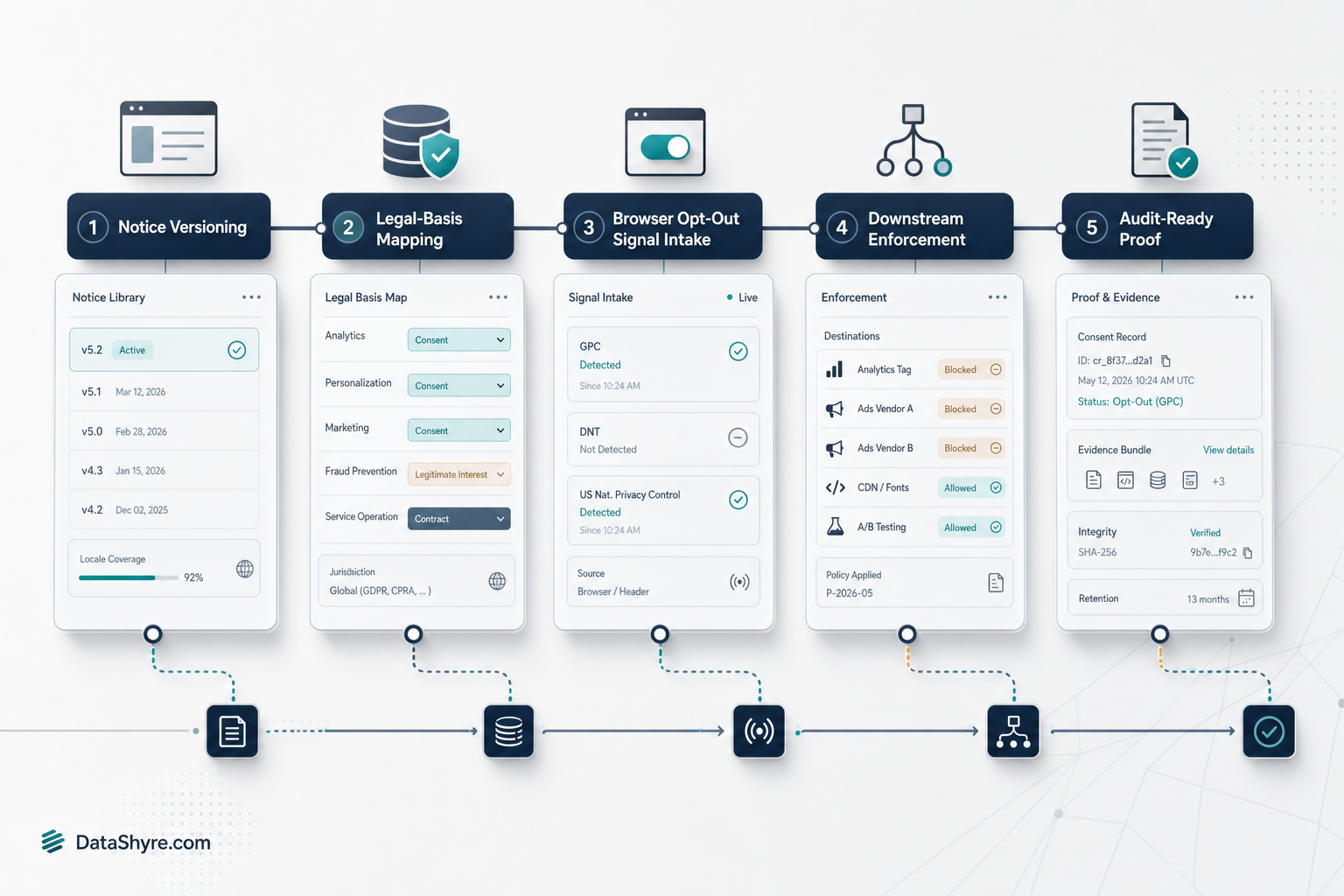
At minimum, the system should be able to preserve and connect all of the following:
the purpose for which data is being processed;
the legal basis or statutory right that applies;
the exact notice, banner, or settings-panel version the person saw;
whether the user action was consent, refusal, withdrawal, opt-out, correction, deletion, or a browser-level signal;
which downstream systems were allowed, blocked, or updated afterward;
what proof remains if legal, support, or engineering asks what happened later.
If one of those layers is missing, the implementation usually looks cleaner than it really is.
7 controls your stack has to get right
1. Separate lawful basis from privacy-choice events
This is the most important architectural split.
GDPR asks whether you have a lawful ground to process personal data in the first place. CCPA often asks what right the consumer is exercising right now. Those are not the same question. If your system stores consent, objection, opt-out, deletion, and limit requests as one generic preference type, the model will get harder to trust with every new market, workflow, or enforcement question.
2. Version the notice and purpose map, not just the click
A record that says a user clicked Accept or Reject is thin evidence.
The better approach is to attach every material action to the notice version, purpose labels, category list, region logic, and timestamp that were active when the user acted. That is what turns front-end behavior into proof. It also helps when legal changes copy or engineering changes the tag mix without telling everyone else.
3. Enforce prior blocking or prior suppression where the rule requires it
Where consent is required before non-essential tracking, optional analytics, advertising, and personalization tools should stay off until the user acts. The ICO’s current guidance is one reason teams have to test this as live behavior, not just as design. The same compliance review can reach more than cookies.
California changes the behavior, but not the need for real runtime enforcement. If the user opts out of sale or sharing, ad-tech and downstream data-sharing workflows still have to change. A polished interface with no technical effect is not serious consent infrastructure.
4. Treat GPC and manual opt-outs as first-class inputs
California’s DOJ is explicit here.
“must be honored”
>
California DOJ
That line applies to a valid Global Privacy Control signal for covered businesses. In practice, your footer path, account setting, and browser-level signal should all feed the same decisioning logic rather than competing in different systems. If one path suppresses sharing and another only changes the UI, the program will drift.
5. Make withdrawal genuinely easy
This is the GDPR test many stacks still fail after launch.
“as easy to withdraw as to give consent.”
>
GDPR Article 7
The stack should let people reopen settings without friction, reverse earlier decisions, and trigger the right downstream changes after withdrawal. If your team can collect consent in one click but requires a multi-screen hunt to undo it, the implementation is weaker than it looks.
6. Put deadlines and owners around rights workflows
This is where many privacy programs stop too early.
The CPPA’s FAQ says delete, correct, and know requests must be substantively answered within 45 calendar days, with one possible 45-day extension if the consumer is notified. The same FAQ says opt-out of sale or sharing and limit requests must be complied with as soon as feasibly possible, up to 15 business days. That means the program cannot end at signal capture. It needs owners, timers, routing, and completion evidence.
7. Preserve proof that another team can understand
The audit trail should be readable by more than the person who configured the tool.
If support, legal, engineering, or procurement cannot understand what the record means without opening five dashboards, the proof layer is not good enough. Strong records usually answer a short list of questions:
What did the user see?
What did the user choose?
Which rule set applied?
What systems changed afterward?
Could the user later change the decision?
That is the operational standard I would want before trusting the implementation on a live site.
A practical architecture I would want this week
If I were reviewing this stack right now, I would want to see these layers kept separate but connected:
A policy layer that maps purposes, regions, vendors, and lawful bases.
A collection layer for banners, forms, settings panels, account choices, and browser signals.
A decision layer that can distinguish consent, opt-out, objection, withdrawal, and rights requests.
A downstream enforcement layer for tags, SDKs, warehouses, ad systems, and vendors.
An evidence layer that stores notice versions, timestamps, rule evaluations, and completion records.
That architecture is less glamorous than a new banner redesign, but it is usually what makes the program survive real legal review.
Bottom line
In 2026, privacy consent management is not just a consent popup, and it is not only a California opt-out link either. It is the operating system that decides what kind of privacy choice a person is making, what legal rule applies to that choice, what systems must react, and what proof remains afterward.
The official materials point in the same direction. The European Commission emphasizes recognized legal grounds, valid consent, and easy withdrawal. California emphasizes actionable rights, browser-level signals, and lower-friction exercise of those rights under a live 2026 regulatory framework. The ICO’s current tracking guidance adds one more practical reminder: the technical surface area is broader than cookies.
If your implementation still treats all of that as one generic preference event, your privacy consent management stack is probably overdue for a rebuild.