

GDPR Consent Form in 2026: 7 Checks Before You Publish It
If you are reviewing a gdpr consent form on August 4, 2026, the useful question is not whether the checkbox text sounds formal enough. It is whether consent is actually the right legal basis, whether the person can say no without pressure, and whether you can later prove exactly what they agreed to.
That is still the right frame because the current official guidance has not become looser. The European Commission still says valid consent must be freely given, informed, specific, and expressed through a clear affirmative act. The ICO updated its consent guidance on August 4, 2026, and its detailed instructions still say consent requests should be prominent, concise, easy to understand, and separate from other matters. CNIL’s May 2026 recommendation on email tracking adds another practical reminder: consent has to come from a positive action, and inactivity should be treated as refusal.
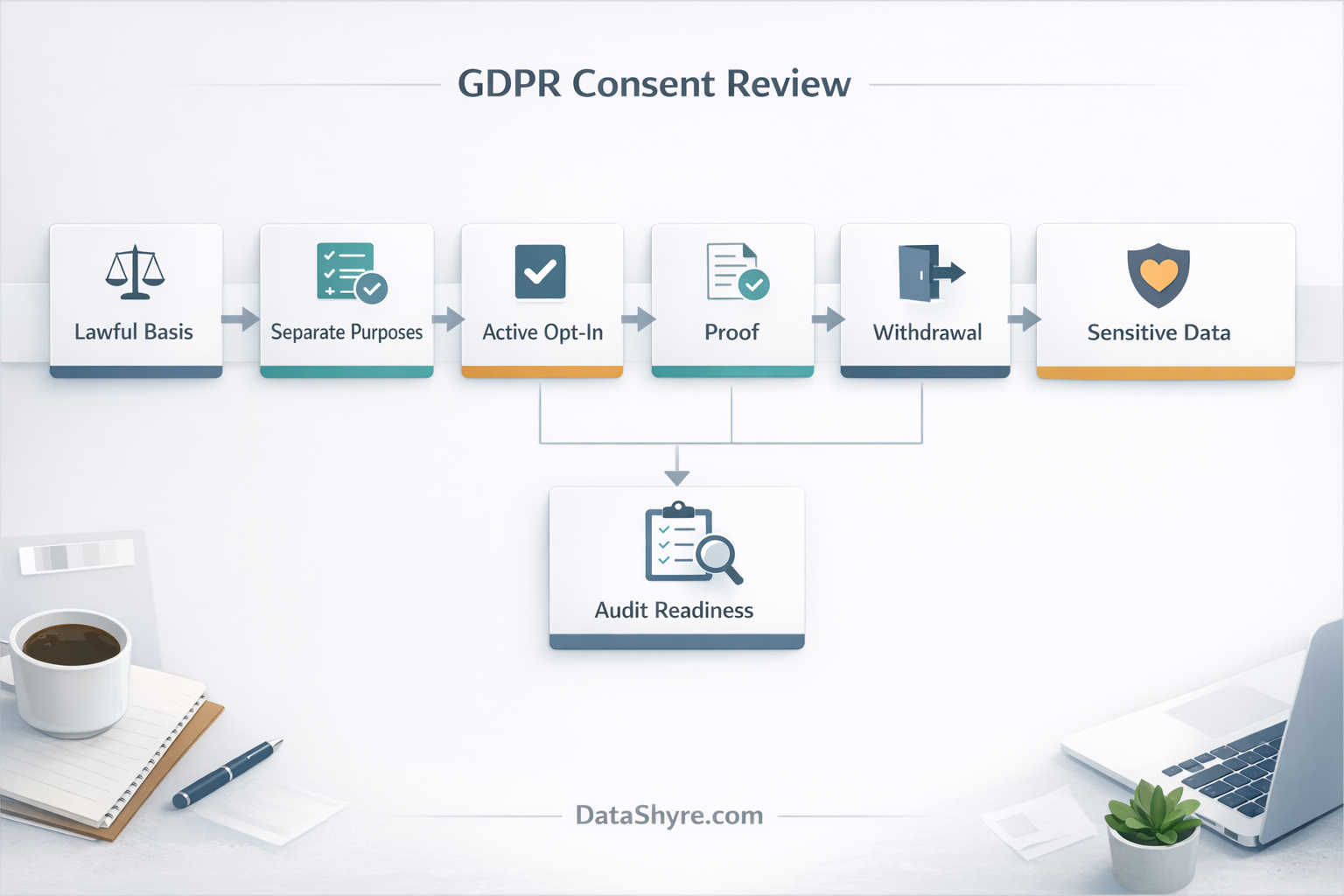
If you want the surrounding materials first, our guides to GDPR compliant privacy notice, GDPR marketing consent, and user consent management are the best companion reads. This article stays narrower. It is the seven-check review I would run before publishing a gdpr consent form this week.

Why GDPR consent forms still fail in predictable ways
Most weak consent forms break before anybody debates the wording.
They fail because the business picked consent when another legal basis would fit better. They fail because three different purposes are bundled into one yes. They fail because withdrawal exists in theory but not in the product. Or they fail because the record only shows that a box was ticked, not what the person saw, which version was live, or whether the choice was truly optional.
The European Commission’s current guidance is still direct on two of the biggest mistakes. Consent is not freely given where there is a clear imbalance, such as employer and employee, and it is not freely given when unnecessary personal data is required as a condition of service. That is why a gdpr consent form should be treated as a governance checkpoint, not as a copywriting task.
1. Confirm that consent is really the right legal basis
This is still the most important check.
The GDPR does not require consent for every processing activity. The European Commission and the ICO both continue to present consent as one lawful basis among several, not as the universal default. If your processing is necessary for a contract, legal obligation, or another valid basis, a gdpr consent form may be the wrong tool.
That matters because consent creates obligations too. If the person later withdraws it, you have to stop the processing that depended on that consent unless another legal ground independently applies. A business that cannot operationally honor withdrawal should not choose consent just because it feels safer on paper.
2. Keep the request separate from terms, account creation, and unrelated choices
The ICO’s current wording is still one of the clearest practical rules for form design:
“prominent, concise, easy to understand and separate from any other information”
>
ICO
That means a gdpr consent form should not hide inside general terms, wrap several unrelated permissions into one declaration, or rely on legal language nobody reads. If you want consent for newsletters, product research, and partner promotions, break those into separate choices. If the user is signing a contract, keep the optional consent language visibly distinct from the contract acceptance itself.
This is where many teams quietly create tied consent without noticing it.
3. Tell people exactly who wants the data, why, and what will happen next
The form has to be informed, not merely visible.
The ICO’s current guidance says a consent request should identify the organization and any other controllers relying on the consent, explain the purposes, describe the processing activities, and tell people they can withdraw at any time. The European Commission likewise says the person needs clear information about the controller, the specific purposes, the types of data, and withdrawal.
For a working gdpr consent form, that usually means the person should understand, in plain language:
- who is collecting the data;
- which purpose each consent option covers;
- what channel or activity the consent enables;
- whether profiling, automation, or international transfer is involved where relevant; and
- how they can reverse the choice later.
If those answers only exist in a long privacy policy and not in or around the form flow, the consent request is usually too thin.
4. Use active opt-in and keep the choices granular
The European Commission still treats consent as something given through a clear affirmative act. CNIL’s 2026 tracking-pixels recommendation makes the same point from another angle, saying consent must come from a positive action and that inactivity should be treated as refusal.
That is why a defensible gdpr consent form still looks boring in the best possible way:
- unticked checkboxes or an equivalent active action;
- one purpose per choice, or tightly related purposes grouped carefully;
- no preselected yes;
- no reliance on silence, scrolling, or passive use.
Bundled consent is especially risky when the purposes are not closely related. CNIL’s 2026 recommendation warns that coupling several different purposes into one consent can affect freedom of choice and undermine validity.
5. Make withdrawal as easy as the original opt-in
This requirement still trips up teams that design for collection but not for reversal.
The European Commission says:
“It should be as easy to withdraw as to give consent.”
>
European Commission
That standard changes how a gdpr consent form should be built. If someone can opt in from one screen in ten seconds, they should not need to open a support ticket, wait for human review, or re-enter information across multiple pages just to opt back out.
In practice, I would expect a visible unsubscribe path, a privacy-settings screen, or a comparable self-service control wherever the consent is used. A footer promise that users can “contact us to withdraw” is much weaker than a designed withdrawal path inside the same channel or account experience.
6. Keep proof that a regulator, customer, or auditor could actually follow
A yes or no value by itself is not much of a record.
The European Commission says the organization has to be able to demonstrate that the individual consented. The ICO’s current guidance on recording consent points in the same direction. If you rely on a gdpr consent form, your evidence should usually show:
- who gave the consent;
- when they gave it;
- what they were shown at the time;
- what option they selected;
- which channel, form, or preference center captured it; and
- which policy or copy version was live.
That proof trail matters most when the form changes over time. If marketing updates the wording, legal changes the purposes, or product redesigns the UI, the record needs to keep pace.
7. Raise the bar for special-category data and for children
Some consent forms need a stricter review than ordinary marketing opt-ins.
The European Commission says special categories of personal data, such as health data, can only be processed if a condition such as explicit consent applies, subject to the law’s limits. The ICO likewise says that if your lawful basis is consent for special-category data, explicit consent will often be the relevant condition and you also need an Article 9 condition. That means a gdpr consent form involving health, biometric, political-opinion, or similar sensitive data should not recycle ordinary newsletter wording.
Children add another design issue. The ICO says consent language must match the audience and that organizations should consider age-verification and parental-authorization questions where relevant. If the user cannot realistically understand the request, the form is not fixed by adding more text.
A short example of what stronger wording looks like
A practical gdpr consent form statement is usually simpler than teams expect:
I agree that DataShyre may send me monthly product updates and webinar invitations by email. I can withdraw my consent at any time using the unsubscribe link or my privacy settings.
That works better than generic wording because it answers four basic questions quickly:
- who wants the consent;
- what the purpose is;
- which channel is involved; and
- how to reverse the choice.
It is still only an example. The right wording depends on the actual purpose and workflow behind the form.
A seven-point review before you publish
Before approving a gdpr consent form, I would ask:
- Is consent the right legal basis for this processing at all?
- Can the person say no without losing something unrelated?
- Are the purposes split cleanly enough to support real choice?
- Is the opt-in unmistakably active?
- Can the person withdraw as easily as they agreed?
- Can the organization prove what the person saw and chose?
- If sensitive data or children are involved, have we raised the standard accordingly?
That short list catches most form failures faster than a long design review.
Bottom line
The strongest gdpr consent form in 2026 is not the longest one. It is the one that uses consent only where it fits, explains each purpose clearly, captures an active and granular choice, keeps proof, and makes reversal easy later.
If your form cannot survive those checks, the problem is usually not that you need more legal copy. It is that the workflow around the form still treats consent like decoration instead of a real user choice.
Sources
- European Commission: Legal grounds for processing data
- European Commission: What if somebody withdraws their consent?
- ICO: Consent
- ICO: How should we obtain, record and manage consent?
- ICO: What is valid consent?
- ICO: What are the rules on special category data?
- EDPB: Guidelines 05/2020 on consent under Regulation 2016/679
- CNIL: Recommendation on tracking pixels in emails
This post was updated on August 4, 2026 using current official European Commission, ICO, EDPB, and CNIL materials available at publication time.