GDPR vs. CCPA in 2026: 7 Differences That Change Website Privacy Work
DataShyre StaffAug 4, 2026
9 min read
GDPR vs. CCPA in 2026: 7 Differences That Still Change Your Privacy Build
If your team still treats gdpr vs. ccpa as a simple Europe-versus-California comparison, it will probably build the wrong controls.
Both laws push companies toward clearer notices, better records, and stronger user rights. But they do not start from the same legal question, and that difference still changes how privacy, product, and marketing teams should build in August 2026.
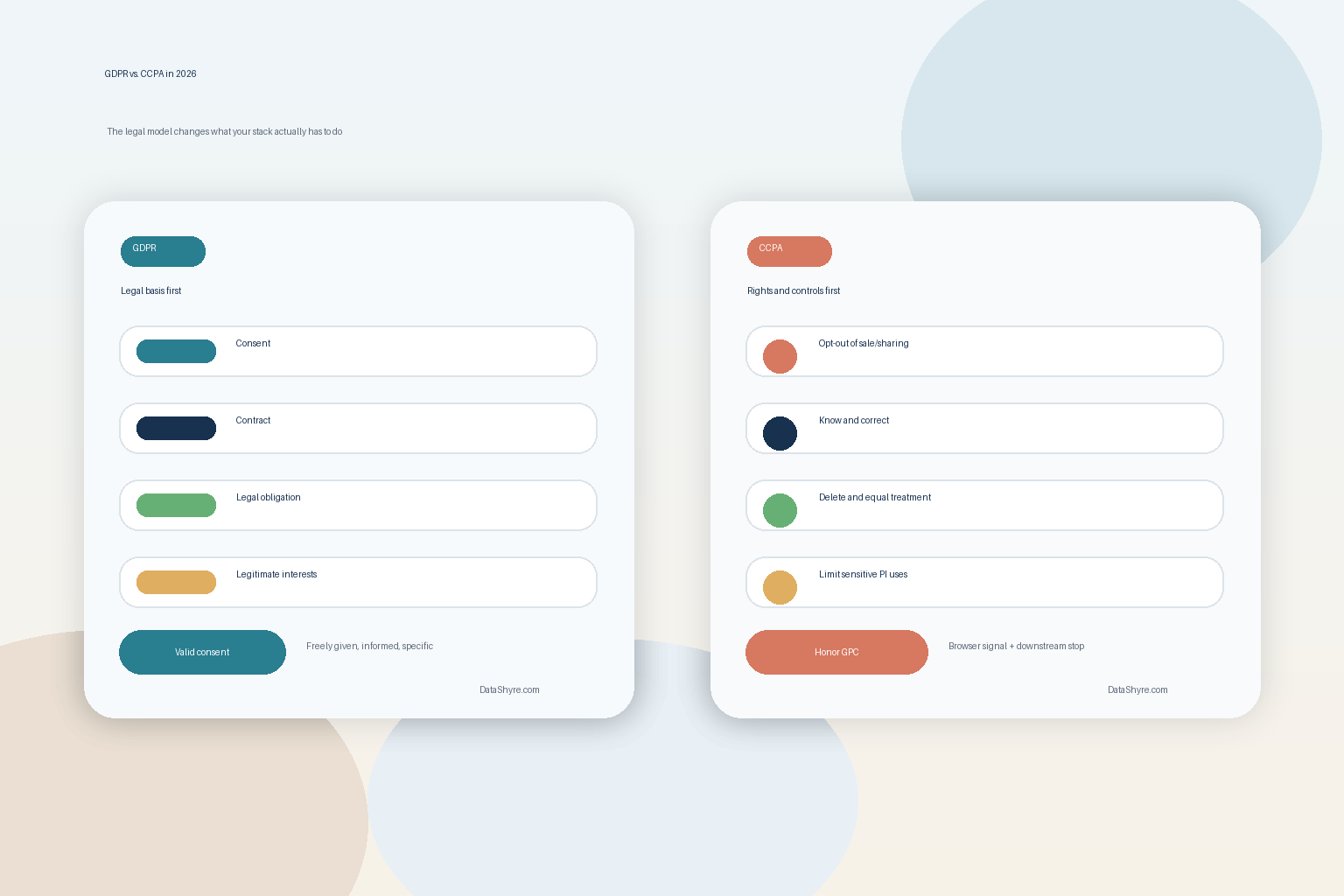
Under the GDPR, consent is only one possible legal basis. The European Commission’s current guidance still lists six grounds for lawful processing, including contract, legal obligation, public interest, vital interests, and legitimate interests. Under California’s framework, the sharper operational focus is consumer rights: opt-out, access, correction, deletion, equal treatment, and limits on some sensitive-personal-information uses.
If you want the related implementation pieces first, our guides to GDPR compliant privacy notice, cookie consent in 2026, and CCPA compliance platform are useful companion reads. This article stays on the comparison itself: where the two regimes still diverge in ways that change real systems.
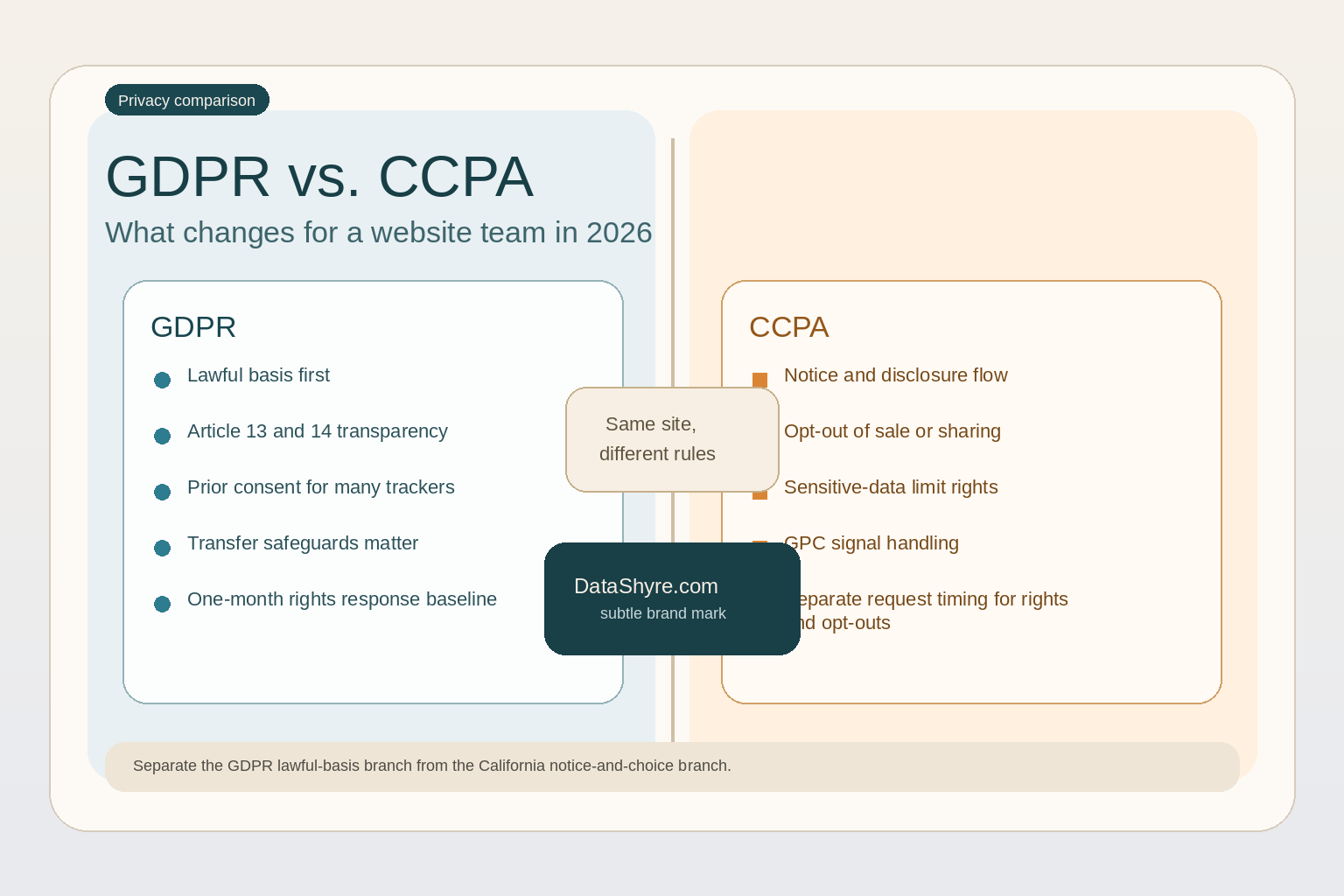
1. GDPR starts with lawful basis; CCPA starts with rights and disclosures
This is still the cleanest way to explain gdpr vs. ccpa.
The European Commission’s current guidance says personal data can only be processed in specific circumstances, including consent, contract, legal obligation, public interest, vital interests, or legitimate interests. That means a GDPR-heavy privacy review usually begins with a question like: why is this processing allowed at all?
CCPA work usually starts somewhere else. California’s consumer-rights materials currently frame the law around what people can ask a business to do: limit, opt out, correct, know, equal treatment, and delete. So a California-heavy review often begins with a different question: what does the consumer need to see, request, or stop?
That split matters because the same data flow can look acceptable under one planning lens and incomplete under the other. A team that designs only for notices and rights intake may miss the legal-basis discipline GDPR expects. A team that designs only for lawful-basis memos may still fail California if its opt-out and disclosure plumbing are weak.
2. Consent plays a very different role
People often overstate how much the two laws depend on consent in the same way.
Under GDPR, consent is one legal basis, but when a company uses it, the European Commission still says it must be “freely given, specific, informed and unambiguous.” That is a high standard, and it is why GDPR work tends to scrutinize wording, timing, granularity, and whether refusal was actually possible.
California is different. CCPA is not built around a universal upfront-consent model for every adult data collection activity. Instead, it leans heavily on notice plus rights, especially the right to opt out of sale or sharing. That means many California builds are less about proving prior permission for everything and more about making sure the user can stop the downstream behavior that matters under the statute.
There are still opt-in exceptions in California, especially where a business has actual knowledge it is dealing with consumers under 16 and wants to sell or share their personal information. But that is narrower than treating consent as the primary operating basis for all processing.
3. Website tracking shows the divergence quickly
This is where product and marketing teams usually feel the difference first.
On April 29, 2026, the UK ICO published final guidance on storage and access technologies covering cookies, tracking pixels, device fingerprinting, and similar techniques. That matters for GDPR-adjacent programs because the compliance conversation is not just about a cookie banner anymore. It is about whether non-essential tracking starts before a real choice and whether users have meaningful technical control after the first interaction.
William Malcolm said the goal is giving people “meaningful control over how their data is used.” That line still captures the European and UK tracking direction better than any vendor feature grid.
California can hit the same stack from another angle. Instead of asking whether every tracker needed prior consent, a CCPA review often turns on whether tracking supports sale or sharing, whether disclosures are accurate, and whether an opt-out request actually stops the data flow. The user experience may look lighter on the first page, but the downstream enforcement burden is very real.
4. California’s current opt-out signal rules make the build more technical than many teams expect
This is one of the clearest 2026 differences.
California’s official materials still say that businesses must honor opt-out preference signals. The Department of Justice’s current Global Privacy Control page describes GPC as a stop-selling-or-sharing signal, and CalPrivacy’s January 15, 2026 explainer says businesses are required to honor those signals. The same CalPrivacy post says browsers must include those opt-out preference signals no later than January 1, 2027.
That means a serious CCPA implementation cannot stop at a footer link. It needs logic that recognizes a browser-level signal, maps it into the correct opt-out state, and propagates that state through advertising, analytics, and vendor-routing decisions.
The GDPR side can be technically demanding too, but the build pressure is different. There the harder question is often whether the processing should start at all before a valid choice or another lawful basis exists. Under CCPA, the harder question is often whether the stop signal reaches every place it needs to reach.
5. The rights lists overlap, but the operating model underneath them does not
At a glance, both laws give people meaningful rights. In practice, the response model is different.
California currently presents the CCPA rights set as LOCKED:
limit the use and disclosure of sensitive personal information in covered cases;
opt out of sale or sharing;
correct inaccurate information;
know what was collected and how it is used or shared;
equal treatment for exercising rights; and
delete personal information, subject to exceptions.
GDPR rights include access, rectification, erasure, restriction, portability, and objection, among others. Those rights often force a company to connect requests back to purpose, legal basis, retention logic, and exemptions across multiple systems.
So while both laws require intake, verification, and response handling, GDPR programs usually need more purpose-level legal reasoning inside the workflow. California programs usually need especially strong routing around disclosures, opt-out states, and downstream sharing controls.
6. California’s 2026 regulatory updates widen the gap
Another reason gdpr vs. ccpa feels more operational in 2026 is that California’s rule set moved again.
The CPPA says its finalized regulations addressing automated decisionmaking technology, privacy risk assessments, and cybersecurity audits became effective on January 1, 2026, with some compliance dates phased into 2027 and 2028. That does not turn CCPA into GDPR, but it does mean California privacy work now reaches further into model use, risk review, and auditable governance than many older comparison articles suggest.
In other words, California is not just a website notice law anymore. The current regime still centers consumer rights, but it also expects more structured operational controls around higher-risk data uses.
7. Enforcement posture exposes different failure modes
Enforcement is where the theory gets practical.
The California Department of Justice announced on February 11, 2026 that Disney agreed to pay $2.75 million to resolve allegations that it failed to fully effectuate opt-out requests across devices and streaming services tied to a consumer’s account. Attorney General Rob Bonta said “businesses can’t force people to go device-by-device or service-by-service.”
That is a useful CCPA lesson because it shows how a rights-centered law still becomes a systems-integration problem. The failure was not just wording. It was whether the stop request reached the full account and all relevant services.
On the GDPR side, the recurring failures are often different: weak lawful-basis analysis, invalid consent, or tracking that starts before a valid choice. The visible symptom may be a banner, but the deeper issue is often whether the processing condition was valid in the first place.
What privacy teams should do this week
If your company touches both regimes, do not force one framework onto the other.
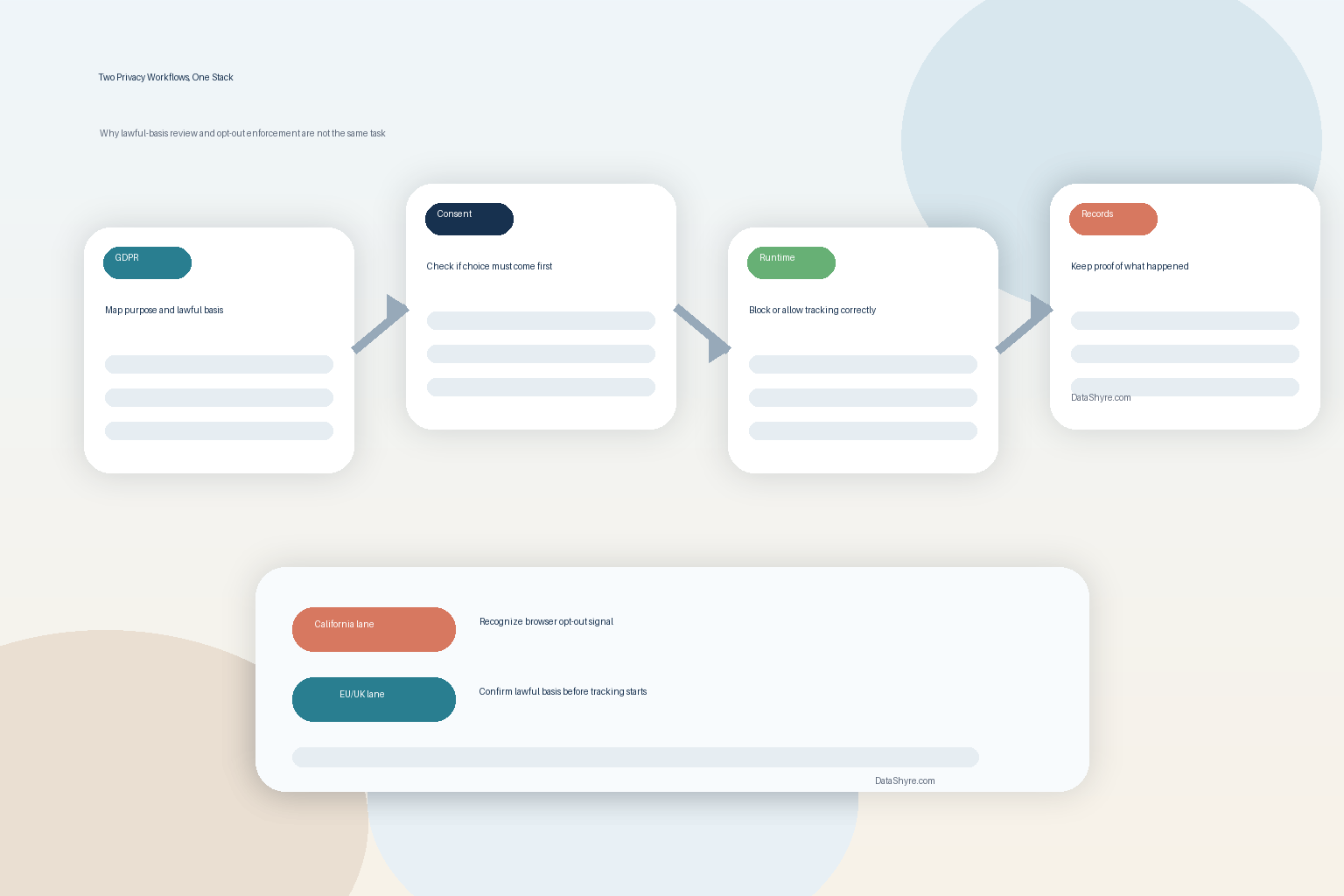
I would separate the work this way:
map each major processing purpose and identify the lawful basis wherever GDPR applies;
review website and app tracking to confirm what starts before user action and why;
keep California notices, opt-out methods, and preference-signal handling explicit instead of hiding them inside a generic consent layer;
test whether GPC or other opt-out preference signals actually stop sale or sharing in connected tools; and
make rights response records explain both the legal reasoning and the technical outcome.
That approach is usually more defensible than trying to run both regimes through one abstract “privacy choice” model.
Bottom line
The useful answer to gdpr vs. ccpa in 2026 is not that one is stricter and the other is lighter. It is that they organize privacy obligations differently.
GDPR asks whether processing is justified and, when consent is used, whether it is valid. CCPA asks whether disclosures, controls, and downstream rights enforcement actually work for Californians, with 2026 regulations pushing that model deeper into operational governance.
If your stack treats those as the same problem, you will likely overbuild the wrong controls in one place and underbuild them in another.