

Google Analytics Cookie Consent: What You Need Before GA4 Fires in 2026
Plenty of teams still treat google analytics cookie consent like a banner-copy problem. It is not. The real question is whether GA4 starts storing analytics cookies before a visitor has made a valid choice, and whether your tag setup actually respects that choice after the click.
In Europe and the UK, that matters immediately. The ICO says rejecting non-essential cookies must be “just as easy to reject all non-essential cookies” as accepting them. Google, meanwhile, expects consent signals to be configured correctly when Analytics is linked to services that use advertising-related data. So the work is both legal and technical.
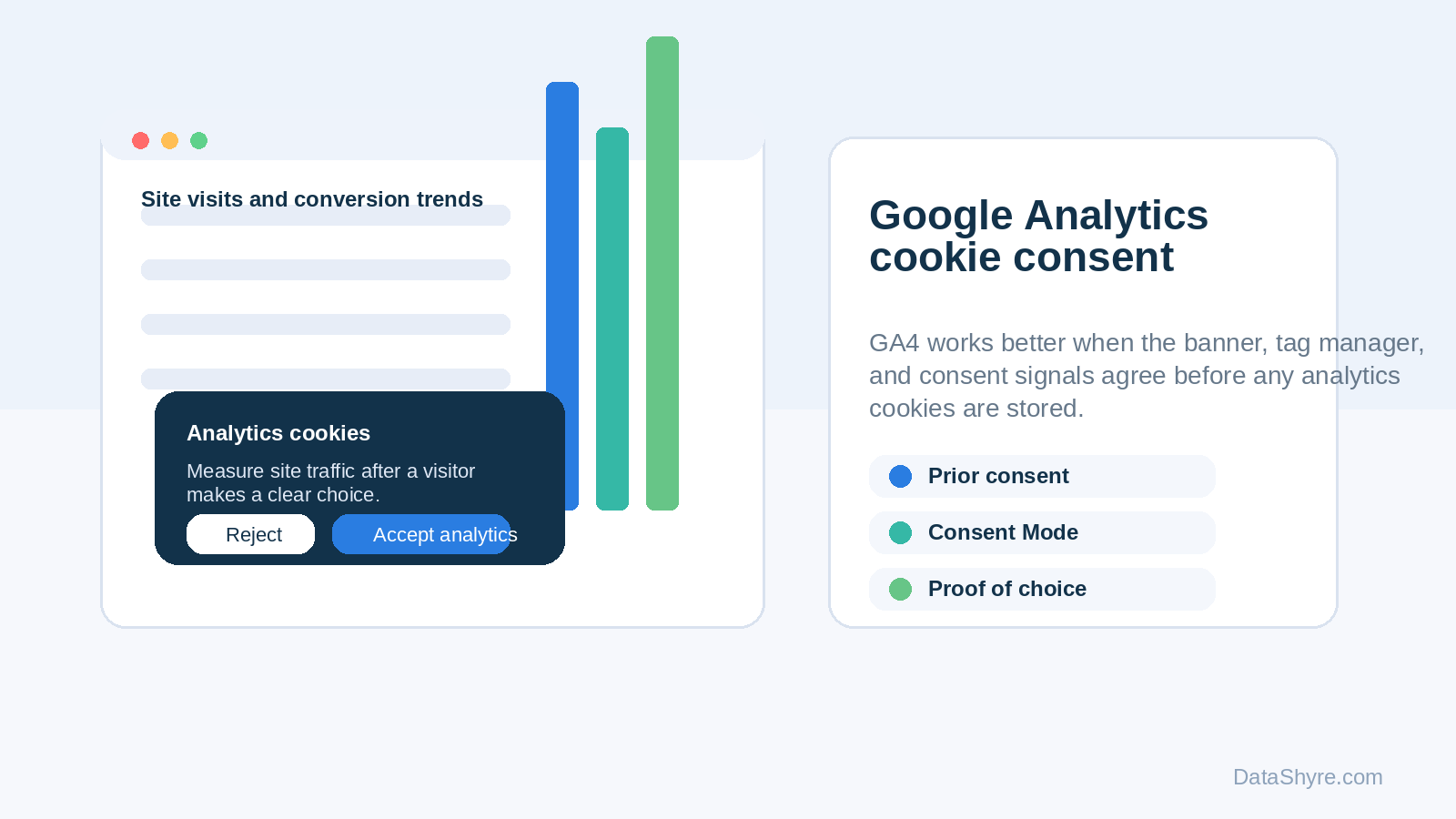
If you are tightening the tag side first, our guides to Google Tag Manager cookie consent, OneTrust cookie consent Google Tag Manager, and GDPR cookie consent examples pair well with this setup.
When google analytics cookie consent is required
For most EU and UK websites, standard GA4 tracking is not something you should turn on by default. Google documents analytics_storage as the consent signal that controls analytics cookie storage. When that signal is denied, Google says Analytics cookies will not be read or written and GA4 instead receives cookieless pings for modeling.
That is the clean dividing line:
- if GA4 cookies are allowed to fire before consent, you likely have a compliance problem;
- if GA4 waits for consent or runs in a denied state with no analytics cookies, you are much closer to the mark.
There is one nuance that gets overclaimed. France’s CNIL says audience-measurement cookies can be exempt from consent only under specific conditions, including a purpose strictly limited to audience measurement for the publisher’s exclusive account. That is a narrow lane. If your configuration goes beyond that, or feeds broader ad-tech use cases, do not assume an exemption just because the tool is called analytics.
What Consent Mode changes, and what it does not
Consent Mode helps, but it does not magically make your implementation compliant on its own.
Henrique de Freitas of Google described Consent Mode as a way to take a “privacy-first approach to digital marketing.” That is useful framing. It tells you what Consent Mode is for: translating a user’s choice into tag behavior.
What it changes:
- it lets Google tags react to consent signals such as
analytics_storage; - it can stop GA4 from reading or writing analytics cookies when consent is denied; and
- it can still send cookieless pings that GA4 uses for behavioral or conversion modeling.
What it does not change:
- it does not provide the banner for you;
- it does not make a dark-pattern banner acceptable; and
- it does not excuse a tag setup that loads the wrong things too early.
That last point is where many deployments still wobble. Scott Herman, a Senior Product Manager for Google Tag Manager, wrote that tags should “respect user consent choices.” In practice, that means checking tag firing order, default denied states where needed, and whether any custom scripts or third-party pixels slip around your CMP.
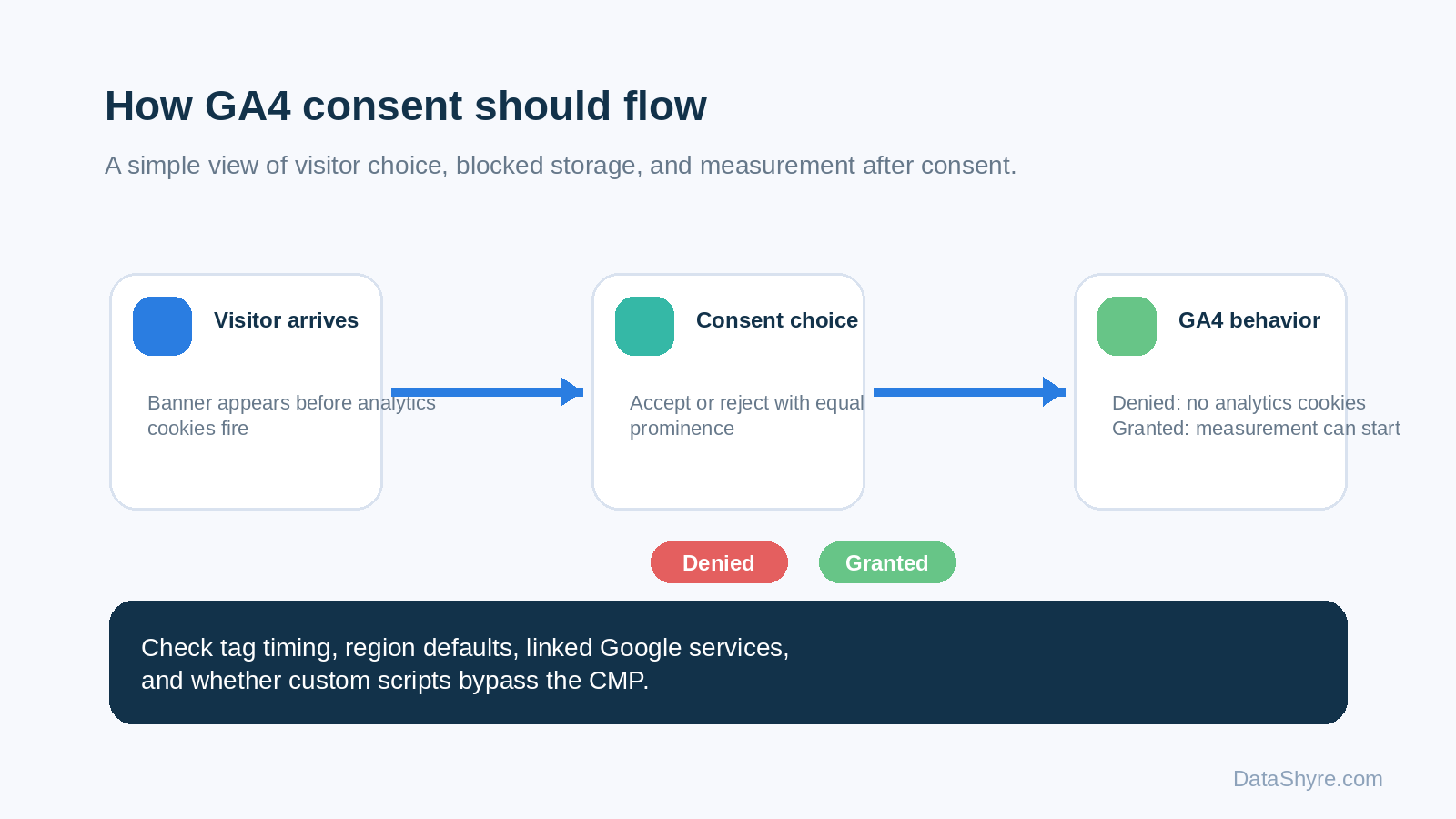
The GA4 setup detail teams miss
A lot of marketers think the problem ends once analytics cookies stop firing before consent. Sometimes it does not.
Google’s own Analytics help says that if a GA4 property is linked to another Google service that requires consent to share data, and one or more streams has EEA visitors, Analytics may flag missing affirmative consent for ads measurement or ads personalization. In other words, the moment your analytics setup touches ad workflows, your consent picture gets more demanding.
So if your stack includes GA4 plus Google Ads, remarketing, or linked advertising features, check more than the analytics cookie itself. Review whether your CMP and tag implementation are sending the right consent signals for the linked use case.
A practical 2026 checklist
If you need google analytics cookie consent to hold up in a real audit, start here:
- Default GA4 analytics storage to denied in regions where prior consent is required.
- Make sure the banner gives a real top-level reject path, not a buried settings maze.
- Use Consent Mode or an equivalent CMP integration that passes consent state before other relevant tags run.
- Test whether any custom HTML tags, plugins, or third-party scripts still drop cookies before consent.
- Check linked Google services for added consent requirements around ads measurement or personalization.
- Document the exact configuration you rely on, especially if you think an audience-measurement exemption might apply.
One more current signal is worth watching: in April 2026, the ICO said 99% of the UK’s top 1,000 websites now meet its compliance checks for advertising cookies after focused regulatory work. That does not mean regulators have relaxed. It means the baseline is getting clearer, and lagging implementations will stand out faster.
The takeaway
The best way to think about google analytics cookie consent in 2026 is simple: GA4 measurement is still possible, but lazy implementations are harder to defend.
If your banner is fair, your tags wait for the right signal, and your linked Google services are configured with the right consent states, you can still get useful analytics without pretending user choice is optional.
Sources
- Google Analytics Help
- Google for Developers Tag Platform
- Google Marketing Platform Blog
- CNIL
- UK Information Commissioner’s Office