

Consent Manager Net in 2026: 7 Live Checks Before You Trust the CMP
If you are searching consent manager net on October 24, 2026, you are usually not asking a generic consent question.
You are usually trying to decide whether consentmanager.net is the right CMP for a live site, or whether an existing deployment is actually doing what the banner, tag manager, and privacy documentation claim.
That is the right question to ask now. The European Commission still says consent should be clear and given via an affirmative act and should be “as easy to withdraw as to give consent.” The UK’s ICO finalized its current storage-and-access-technologies guidance on April 29, 2026, and that guidance covers not only cookies but also tracking pixels, fingerprinting, scripts, and similar technologies. Google, meanwhile, still says consent defaults need to be in place “before any commands that send measurement data.”
If you want nearby context first, start with our guides to consent management provider, Google Tag Manager cookie consent, and cookie consent banner examples. This page is narrower. It is the seven-check review I would run this week before trusting consent manager net on a real site.
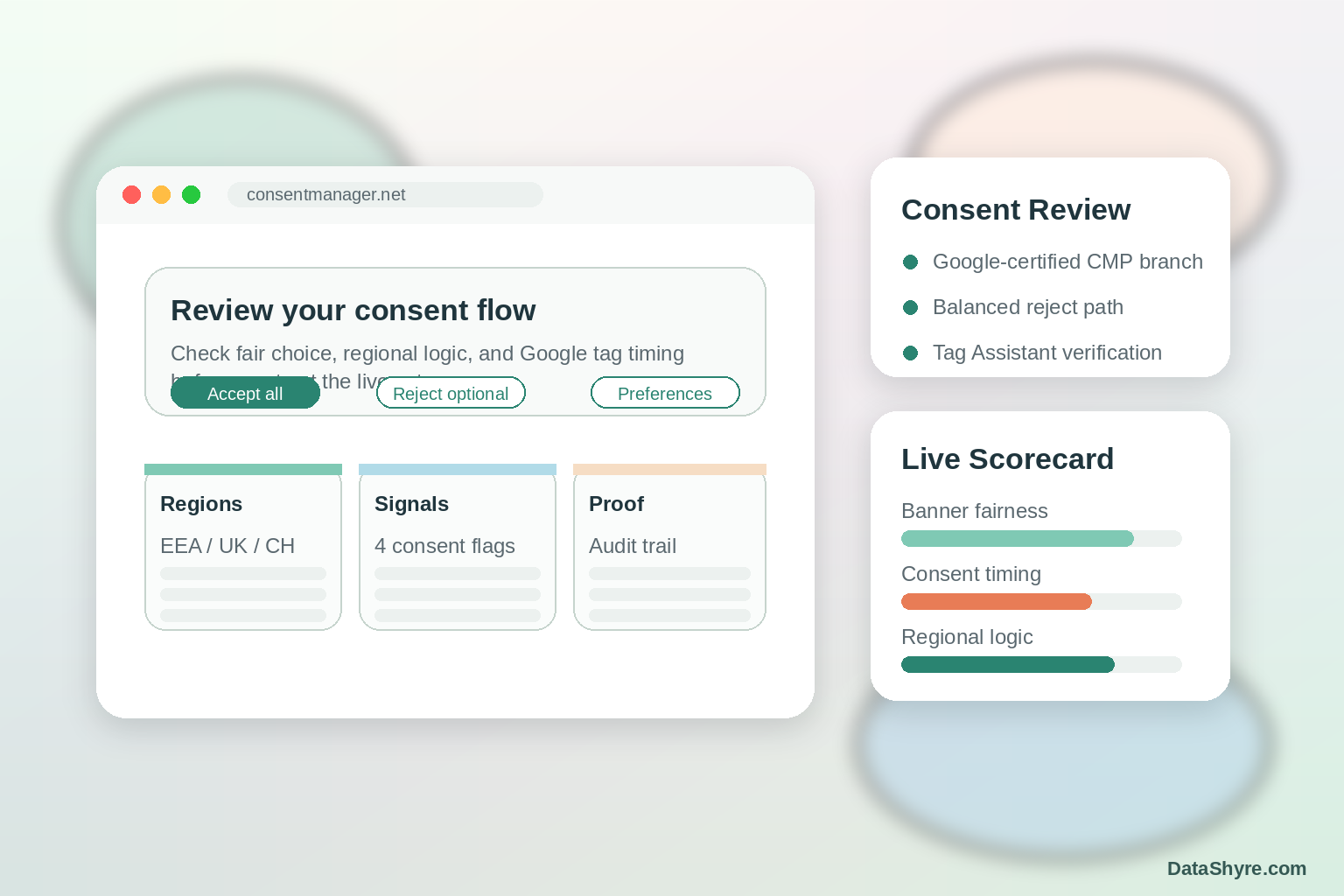
1. Start with what the product says it is, then test that claim on your site
This is the first useful check because consent manager net is really a vendor-specific query.
On its current official site, consentmanager says it is built on IAB TCF v2.3 (CMP ID 31), Google Consent Mode v2, and IAB GPP. It also says it integrates with Google Tag Manager, Google Analytics, Google Ads, and a wider vendor stack.
That sounds promising, but it is still only the opening claim.
The live review should ask:
- are you using the exact product edition and integration path your team thinks it is using;
- are the intended regions configured correctly;
- are the right domains, subdomains, or properties actually covered;
- does the vendor inventory on the page match the technologies that really load.
This is where many CMP reviews go wrong. Teams validate the sales description, not the runtime.
2. Separate Google’s publisher requirement from broader privacy-law compliance
This is the most important commercial distinction in many CMP evaluations.
Google’s current publisher help still says that partners using AdSense, Ad Manager, or AdMob must use a Google-certified CMP integrated with the IAB Transparency and Consent Framework when serving personalized ads in the EEA and UK and, separately, in Switzerland under Google’s published dates. The same help also says Google “does not check CMPs for full compliance” with applicable privacy laws.
That means a consent manager net review should split into two separate questions:
- does the CMP satisfy the Google publisher-program requirement for the traffic and monetization model involved;
- does the banner, preference center, and runtime behavior satisfy your broader legal and operational expectations.
Those are related, but they are not the same thing. A CMP can satisfy a Google-specific publisher requirement and still need deeper review on notice quality, regional logic, or withdrawal handling.
3. Verify default consent timing in GTM or gtag before anything else fires
This is where the implementation usually becomes real.
Google’s current developer guide still says default consent should be set on every page before any commands that send measurement data such as config or event. Google Tag Manager help also says the Consent Initialization trigger fires before all other tags and is the right place for tags that set or update user consent state.
So if consent manager net is connected to GTM or Google tags on your site, prove this sequence:
- default denied states exist where they should;
- the CMP or template runs on Consent Initialization if GTM is involved;
- later tags do not outrun that state;
- a pageview is not measured under the wrong assumption before the banner interaction lands.
If defaults are late, the rest of the review is mostly performance theater.
4. Test all four current Google consent signals, not only analytics
Older implementations still fail here.
Google’s current consent documentation and Tag Assistant guidance point teams to four key parameters:
ad_storageanalytics_storagead_user_dataad_personalization
Tag Assistant’s current debugging flow is still simple and useful: inspect the earliest Consent event for defaults, inspect the most recent Consent event after interaction, and confirm which tags fired or stayed blocked.
This matters because many teams validate only one branch. They see analytics working, or one denied value on the page, and assume the whole consent path is healthy. A serious consent manager net check needs to prove the full state model, not just one green light.
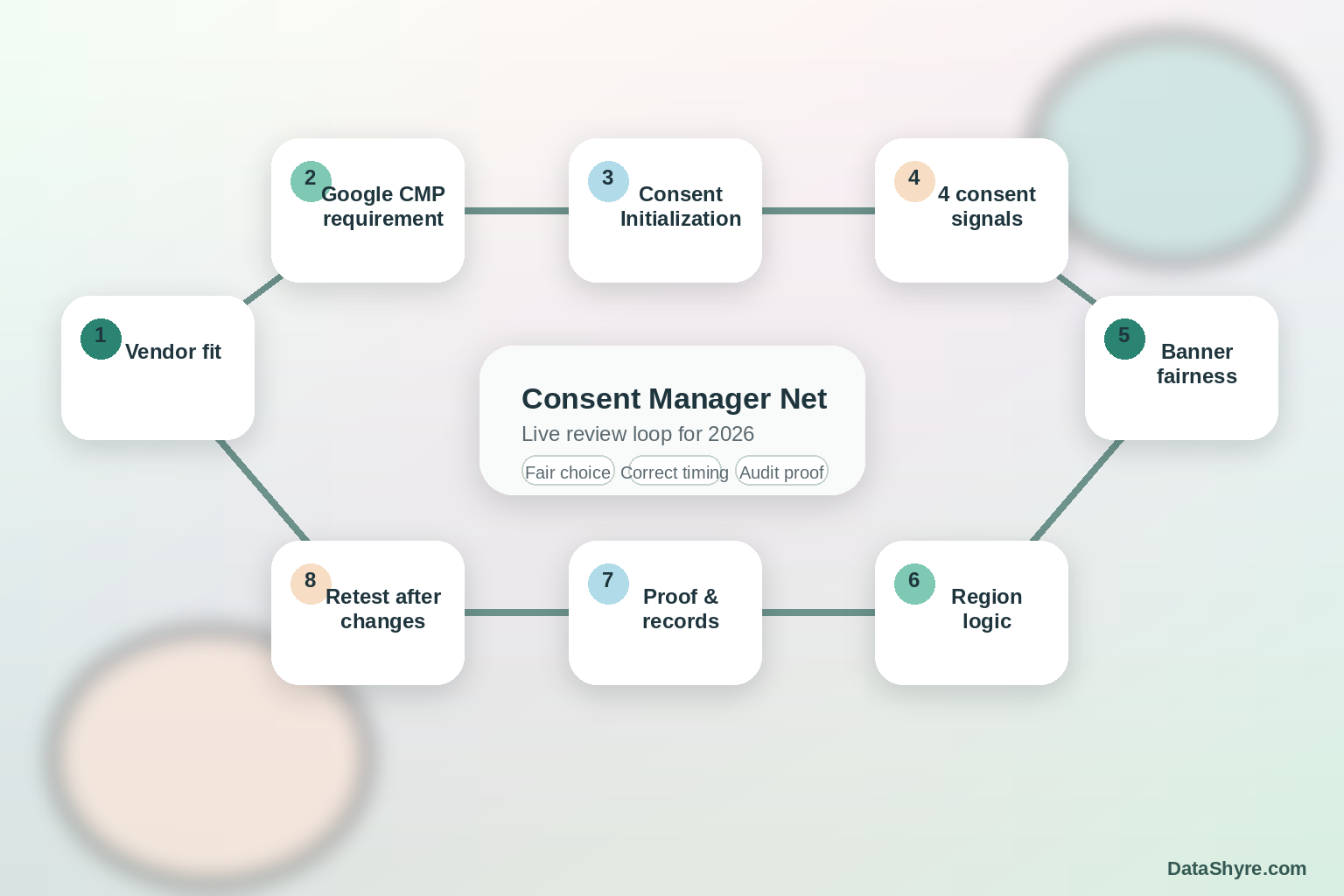
5. Audit banner fairness on desktop and mobile
This is where product capability meets regulator expectations.
The European Commission still frames consent around clear information and easy withdrawal. CNIL’s current banner-enforcement position is even sharper: rejecting cookies should be “just as easy as accepting them.” The ICO’s final 2026 guidance also keeps the focus on meaningful control over storage and access technologies, not decorative consent language.
So the right consent manager net review is not only technical. It should ask:
- is the reject path visible on first layer where your model requires it;
- is it still visible on mobile;
- are optional purposes described in clear language;
- can a person return later and withdraw without friction.
If the visual path is lopsided, your runtime proof alone is not enough.
6. Check whether regional logic matches real purposes, not only geography
This is where mature CMPs help, but also where teams can get overconfident.
consentmanager currently markets geo-targeted consent rules for GDPR, UK GDPR, US state laws, and other regional frameworks. That is useful, but regional switching by itself does not solve the harder question: whether the purpose logic behind the interface matches what the site is really doing.
The ICO’s finalized 2026 guidance is a good reminder here because it explicitly reaches beyond classic cookies into scripts, pixels, and similar technologies. In practice, a consent manager net audit should confirm:
- which regions get prior-consent treatment;
- which technologies are blocked until choice;
- which uses rely on different regional privacy choices rather than prior consent;
- whether the same purpose is quietly reused across multiple technologies.
A site can have clean geolocation rules and still fail because the underlying purpose mapping is sloppy.
7. Keep proof that survives redesigns, plugin changes, and new vendors
This is the operational check too many CMP reviews skip.
consentmanager’s current site emphasizes continuous monitoring and audit-ready reporting. That can be helpful, but the broader principle matters more than the feature list: you need evidence another team can still understand later.
For a practical consent manager net review, keep:
- the banner version and settings that were live;
- the vendor list and purpose mapping in force at the time;
- screenshots of desktop and mobile choice paths;
- Tag Assistant or browser-test proof of defaults and updates;
- notes from the last GTM publish, plugin change, or vendor addition.
That record matters because consent failures often appear after a redesign or tooling update, not on the day the CMP was approved.
A practical review order for this week
If I were evaluating consent manager net today, I would do it in this order:
- confirm the exact product scope, regions, and domains in use;
- separate the Google publisher branch from the broader privacy-law review;
- verify consent defaults and Consent Initialization timing;
- test all four Google consent signals in Tag Assistant;
- review reject, accept, and withdrawal paths on desktop and mobile;
- validate regional logic against real purposes and loaded technologies;
- store proof another team can still verify next month.
That sequence usually tells you more than a long checklist copied from a vendor sales page.
FAQ
Is consentmanager.net enough by itself for compliance?
No. A capable CMP can help a lot, but the live result still depends on banner design, regional logic, purpose mapping, tag timing, and the technologies actually loading on the page.
Does Google certification settle the legal review?
No. Google’s own help says its CMP certification does not decide full privacy-law compliance. It is a product-program requirement for certain publisher use cases, not a substitute for your broader review.
What is the fastest technical check to run first?
Open Tag Assistant on a fresh session, inspect the earliest Consent event, inspect the most recent Consent event after interaction, and confirm whether the right tags fired or stayed blocked.
Bottom line
In 2026, the best consent manager net review is not a vendor feature tour.
It is a live check of whether consentmanager.net, your banner design, your GTM or Google-tag timing, your regional logic, and your proof trail all still agree on the same page.
If those seven checks hold up today, you have something much more valuable than a polished CMP demo. You have a consent setup another team can still trust after the next site change.
Sources
- https://www.consentmanager.net/en/
- https://support.google.com/admanager/answer/13554116?hl=en
- https://developers.google.com/tag-platform/security/guides/consent
- https://developers.google.com/tag-platform/security/guides/consent-debugging
- https://support.google.com/tagmanager/answer/10718549?hl=en
- https://commission.europa.eu/law/law-topic/data-protection/information-business-and-organisations/legal-grounds-processing-data_en
- https://ico.org.uk/for-organisations/direct-marketing-and-privacy-and-electronic-communications/guidance-on-the-use-of-storage-and-access-technologies/
- https://ico.org.uk/about-the-ico/media-centre/news-and-blogs/2026/04/final-storage-and-access-technologies-guidance-published/
- https://www.cnil.fr/en/dark-patterns-cookie-banners-cnil-issues-formal-notice-website-publishers
—
Published: October 24, 2026. Updated using current official regulator, government, platform, and vendor materials available at publication time.