

Consent Management Provider in 2026: 5 Providers to Shortlist and 7 Live Checks Before You Sign
If you are evaluating a consent management provider in 2026, the useful question is not which vendor has the cleanest demo.
The useful question is whether the provider can turn a person’s choice into real runtime behavior across scripts, tags, embeds, regions, ad stacks, and later withdrawal.
That is where buying mistakes still happen. A consent management provider can look polished in a sales walkthrough and still fail on timing, regional branching, or proof once it reaches a live site.
If you want nearby context first, start with our guides to consent management platforms, consent management platform best practices, and cookie consent manager. This page is narrower. It is the shortlist and review sequence I would use this week before choosing a consent management provider for a real deployment.

Why choosing a consent management provider is now a control-layer decision
The legal baseline still points in the same direction, and it is more operational than many vendor pages admit.
The European Commission still says a valid consent request should use “clear and plain language” and should be withdrawable in a way that is “as easy to withdraw as to give consent.” On April 29, 2026, the ICO published final storage-and-access-technologies guidance, which is useful because it makes clear the review surface is broader than classic cookies alone. In 2026, the EDPB also launched a coordinated enforcement action focused on transparency and information obligations under Articles 12, 13, and 14 GDPR. Google’s current implementation guidance still says the default consent state should be set “before any commands that send measurement data.”
That combination changes how I would score any consent management provider. The provider should help a team do five things reliably:
- present a fair and understandable first-layer choice;
- hold optional technologies back until the right signal exists;
- route consent and opt-out logic into the correct regional branch;
- propagate consent changes fast enough to affect downstream tags and platforms; and
- leave behind records another team can still use later.
If a provider cannot do that, the feature grid matters less than it looks.
5 consent management providers worth shortlisting by use case
There is no single best consent management provider for every stack. These five belong on a serious shortlist because their current product materials point to different strengths.
1. OneTrust
Best for: large organizations that want broad consent operations across multiple brands, domains, apps, and regions.
OneTrust’s current consent materials emphasize geolocation-aware templates, no-code blocking and script control, audit-ready consent receipts, change history, exportable logs, and synchronization across websites, mobile apps, and OTT or CTV environments. That makes it a natural shortlist candidate when scale and regional branching matter more than implementation simplicity.
2. Usercentrics
Best for: teams that care heavily about consent UX, publishing speed, and publisher-facing ad requirements.
Usercentrics currently positions its website CMP as both Google-certified and IAB-certified, highlights support for more than 60 languages, and offers one CMP across multiple domains and devices. That makes it especially relevant when a team wants a consent layer that is easier to launch and manage without losing ad-tech compatibility.
3. Osano
Best for: mid-market teams that want stronger out-of-the-box guardrails and operational simplicity.
Osano’s current CMP materials emphasize AI-powered cookie classification, unauthorized tag blocking, granular consent controls, a unified preference hub, reporting, global language and regulation support, and GPC support. This is the kind of consent management provider to test when you want the platform to reduce configuration burden rather than expand it.
4. Transcend
Best for: engineering-led organizations that need enforcement deeper in the stack than a classic banner.
Transcend’s consent documentation describes a system that collects, manages, and enforces user choices across websites and mobile apps, with network-level regulation, regional experiences, full-stack integration, and detection of privacy signals such as GPC and Do Not Track. It is especially interesting when your harder problem is controlling data flows after the choice is made, not just collecting the choice.
5. TrustArc
Best for: companies that need consent and preference orchestration across more downstream systems.
TrustArc’s current materials emphasize centralized consent history, real-time syncing, configurable forms and preference centers, and 300-plus connectors into CRM, marketing, and other downstream systems. That makes it a practical shortlist option when your privacy problem touches both device-level tracking and broader customer preference management.
The useful point is not that these are the only options. It is that each consent management provider should be judged against your actual failure point instead of being compared as if every CMP solves the same operational problem.
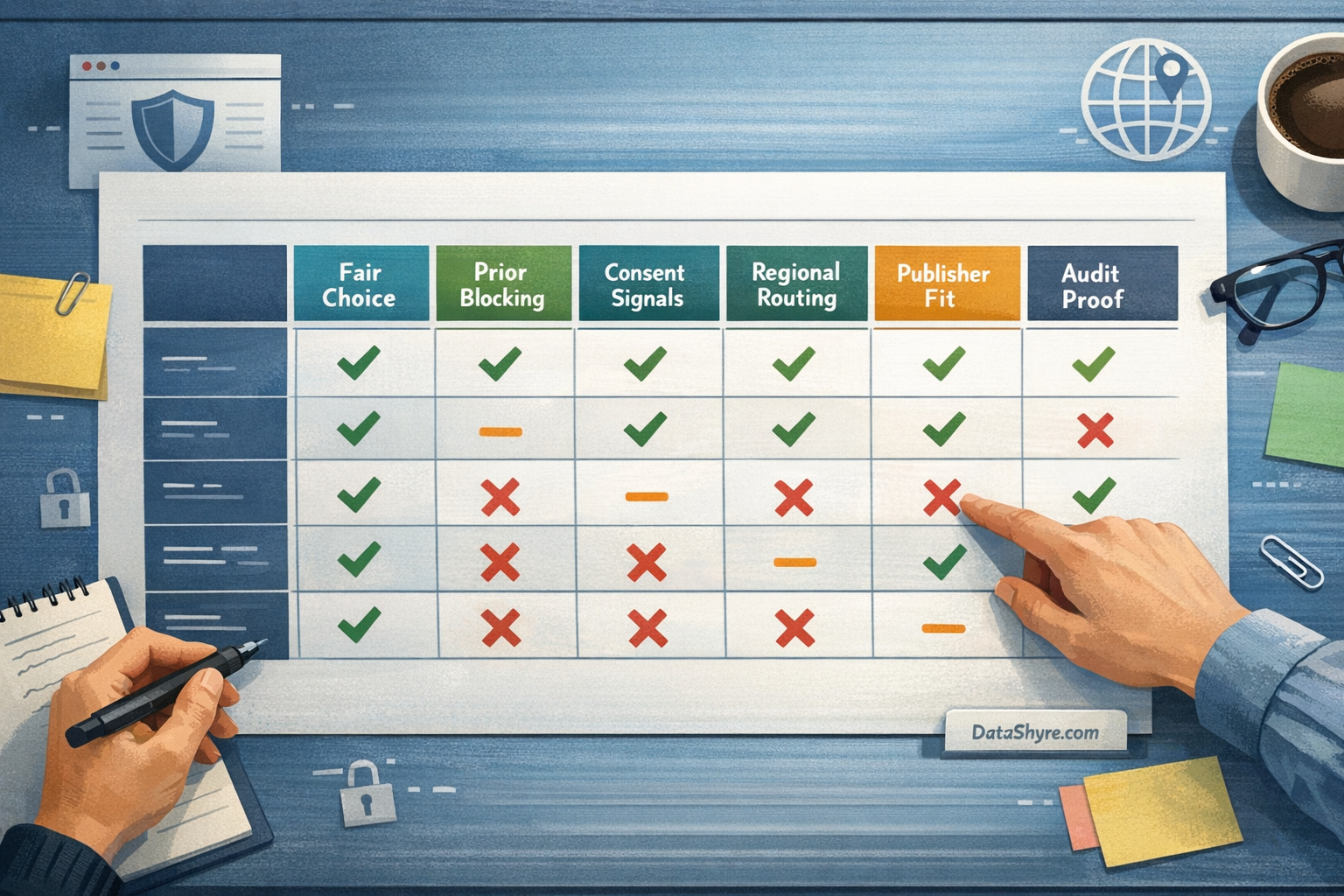
7 live checks before you choose a consent management provider
The easiest way to buy the wrong consent management provider is to compare only screenshots and pricing tiers. I would run these seven checks live instead.
1. Check whether the first-layer choice is genuinely fair
CNIL’s current wording is still blunt: rejecting cookies should be “just as easy as accepting them.” California’s privacy regulator has also stressed symmetry in choice and clear, understandable language when warning against dark patterns.
So before you compare dashboards, inspect the first layer on desktop and mobile:
- is
Reject allvisible whereAccept allappears; - is the privacy-protective path equally visible on small screens;
- are categories and purposes written in plain language;
- does the layout avoid manipulative color, size, or placement choices.
If a consent management provider fails the first-layer test, the rest of the implementation usually gets weaker from there.
2. Check prior blocking on the templates that leak first
The next real test is not whether the provider can save a preference. It is whether it can stop optional technologies from acting before the right choice exists where prior-consent rules apply.
That means the homepage is not enough. Test the pages most likely to leak first:
- landing pages with analytics and advertising tags;
- product pages with personalization scripts;
- article templates with embedded video or social widgets;
- pages running chat, heatmaps, or session replay tools;
- cached or tag-manager-heavy templates.
The ICO’s 2026 guidance matters here because it covers a broader set of storage and access technologies than cookies alone. A consent management provider that documents a choice but does not actually hold back the optional behavior is weaker than it appears.
3. Check signal timing, not just stored state
Many teams over-test storage and under-test sequence.
Google’s current guidance still says the default consent state should be called on every page before any commands that send measurement data such as config or event. That means timing is part of provider quality, not just tag quality.
A useful live test looks like this:
- deny defaults exist before optional measurement runs;
- the visitor makes a choice;
- downstream tags receive the update on the same page;
- later page loads respect the stored state;
- withdrawal changes behavior after the person changes their mind.
If the banner looks compliant but the tag layer races ahead, the consent management provider is not really in control.
4. Check regional routing on purpose
One of the fastest ways to misjudge a consent management provider is to assume one consent path fits every visitor.
For EU and UK traffic, the review often centers on prior consent for non-essential technologies and valid choice design. In California, the branch may also include browser-based privacy signals and opt-out workflows where sale or sharing is in scope. California’s Department of Justice still describes Global Privacy Control as a “stop selling or sharing my data switch.”
A real provider review should test separate branches on purpose:
- EU or UK first visit with no prior preference;
- California visit where GPC and opt-out logic may matter;
- return visits after refusal;
- return visits after acceptance;
- cross-domain or multi-property cases if the provider claims to support them.
If a consent management provider cannot explain those branches clearly, it is not ready for multi-region production.
5. Run the publisher branch separately if ads matter
This is one of the easiest places for provider reviews to get blurred.
General consent hygiene and Google’s publisher requirements overlap, but they are not the same test. Google’s current AdSense guidance still says publishers using AdSense, Ad Manager, or AdMob must use a Google-certified CMP integrated with the IAB Transparency and Consent Framework when serving personalized ads to users in the EEA, the UK, and Switzerland under Google’s published dates.
So the clean review order is:
- does the site present a fair first-layer choice;
- does runtime behavior match that choice;
- if publisher ads matter, does the chosen consent management provider also satisfy Google’s separate publisher requirement.
A provider can pass one of those checks and fail another.
6. Check whether withdrawal and records remain usable after ordinary change
The European Commission’s consent guidance still matters here because it ties valid consent to both understandable notice and easy withdrawal.
The strongest consent management provider does more than save a yes or no value. It should help your team answer:
- what the visitor saw;
- which categories or purposes were active at that time;
- when the preference changed;
- whether refusal or withdrawal altered runtime behavior;
- who changed the rule set later.
That matters because consent failures often appear after a routine site release, not on the day the banner was approved.
7. Check whether the operating model fits your actual team
This is where many buying decisions go wrong.
Some organizations need a provider that can support legal review, multiple brands, and regional branching at enterprise scale. Some need faster deployment with fewer moving parts. Some need deeper engineering control over data flows and server-side behavior. Some need stronger orchestration into CRM, marketing, and first-party preference systems.
The best consent management provider is usually the one that solves your real failure point:
- weak banner fairness;
- weak tag blocking;
- weak regional routing;
- weak ad-tech compatibility;
- weak records and downstream synchronization.
If you do not identify the real failure first, almost any demo can look good enough.
A faster shortlist sequence for this week
If I had to narrow a long CMP list to two providers this week, I would do it in this order:
- identify whether the main risk is choice design, enforcement, regional branching, or downstream orchestration;
- test first-layer fairness on desktop and mobile;
- test prior blocking on the templates most likely to leak;
- verify signal timing into tags and measurement tools;
- separate EU and UK routing from California and GPC logic;
- run the Google publisher branch separately if ads matter;
- inspect records, exports, and change history after a simulated site change.
That sequence usually reveals more than a vendor scorecard does.
FAQ
Is a consent management provider basically the same as a cookie banner tool?
No. A real consent management provider should influence first-layer choice, technical enforcement, regional behavior, later withdrawal, and records another team can still verify later.
Does GPC matter when choosing a consent management provider?
Yes, if California opt-out handling is relevant to your legal and business model. A provider review should test whether the site recognizes and routes that signal correctly instead of treating the banner as the whole workflow.
Can a Google-certified CMP still need more legal or operational review?
Yes. Google’s certification matters for a specific publisher requirement, but it does not replace your own review of runtime behavior, regional logic, notice quality, or broader privacy-law obligations.
Bottom line
The best consent management provider in 2026 is not the one with the smoothest banner animation.
It is the one that presents a fair first choice, holds optional technologies back until the right signal exists, routes visitors into the right regional logic, satisfies separate publisher requirements where needed, and leaves behind proof another team can still verify later.
That is the buying standard worth using before you shortlist, pilot, renew, or migrate one.
Sources
- European Commission, legal grounds for processing data: https://commission.europa.eu/law/law-topic/data-protection/information-business-and-organisations/legal-grounds-processing-data_en
- ICO, final storage and access technologies guidance published: https://ico.org.uk/about-the-ico/media-centre/news-and-blogs/2026/04/final-storage-and-access-technologies-guidance-published/
- ICO, guidance on the use of storage and access technologies: https://ico.org.uk/for-organisations/direct-marketing-and-privacy-and-electronic-communications/guidance-on-the-use-of-storage-and-access-technologies/
- EDPB, CEF 2026 on transparency and information obligations: https://www.edpb.europa.eu/news/cef-2026-edpb-launches-coordinated-enforcement-action-on-transparency-and-information_fr
- CNIL, dark patterns in cookie banners: https://www.cnil.fr/en/dark-patterns-cookie-banners-cnil-issues-formal-notice-website-publishers
- California Department of Justice, Global Privacy Control: https://oag.ca.gov/privacy/ccpa/gpc
- CPPA, enforcement advisory on avoiding dark patterns: https://cppa.ca.gov/announcements/2024/20240904.html
- Google for Developers, set up consent mode on websites: https://developers.google.com/tag-platform/security/guides/consent
- Google AdSense Help, consent management requirements for publishers: https://support.google.com/adsense/answer/13554116
- OneTrust, consent management platform: https://www.onetrust.com/products/consent-management/
- Usercentrics, website consent management platform: https://usercentrics.com/website-consent-management/
- Osano, consent management platform: https://www.osano.com/solutions/consent-management-platform
- Transcend, consent management: https://docs.transcend.io/docs/articles/consent-management
- TrustArc, consent and preference manager: https://trustarc.com/products/consent-consumer-rights/consent-preference-manager/
—
Published: October 23, 2026. Updated using current official regulator, government, Google, and primary vendor materials available at publication time.