

WordPress Cookie Consent in 2026: 7 Runtime Checks Before You Publish
If you are searching for wordpress cookie consent guidance in 2026, the useful question is not which plugin gives you a banner fastest.
The useful question is whether your WordPress stack can keep optional storage and tracking off until it should run, route choices correctly across regions, and still behave after the next plugin update, cache tweak, or marketing embed.
That is the standard now. WordPress still says “Privacy should be the default setting.” Its detailed plugin guidelines still say plugins may not contact external servers without “explicit and authorized consent.” The UK’s ICO finalized its storage-and-access-technologies guidance on April 29, 2026, and that guidance expressly covers cookies, tracking pixels, scripts, device fingerprinting, and similar technologies. For WordPress teams, that means the review cannot stop at banner copy alone.
If you want nearby context first, start with our guides to cookie consent, cookie consent message, and cookie consent manager. This page is narrower. It is the seven-check runtime review I would use this week before trusting wordpress cookie consent on a live site.

1. Inventory every place WordPress can store, access, or transmit data
The first wordpress cookie consent mistake is treating consent as a banner-only feature.
On a real site, tracking behavior can start from:
- the consent plugin itself;
- Google Tag Manager or direct tag snippets;
- analytics, ad-tech, chat, heatmap, or form plugins;
- embeds for video, maps, or social content;
- theme code, custom snippets, or page-builder blocks; and
- performance tooling that changes script timing.
The ICO’s finalized 2026 guidance matters here because it frames the review around a wider class of storage-and-access technologies, not just classic browser cookies. If your inventory still focuses only on named cookies while ignoring pixels, fingerprinting, remote scripts, or third-party requests, the wordpress cookie consent review is too narrow already.
2. Check whether denied defaults land before anything else runs
This is where many WordPress installs look compliant and still fail in practice.
Google’s current consent-mode implementation guide says you should set the default consent state on every page before any commands that send measurement data. Google’s Tag Assistant troubleshooting guide also says the site should set the correct default consent state before any tags fire and warns against setting those defaults asynchronously.
For wordpress cookie consent, that becomes a timing audit:
- load a fresh page with no stored preference;
- confirm denied defaults exist before optional measurement or ad tags run;
- reject optional tracking and reload;
- accept and confirm that updates happen on the page where the user acted;
- repeat on pages with different templates or embeds.
If tags fire before the consent default is set, the banner promise and the browser behavior are out of sync.
3. Make refusal as easy and visible as acceptance
The front layer still matters because it determines whether the user is getting a real choice.
The European Commission’s current guidance says consent requests should use “clear and plain language” and that withdrawal should be as easy as giving consent. CNIL’s enforcement position remains even more practical for banner reviews: it should be “as easy to refuse cookies as to accept them.”
That means a serious wordpress cookie consent check should ask:
- does
Reject allappear whereAccept allappears; - is the refusal path equally clear on mobile;
- do optional categories start off by default where prior-consent rules apply;
- does
Customizehelp people understand the choice instead of hiding the refusal path.
If saying no takes more effort than saying yes, the design is still doing compliance damage.
4. Test plugins and embeds that bypass the banner
This is the most WordPress-specific failure point.
WordPress’s detailed plugin guidelines still say plugins may not contact external servers without “explicit and authorized consent.” That is not just a plugin-directory rule. It is a useful runtime lens for site owners because many WordPress builds rely on plugins or blocks that call home early for analytics, remote assets, chat, personalization, recommendations, or embedded media.
So for wordpress cookie consent, do not only test the homepage. Test:
- a landing page with forms;
- a page with video or map embeds;
- a template that uses marketing scripts;
- a cached page;
- a mobile page path if the theme changes layout or script order there.
If one plugin or embed wakes up first and asks questions later, the site-wide consent story is not ready.
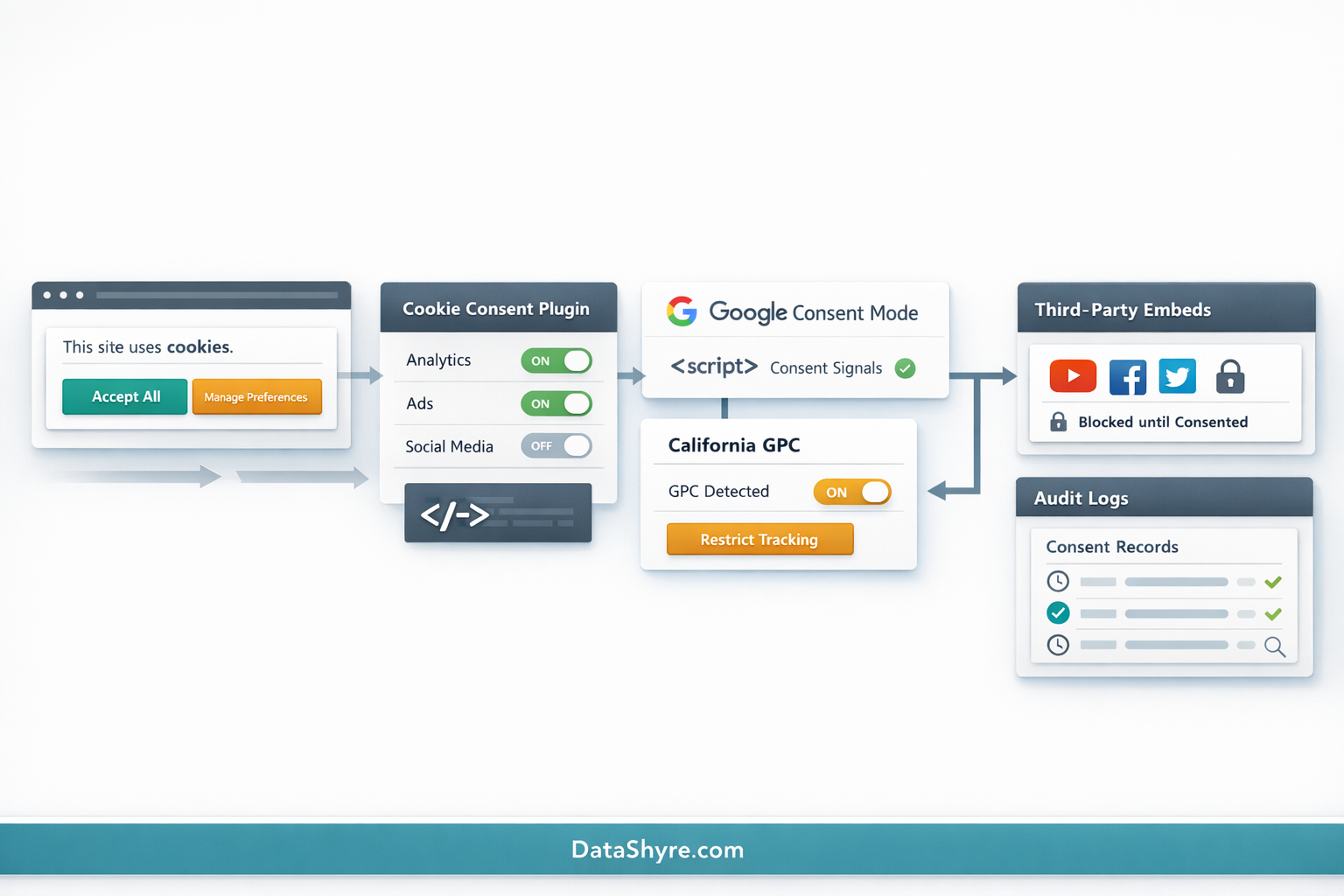
5. Separate the EU and UK prior-consent branch from the California opt-out branch
One wordpress cookie consent flow does not always fit every audience.
For EU and UK traffic, the live question is often whether non-essential storage or access waits for valid prior consent. The EDPB’s practical consent examples still say scrolling or swiping is not a clear affirmative action for consent. That means passive-browse banners and implied-consent shortcuts are still weak patterns.
California is different. The California DOJ’s current CCPA material still says businesses covered by the law must honor Global Privacy Control where relevant, and the DOJ still describes GPC as a “stop selling or sharing my data switch.” On February 11, 2026, Attorney General Rob Bonta announced California’s Disney settlement, which required Disney to implement opt-out methods that fully stop sale or sharing and to effectuate opt-out choices across associated services.
So if your wordpress cookie consent setup touches remarketing, audience sharing, or third-party advertising, test a California branch separately:
- enable GPC in the browser;
- load the site fresh;
- verify sale-or-sharing related behavior changes where it should;
- confirm the notice and runtime behavior match;
- test whether account-linked or multi-property logic still honors the choice.
One polished banner does not automatically cover both prior consent and downstream opt-out obligations.
6. If you serve Google publisher ads, verify the CMP requirement separately
Not every WordPress site needs this branch, but many content sites do.
Google’s current AdSense help documentation still says publishers using AdSense, Ad Manager, or AdMob must use a Google-certified CMP integrated with the IAB Transparency and Consent Framework when serving personalized ads to users in the EEA and UK. Google says that requirement has applied there since January 16, 2024, and in Switzerland since July 31, 2024.
For wordpress cookie consent, that means your plugin short list should change if your site serves publisher ads in those regions. A banner that looks acceptable from a pure UX standpoint may still be the wrong operational choice if it cannot support the certified-CMP path you actually need.
7. Make withdrawal easy, persistent, and stable after updates
The final wordpress cookie consent check is whether the control survives normal site life.
The European Commission still says withdrawal should be as easy as giving consent. In practice, WordPress teams should test whether users can reopen settings from a visible control, reverse an earlier choice, and see the technical result change without waiting for a manual support intervention.
I would also treat these as automatic retest triggers:
- plugin additions or updates;
- theme or page-builder changes;
- GTM, analytics, or ad-tech changes;
- cache, defer, minification, or CDN changes;
- new embeds, chat tools, forms, or media blocks.
That discipline matters because wordpress cookie consent often breaks through routine operational drift rather than a dramatic redesign.
A short review order for this week
If I were reviewing wordpress cookie consent today, I would use this order:
- inventory every storage, access, and third-party call path;
- test default denied states before any optional tags fire;
- compare the path to reject with the path to accept;
- test embed-heavy and plugin-heavy pages, not only the homepage;
- run a California GPC branch where sale or sharing may matter;
- confirm any Google publisher-ad requirement separately;
- retest after the next site change.
That sequence catches more real problems than another round of banner wording by itself.
FAQ
Do all WordPress sites need a cookie banner?
No. The answer depends on what technologies the site uses, where visitors are located, and whether the relevant storage or access is strictly necessary. Many marketing-driven WordPress sites use analytics, advertising, embeds, or personalization tools that make consent controls relevant quickly.
Is one consent plugin enough?
Sometimes, but only if it governs what actually runs. If tracking also comes from GTM, theme code, embeds, or custom scripts, a single plugin may still need careful integration and repeated testing.
Does scrolling count as consent?
No. The EDPB’s practical consent examples still say scrolling or swiping through a page is not a clear affirmative action for consent.
Bottom line
Good wordpress cookie consent in 2026 is not a banner design exercise.
It is a runtime control problem. You need clear first-layer choices, denied defaults that land before optional tags run, plugin and embed behavior that actually respects those choices, separate regional logic where the law expects it, and a withdrawal path that still works after the site changes.
If those pieces line up, your banner is supporting a real consent system. If they do not, the banner may look finished while the live WordPress behavior is still making promises it cannot keep.
Sources
- WordPress Plugin Handbook, Privacy: https://developer.wordpress.org/plugins/privacy/
- WordPress Detailed Plugin Guidelines: https://developer.wordpress.org/plugins/wordpress-org/detailed-plugin-guidelines/
- European Commission, legal grounds for processing data: https://commission.europa.eu/law/law-topic/data-protection/information-business-and-organisations/legal-grounds-processing-data_en
- EDPB, practical examples for consent: https://www.edpb.europa.eu/system/files/2026-04/edpb-summary-consent_en.pdf
- CNIL, dark patterns in cookie banners: https://www.cnil.fr/en/dark-patterns-cookie-banners-cnil-issues-formal-notice-website-publishers
- ICO, final storage and access technologies guidance published: https://ico.org.uk/about-the-ico/media-centre/news-and-blogs/2026/04/final-storage-and-access-technologies-guidance-published/
- ICO, guidance on the use of storage and access technologies: https://ico.org.uk/for-organisations/direct-marketing-and-privacy-and-electronic-communications/guidance-on-the-use-of-storage-and-access-technologies/
- Google for Developers, set up consent mode on websites: https://developers.google.com/tag-platform/security/guides/consent
- Google for Developers, troubleshoot consent mode with Tag Assistant: https://developers.google.com/tag-platform/security/guides/consent-debugging
- Google AdSense Help, consent management requirements for publishers: https://support.google.com/adsense/answer/13554116
- California DOJ, Global Privacy Control: https://oag.ca.gov/privacy/ccpa/gpc
- California DOJ, Disney settlement announcement: https://oag.ca.gov/news/press-releases/california-wont-let-it-go-attorney-general-bonta-announces-275-million
—
Published: October 20, 2026. Updated using current official regulator, government, WordPress developer, and Google platform materials available at publication time.