

Cookie Consent Message in 2026: 7 Live Checks Before You Publish
If you are searching for cookie consent message guidance in 2026, the real question is not whether your banner sounds professional.
The real question is whether the message gives people a genuine choice, matches the technical behavior of the site, and still makes sense across the regions where your traffic lands.
If you want nearby context first, start with our guides to cookie consent, cookie consent requirements, and cookie consent manager. This page is narrower. It is the seven-check review I would use this week before trusting any cookie consent message on a live site.
What a cookie consent message has to carry now
A strong cookie consent message is not just a sentence at the bottom of the screen.
It has to connect five things:
- the first-layer wording people actually read;
- the choices they can actually make;
- the categories or purposes the site really uses;
- the region-specific rules that shape those choices; and
- the technical state the browser enters after the click.
That is why the official guidance still matters. The European Commission says a consent request should use “clear and plain language” and that withdrawal should be “as easy to use as giving consent.” The ICO’s finalized storage-and-access-technologies guidance, published on April 29, 2026, also makes the scope broader than classic cookies by covering tracking pixels, scripts, device fingerprinting, and similar technologies. So the message cannot be written as if the only issue is one analytics cookie.
1. Write the first layer in plain language about real purposes
The first cookie consent message check is the wording itself.
If the banner says only “We value your privacy” and leaves the real point vague, the user still does not know what the site is asking for.
The European Commission’s current guidance still points in the right direction. Consent must be informed, specific, and presented in clear language. So the first layer should name the real purposes in normal words:
- site operation if that is relevant;
- analytics or measurement;
- advertising or personalization; and
- any follow-up path for detailed settings.
That does not mean the first layer has to be long. It means it has to say something concrete.
2. Make refusal as easy to understand and use as acceptance
This is where many cookie consent message reviews still fail.
CNIL’s current position is blunt: rejecting cookies should be “just as easy as accepting them.” California enforcement language pushes in the same direction. The CPPA’s advisory on dark patterns says businesses should offer symmetry in choice, and its enforcement announcement captured the principle in one short line: “Dark patterns aren’t about intent, they’re about effect.”
That means a serious message review should check:
- whether
Reject allis available whereAccept allappears; - whether the wording on both choices is equally explicit;
- whether the more privacy-protective path takes more steps; and
- whether mobile layout quietly favors acceptance.
If the words look compliant but the path to say no is longer or weaker, the cookie consent message is still doing the wrong job.
3. Do not imply consent from scrolling, swiping, or continued browsing
Some weak cookie consent message patterns still try to turn passive behavior into permission.
The EDPB’s practical consent examples still say scrolling or swiping through a page is not a clear affirmative action. The same summary also gives a useful cookie-wall example: if the person cannot access the content without clicking accept, the choice is not freely given.
So remove the patterns that still cause trouble:
- “By continuing to browse, you agree…”
- banners with only an
OKbutton and no refusal path; - content blocks that force acceptance of optional tracking; and
- wording that mixes necessary site functions with optional advertising as if they were one choice.
Those shortcuts make the message look simpler while making the consent logic weaker.
4. Name categories the way a normal visitor can understand them
The next cookie consent message check is whether the category labels help or hide.
Many banners still use labels that are technically familiar to the privacy team but muddy for everyone else. If the user opens preferences and sees a list that feels abstract, the message has not finished its job.
I would rather see a short list like this:
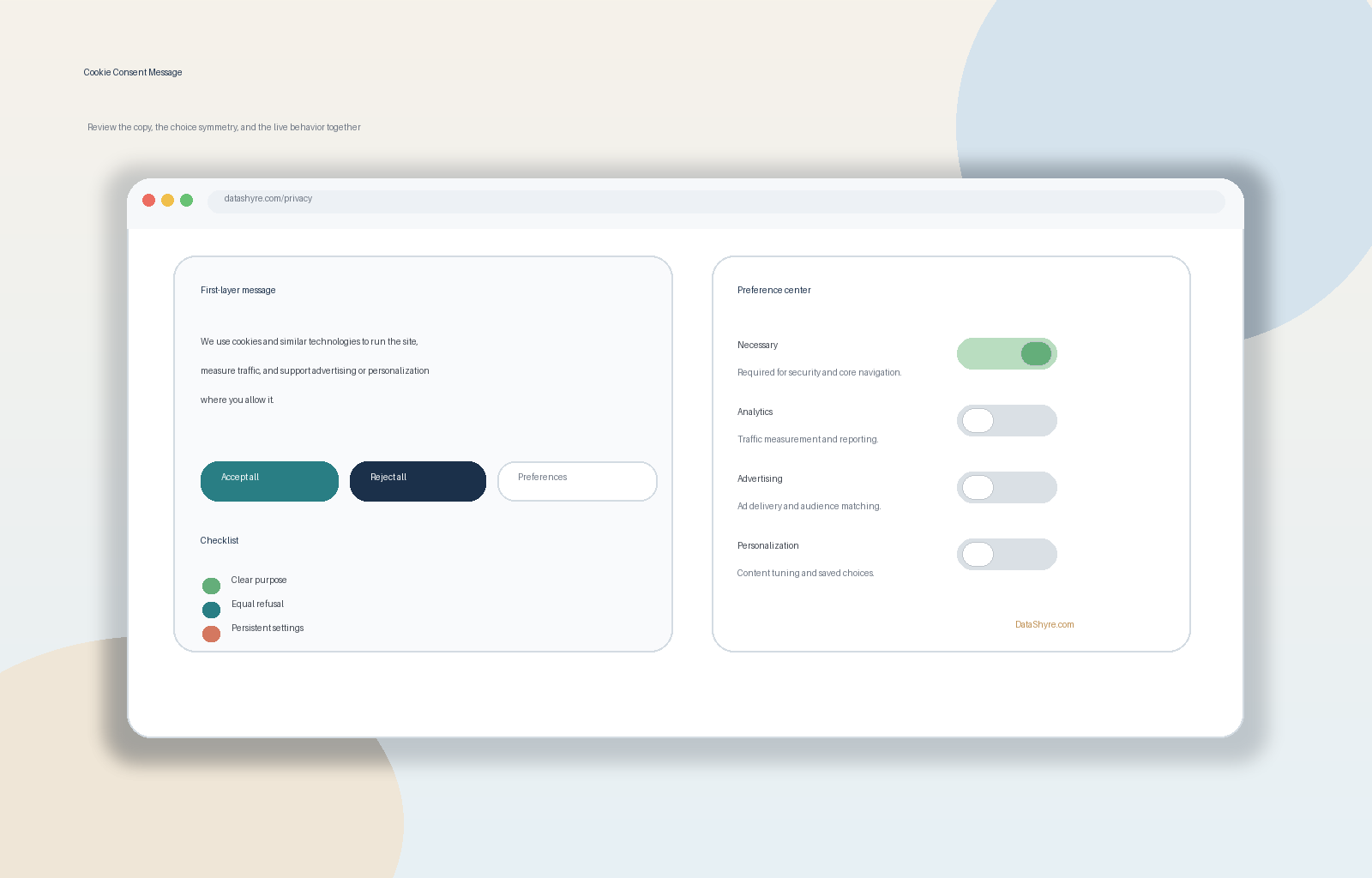
NecessaryAnalyticsAdvertisingPersonalization
Then pair those labels with one-line explanations people can decode quickly. The message should not pretend all optional tools do the same thing.
A working starting point for message copy
For most sites, a useful cookie consent message starting point looks more like this:
We use cookies and similar technologies to run the site, measure traffic, and support advertising or personalization where you allow it. You can accept all, reject optional technologies, or manage preferences. You can change your choice any time in Cookie Settings.
That copy is not universally sufficient on its own, but it is closer to what current guidance expects because it identifies purposes, presents choices, and tells the user where later control lives.
5. Match the message to the technical behavior behind it
This is where a polished cookie consent message often falls apart.
If the text says optional technologies stay off until the user decides, the browser result has to support that claim. The ICO’s 2026 guidance is useful here because it covers more than cookies. Scripts, pixels, and similar technologies also belong in the review.
So test at least these states:
- first visit with no saved preference;
- explicit reject;
- explicit accept;
- later withdrawal; and
- a fresh reload after each state.
The message is only trustworthy if the site’s actual requests line up with the choice it presents.
6. Keep regional branches inside the message logic
One cookie consent message does not always fit every traffic segment.
For EU and UK traffic, the working question is often whether non-essential storage or access waits for prior consent. In California, the message may also need to align with opt-out rights and browser-based privacy signals where sale or sharing is in scope. California’s Department of Justice still describes Global Privacy Control as a “stop selling or sharing my data switch.”
That means the message review should ask:
- does the EU and UK path explain the prior-consent choice clearly;
- does the California path fit the site’s actual sale or sharing logic;
- is GPC honored where it should be; and
- does the on-screen wording still match the branch the user is actually seeing.
If the site serves publisher ads, there is also a separate Google-specific branch. Google’s current AdSense guidance still says publishers serving personalized ads to users in the EEA and UK must use a Google-certified CMP integrated with the IAB TCF as of January 16, 2024, and that the same requirement applies in Switzerland as of July 31, 2024. That is not the whole legal story, but it can change what the message and stack need to support.
7. Make withdrawal visible and usable later
The best cookie consent message is not just about the first click.
The European Commission still says it should be as easy to withdraw consent as to give it. In practice, that means the message should connect users to a persistent settings path they can actually find later.
Check whether people can:
- reopen settings from any page where that promise was made;
- reverse an earlier choice without extra friction;
- see the technical result update after the change; and
- understand what changed after withdrawal.
If the banner disappears forever and the site offers no obvious return path, the first-layer message overpromised.
A short review order for this week
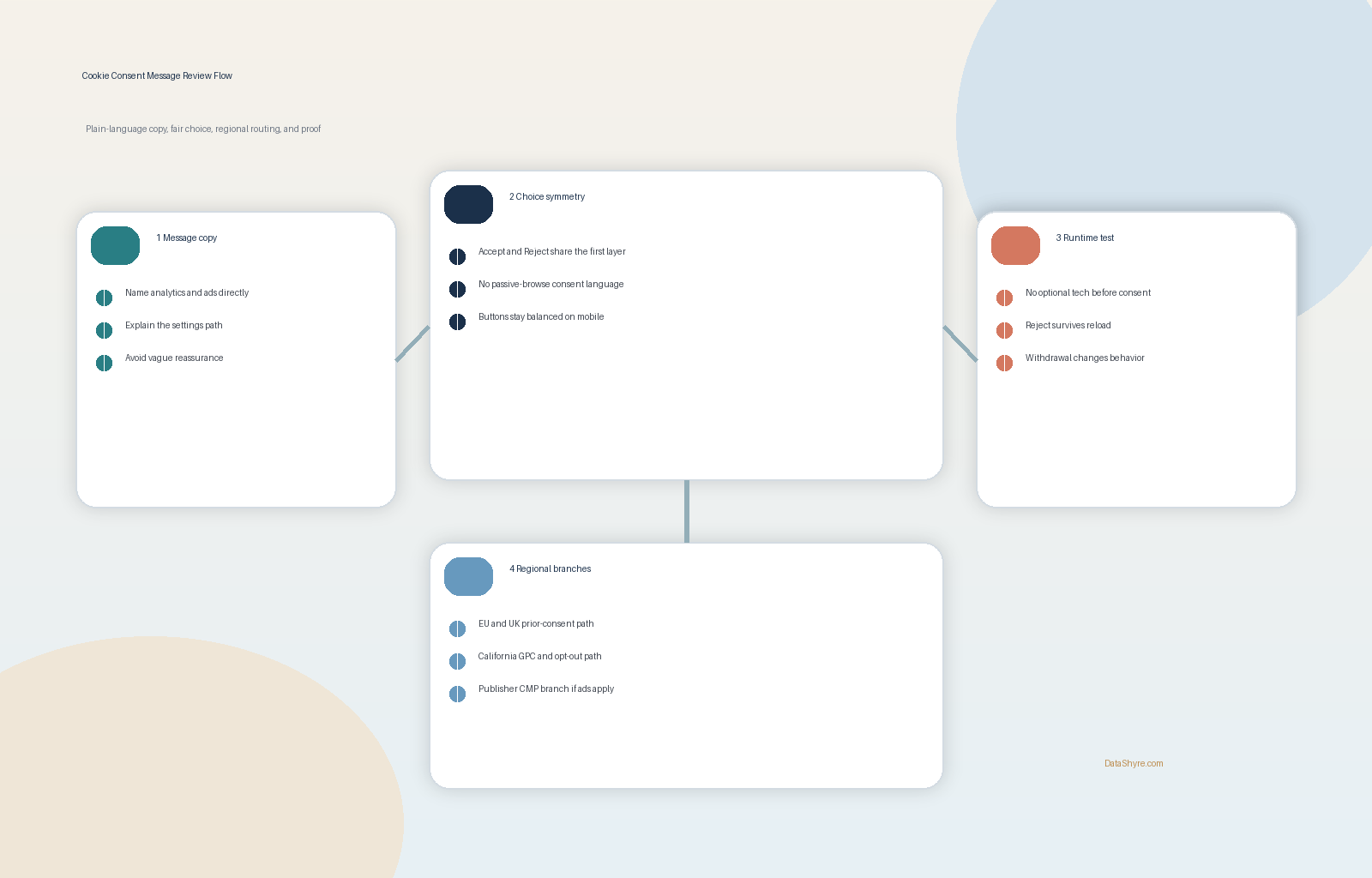
If I were reviewing a cookie consent message today, I would use this order:
- read the first-layer copy out loud and remove vague language;
- compare the path to reject against the path to accept;
- test whether scrolling or passive browsing is treated as consent;
- open the detailed preferences and simplify category labels;
- inspect browser behavior before and after each choice;
- verify the California and GPC branch separately where relevant; and
- split out the Google publisher branch if personalized ads matter.
That sequence usually exposes the real weakness faster than another round of button-color debate.
FAQ
Does every cookie consent message need a reject-all button?
Where prior-consent rules apply and Accept all is offered on the first layer, a missing or buried refusal path is a major risk. CNIL’s current position is that rejecting should be just as easy as accepting.
Does scrolling count as consent in 2026?
No. The EDPB’s practical examples still say scrolling or swiping is not a clear affirmative action for consent.
Can one banner message cover EU, UK, California, and publisher-ad traffic?
Sometimes, but only if the message and routing still reflect the real differences in choice model, opt-out handling, and technical behavior. One generic message can become misleading faster than teams expect.
Bottom line
In 2026, a strong cookie consent message is not just friendly copy.
It is clear about purpose, fair about refusal, honest about what the site really does, aligned with regional branches, and backed by settings and technical behavior that still hold up after the first interaction.
If those pieces line up, the message is doing its job. If they do not, the banner may look finished while the actual cookie consent message is still making promises the site cannot keep.
Sources
- European Commission: Legal grounds for processing data
- EDPB: Practical examples on consent
- ICO: Final storage and access technologies guidance published, April 29, 2026
- CNIL: Dark Patterns in Cookie Banners: CNIL issues formal notice to website publishers
- California Department of Justice: Global Privacy Control
- CPPA Enforcement Advisory No. 2024-02: Avoiding Dark Patterns
- Google AdSense Help: Google consent management requirements for serving ads in the EEA, the UK, and Switzerland (for publishers)