

GDPR Consent Email in 2026: 7 Live Checks Before You Hit Send
If you are reviewing gdpr consent email on October 13, 2026, the first thing to drop is the idea that one repermission message can repair a weak list by itself.
That is not what the current official guidance says. The European Commission still says valid consent must be freely given, specific, informed, and unambiguous, with a clear affirmative act and wording in “clear and plain language.” The ICO’s electronic-mail marketing guidance, updated on April 28, 2026, still says unsolicited marketing emails to individuals usually need consent unless a narrow soft opt-in applies. And the CNIL refreshed both its commercial-prospecting and electronic-communications guidance on June 10, 2026, then added 2026 recommendations on email tracking pixels.
So a gdpr consent email is not mainly a copy problem. It is a workflow problem. You are checking whether the person can be emailed at all, whether the permission is narrow enough to defend, whether the no path is real, and whether your records still make sense after the next sync, vendor change, or campaign launch.
If you want the closest companion reads first, start with our guides to GDPR marketing consent, GDPR consent form, and GDPR compliant privacy notice. This article stays narrower. It is the seven-check review I would use before trusting a gdpr consent email workflow this week.

1. Decide whether the message is marketing at all
This is the first filter because teams often label a message as “administrative” when it is really trying to drive future sales.
The CNIL’s current guidance on electronic communications says relationship messages can support an existing customer relationship without relying on prior consent, but a message can still be reclassified as commercial prospecting if it promotes offers, encourages more use, or pushes the recipient toward a purchase. That matters for gdpr consent email because the legal analysis changes fast once the message becomes marketing.
If the email includes product offers, upsell prompts, event promotions, or partner content, review it as marketing first and only relax that conclusion if the content is genuinely service-only.
2. Confirm why you are allowed to contact the person
For most consumer email marketing, the default answer is still prior consent.
The ICO’s current PECR guidance says marketing emails to individuals usually need specific consent, with a limited soft opt-in where the details were collected during a sale or negotiations for a sale, the marketing is for your own similar products or services, and the person had a simple chance to refuse both at collection and in every later message. The charitable soft opt-in that commenced on February 5, 2026 is real, but it is limited to qualifying charity scenarios rather than ordinary commercial campaigns.
For gdpr consent email, that means you should be suspicious of plans built around old event lists, bought leads, dormant accounts, or vague “selected offers” language. If the lawful route is fuzzy, the email is already the wrong fix.
3. Make the permission specific to the sender, channel, and purpose
A usable consent record does not say only that the person “agreed to marketing.”
The European Commission says a consent request must clearly state all the reasons for the processing and explain that consent can be withdrawn. The ICO’s current direct-marketing guidance says people must take a “positive action to consent” and that the consent should cover the organization and the type of communication you actually want to send.
In practice, a stronger gdpr consent email setup usually answers all of these questions without guesswork:
- who is sending the email;
- what category of email the person is agreeing to receive;
- whether the choice covers email only or several channels;
- whether any third party is involved;
- how the person can reverse the decision later.
If your preference language blurs newsletters, product promotions, webinars, and partner offers into one checkbox, the permission is weaker than it looks.
4. Do not use a consent email to launder third-party or partner data
This is still one of the riskiest patterns in gdpr consent email work.
The European Commission’s marketing guidance says that before acquiring a contact list from another organization, that organization must be able to show the data was collected lawfully. If consent was the basis, it should also have covered transmission to other recipients for their own direct marketing. The CNIL’s current partner-data guidance points the same way: where electronic marketing requires consent, the organization transferring the data has to obtain that consent for the transmission itself.
So if your idea is “we will email the whole third-party list once and clean up the rest later,” stop there. A repermission email does not automatically cure a weak source list.
5. Send the click to a real preference center with a real no path
The email is only the front door. The defensible choice usually happens on the page behind it.
The European Commission says consent requests must be clearly distinguishable, easy to understand, and as easy to withdraw as to give. The CNIL’s current guidance says valid consent needs a dedicated unticked checkbox or another equally clear positive step. That is a practical standard for gdpr consent email because it translates law into interface review.
The preference destination should let a person:
- understand exactly what each email choice covers;
- refuse without hunting for a hidden link;
- choose categories separately where more than one purpose exists;
- leave with a result your systems can enforce immediately.
If the landing page offers a bright confirm button and turns refusal into a scavenger hunt, the evidence record is weaker than the campaign team thinks.
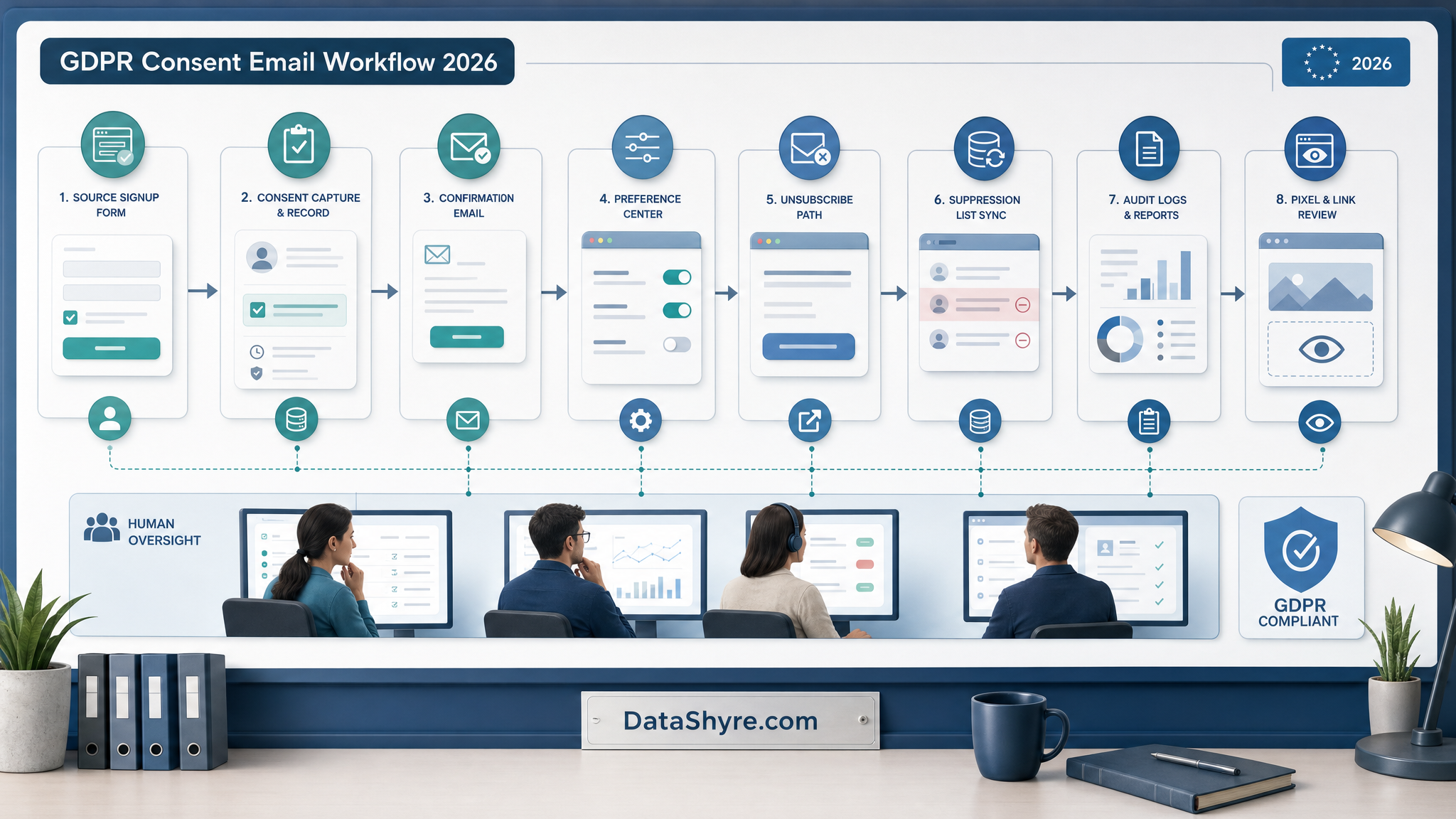
6. Keep proof that reconstructs what the person actually saw
For gdpr consent email, a timestamp is not enough.
The European Commission says the controller must be able to demonstrate that the person consented. The ICO’s guidance says you should keep records of who consented, when, and how, so you can demonstrate compliance if challenged.
A stronger record usually preserves:
- the source page, form, or email that drove the action;
- the exact wording shown at the time;
- the named sender or brand;
- the purpose or category selected;
- the date, time, and system event;
- later unsubscribe or preference changes.
If your team cannot reconstruct that story without digging through screenshots, ticket threads, and half-synced CRM notes, the program is relying on memory instead of proof.
7. Separate email permission from tracking-pixel permission
This is one of the most useful 2026 reminders.
The CNIL’s April 14, 2026 recommendation on email tracking pixels says these pixels raise their own privacy issues, and its later FAQ says the fact that an email may be sent without consent under marketing rules does not automatically exempt the tracking pixel inside it from consent rules. The ICO makes the same distinction in its storage-and-access guidance: most electronic mail marketing sits under PECR’s marketing rules, but tracking pixels can also trigger PECR’s separate storage-and-access provisions.
So a serious gdpr consent email review should ask two separate questions:
- were we allowed to send this marketing email?
- were we allowed to use the pixel, identifier, or measurement method inside it?
That separation matters because an email program can look compliant at the list level while still creating risk through invisible measurement.
A practical structure for a gdpr consent email
If I were rewriting a gdpr consent email flow this week, I would keep it boring in the right way:
- name the sender clearly;
- state the exact email category being requested;
- send the click to a preference center with a visible yes and no path;
- avoid bundling partner promotions unless each controller and purpose can be understood;
- record the result immediately;
- preserve the unsubscribe path in every later message.
A simple example is:
Email me product updates and occasional privacy webinar invitations from DataShyre.
That line is still only one piece of the system, but it is closer to a defensible gdpr consent email than vague language about “selected offers from us and trusted partners.”
What I would check before approving the send
Before I would sign off on a gdpr consent email campaign, I would want clear answers to these questions:
- why are we contacting this audience at all;
- are we relying on consent, a genuine soft opt-in, or a service-message rationale;
- what exact wording did this segment previously see;
- can the person refuse as easily as they can accept;
- will every downstream tool honor the result quickly;
- are tracking pixels or similar identifiers reviewed separately from the email permission itself.
If those answers are fuzzy, the safest fix is usually not a stronger subject line. It is a cleaner collection, preference, and suppression workflow.
Bottom line
The safest way to think about gdpr consent email in 2026 is not “how do we get one more click?” It is “can we prove the person was contacted lawfully, asked clearly, answered freely, and can change their mind easily later?”
If the answer is yes, the workflow may be defensible. If the answer depends on bundled purposes, shaky source data, hidden no paths, or silent tracking, the real fix sits underneath the email.
Sources
- European Commission: Information for individuals
- European Commission: Legal grounds for processing data
- European Commission: Can data received from a third party be used for marketing?
- ICO: Guidance on direct marketing using electronic mail
- ICO: How do we comply with the PECR electronic mail marketing rules?
- ICO: Charities given new flexibility to contact supporters under data law change
- ICO: What are storage and access technologies?
- CNIL: La prospection commerciale par courrier électronique, SMS-MMS et automate d’appel
- CNIL: Communications par voie électronique aux prospects et clients : quelles règles respecter ?
- CNIL: Pixels de suivi dans les courriers électroniques : la CNIL publie ses recommandations pour mieux protéger la vie privée
- CNIL: Questions-réponses – recommandation relative aux pixels dans les courriers électroniques de la CNIL
—
Published: October 13, 2026. Updated using current official European Commission, ICO, and CNIL materials available at publication time.