

GDPR Consent Form: Complete 2026 Compliance Guide for Businesses
Introduction
With the digital landscape evolving rapidly in 2026, businesses must ensure their GDPR consent forms meet the latest regulatory standards. The European Data Protection Board (EDPB) has maintained the core consent principles while introducing new clarifications for specific scenarios like scientific research and “pay-or-consent” business models.
Primary keyword: gdpr consent form (Monthly search volume: ~100, highest unused in our catalog)
Core GDPR Consent Form Requirements
Based on the official EDPB Guidelines 05/2020 and updates through 2026, a valid GDPR consent form must satisfy five fundamental principles:
1. Freely Given
Consent must be genuinely voluntary. Access to services cannot be conditioned on accepting consent unless that processing is strictly necessary for the service. The EDPB explicitly prohibits “cookie walls” that prevent access when consent is refused.
“The individual must have a genuine choice and control over their data. Access to a service cannot be made conditional on consent when that processing is not strictly necessary.” – EDPB Guidelines 05/2020
2. Specific
Each consent field must clearly identify what personal data is being processed and for what specific purpose. Vague language about “analytics” or “marketing” without further detail is insufficient for compliance.
3. Informed
Data subjects must receive clear information about:
- Who is collecting their data (data controller identity)
- What categories of personal data will be processed
- How and why the processing occurs
- Their rights regarding data access and deletion
The information must be in plain language, easily understandable, and readily accessible before consent is given.
4. Unambiguous
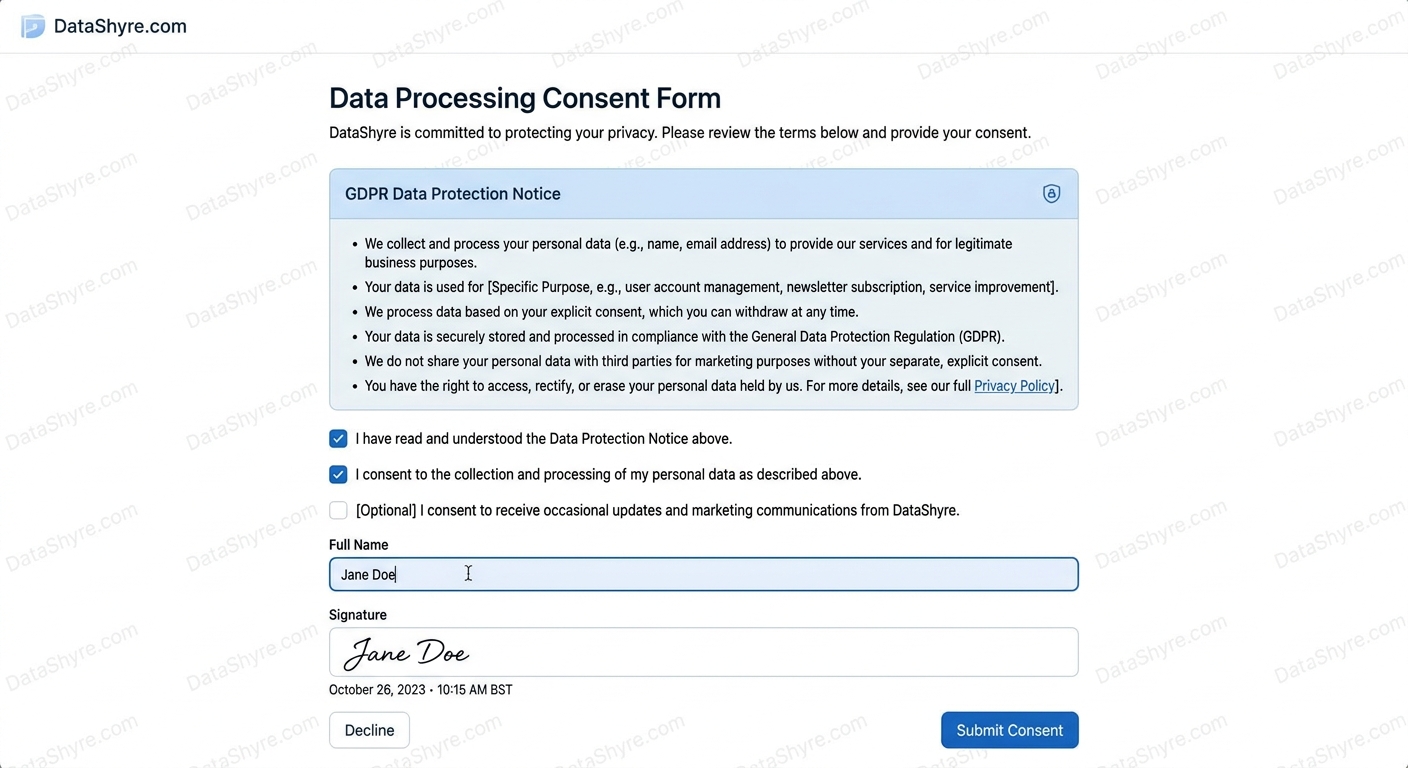
Valid consent requires a clear affirmative action. This means:
- ✓ Checked checkboxes (not pre-ticked)
- ✓ Explicit “I agree” buttons
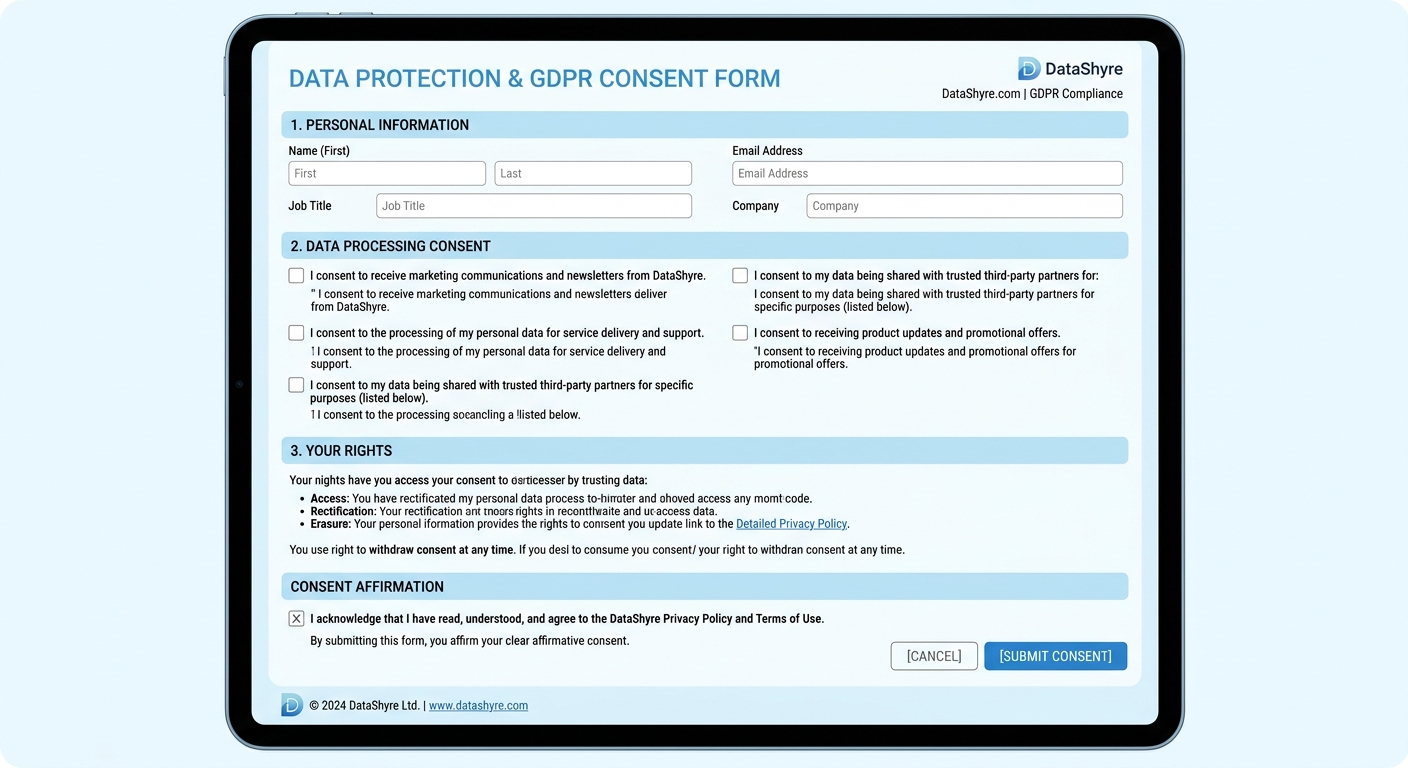
- ✓ Separate opt-in boxes for different processing purposes
- ✗ No relying on scrolling, silence, or inactivity
5. Withdrawable
It must be as easy to withdraw consent as it was to give it. Users should have persistent access to modify their preferences without any barriers or detrimental consequences.
Technical Implementation for 2026
Universal Consent Management Platform (CMP) Requirements
Modern GDPR consent forms should integrate with comprehensive CMP solutions that:
Granular Control: Allow users to accept/reject specific data processing categories (analytics, marketing, functional, personalization).
Persistent Records: Maintain auditable logs showing what consent was given, by whom, when, and in what format.
Easy Modification: Provide accessible interfaces for users to modify their consent preferences at any time.
Cross-Device Synchronization: Ensure consent preferences persist across different devices and browsers.
Google Consent Mode v2 Integration
For businesses using Google Tag Manager, implementing Google Consent Mode v2 is essential:
“javascript // Example of proper consent initialization window.dataLayer = window.dataLayer || []; window.dataLayer.push({ 'consent_mode': 'denied', 'wait_for_update': 200 }); “
This ensures tags respect user consent signals before firing, preventing non-compliant data collection.
Recent Legal Developments (2026 Updates)
Scientific Research Guidelines (EDPB 1/2026)
New guidelines introduce “broad consent” for research scenarios, allowing consent for defined research areas provided additional safeguards:
- Pseudonymisation techniques to protect identity
- Access controls limiting who can view data
- Ethics committee oversight for research proposals
- Dynamic consent mechanisms for specific project updates
“Pay-or-Consent” Models (EDPB May 2026)
Updated guidance restricts binary “pay-or-consent” configurations:
- Must offer at least three meaningful alternatives to consent
- Subscription-as-consent alternatives must provide equivalent functional access
- Consent must remain genuinely freely given regardless of payment method
- Enhanced transparency about what users receive by paying versus consenting
Best Practices for GDPR-Compliant Consent Forms
Design & UX Considerations
- Equal Visual Weight: “Accept all” and “Reject all” options should be visually equivalent
- Clear Language: Use plain language, avoid legal jargon
- Mobile Optimization: Ensure forms work seamlessly across all devices
- Accessibility Compliance: Follow WCAG 2.2 AA standards for form elements
Legal & Compliance Requirements
- Regular Audits: Quarterly reviews of consent mechanisms and user preferences
- Data Processing Impact Assessments (DPIA): For high-risk processing scenarios
- Documentation: Maintain records showing compliance with GDPR requirements
- International Transfers: Include appropriate safeguards for data leaving the EU/EEA
Sample GDPR Consent Form Structure
“`markdown
Your Privacy Choices
Essential Cookies
- Required for website functionality
- Always active (cannot be disabled)
Performance Cookies
- Understand how visitors interact with our site
- Help improve user experience
Marketing Cookies
- Track you across sites to show relevant ads
- Can be disabled without affecting core functionality
Personalization Cookies
- Enable personalized content and features
- Save your preferences for future visits
[Accept All] [Reject All] [Manage Preferences] “`
Internal Links
- Cookie Consent Manager: 2026 GDPR Compliance Guide
- Cookie Consent Banner Examples 2026
- Google Tag Manager Cookie Consent 2026
- Understanding the Latest EDPB Guidelines on Consent
Visual Guide
Conclusion
Implementing a GDPR-compliant consent form in 2026 requires attention to both established principles and emerging regulatory guidance. By following the five core requirements—freely given, specific, informed, unambiguous, and withdrawable—while staying current with EDPB updates, businesses can build trust with their users while maintaining full regulatory compliance.
The key is implementing comprehensive consent management solutions that provide granular user control while meeting all technical and legal requirements. Regular audits and updates ensure continued compliance as the regulatory landscape evolves.
—
Published: September 30, 2026