

GDPR Marketing Consent in 2026: 7 Checks Before You Send, Share, or Track
If you are revisiting gdpr marketing consent on August 6, 2026, the hard part is usually not writing a prettier checkbox line. It is deciding whether consent is actually the right lawful basis, whether a channel-specific rule still forces opt-in, whether partner sharing was covered properly, and whether your team can later prove what a real person saw and chose.
That is still the right frame. The European Commission’s current guidance says valid consent must be freely given, informed, tied to a specific purpose, and given through a clear affirmative act. It also says the request should use clear and plain language, explain withdrawal, and be easy to reverse. The GDPR also gives people a separate right to object to direct marketing, and when they do, the company must stop.
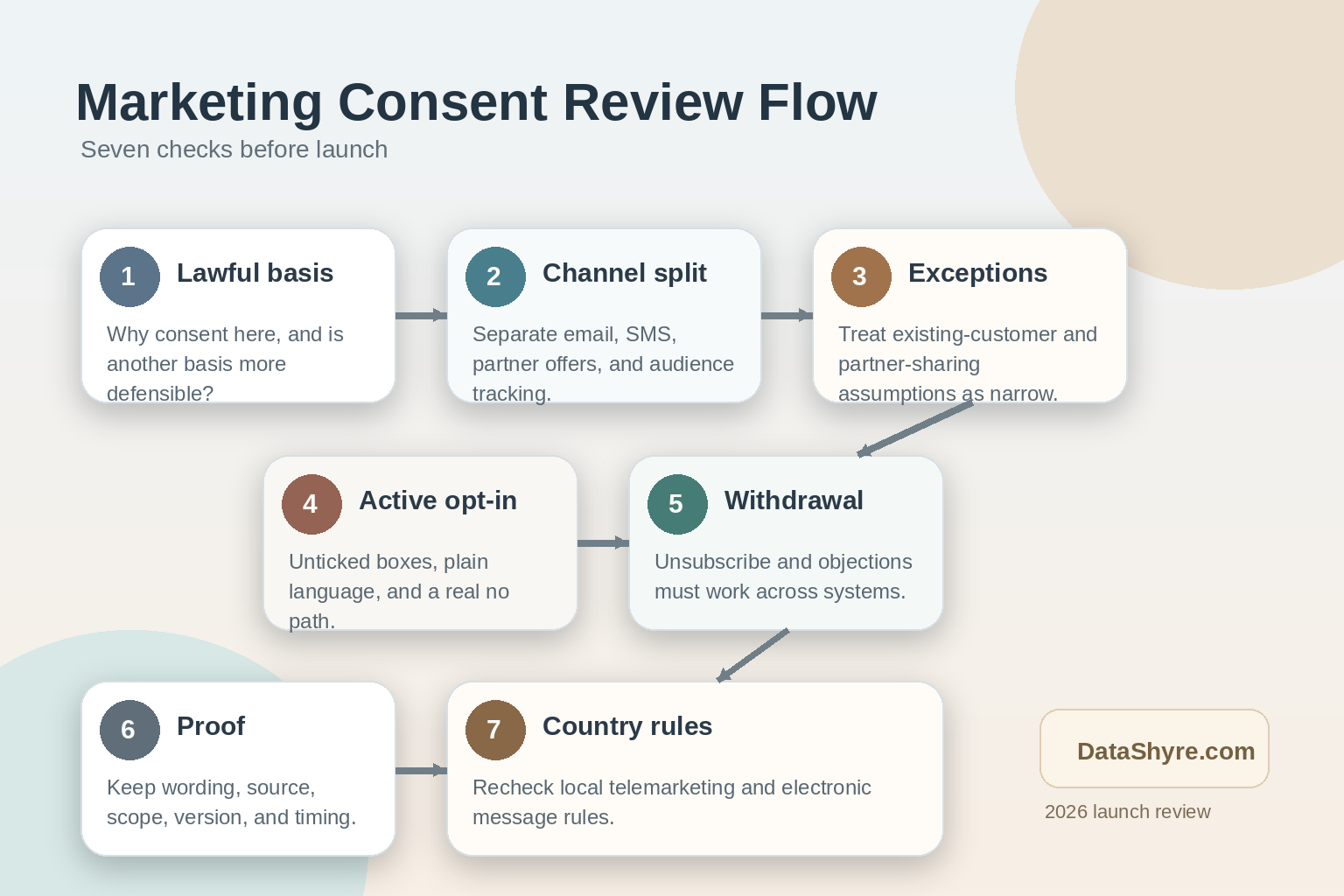
If you want the surrounding materials first, our guides to GDPR consent form, GDPR consent email, and marketing consent are the best companion reads. This article stays narrower. It is the seven-check review I would use before trusting a gdpr marketing consent workflow this week.
Why GDPR marketing consent still gets overused
The biggest mistake is often upstream from the checkbox.
Teams choose consent because it feels safer, then discover later that the campaign actually depended on several different legal questions:
- the GDPR lawful basis for processing;
- channel rules for email, text, or phone marketing;
- whether partner disclosure and data sharing were specific enough;
- whether objection and withdrawal routes really work; and
- whether proof is good enough to survive regulator or customer scrutiny.
That is why gdpr marketing consent should be treated as a governance check, not only as copy.
1. Confirm that consent is really the right lawful basis
The European Commission still presents consent as only one lawful basis among several. It sits alongside contract, legal obligation, public task, vital interests, and legitimate interests.
That matters because some direct marketing processing may rely on legitimate interests, while some channels or situations still require consent. The GDPR analysis and the messaging-channel analysis are related, but they are not identical.
The ICO’s current direct-marketing guidance still puts this plainly: the two lawful bases most likely to apply to direct marketing messages are consent and legitimate interests, while PECR can still affect that choice by requiring consent for some messages.
So the first question for gdpr marketing consent is not “How do we word the box?” It is “Why are we using consent here instead of another lawful basis, and does the channel law leave us any real choice?”
2. Split purpose, channel, and recipient
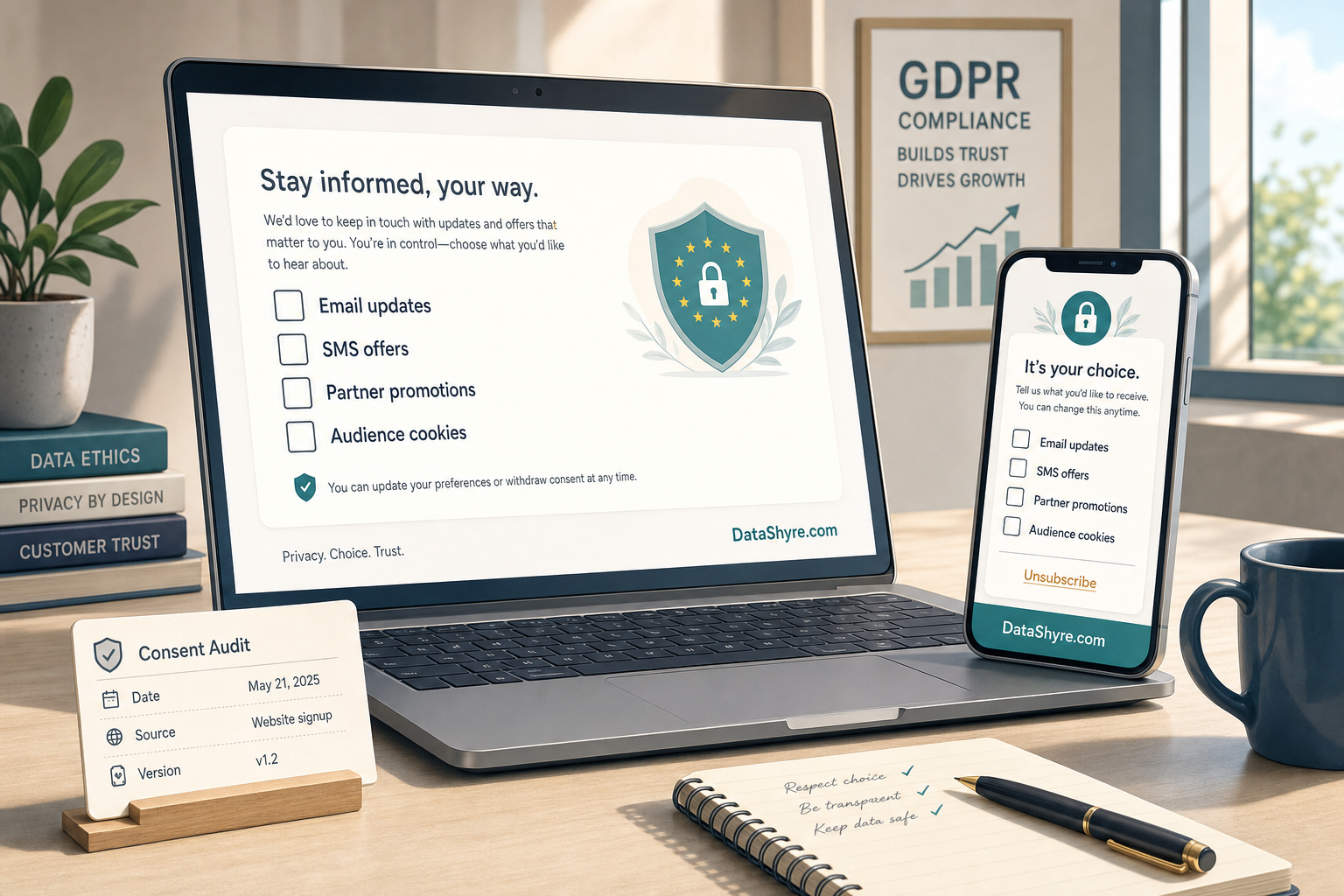
Valid consent still has to be specific. In practice, that means marketing permission should not be flattened into one vague yes.
Email updates are not the same as SMS promotions. Product news is not the same as partner offers. Audience-building cookies are not the same as newsletter signups. If several controllers want to rely on the same permission, that has to be spelled out clearly enough for the person to understand who will use the data and why.
This is where many gdpr marketing consent flows get too broad to defend later. They ask for one umbrella permission that really covers multiple channels, several purposes, and sometimes outside recipients the person would not reasonably expect.
3. Treat existing-customer and partner-sharing exceptions as narrow
One reason teams over-collect consent is that they do not trust exceptions. Another reason they under-collect it is that they overread those exceptions.
The ICO’s current electronic-mail guidance still says marketing emails and texts to individuals generally need “specific consent”, subject to a limited soft opt-in for your own previous customers. The CNIL’s current guidance on electronic communications says B2C marketing by email or SMS is, in principle, based on prior consent, with a limited existing-customer exception for similar products or services from the same company.
Partner sharing needs even more care. The European Commission’s current marketing page says that if a list was obtained on the basis of consent, that consent should have included the possibility of transmitting the data to other recipients for their own direct marketing.
That means a serious gdpr marketing consent review should ask:
- is this for our own marketing or somebody else’s;
- is the person truly an existing customer for this channel and offer;
- was the opt-out offered at collection and in later messages where an exception is used; and
- if a third party will market, was that third-party use actually covered?
4. Use active opt-in and make refusal genuinely possible
The European Commission’s current consent guidance still requires an affirmative act, clear language, and a visible request. CNIL’s current telemarketing page uses the same classic formulation for valid consent: it must be “libre, spécifique, éclairé et univoque” and must result from a positive action.
For gdpr marketing consent, that normally means:
- unticked boxes or an equivalent active step;
- no consent hidden inside terms or general account acceptance;
- no silence, scrolling, or inactivity treated as agreement;
- no single box that quietly covers multiple unrelated purposes.
The practical product test is simple. If the no path is confusing, buried, or softened until it barely exists, the yes is not very credible either.
5. Design withdrawal and objections before launch
This is the operational check many teams leave too late.
The European Commission says consent requests must clearly state that withdrawal is possible and gives the example of an unsubscribe link at the end of a newsletter or another method that is just as easy to use. It also says, in current guidance, that withdrawal should be “as easy to use as giving consent.”
That is only half of the story. The GDPR also gives people the right to object to direct marketing, and the European Commission’s current individuals page says that if someone objects to direct marketing, the company must stop using their personal data for that purpose.
So a working gdpr marketing consent flow should not end at collection. It needs:
- unsubscribes that actually suppress future outreach;
- preference updates that propagate across systems;
- suppression handling for partner or downstream sends where relevant; and
- a direct-marketing objection path that does not rely on manual cleanup days later.
6. Keep proof that reconstructs the real context
This is the part regulators keep steering toward.
On January 22, 2026, CNIL opened a consultation on proof of consent in the marketing sector because many marketing operations depend on consent and organizations need to be able to demonstrate that it was valid. CNIL also noted that these proof questions get harder when consent is collected across different methods or through complex chains such as data brokers.
For gdpr marketing consent, a timestamp alone is weak evidence. A stronger record usually shows:
- who collected the consent;
- the exact wording and version shown;
- the purpose, channel, and recipient scope;
- when and where the choice was made;
- what no path or opt-out route was offered at the time; and
- later withdrawals, objections, or preference changes.
If your team cannot reconstruct that story without joining five systems and guessing which form version was live, the proof model is thin even if the checkbox value says true.
7. Re-check country-level marketing rules before every campaign
The GDPR does not erase channel-specific national rules. That is where many cross-border campaigns drift.
France is a useful live example. CNIL’s current telemarketing guidance says that from August 11, 2026, consumers generally may not be contacted by commercial phone calls unless they gave prior consent or the call relates to an ongoing contract. That is a reminder that gdpr marketing consent cannot be handled as one pan-European checkbox that never changes by channel or market.
The same discipline applies to email and SMS. If your workflow touches EU member states, the UK, or Switzerland, check the country-level direct-marketing and electronic-communications rules attached to the channel before launch. The lawful basis analysis can be correct while the channel execution is still wrong.
A short pre-launch review
Before I would approve a gdpr marketing consent workflow, I would ask:
- Is consent truly the right lawful basis here?
- Are the purpose, channel, and recipient scope separated clearly enough?
- Are any existing-customer or partner-sharing assumptions actually supported?
- Does the person take a real affirmative step?
- Can they withdraw or object just as easily later?
- Can we prove what they saw and chose?
- Have we checked the country-specific channel rules for this launch?
That sequence catches more real problems than polishing the checkbox label one more time.
Bottom line
The strongest gdpr marketing consent setups in 2026 are not the ones that ask for consent the most often. They are the ones that ask only when they should, ask narrowly, honor the answer quickly, and keep records that still make sense later.
If your current flow cannot show that story across lawful basis, channel rules, partner scope, withdrawal, objections, and proof, the form may look finished while the compliance work is not.
Sources
- European Commission: Legal grounds for processing data
- European Commission: Information for individuals
- European Commission: Can data received from a third party be used for marketing?
- UK ICO: Guidance on direct marketing using electronic mail
- UK ICO: Electronic mail marketing
- UK ICO: Sending direct marketing: Choosing your lawful basis
- CNIL: Communications par voie électronique aux prospects et clients : quelles règles respecter ?
- CNIL: Marketing : la CNIL ouvre une concertation sur la preuve du consentement
- CNIL: Prospection commerciale par téléphone (hors automate d’appel) : quelles sont les règles ?
This post was updated on August 6, 2026 using current official European Commission, ICO, and CNIL materials available at publication time.