

Opt In Consent in 2026: Where You Need It and Where You Usually Don’t
Teams often treat opt in consent as the safe answer to every privacy question. It is not. In July 2026, the better question is narrower: when do the rules actually require consent, and when are you forcing a clumsy consent flow onto processing that should be handled some other way?
Under GDPR, consent has a defined standard. Article 4 says it must be freely given, specific, informed, and unambiguous, shown by a clear affirmative action. Article 7 adds two tests privacy teams still trip over: you must be able to prove consent, and it must be as easy to withdraw as it was to give.
That matters because bad consent is worse than no consent strategy at all. John Edwards, the UK Information Commissioner, put the cookie-banner version plainly in 2024: it must be “just as easy to reject all non-essential cookies” as it is to accept them. And in 2024, EDPB Chair Anu Talus said platforms should “give users a real choice” when they rely on consent.
If you are tightening the basics first, our guide to marketing consent is the closest companion piece. For banner design and implementation, it also helps to compare this topic with our cookie consent guide and these GDPR cookie consent examples.
What consent actually means
At a practical level, valid consent means the user takes a deliberate step before you process data for that purpose. No pre-ticked boxes. No passive scrolling. No “by continuing to browse, you agree” language. No hiding the withdrawal control three layers deep after signup.
It also means consent is purpose-bound. If you collect an email for receipts, that does not automatically cover newsletters. If you ask for analytics tracking, that does not automatically cover ad retargeting. And if you need explicit consent for sensitive data, ordinary opt-in wording may still be too weak.
Where businesses usually need it
1. Non-essential cookies and similar tracking
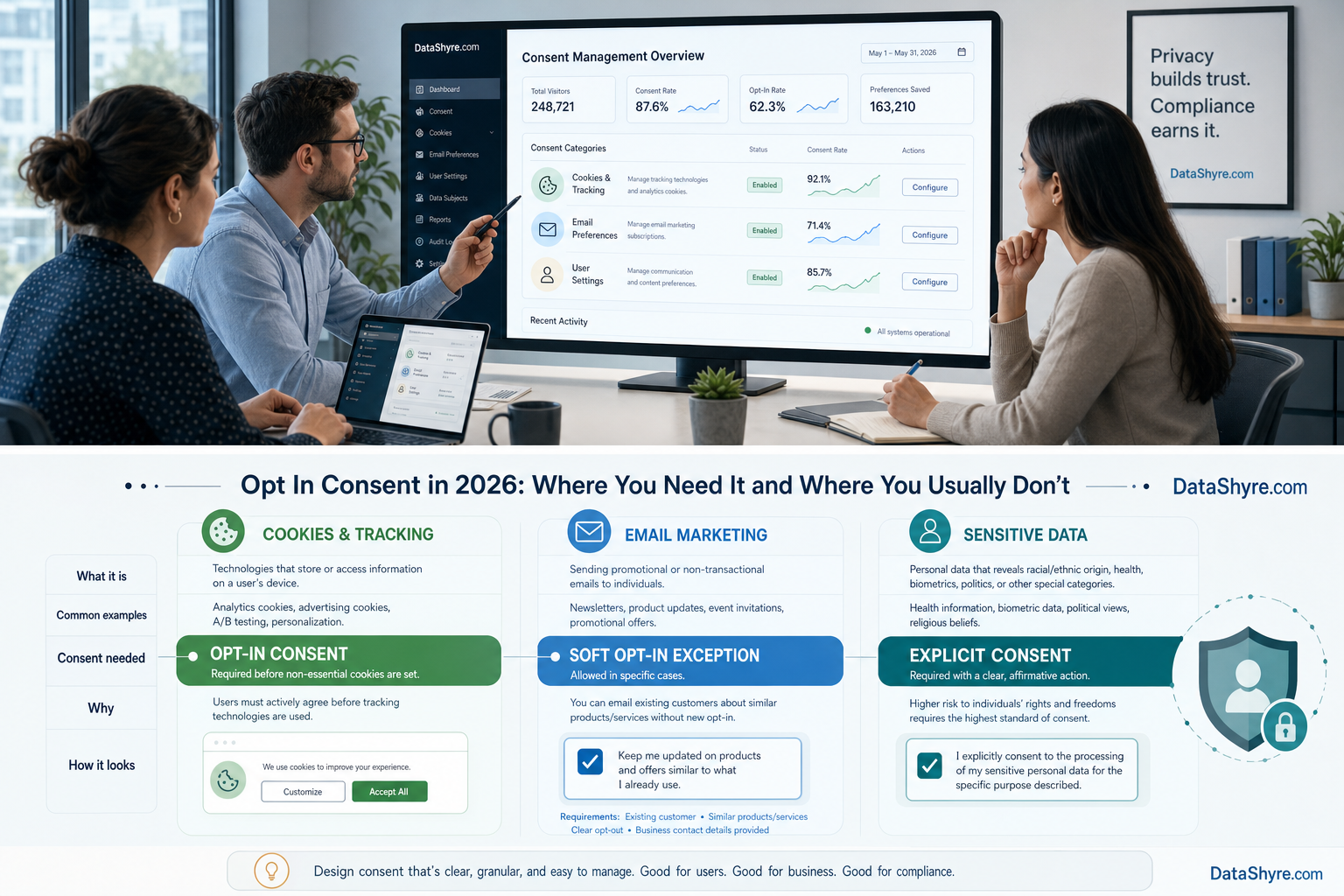
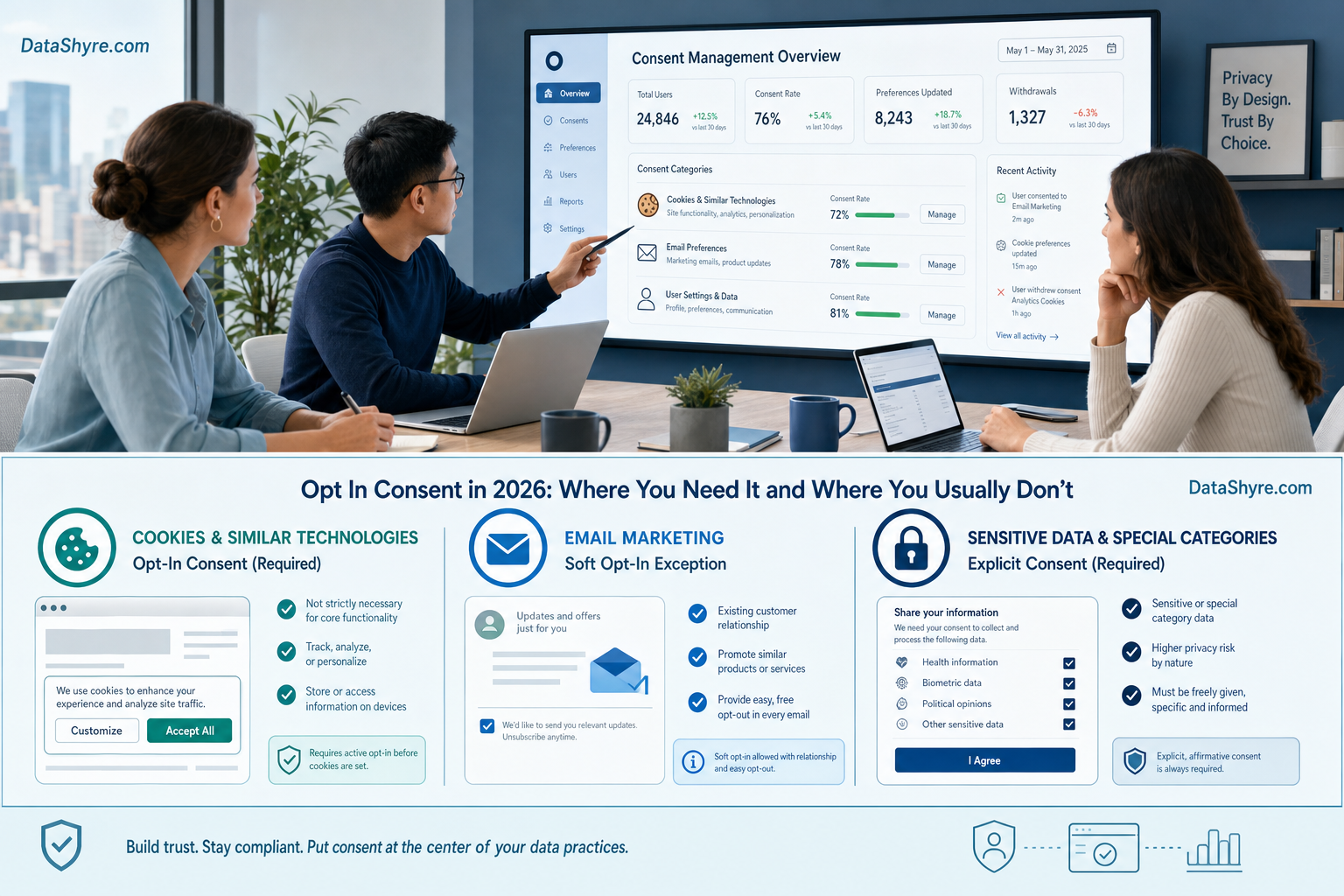
This is still the clearest use case. The ICO’s PECR guidance says you must tell people what cookies do, why you use them, and get consent before storing non-essential cookies on the device. There is a narrow exemption for cookies that are strictly necessary for the service the user asked for, such as a shopping basket or essential security session.
So if the tracker is there for advertising, personalization, measurement beyond the exemption, or cross-site profiling, opt in consent is usually the right frame. The reject path needs to be real, visible, and as usable as the accept path.
2. Marketing emails and texts to individuals
In the UK, the ICO’s guidance on electronic mail marketing still starts from a simple rule: do not send marketing emails or texts to individuals without specific consent, unless a limited soft opt-in applies. That soft opt-in is narrow. It is for your own existing customers or people who negotiated for similar products or services, and only if you offered a clear opt-out when you collected their details and in every message after that.
That means many lead-gen forms need a true opt-in box for email marketing. Bought lists do not fit the soft opt-in. New prospects do not fit it either. The ICO also updated its detailed electronic mail guidance on 28 April 2026 to reflect the new charitable soft opt-in added by the Data (Use and Access) Act 2025, which is a reminder that even small exceptions are rule-specific and should not be stretched.
3. Special category data when consent is your route
GDPR Article 9 raises the bar for special category data such as health data, biometric data used for identification, political opinions, religious beliefs, and similar sensitive categories. If you are relying on consent here, the rule is not just ordinary opt-in. It is explicit consent.
For product teams, that is the important distinction. A clean checkbox flow may be enough for a newsletter. It is not the same thing as the explicit statement you may need for a health questionnaire, sensitive profiling feature, or wellness app intake.
Where you usually do not need it
1. Strictly necessary cookies
If the cookie is genuinely essential to deliver the service a user requested, the consent requirement usually drops away. The classic examples are cart cookies, authentication security, and some load-balancing functions. Helpful is not the same as necessary, though. Teams get this wrong when they relabel analytics or ad-tech helpers as “essential” because they are useful to the business.
2. Processing that fits another lawful basis better
GDPR does not make consent the default lawful basis for everything. Some processing belongs under contract necessity, legal obligation, or legitimate interests instead. If you need an address to ship an order, you do not solve that with a marketing-style consent box. If you need to retain invoices for tax law, consent is the wrong frame entirely because the user cannot meaningfully revoke your legal duty.
This is where consent programs drift. Teams add banners, toggles, and checkboxes because they feel safer, but they end up muddying the real legal basis and making records harder to defend.
3. Some business-to-business outreach
This depends heavily on jurisdiction and recipient type, but it is another area where blanket assumptions cause mistakes. The ICO’s PECR guidance distinguishes between individuals, sole traders, and some partnerships on one side, and corporate bodies on the other. In other words, “B2B” is not one neat bucket. The label alone does not tell you whether an opt-in is required.
A better internal test for 2026
Before you add another checkbox, ask four questions:
- Is consent actually the legal basis here, or are we defaulting to it out of habit?
- If we need consent, can we prove who opted in, when, for what purpose, and what they saw?
- Is withdrawal as easy as signup?
- If we are claiming an exception, can we explain it clearly without hand-waving?
That short test will catch a surprising amount of weak privacy design.
Bottom line
The point of consent here is not to collect more clicks. It is to create a permission record you can defend because the user had a real choice, understood the purpose, and could change their mind easily.
That is why the sharpest privacy teams in 2026 use consent more carefully, not more broadly. They reserve it for the places the rules or the risk profile truly call for it, and they document the rest under the lawful basis that actually fits.
This is a business guide, not legal advice. For cross-border programs, check the local rule set before treating one market’s consent pattern as portable.
Sources
- EUR-Lex
- legislation.gov.uk
- UK Information Commissioner’s Office
- European Data Protection Board