

GDPR and Marketing Consent in 2026: 7 Live Checks Before You Reuse One Yes
If you are searching for gdpr and marketing consent in October 2026, the useful question is not whether you can add one more checkbox to the footer of a signup form.
The useful question is whether the permission you are collecting actually matches the marketing use that follows. In practice, that means separating GDPR lawful-basis analysis from channel-specific rules for email, SMS, cookies, pixels, and partner sharing. It also means making sure the record still tells the truth after your next CRM sync, campaign launch, or vendor change.
That is still the direction of the current official guidance that matters. The European Commission’s current GDPR guidance says valid consent must be specific, informed, and presented in “clear and plain language,” and withdrawal should be “as easy to use as giving consent.” The EDPB’s April 2026 consent summary says “Silence, pre-ticked boxes, or inactivity do not constitute consent.” The ICO’s electronic-marketing guidance, updated on April 28, 2026, still says consent should cover the organization and “the type of communication you want to use.” CNIL refreshed its commercial prospecting guidance on June 10, 2026, again stressing prior consent for many B2C electronic marketing uses and a dedicated unticked control.
If you want the closest companion reads first, start with our guides to marketing consent, GDPR consent email, and GDPR marketing consent. This article is narrower. It is the seven-check review I would use this week before trusting any broad gdpr and marketing consent workflow.

1. Start by asking whether consent is really the basis for this marketing use
The first mistake in gdpr and marketing consent work is assuming every marketing activity lives on the same legal basis.
GDPR gives several possible legal bases, and the right answer depends on the activity. At the same time, separate electronic-marketing and storage-access rules can still require prior consent for specific channels or technologies even when the broader data-processing analysis feels familiar.
So before you write new form copy, ask:
- is this email marketing, SMS marketing, cookie-based targeting, or partner sharing;
- does this channel require prior consent where the audience sits;
- if not, what exactly is the lawful basis and what limits come with it.
If those answers are fuzzy, the checkbox is already doing more work than it can defend.
2. Keep the consent specific to the sender, the channel, and the purpose
Broad consent records are one of the fastest ways a gdpr and marketing consent program becomes misleading.
The European Commission still says the request must clearly state the reasons for the processing. The ICO’s current PECR guidance still says consent should cover the organization and the communication type actually being used. The EDPB’s consent summary keeps the same operational line: no pre-ticked box, no silence, no inactivity, no vague implication that one passive action covers everything.
In practice, that means the record should tell you all of this without guesswork:
- who is sending the marketing;
- whether the choice covers email, SMS, or both;
- what kind of offers or updates are included;
- whether any third party receives the data for its own marketing.
If your database only says marketing = yes, your evidence is broader than the person’s likely understanding.
3. Do not bundle email, SMS, cookies, and ad audiences into one yes
This is where gdpr and marketing consent breaks most often on live systems.
Teams collect one broad marketing yes and then stretch it across newsletter sends, promotional texts, remarketing cookies, audience uploads, embedded tracking pixels, and preference-center updates. That usually creates a mismatch between the front-end language and the downstream behavior.
The safer pattern is to split consent where the operational consequences are different:
- email from SMS;
- direct marketing from website tracking;
- first-party promotions from partner marketing;
- product updates from broader promotional campaigns.
Granularity is not busywork. It is how you stop one permission from being silently reused for a different channel later.
4. Treat existing-customer and soft-opt-in exceptions narrowly
A lot of gdpr and marketing consent advice gets overconfident the moment someone says “they are already in our system.”
The ICO’s current guidance still limits the products-and-services soft opt-in to specific conditions. CNIL’s refreshed June 10, 2026 guidance also stresses that the existing-customer exception is narrow and notes that creating an online account, by itself, does not equal a sale or service for this purpose.
That means you should be careful with:
- old webinar lists;
- dormant free accounts;
- checkout flows that never completed a purchase;
- lead magnets later repurposed for unrelated offers.
If the business is leaning on an exception, the safest move is to test the exact facts against the current rule, not the team’s memory of how it worked two years ago.
5. Do not try to launder partner or purchased data through a repermission email
This is still one of the weakest patterns in gdpr and marketing consent programs.
The European Commission’s current marketing guidance says that if data was acquired on the basis of consent, that consent should have included the possibility of transmitting the data to other recipients for their own direct marketing. CNIL’s current partner-data guidance points the same direction for B2C electronic marketing that requires consent.
So if the plan is “we bought the list, and we will clean it up with one permission email,” stop there.
The real questions are:
- was the data collected lawfully in the first place;
- was transmission to partners covered clearly enough;
- does the person understand who is contacting them and why.
If the source list is weak, the repermission campaign usually inherits that weakness.
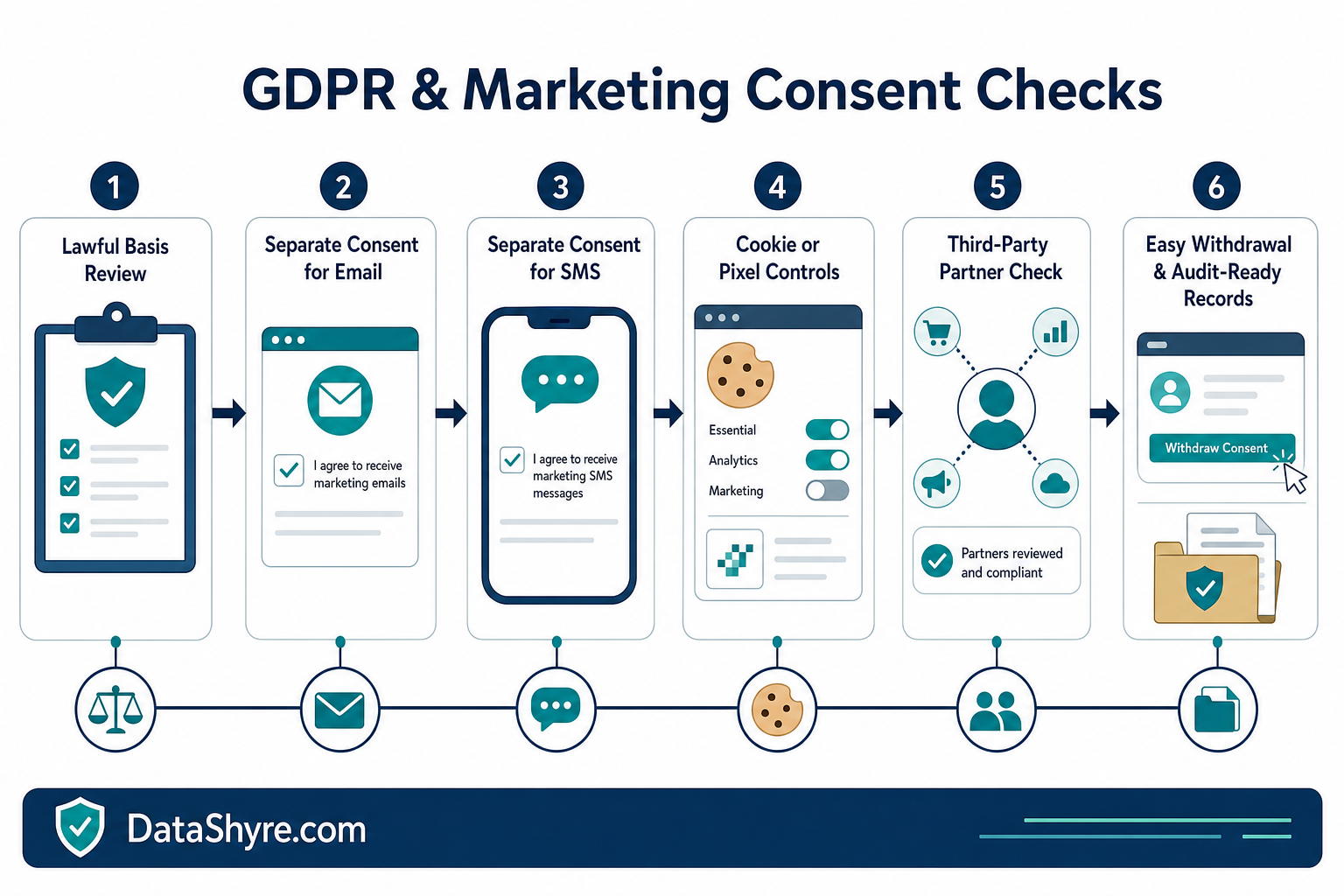
6. Make refusal and withdrawal as easy as sign-up
The most important usability rule in gdpr and marketing consent is still the simplest one.
The European Commission says withdrawal must be as easy as giving consent. The EDPB’s summary repeats the same point. That means a valid setup should not trap people after the first click.
I would want to see:
- an unsubscribe path in every marketing email where required;
- SMS stop instructions that work in practice;
- a visible preference path for changing categories later;
- no forced account login just to switch off optional marketing choices.
If acceptance happens in one tap but withdrawal turns into a support ticket, the design is already weaker than the record suggests.
7. Keep proof that reconstructs what actually happened
For gdpr and marketing consent, proof matters almost as much as the prompt itself.
The Commission’s current guidance says controllers must be able to demonstrate consent. In practice, that means keeping enough detail to reconstruct the event later:
- the exact wording shown;
- the sender or brand named at collection;
- the channel or channels selected;
- the purpose tied to that choice;
- when the choice was captured;
- how later withdrawal or objection was handled.
For website marketing, I would also test runtime behavior, not just the stored flag. If someone refuses tracking or withdraws later, optional pixels, tags, and ad-tech behavior should match the record. Otherwise the interface says one thing while the stack does another.
A practical review order for this week
If I were reviewing gdpr and marketing consent today, I would use this order:
- identify the exact marketing channel and purpose;
- decide whether consent is truly the legal basis or whether another rule is driving the workflow;
- split email, SMS, website tracking, and partner sharing where they differ;
- test any soft-opt-in or existing-customer logic against the current facts;
- verify refusal and withdrawal paths on the live journey;
- compare stored records with what actually happens in the browser or messaging flow.
That process is more useful than rewriting one checkbox label again.
Bottom line
In 2026, gdpr and marketing consent is not one reusable yes.
It is a set of narrower decisions tied to sender, channel, purpose, partner sharing, and withdrawal. The strongest programs separate those choices cleanly, save records that still make sense later, and keep runtime behavior aligned with what the person was actually told.
If your current workflow cannot do that, the real fix is probably underneath the form.
Sources
- https://commission.europa.eu/law/law-topic/data-protection/information-business-and-organisations/legal-grounds-processing-data_en
- https://commission.europa.eu/law/law-topic/data-protection/information-business-and-organisations/legal-grounds-processing-data/can-data-received-third-party-be-used-marketing_en
- https://commission.europa.eu/law/law-topic/data-protection/information-individuals_en
- https://www.edpb.europa.eu/system/files/2026-04/edpb-summary-consent_en.pdf
- https://ico.org.uk/for-organisations/direct-marketing-and-privacy-and-electronic-communications/guidance-on-direct-marketing-using-electronic-mail/
- https://ico.org.uk/for-organisations/direct-marketing-and-privacy-and-electronic-communications/guide-to-pecr/electronic-and-telephone-marketing/
- https://ico.org.uk/for-organisations/direct-marketing-and-privacy-and-electronic-communications/guidance-on-direct-marketing-using-electronic-mail/how-do-we-comply-with-the-pecr-electronic-mail-marketing-rules/
- https://www.cnil.fr/fr/la-prospection-commerciale-par-sms-mms
- https://www.cnil.fr/fr/communication-electronique-quelles-regles
- https://www.cnil.fr/fr/la-prospection-b-to-c-quelles-regles-pour-transmettre-des-donnees-des-partenaires
—
Published: October 17, 2026. Updated using current official European Commission, EDPB, ICO, and CNIL materials available at publication time.