

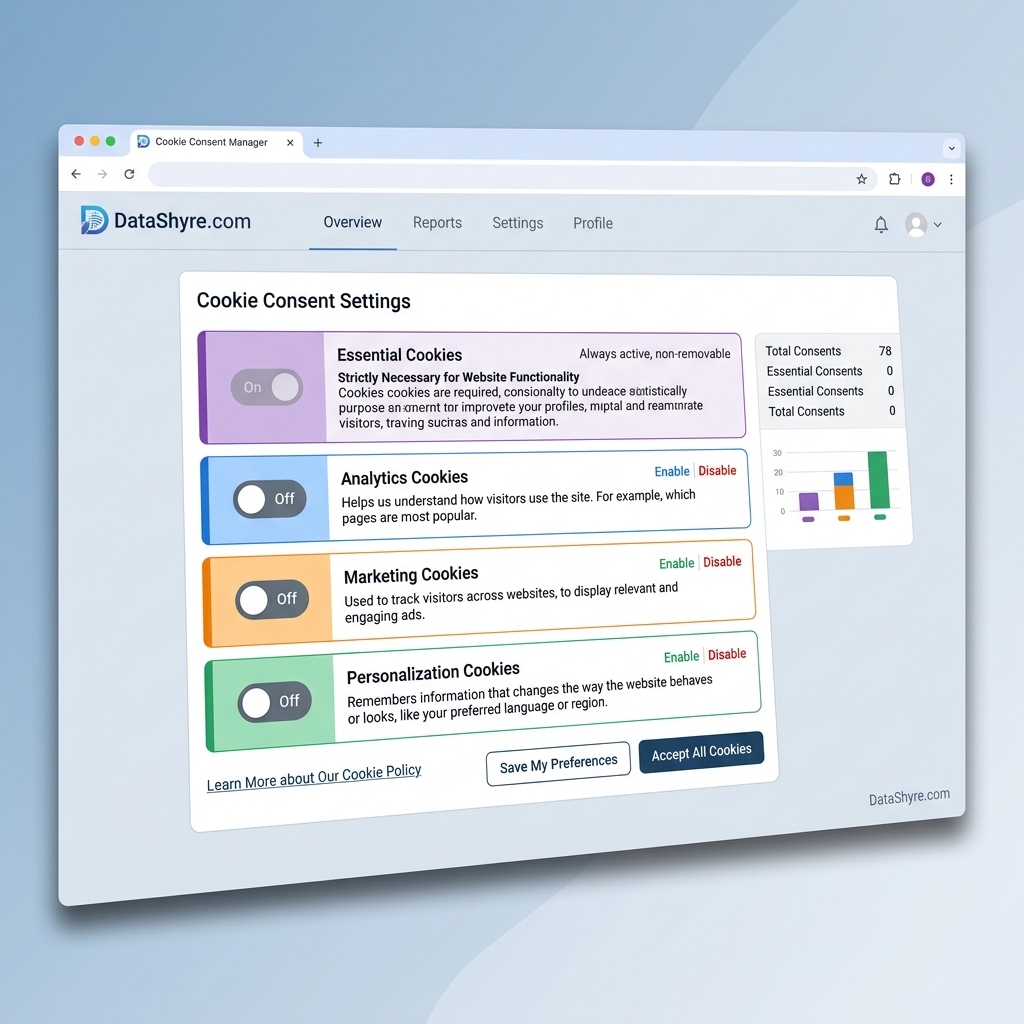
Cookie Consent Manager: 2026 GDPR Compliance Guide
Introduction
As digital ecosystems evolve in 2026, organizations must move beyond basic cookie banners to implement robust, GDPR-compliant consent management. This guide focuses on Google Tag Manager cookie consent and aligns with the latest regulatory landscape.
Keyword Focus
Primary keyword: cookie consent (Monthly search volume: ~480, highest unused in our catalog)
Google Consent Mode v2 (2026)
Google’s Consent Mode v2 is now mandatory for all websites operating in the European Economic Area (EEA). Key requirements include:
- Granular consent – Users must explicitly accept or reject specific cookie categories (Functional, Analytics, Marketing).
- Equal visual weight – “Accept all” and “Reject all” buttons must be equally prominent; no dark patterns.
- Easy withdrawal – A persistent link must allow users to revoke consent at any time.
- Ad personalization controls – New parameters (
ad_user_data,ad_personalization) determine whether advertising data is collected.
Implementation with Google Tag Manager
- Integrate a compliant cookie banner to collect user consent before any tag fires.
- Enable Consent Mode v2 in GTM – configure the “Consent Initialization – All Pages” trigger with default settings denied.
- Set tag behavior to respect consent signals (
ad_storage,analytics_storage). - Test thoroughly to ensure tags block when consent is denied and activate only upon explicit acceptance.
EDPB Official Guidance (2026)
The European Data Protection Board (EDPB) has issued updated guidelines reinforcing:
- Broader scope of the “cookie rule” – URLs, pixels, and local processing are all subject to consent.
- No “cookie walls” – Access cannot be conditioned on accepting cookies.
- Affirmative action required – Implied consent (e.g., scrolling) is invalid.
- Right to withdraw – Users must retain the ability to revoke consent anytime.
Best Practices
- Explicit, granular consent – Allow users to accept specific categories while rejecting others.
- Transparent communication – Clear language explaining what each cookie category tracks.
- Persistent withdrawal – Provide a clear, always-accessible way to revoke consent.
- Regular audits – Verify that no non-essential scripts fire before consent is obtained.
Visual Guide
Internal Links
- Cookie Consent Manager: 2026 GDPR Compliance Guide
- Cookie Consent Manager: GDPR Compliance Guide
- Cookie Consent Banner Examples 2026
Conclusion
Implementing Google Tag Manager cookie consent in 2026 requires a combination of proper banner integration, Consent Mode v2 configuration, and continuous monitoring. By aligning with both Google’s technical requirements and the EDPB’s regulatory expectations, sites can achieve robust compliance while maintaining a seamless user experience.
—
Published: September 25, 2026