

Consent Management Solution: 7 Checks Before You Choose One in 2026
If you are searching for a consent management solution, you are probably not looking for a definition. You are trying to decide whether a platform will hold up when legal asks about proof, marketing asks about lost measurement, and engineering asks why tags still fire before a user has made a choice.
That is a fair question in July 2026. On April 29, 2026, the UK ICO published final guidance on storage and access technologies covering cookies, pixels, fingerprinting, and similar tracking tools. In that announcement, William Malcolm said organizations want “clear, practical guidance they can rely on.” A few months later, on July 14, 2026, the EDPB said the Belgian DPA must assess the merits of a cookie-banner complaint involving broadcaster VRT’s site instead of dismissing it on procedural grounds. Cookie controls are still getting real regulatory attention.
If you want broader background first, our guides to consent management platform, consent management platform best practices, and GDPR consent management platform cover the bigger buying picture. This article is narrower: how to tell whether a tool is actually ready for production.
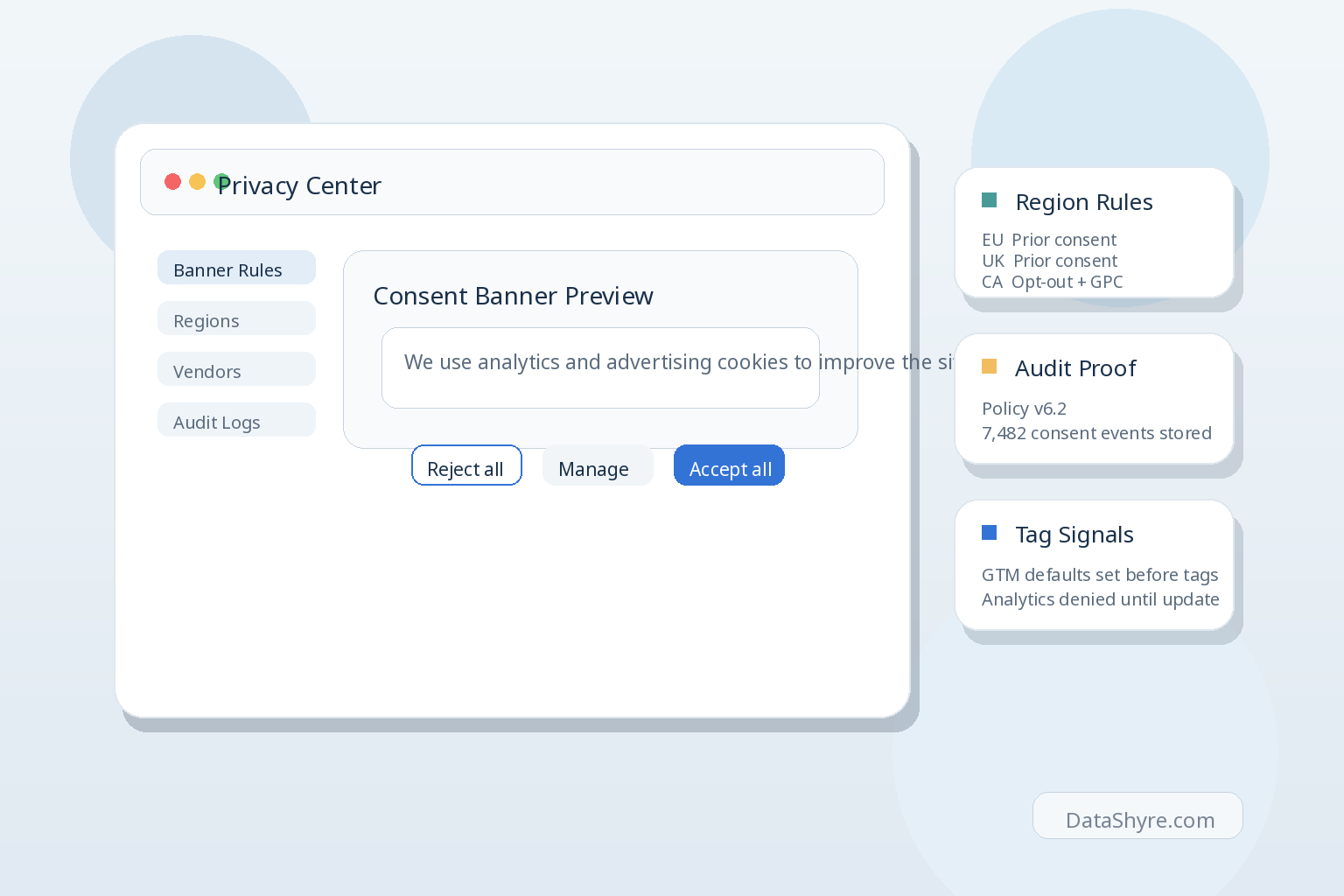
How to evaluate a consent management solution in 2026
The fastest way to cut through the sales deck is to ask one blunt question: does the product control what happens on the site, or does it just decorate the site with a banner?
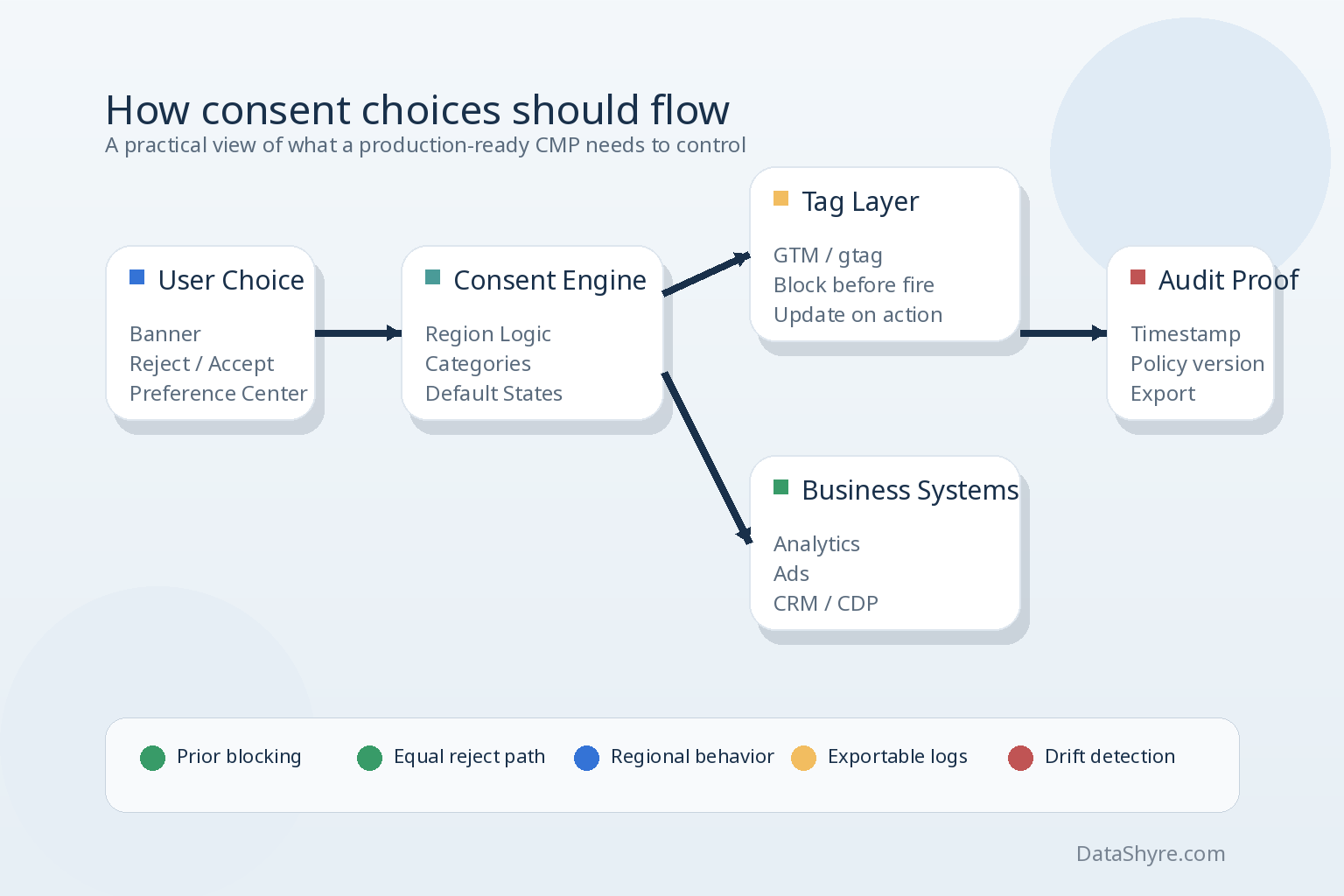
A good consent management solution should handle four jobs well. It should capture a real user choice. It should stop non-essential tracking until the right choice is made where prior consent is required. It should pass that choice into tools like Google Tag Manager and downstream analytics or ad systems. And it should keep records your team can review later without reconstructing the whole story from screenshots.
Google’s current consent mode documentation is useful here because it turns a fuzzy compliance conversation into an implementation test. Google says teams should set the default consent state before tags send measurement data, and its troubleshooting guidance says a default set too late may not have the effect you expect. In practice, that means a pretty banner is not enough if the underlying tag flow is out of order.
The 7 checks that matter most
1. Prior blocking works on the live site
Do not accept a slide or a product diagram. Ask the vendor to show the live behavior in a browser. If analytics, ad, or personalization tags can still run before a decision, the control layer is weak.
2. Reject is as easy as accept
This sounds basic, but it still trips teams up. In a 2024 ICO speech, John Edwards said it must be “just as easy to reject all non-essential cookies” as it is to accept them. If refusal is buried in a second layer or slowed by extra clicks, the implementation deserves a second look.
3. Regional logic is configurable
EU, UK, and California visitors do not always need the same treatment. You want rules that can adapt by geography and use case without forcing your team to run separate tools for each market.
4. Consent signals reach the rest of the stack
If the banner captures a choice but your tag manager, analytics setup, or ad platform never receives it correctly, the system is cosmetic. This is one of the easiest places for drift to hide.
5. Audit evidence is easy to export
Your privacy team should be able to review timestamps, policy versions, categories, and user actions without opening a support ticket. If the answer to every proof question is “our team can pull that for you,” that is a buying warning.
6. Google integration is not an afterthought
For teams that rely on Google advertising or measurement, the consent layer has to work in the real order of execution. Ask specifically how the product handles default consent states, updates after user interaction, and GTM or gtag timing.
7. The platform helps you catch drift
Sites change all the time. New tags appear. Old scripts get reconfigured. A consent management solution should help you detect when the live site no longer matches the consent experience your team approved.
Common buying mistakes
The first mistake is buying for appearance. A polished interface can still fail the operational test. The second is assuming one EU-style banner strategy will cover every privacy workflow. It usually will not. The third is underestimating implementation detail. Teams often discover too late that the hard part is not the banner copy. It is the sequencing, signal mapping, and evidence trail behind it.
That is also why recent enforcement signals matter. The ICO’s April 2026 update said 99% of the UK’s top 1,000 websites now meet its cookie-banner compliance standards after focused work with industry. That is progress, but it is also a sign that regulators are still checking how banners behave in the wild, not just whether a notice exists.
A short shortlist test for procurement
Bring these questions into the demo:
- Can you show prior blocking live by region?
- Can users reject and later withdraw consent without friction?
- How do consent choices reach GTM, analytics, and ad tools?
- What evidence can we export without vendor help?
- How do you detect new trackers or broken configurations after launch?
If the answers stay vague, keep looking.
Bottom line
The right tool is not the one with the nicest banner gallery. It is the one that can prove real choice, enforce it in the tag layer, and leave behind a clean record of what happened. If your platform cannot do those three things, it is not really solving the problem.
Sources
- UK Information Commissioner’s Office
- European Data Protection Board
- Google for Developers