

OneTrust Comparison in 2026: 7 Checks Before You Treat It as the Default CMP
If you are searching for onetrust comparison on August 10, 2026, the useful move is not starting with a feature grid. It is deciding what job you need the platform to do on the live stack.
That sounds obvious, but it is exactly where many CMP evaluations still drift. OneTrust is often treated as the default benchmark because it has a broad market footprint and a broad public product story. On its current consent-management pages, OneTrust says it supports consent across web, mobile apps, and OTT/CTV, offers geolocation-aware experiences, blocks trackers until consent, and stores audit-ready consent receipts with change history. Those are meaningful comparison points. They are just not the only ones that matter.
The official baseline is stricter than vendor demos. The European Commission still says valid consent must be freely given, specific, informed, and unambiguous, and it still says withdrawal must be “as easy to withdraw as to give consent.” The UK’s ICO says any consent mechanism must “function as intended” so the choices made through it are actually respected. Google adds another practical requirement for teams that run ads or measurement through its stack: consent updates need to be tracked on the page where they happen, “before any page transition.”
That is why a useful onetrust comparison in 2026 is not mainly about who has the prettiest banner. It is about which platform best matches your surfaces, your traffic mix, your regional obligations, your tag behavior, and your evidence requirements.
If you want adjacent context first, start with our posts on OneTrust cookie consent, best consent management platforms, and Evidon vs OneTrust. This article is narrower. It is the seven-check scorecard I would use before treating OneTrust as the automatic winner.

1. Compare OneTrust by surface coverage first
The fastest bad comparison is putting every CMP into one generic website bucket.
OneTrust’s current public product materials are explicit that its consent coverage is broader than a simple website banner. The company positions its CMP across web and mobile apps, and separately promotes consent support for OTT and CTV environments. Google’s current certified-CMP list also shows Onetrust / Cookiepro CMP certified for web, app, and CTV in its publisher program.
That matters because a fair onetrust comparison depends on what you actually run:
- a marketing website with analytics and ad tags;
- a logged-in product with persistent preference management;
- a mobile app estate;
- a publisher workflow that stretches into app or CTV inventory;
- a multi-brand business that wants one operating model across regions.
If you only need a lean website banner for a single domain, a lighter CMP may compare more favorably on cost and operating simplicity. If you need one program spanning browser, app, and CTV surfaces, OneTrust enters the comparison from a stronger position.
2. Separate Google publisher fit from broader privacy compliance
This is one of the most useful comparison filters because it stops teams from treating one badge as the whole answer.
Google’s current publisher guidance says that partners using AdSense, Ad Manager, or AdMob must use a Google-certified CMP integrated with the IAB Transparency and Consent Framework when serving personalized ads in the EEA, the UK, or Switzerland. Google’s current list includes Onetrust / Cookiepro CMP as certified for web, app, and CTV.
But the same Google page also says something buyers should not skip: Google does not check CMPs for full compliance with the TCF or applicable privacy laws.
That means a serious onetrust comparison needs two separate questions:
- Does the platform fit your Google publisher requirements?
- Does the platform fit your broader privacy and runtime-control requirements?
Those are related, but they are not identical. A CMP can be a strong publisher fit and still be a weak operational fit for your internal workflow, your California opt-out handling, or your downstream preference propagation.
3. Compare runtime control, not only admin screens
This is where polished demos and live behavior often diverge.
OneTrust’s current product page says it can block trackers until consent is received and enforce user choices with no-code blocking and script control. That is the right type of claim to test. The ICO’s current guidance gives the operational standard: the mechanism must “function as intended” and non-exempt storage or access technologies should only be set when valid consent is gathered or when an exception applies.
So, when you run an onetrust comparison, do not stop at:
- category design;
- banner customization;
- admin UI quality;
- dashboard screenshots.
Instead, test what actually happens on a cold page load, a reject flow, a granular acceptance flow, and a later withdrawal. If you use Google tags, Google’s current consent-mode guidance still says defaults must be set before measurement commands run and consent updates must land on the page where the user acts.
If one platform has the stronger-looking console but another platform more reliably controls real first-load behavior, the second one may be the better comparison winner.
4. Compare regional branching, especially California and Europe
A lot of CMP evaluations are still too Europe-shaped.
For the EU and UK, the practical test is usually whether non-essential cookies and similar technologies stay off until valid prior consent exists. For California, the flow often shifts toward sale-or-sharing opt-outs, browser-level signals, and the ability to carry a preference through the rest of the stack.
The California Department of Justice still says the Global Privacy Control is a “stop selling or sharing my data switch” and must be honored by covered businesses as a valid request to stop sale or sharing. The Disney settlement California announced on February 11, 2026 is the practical warning: the state said Disney limited opt-out effects to the specific device or service in too many cases and failed to provide in-app opt-out methods in some connected-TV apps.
That matters in an onetrust comparison because regional logic is not only about translated copy. It is about whether the platform can help your team:
- run prior-consent flows where they are required;
- honor browser-level opt-out signals where they matter;
- carry a valid opt-out across connected services when account context exists;
- avoid flattening every jurisdiction into one shallow banner.
If your business has both European and California exposure, regional branching quality should be one of the highest-weighted comparison criteria.
5. Compare how well preferences persist across domains, devices, and identities
OneTrust’s current product materials emphasize synchronizing consent across touchpoints and reducing re-prompts. That can be a real strength, but only if it matches how your company actually identifies people and routes data.
For a practical onetrust comparison, ask:
- does the platform only manage anonymous browser-state well;
- does it also work well when a user becomes known or logs in;
- can it keep preference logic consistent across brands or domains;
- can another team reconstruct why a user saw a certain experience later;
- can marketing, product, analytics, and privacy teams all work from the same state model.
This is where a broad enterprise platform often compares differently from a lighter site-only banner tool. The smaller tool may be easier to launch. The broader platform may compare better if your real problem is preference orchestration across multiple properties and systems.
6. Compare proof quality, not just collection
Nearly every CMP promises records. The better comparison is whether the records are usable.
OneTrust says it stores consent receipts in an audit-ready database with change history and exportable logs. Those are good raw ingredients. But the winning onetrust comparison should test whether your team can answer five practical questions quickly:
- What did the user see?
- What did they choose?
- Which categories, vendors, or purposes were in scope?
- What happened in the runtime after that choice?
- How did later withdrawal or change get recorded?
If a competing tool makes those answers easier to reconstruct for your actual team, it may compare better for day-two operations even if OneTrust still looks stronger on surface breadth.
7. Compare operating overhead honestly
This is where many teams quietly decide the winner after pretending the choice was about features.
OneTrust is often compared as the safer enterprise answer because it can cover more surfaces and more governance scenarios. That same breadth can also mean more implementation design, more coordination, more configuration discipline, and more internal ownership questions.
So the final onetrust comparison should include:
- how many surfaces must go live this year;
- how many teams will touch the consent program;
- whether engineering wants a lighter implementation path;
- whether privacy wants stronger central governance;
- whether publisher, app, and web teams need one shared system;
- how much operational proof the business really needs to produce.
If your environment is relatively simple, OneTrust may compare as more platform than you need. If your environment is fragmented and high-risk, the broader operating model may be exactly why it wins.
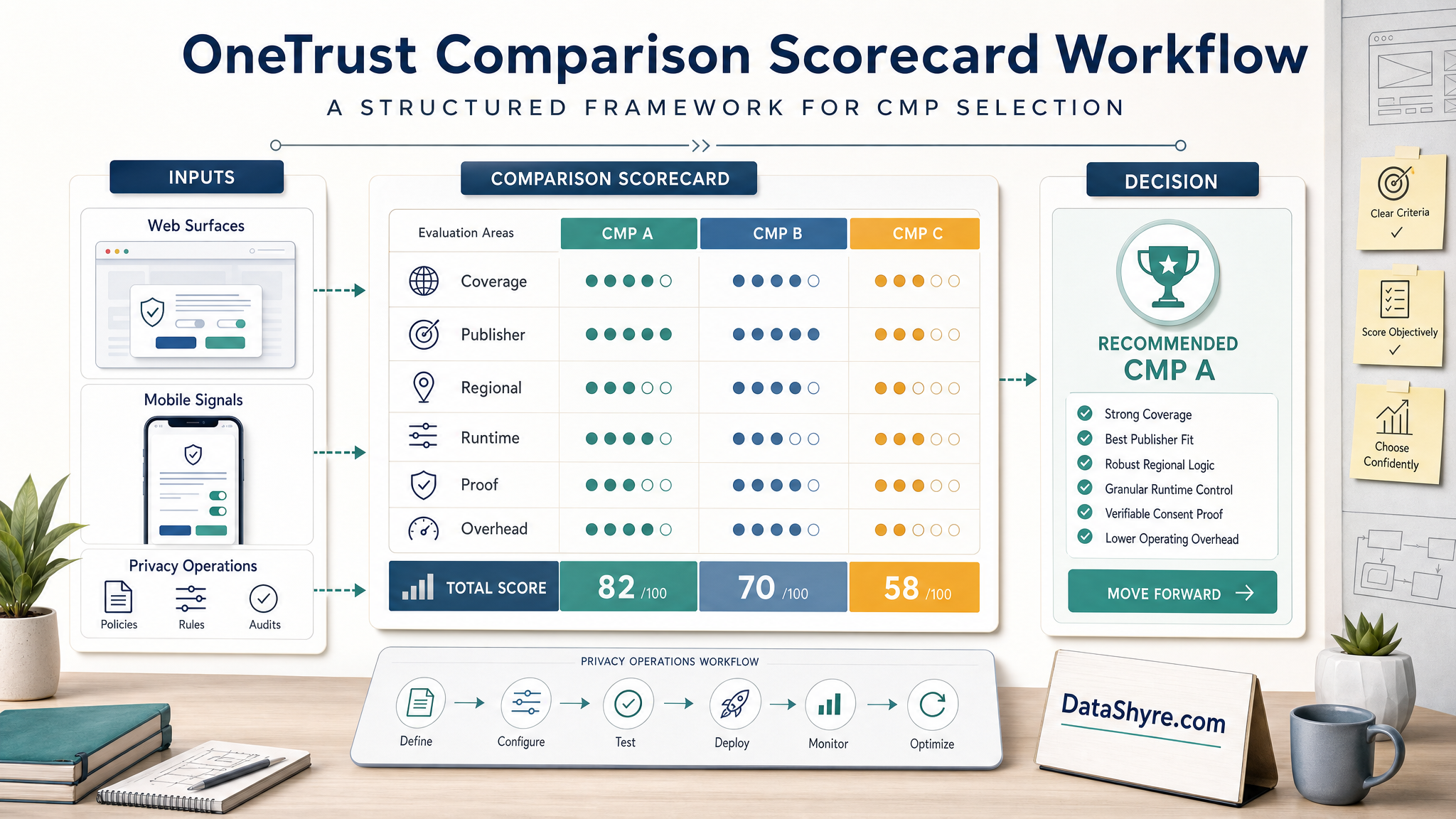
A short scorecard I would use this week
If I were running an onetrust comparison today, I would score it against alternatives in this order:
- Surface coverage: web only, web plus app, or web plus app plus CTV.
- Publisher fit: certified CMP needs, TCF fit, and any Additional Consent needs.
- Runtime control: cold-load blocking, reject behavior, granular choices, and withdrawal.
- Regional branching: EU or UK prior consent, California GPC, and downstream opt-out propagation.
- Preference persistence: domain, account, and cross-property behavior.
- Evidence quality: usable receipts, change history, and exportable logs.
- Operating load: rollout complexity, governance overhead, and who has to own it.
That sequence usually produces a better result than starting with price sheets or homepage claims.
Bottom line
The smartest onetrust comparison in 2026 is not asking whether OneTrust is broadly capable. It clearly is. The better question is whether its breadth matches your actual privacy operations problem better than a lighter or more specialized alternative.
If you need broad surface coverage, strong publisher fit, regional branching, and centralized preference governance, OneTrust often deserves a serious look. If you mainly need a simpler website consent layer with less internal overhead, you should force it to compete against leaner tools on implementation weight, not just on brand recognition.
That is the comparison standard worth using now: not who demos best, but which platform still looks correct after live testing, regional review, and a month of real operations.
Sources
- European Commission: When is consent valid?
- European Commission: What if somebody withdraws their consent?
- ICO: How do we manage consent in practice?
- Google for Developers: Set up consent mode on websites
- Google Ad Manager Help: Google consent management requirements for serving ads in the EEA, the UK, and Switzerland (for publishers)
- OneTrust: Consent Management Platform
- California Department of Justice: Global Privacy Control
- California Department of Justice: California Won’t Let It Go: Attorney General Bonta Announces $2.75 Million Settlement with Disney
This post was updated on August 10, 2026 using current official regulator, government, platform, and vendor materials available at publication time.