

Cookie Consent Message Examples in 2026: 8 Patterns That Explain the Real Choice
If you are collecting fresh cookie consent message examples on September 12, 2026, the best ones no longer sound like generic banner filler.
They explain a real decision in plain language, and they match what the site actually does after a visitor clicks.
That matters because the current regulator pattern is still consistent. The ICO says consent requests for storage and access technologies must give users “clear and comprehensive” information about purposes, require a positive action, and make sure the mechanism actually works as intended. France’s CNIL is still using the cleanest banner fairness test available: “rejecting cookies should be just as easy as accepting them.” And for California, the Department of Justice still describes Global Privacy Control as a “stop selling or sharing my data switch” that covered businesses must honor where applicable.
If you want the nearby context first, our guides to cookie consent message, cookie consent, and GDPR cookie consent examples cover the broader compliance picture. This piece is narrower. It is a working set of cookie consent message examples you can adapt for different site types in 2026.
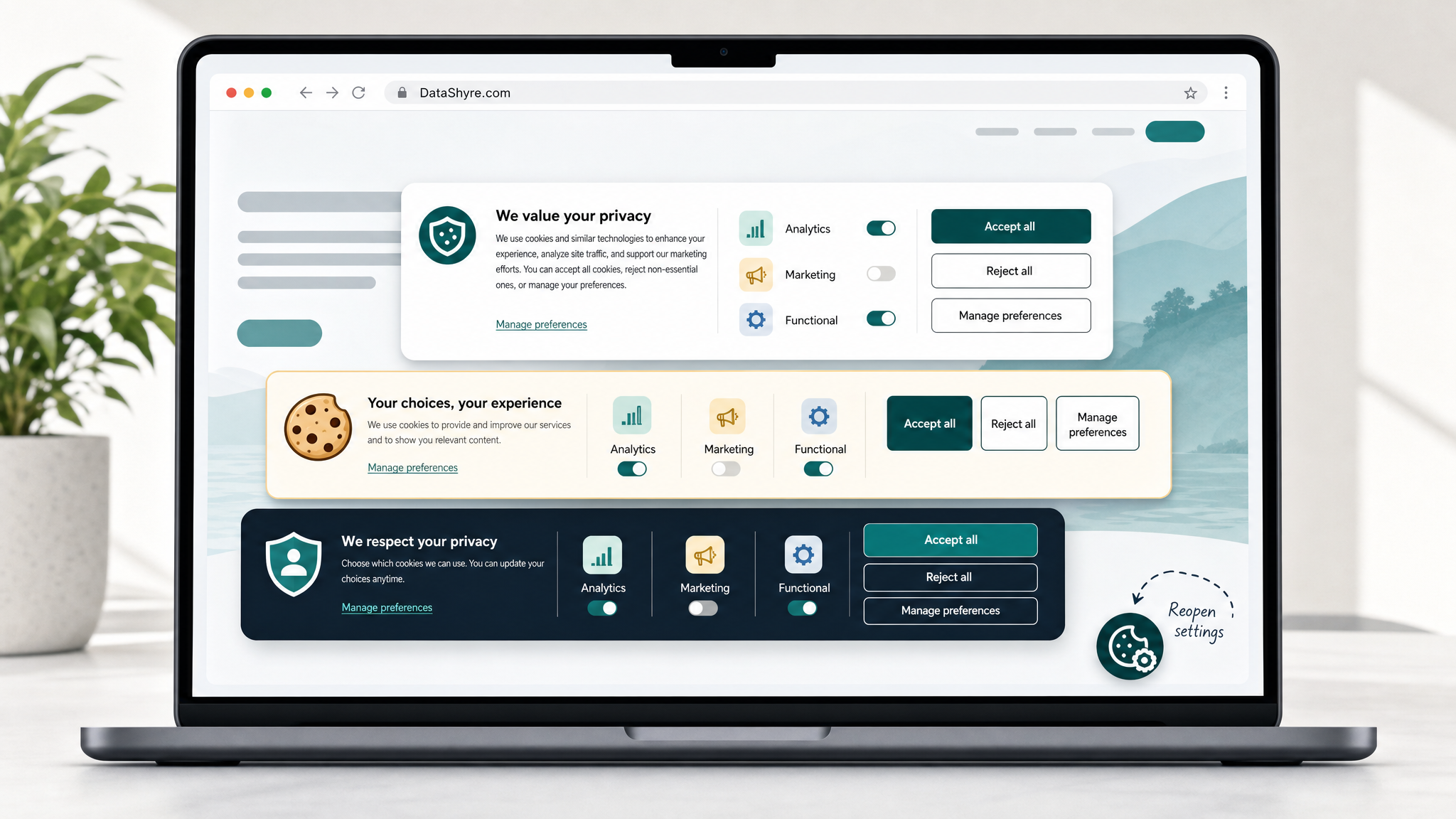
What strong cookie consent message examples still have in common
Before the examples, it helps to set the filter.
The ICO’s current guidance says users need understandable information about what non-exempt technologies do and why they are used, and that silence or inactivity does not count as consent. Its newer practical guidance also says the consent mechanism should make refusal as easy as acceptance, offer granular controls, identify third parties, show how to revisit choices, and ensure the mechanism functions as intended.
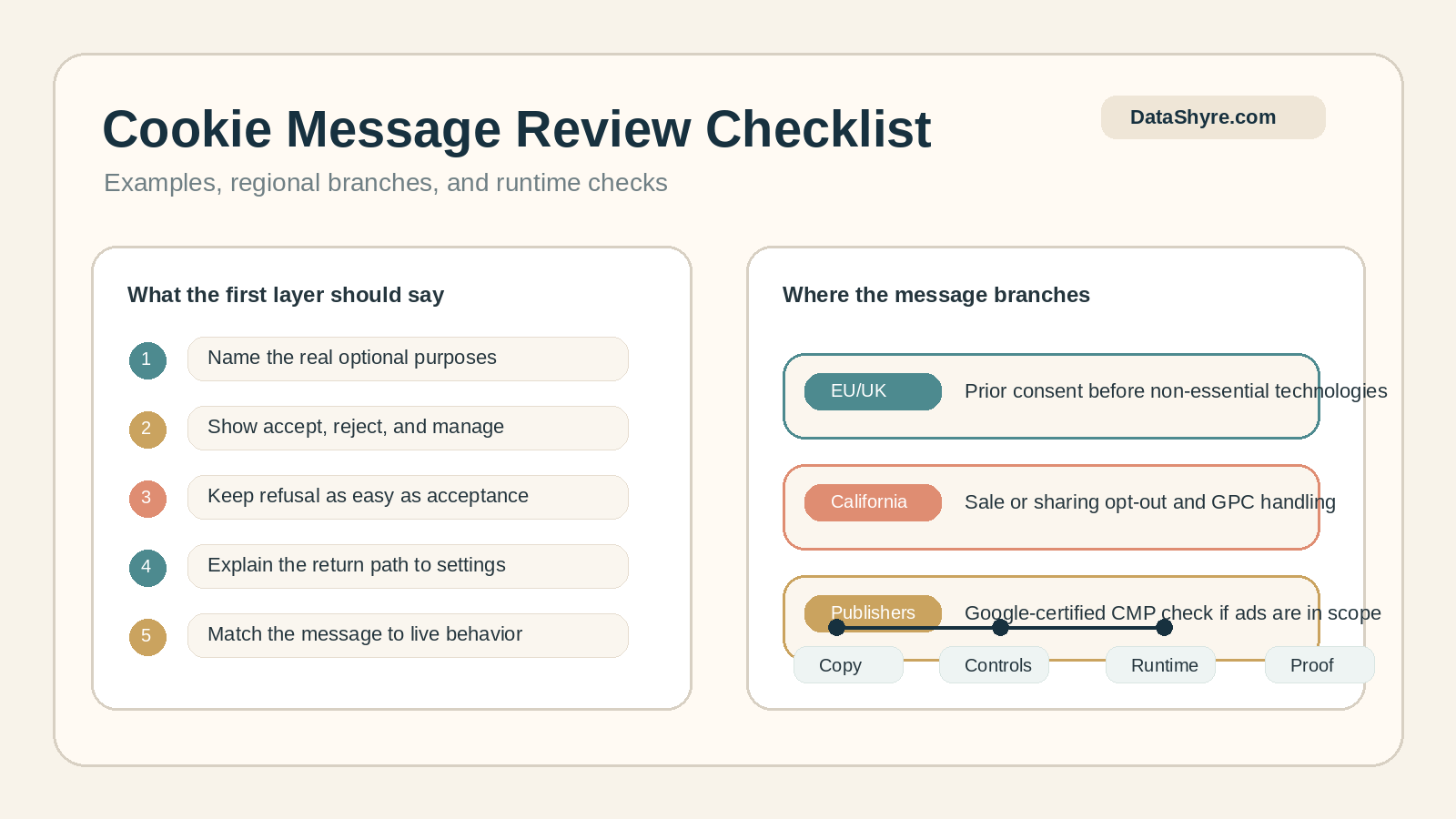
That means most usable cookie consent message examples in 2026 share five traits:
- they name real purposes instead of vague experience language;
- they present acceptance, refusal, and customization as genuine choices;
- they imply only the tracking that is actually happening;
- they connect to a working preference path later;
- they stay aligned with region-specific logic when California or publisher requirements apply.
1. The straightforward analytics-and-performance example
For a simple marketing site that uses optional analytics but not ad targeting, this is still a strong first-layer pattern:
We use cookies and similar technologies to keep the site working, measure traffic, and improve performance. You can accept analytics cookies, reject non-essential technologies, or manage your preferences.
Why it works:
- it names the optional purpose clearly;
- it avoids pretending analytics is essential;
- it offers rejection on the first layer;
- it leaves room for a second layer with category detail.
This kind of message is often better than a longer banner because it tells the user what changes if they say no.
2. The ecommerce measurement example
For ecommerce teams that use analytics, on-site personalization, and conversion measurement, a more specific version usually reads better:
We use cookies and similar technologies to run the store, remember preferences, measure sales performance, and personalize content. You can accept all, reject non-essential technologies, or choose by category.
Why it works:
- it separates store operation from optional uses;
- it uses language a normal shopper can understand;
- it avoids the misleading shortcut of calling everything functional;
- it points visitors toward category-level choice.
This is one of the more adaptable cookie consent message examples because it can scale across Shopify, WooCommerce, and custom storefronts without sounding like vendor copy.
3. The publisher-and-advertising example
Publisher environments usually need more honesty up front because the data flows are broader:
We use cookies and similar technologies to operate the site, measure audiences, personalize content, and support advertising. You can accept all, reject non-essential technologies, or manage your choices at any time in Privacy Settings.
Why it works:
- it signals that advertising is really in scope;
- it does not bury the ongoing settings path;
- it helps keep the first layer consistent with later vendor and purpose disclosures.
But there is an extra branch here. Google’s current publisher help says AdSense, Ad Manager, and AdMob partners serving personalized ads in the EEA and UK have needed a Google-certified CMP integrated with the IAB TCF since January 16, 2024, and the same requirement has applied in Switzerland since July 31, 2024. Google also says that certification is not the same thing as full legal compliance.
So for publisher work, evaluate the message and the platform requirement separately.
4. The B2B lead-generation example
B2B teams often overcomplicate the message because they are trying to sound formal. Usually this cleaner version is better:
We use cookies and similar technologies to run the site, understand visit patterns, and improve lead-generation performance. You can accept optional tracking, reject it, or adjust your preferences.
Why it works:
- it is short enough to read on mobile;
- it avoids loaded ad-tech language when the stack is simpler;
- it still makes the optional tracking choice explicit.
This is also where many weak cookie consent message examples fail. They promise choice, but then fire heatmaps, analytics, or marketing tags before any choice is made.
5. The embedded-content example
If videos, maps, chat widgets, or social embeds trigger optional technologies, the message should prepare users for that reality:
We use cookies and similar technologies for site functions, analytics, and optional embedded content such as video or maps. You can reject non-essential technologies now and enable specific categories later if you prefer.
Why it works:
- it warns users that embeds can trigger tracking;
- it supports a later opt-in flow for specific features;
- it matches the practical problem many sites actually have.
The copy only works if the runtime matches it. If the video player or map still drops non-essential technologies before the visitor opts in, the wording is not saving you.
6. The California-aware example
Not every site needs a pure consent flow for every visitor. If California sale-or-sharing logic is relevant, your visible messaging and backend handling need to stay in sync:
We use cookies and similar technologies for site operation, analytics, personalization, and advertising. Depending on your location, you may also have additional privacy choices, including opt-out rights that apply to sale or sharing.
Why it works:
- it avoids falsely presenting one global legal model;
- it leaves room for California-specific controls and notices;
- it does not imply that every user gets the exact same consequence set.
The California DOJ says businesses that sell or share personal information must treat a user-enabled GPC as a valid opt-out request, and describes it as a “stop selling or sharing my data switch.” That means California review should include the message, the visible opt-out path, and the signal handling behind it.
7. The compact mobile-first example
Small screens are where many banners stop being fair. This shorter pattern can still work:
We use cookies and similar technologies for analytics, personalization, and advertising. Accept all, reject non-essential, or manage preferences.
Why it works:
- it preserves three distinct choices in limited space;
- it keeps the core purposes visible;
- it does not hide refusal under a vague
learn morelink.
The design still matters. CNIL’s current enforcement posture is useful precisely because it focuses on misleading presentation. If the text is balanced but the mobile layout makes rejection harder to reach, the real choice has changed.
8. The review-and-renew example
Sometimes the strongest message is the one you show when purposes, vendors, or legal treatment has changed:
We have updated our cookie and privacy choices to reflect changes in how we measure performance, personalize content, and work with partners. Please review and confirm your preferences.
Why it works:
- it tells returning visitors why they are seeing the prompt again;
- it frames consent refresh as a change-management issue, not just a banner rerun;
- it supports situations where the old signal should not simply roll forward untouched.
If your stack changed, asking again with honest wording is usually safer than stretching an old message beyond what it actually covered.
What to avoid when adapting these cookie consent message examples
Even now, the weakest patterns are usually predictable:
By continuing to browse, you accept cookies.Acceptas the only obvious button.We use cookies to improve your experiencewith no real purpose detail.- refusal hidden in a second layer or low-contrast text link.
- copy that promises rejection while scripts still fire.
The ICO’s current guidance is especially clear on two of these points: continuing to browse is not valid consent, and non-essential technologies should not be set before the positive opt-in happens.
A fast review sequence before you publish
If I were reviewing cookie consent message examples for a live site this week, I would use this order:
- confirm the first layer names the real optional purposes;
- test whether
Reject allis as immediate asAccept all; - verify that refusal and later withdrawal change runtime behavior;
- check whether embeds, tags, or vendor calls still leak before consent;
- run the California branch or publisher branch separately if either one applies.
That sequence usually exposes more truth than rewriting the banner for a tenth time.
Bottom line
The best cookie consent message examples in 2026 do not win because they sound polished.
They win because the words, interface, and technical behavior all describe the same thing.
If the message is clear but the mechanism is weak, the banner is still risky. If the mechanism works but the wording hides the real choice, the banner is still risky. The durable version is where the copy and the control logic finally agree.
Sources
- ICO: Cookies and similar technologies
- ICO: How do we manage consent in practice?
- CNIL: Dark patterns in cookie banners
- California DOJ: California Consumer Privacy Act FAQs
- Google AdSense Help: Google consent management requirements for serving ads in the EEA, the UK, and Switzerland (for publishers)
This post was updated on September 12, 2026 using current official regulator, government, and platform sources available at publication time.