

Cookie Consent Message in 2026: What to Say and What the Design Must Do
If you are revising a cookie consent message on September 12, 2026, the real question is not whether the banner sounds polite.
It is whether the message tells the truth about what your site will do next.
That standard is sharper now because current official guidance keeps pushing teams away from cosmetic banner work and toward real control. The UK’s ICO says consent requests for storage and access technologies must be purpose-specific, generally granular, and able to support withdrawal with the same ease, while the mechanism must also “function as intended.” France’s CNIL is still using one of the clearest banner tests available: “rejecting cookies should be just as easy as accepting them.” And in California, the Department of Justice still describes Global Privacy Control as a “stop selling or sharing my data switch” that covered businesses must honor where it applies.
If you want the adjacent context first, start with our guides to cookie consent, consent management and GDPR, and is cookie consent required in USA. This article is narrower. It is about what a practical cookie consent message should say on the first layer, and what the underlying design still has to prove.
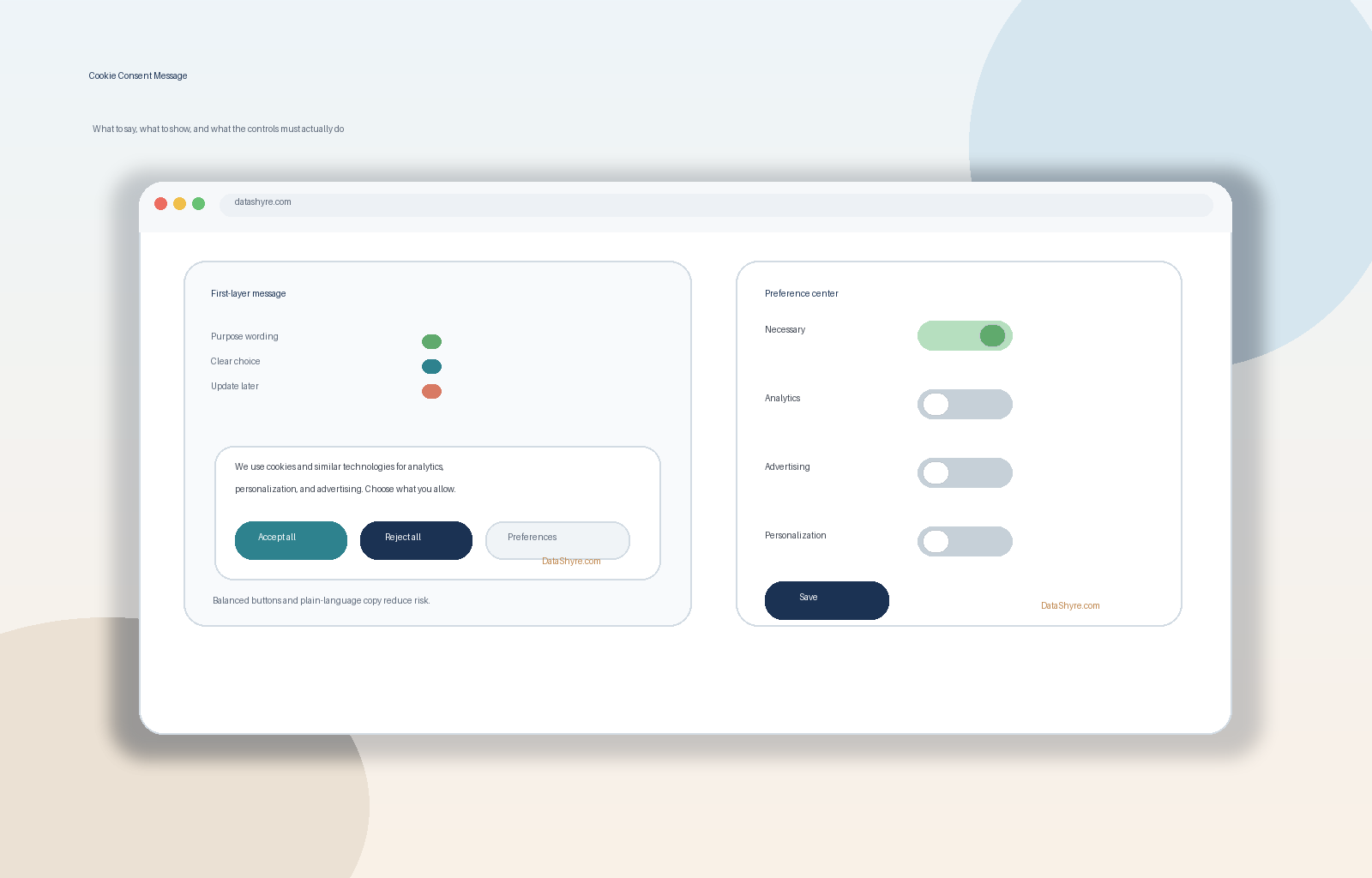
What a cookie consent message has to communicate now
The best first-layer messages are short, but they are not vague.
In most cases, a defensible cookie consent message should cover five things quickly:
- what the site wants optional technologies for;
- that the user has a real choice;
- that rejection is available immediately, not buried;
- that preferences can be changed later;
- that the message connects to real technical behavior.
That last point is where many banners still fail. The ICO’s current storage-and-access technologies guidance is broader than old cookie-only thinking. It covers cookies, tracking pixels, device fingerprinting, and similar technologies, and it says that if no exception applies you must obtain prior consent. So a first-layer message should not imply that the control only touches one harmless browser file when the real issue is a larger tracking stack.
The wording also has to match third-party reality. The ICO says users must be told about third parties and must be able to access specific information about each one. If your message says we use cookies to improve your experience but the site actually routes data into analytics, ad-tech, and embedded vendors, the copy is already underspecified.
A practical cookie consent message example
For many B2B, ecommerce, and publisher sites, this is a strong starting pattern:
We use cookies and similar technologies to operate the site, measure performance, personalize content, and support advertising. You can accept all, reject non-essential technologies, or manage your preferences. You can update your choice at any time in Cookie Settings.
Why this works:
- it names the main purposes in plain language;
- it distinguishes acceptance, rejection, and granular choice;
- it does not imply optional tracking is required to use the site;
- it promises an ongoing settings path instead of a one-time pop-up.
What it should not do is overpromise. If the message says users can reject non-essential technologies, the rejected path has to hold on refresh, on return visits, and after later preference changes.
The design rules behind the words
A cookie consent message is judged partly by text and partly by interface structure.
The CNIL’s December 12, 2024 formal notices are still useful because they targeted misleading cookie banners directly. Then on November 27, 2025, CNIL fined the publisher of vanityfair.fr EUR 750,000 and said refusal and withdrawal mechanisms were ineffective, with new consent-requiring cookies still being placed after users clicked Refuse all. That is the practical warning: wording alone does not save a broken mechanism.
So when you review message copy, check the design around it too:
1. Reject belongs on the first layer
If Accept all is prominent and Reject all is hidden in a second layer, the message is not presenting equal choice.
2. Purposes should be readable at first glance
Labels such as marketing, analytics, personalization, or embedded content are usually more useful than abstract language like experience or partners.
3. The return path has to be obvious
Withdrawal should not depend on clearing cookies manually or hunting through a privacy policy. The ICO says the mechanism must allow users to withdraw consent with the same ease that they gave it.
4. Mobile still counts
If refusal drops below the fold, becomes a low-contrast text link, or turns awkward on touch devices, the real user choice has changed even if the desktop mockup looked balanced.
The California branch changes the message review
Not every cookie consent message is solving exactly the same legal or operational problem.
For California-facing data flows, the Department of Justice says a user-enabled Global Privacy Control is one acceptable method for consumers to opt out of sale or sharing online, and that covered businesses must honor it as a valid request. The CPPA’s current CCPA updates page says the latest adopted regulations became effective on January 1, 2026.
That means the message review should not stop at banner copy if California rules are in scope. You should also ask:
- whether the site needs a sale-or-sharing opt-out path;
- whether GPC reaches the relevant downstream systems;
- whether the visible message and the backend branching stay aligned.
For some sites, the first-layer wording will still look similar across regions. The underlying logic may not.
Publishers need a separate platform check
If your site serves personalized ads through Google publisher products, there is an additional requirement that should be treated separately from the message itself.
Google’s current AdSense help says publishers using AdSense, Ad Manager, or AdMob must use a CMP certified by Google and integrated with the IAB Transparency and Consent Framework when serving personalized ads to users in the EEA and UK as of January 16, 2024, and in Switzerland as of July 31, 2024. The same page also says Google does not check CMPs for full compliance with the TCF or applicable privacy laws.
That distinction matters. A publisher can satisfy Google’s certification requirement and still have weak copy, weak rejection design, or weak runtime behavior. The reverse is also possible. So if publishing is in scope, review the cookie consent message and the Google publisher requirement as two related but separate checks.
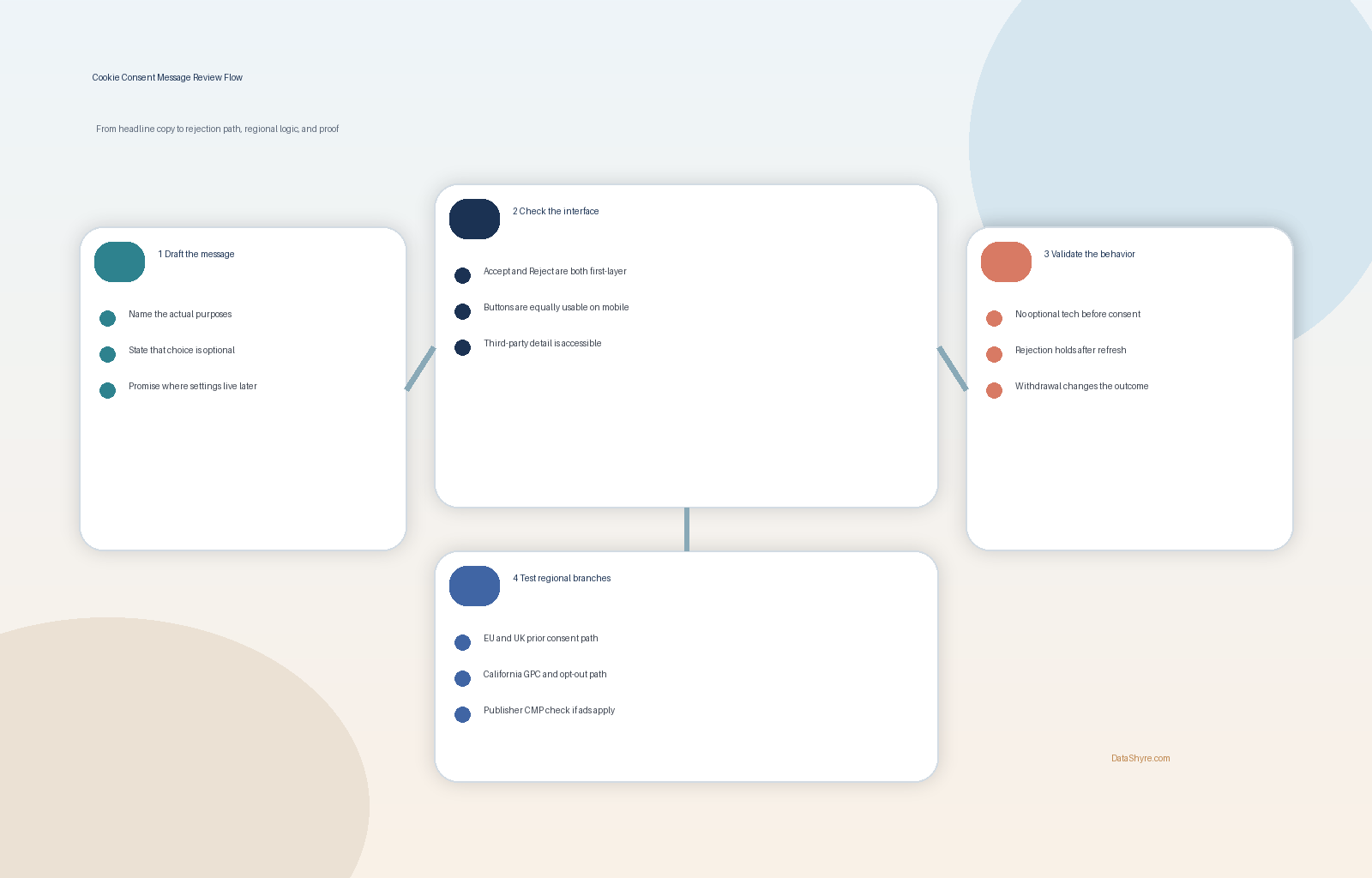
Five checks before you publish a new message
If I were reviewing a cookie consent message this week, I would use this order:
- read the first layer out loud and confirm it names actual purposes;
- test whether
Reject allis as immediate and usable asAccept all; - reload the site after rejection and verify optional technologies stay off;
- reopen settings later and confirm withdrawal or revision changes behavior;
- run the California or publisher branch separately if either one really applies.
That sequence is usually more revealing than writing ten more banner variants.
Bottom line
The strongest cookie consent message in 2026 is not the one with the smoothest marketing copy.
It is the one that accurately describes the choice, presents refusal honestly, supports later change, and matches what the site actually does after the click.
If the message is clear but the mechanism is weak, the banner is still risky. If the mechanism works but the message hides the real choice, the banner is still risky. The durable version is where both pieces agree.
Sources
- ICO: How do we manage consent in practice?
- ICO: Final storage and access technologies guidance published
- CNIL: Dark Patterns in Cookie Banners
- CNIL: vanityfair.fr fined 750,000 euros for cookies placed without consent
- California DOJ: Global Privacy Control
- CPPA: CCPA updates effective January 1, 2026
- Google AdSense Help: Google consent management requirements for serving ads in the EEA, the UK, and Switzerland (for publishers)
This post was updated on September 12, 2026 using current official regulator, government, and platform sources available at publication time.