

Consent Management and GDPR in 2026: 8 Checks That Still Matter
If you are looking into consent management and gdpr on September 11, 2026, the useful question is not whether your banner exists. It is whether the choice a person makes turns into real behavior across cookies, pixels, scripts, third-party vendors, and later withdrawal.
That is the right frame because the current regulatory signal is practical, not theoretical. GDPR still requires consent to be demonstrable, clearly presented, and as easy to withdraw as to give. The UK ICO’s finalized 2026 storage-and-access technologies guidance says consent controls must cover cookies, tracking pixels, device fingerprinting, and similar tools. France’s CNIL still says some trackers require prior information and prior consent. And on July 14, 2026, the EDPB required the Belgian DPA to assess the merits of a cookie-banner complaint involving broadcaster VRT instead of ending the matter on procedural grounds.
If you want adjacent reading first, start with our guides to cookie consent, consent management provider, and GDPR cookie consent examples. This article stays focused on the operating checks behind consent management and gdpr.

Why consent management and GDPR still need an operational review
Many teams still treat consent as a design task.
That is too narrow in 2026.
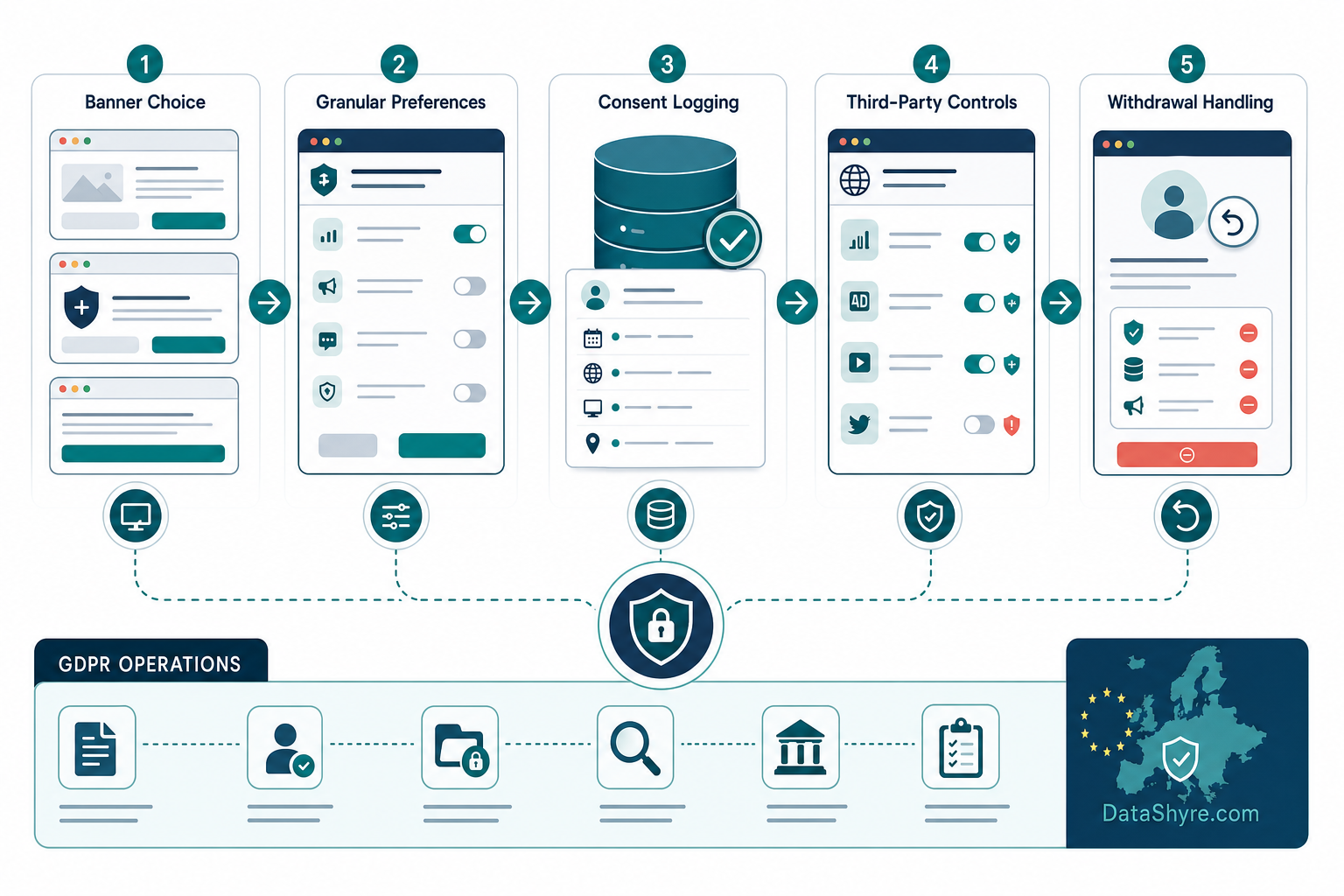
Under GDPR Article 7, a controller must be able to demonstrate consent, present the request clearly, and make withdrawal easy. In Recital 42 and Recital 43, the regulation also pushes toward genuine choice, clear purpose statements, and no detriment when someone refuses or later withdraws. The result is that consent management and gdpr should be reviewed as a system:
- the first-layer banner;
- the preference center;
- the tag and script behavior before consent;
- the vendor list and disclosures;
- the consent log and withdrawal flow.
If any one of those pieces breaks, the visible banner can look compliant while the real implementation is not.
1. Confirm the legal standard you are designing to
The baseline has not become simpler.
GDPR Article 7 says consent must be demonstrable, clearly distinguishable from other matters, and withdrawable at any time. The same article says: “It shall be as easy to withdraw as to give consent.” That line is still one of the fastest ways to test whether your implementation is serious or decorative.
The ICO’s 2026 guidance adds a practical implementation test. It says you must obtain prior consent for non-exempt storage and access technologies, make requests specific to purpose, and ensure any consent mechanism has the technical capability to honor withdrawal with the same ease the user used to give consent.
For consent management and gdpr, that means the compliance target is not “somebody clicked accept once.” It is a repeatable process with clear purposes, easy refusal, easy withdrawal, and evidence.
2. Make prior blocking real, not assumed
This is still where many deployments quietly fail.
The ICO says that if no exception applies, you must obtain prior consent before using the storage and access technologies in scope. The CNIL’s cookie rules page makes the same basic point in French practice: some trackers require people to be informed and to give consent before those trackers are read or deposited.
In operational terms, consent management and gdpr should trigger questions like:
- Do analytics, advertising, personalization, or heatmap tags fire before a choice is made?
- Do embedded videos, chat widgets, or A/B testing tools set identifiers too early?
- Does the site still leak data to vendors through scripts or pixels before the consent layer finishes loading?
A banner that appears quickly is not enough. The scripts underneath it have to wait.
3. Give choices by purpose, not one bundled permission
Granularity is still essential.
The ICO’s guidance says consent requests should generally provide granular options for each purpose and that users must have control over all non-exempt technologies you use. GDPR Recital 43 also warns that consent is presumed not to be freely given if separate consent cannot be given to different processing operations when that separation is appropriate.
That matters because consent management and gdpr usually falls apart when teams bundle everything into one broad “improve your experience” toggle.
A practical structure still looks like this:
- strictly necessary;
- analytics;
- advertising;
- personalization;
- social or third-party content where relevant.
The exact categories can change by stack, but the principle does not. Users need a real way to say yes to one purpose and no to another.
4. Treat third-party disclosure as part of the consent flow
Vendor sprawl is a real consent problem.
The ICO says users must be told about third parties and be able to access specific information about each one. It also says valid consent requires providing the identity of any third parties you share data with, because otherwise people cannot understand the consequences of the consent they may give.
That point is often underestimated in consent management and gdpr projects. Teams review the banner language, but the second layer still contains a vague vendor list, old names from retired tools, or generic labels that do not match the live stack.
I would check:
- whether each vendor on the consent screen still exists in production;
- whether each vendor maps to a stated purpose;
- whether new embeds or plugins were added without being reflected in the consent layer;
- whether withdrawal notices actually propagate to downstream processors where relevant.
If the vendor story is fuzzy, the consent story is fuzzy too.
5. Test refusal and withdrawal as first-class paths
This is where law and runtime behavior meet.
The GDPR text says withdrawal must be easy. The ICO goes further in its 2026 guidance by showing a good-practice mechanism where it is as easy to refuse non-exempt technologies as it is to accept them, and by stressing that the mechanism must “function as intended.”
That means your consent management and gdpr review should not stop at the accept path. It should test:
- accept all;
- reject all;
- one granular choice such as analytics yes and advertising no;
- later withdrawal through a persistent settings path;
- a fresh visit with no cached preference.
If the saved preference changes but the live tag behavior does not, the implementation is weaker than the UI suggests.
6. Keep evidence you can actually use
A consent decision that cannot be reconstructed later is a weak control.
GDPR Article 7 requires controllers to be able to demonstrate consent. That alone should push teams to keep better records than a simple “accepted=true” cookie. In practice, consent management and gdpr usually needs logs that show:
- when the choice was made;
- what purposes were available;
- which version of the notice or banner was shown;
- what the user chose;
- how the choice was later updated or withdrawn.
The useful question is whether a privacy, legal, or engineering team could explain a single user’s path from first visit to later withdrawal without guessing.
If the answer is no, improve the log before the next audit request or complaint.
7. Review mobile and layered UX as compliance issues
The ICO explicitly warns that banners, pop-ups, and similar techniques can become hard to read or interact with on mobile devices, which can undermine the validity of consent. It also says long lists of checkboxes can create usability risks even when the goal is granularity.
That is a useful reminder for consent management and gdpr work: user experience and compliance are not separate tracks.
I would review:
- whether the first layer is readable on a small screen;
- whether reject and customize actions are as reachable as accept;
- whether layered disclosures are clearly signposted;
- whether the preference center is accessible after the first visit.
A design that is technically detailed but practically confusing can still fail the consent test.
8. Do not assume enforcement pressure has cooled off
It has not.
On April 29, 2026, the ICO published its finalized storage-and-access technologies guidance and said it reflects the law as it currently stands while also updating its online tracking strategy. In the same announcement, William Malcolm said online service providers want “clear, practical guidance they can rely on.” He also said the ICO’s work is meant to support a fairer, more transparent online tracking ecosystem that gives people meaningful control over how their data is used.
Then on July 14, 2026, the EDPB said the Belgian DPA must handle the merits of the VRT cookie-banner complaint. That does not mean every banner dispute becomes a fine. It does mean consent management and gdpr is still active enforcement territory rather than old implementation housekeeping.
For teams that have postponed a cleanup because the banner “basically works,” that is not a comforting signal.
A short review sequence for this week
If I were checking consent management and gdpr this week, I would do it in this order:
- map every non-essential cookie, pixel, script, and embed in scope;
- confirm prior blocking on a fresh visit;
- verify purpose-level categories and defaults;
- reconcile the live vendor list with production tools;
- test accept, reject, granular choice, and withdrawal;
- review the consent log for versioned evidence;
- check mobile usability and persistent settings access;
- re-run the review after any major marketing, analytics, or plugin change.
That sequence finds more real defects than another round of banner copy edits.
Bottom line
The best working definition of consent management and gdpr in 2026 is not “we have a banner.”
It is “we can show what the user was told, what they chose, what technologies waited, what vendors received data, and how withdrawal changed the system afterward.”
That is the level where consent becomes an operating control instead of a homepage decoration.
Sources
- EUR-Lex: Regulation (EU) 2016/679, including Article 7 and Recitals 42-43
- ICO: How do we manage consent in practice?
- ICO: Final storage and access technologies guidance published
- CNIL: Les regles a suivre pour les cookies
- EDPB: EDPB requires Belgian DPA to handle the merits of NOYB cookie banner complaint
This post was updated on September 11, 2026 using current official regulator and legal sources available at publication time.