

Osano Consent Manager in 2026: 7 Checks Before You Trust It
If you are evaluating osano consent manager on August 20, 2026, the useful question is not whether the banner looks polished in a demo. It is whether the platform can collect a valid choice, keep optional technologies off until the right moment, respect regional differences, and leave behind records your team can still explain later.
That is the right frame because Osano’s current public materials position the product as more than a simple banner. The CMP page says it can “manage consent and preferences for cookies and more” across multiple laws, regions, and website endpoints from one platform, while its current feature set highlights AI-powered cookie classification, unauthorized tag blocking, granular consent controls, language and regulation support, a unified preference hub, and reporting. The legal baseline is still active too. The UK ICO finalized its storage-and-access technologies guidance on April 29, 2026 and made clear that the review reaches cookies, tracking pixels, device fingerprinting, and similar technologies. The European Commission still says valid consent must be freely given, informed, specific, and tied to a clear affirmative act, while withdrawal should remain as easy as giving consent. In California, the Department of Justice still describes Global Privacy Control as a “stop selling or sharing my data switch” that covered businesses must honor where applicable.
If you want the closest companion reads first, start with our guides to cookie consent manager, Google Tag Manager cookie consent, and consent management platform best practices. This article is narrower. It is the live deployment review I would run before trusting osano consent manager in production this week.
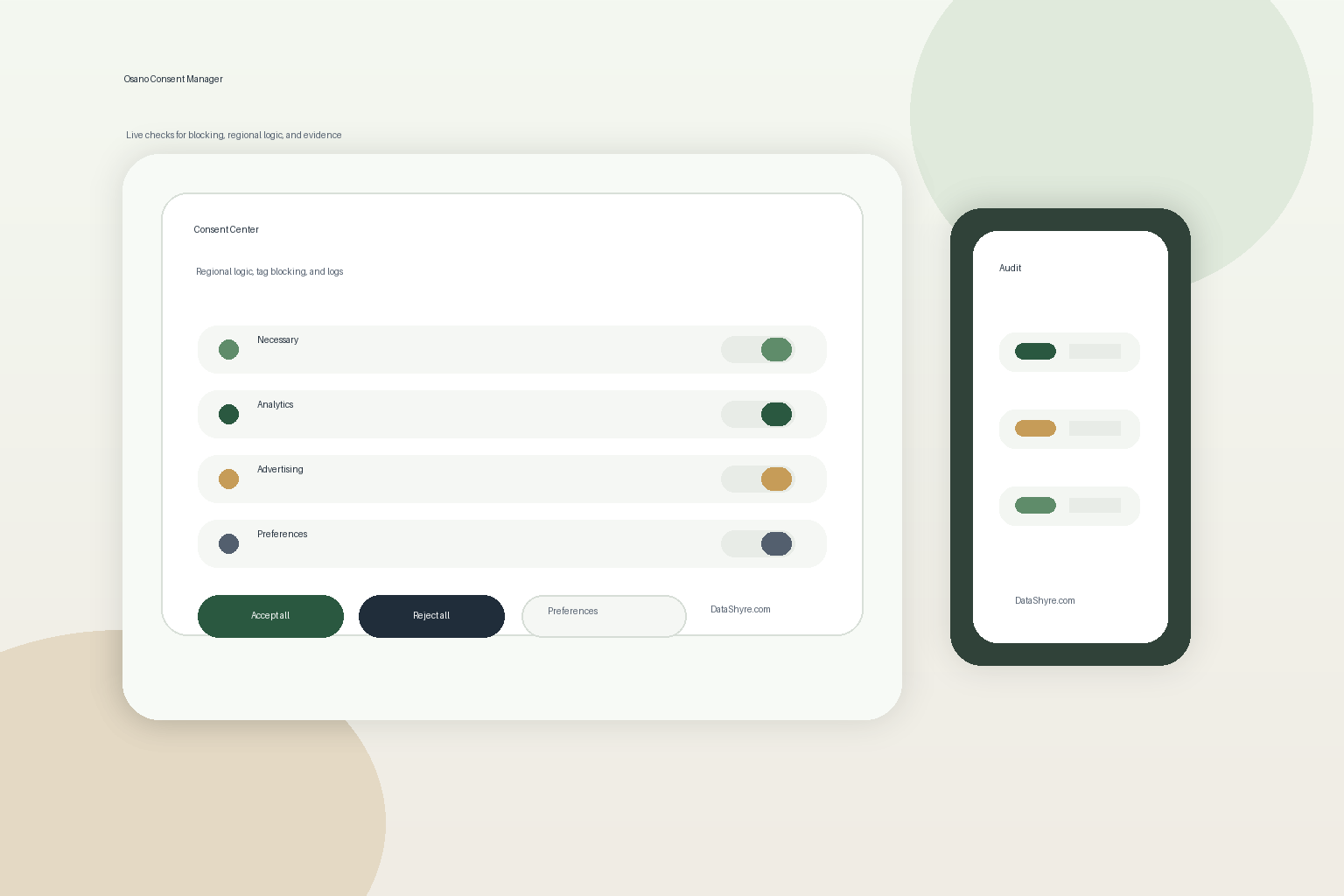
Why osano consent manager should be reviewed as a live control layer
The easiest way to misunderstand osano consent manager is to review it only as front-end copy and buttons.
Osano’s current product materials describe a broader operating layer. Depending on how your team deploys it, the platform can touch:
- cookie and tracker discovery;
- consent collection and category control;
- blocking of unauthorized tags;
- localization by language and jurisdiction;
- Google Tag Manager or other tag workflows;
- consent records and reporting;
- mobile-app or broader preference-management paths.
That means the real review is operational, not cosmetic. You are not only checking whether the first screen looks balanced. You are checking whether the policy logic, runtime behavior, downstream integrations, and evidence trail still line up after real site changes.
7 checks before you trust osano consent manager
1. Confirm the real scope before you start judging the banner
The phrase osano consent manager can describe more than one job.
Osano’s current CMP materials say the platform can support websites, mobile apps, and a broader preference hub that goes beyond cookies into other consent or preference use cases. If your business expects only a web banner, that is a lighter review. If it expects consent logic across multiple surfaces, your checklist needs to widen immediately.
So before testing anything else, write down what this deployment is supposed to control now:
- website pages only;
- website plus tag-manager flows;
- website plus mobile-app surfaces;
- cookie controls only;
- or a broader consent-and-preference workflow.
If that scope is fuzzy, the rest of the review will be fuzzy too.
2. Split the regional rule paths before you optimize the interface
One polished interface can still hide weak rule logic.
Osano emphasizes global language and regulation support, which is helpful because the operating rules are not identical everywhere. In the EU and UK, the practical question is often whether non-essential technologies stay off until valid consent exists. In California, the more immediate branch may be opt-out handling, privacy notices, and qualifying browser preference signals such as GPC.
The European Commission still says valid consent must be freely given, informed, specific, and affirmative. California’s DOJ still says GPC functions as a browser-based signal to stop sale or sharing. CNIL’s current enforcement messaging is still a useful design warning too: “rejecting cookies should be just as easy as accepting them.”
For osano consent manager, that means the right review is not one generic happy path. It is at least:
- an EU or UK prior-consent path;
- a California path where sale-or-sharing logic and GPC are tested where relevant;
- a usability review of equal rejection versus acceptance;
- and a withdrawal path that stays easy to reach later.
3. Verify discovery, classification, and blocking on the pages that actually matter
This is where many CMP projects look strong in configuration screens and weaker on the live site.
Osano’s current materials say the platform uses AI-powered cookie classification, can automatically scan the site, and can block unauthorized tags. Its cookie-consent page also notes an important implementation detail: HTTP-only cookies may still require manual scanning or rule setup.
That is exactly why osano consent manager should be tested on the templates that carry the most risk, not only on the homepage:
- marketing pages with ad tech;
- blog posts with video or map embeds;
- support pages with chat widgets;
- pricing pages with analytics and experimentation tools;
- account or checkout flows with extra scripts.
The ICO’s April 2026 guidance matters here because it makes the review broader than classic cookie-only thinking. If optional pixels, scripts, or fingerprinting-like behavior can still activate too early on those real pages, the implementation is not ready just because the dashboard looks organized.
4. Follow the consent signal into Google timing and tag workflows
This is where the runtime review gets technical in a useful way.
Osano says it integrates with Google Tag Manager and other tag systems. Google still says the default consent state should be set before any measurement data is sent, and that consent updates should be tracked on the page where they occur before any page transition. Google also recommends using Tag Assistant to verify default and updated consent states.
So for osano consent manager, do not stop after clicking Accept all or Reject all. Test whether:
- consent defaults load before measurement starts;
- updates fire on the same page as the banner interaction;
- region-specific defaults behave as intended;
- GTM publishes or performance changes have altered timing;
- blocked tags stay blocked until the right consent state exists.
If you run ads in Google publisher products, keep a separate branch for that too. Google’s current help still says publishers serving personalized ads in the EEA, the UK, or Switzerland must use a certified CMP integrated with the IAB TCF. That is related to CMP work, but it is not the same as saying a banner is legally sufficient on its own.
5. Treat Osano’s logs and reporting as production evidence
One reason teams choose a full consent manager is the evidence layer, not just the banner layer.
Osano’s current public materials say the platform stores consent records, tracks logs, and surfaces configuration changes for audits and legal review. That promise is only valuable if another person on your team can retrieve the record and understand what happened without reverse-engineering the implementation.
For osano consent manager, test whether:
- consent records are easy to retrieve;
- category changes make sense in the logs;
- configuration changes are visible enough to explain drift;
- runtime observations match the records being stored;
- your team can quickly answer what a user saw, chose, and changed later.
If the evidence trail is messy, the deployment may be harder to defend than the interface suggests.
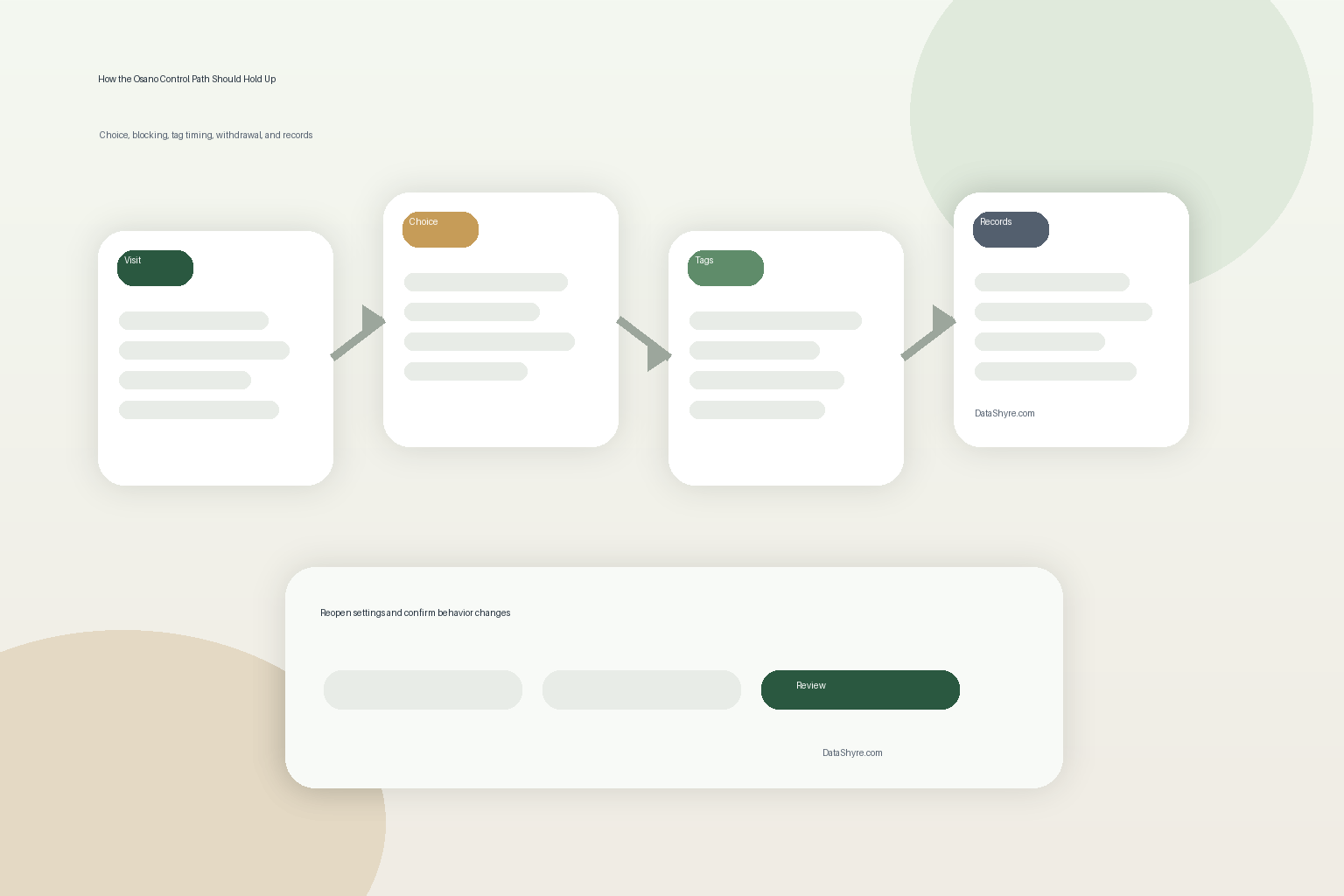
6. Reopen preferences and confirm withdrawal changes later behavior
This is one of the most important practical tests.
The European Commission still states the standard plainly: “It should be as easy to withdraw as to give consent.” Osano’s public materials say users can withdraw consent at any time and that the cookie-consent tool provides a persistent way back to settings.
For osano consent manager, the useful test is not whether the icon exists. It is whether behavior actually changes after a user changes their mind:
- do optional tags stop or remain suppressed on later pages;
- do embedded tools go back behind consent where they should;
- do category updates affect future sessions as expected;
- do the stored records reflect the revised choice clearly.
If the interface acknowledges withdrawal but the site keeps behaving as if consent remains granted, the control is weaker than it looks.
7. Tie configuration changes to release review
This is what keeps a good setup from drifting into a false sense of security.
Osano says it keeps banners current as new regulations become active over time, but no platform removes the need for live release discipline. External scrutiny remains active too. On July 14, 2026, the EDPB required the Belgian DPA to handle the merits of a NOYB cookie-banner complaint involving VRT instead of dismissing it on procedural grounds.
That is a reminder that cookie-banner and consent-layer scrutiny has not gone away. For osano consent manager, the release checklist should trigger a re-test after:
- new vendors, embeds, or pixels;
- GTM container publishes;
- caching or script-deferral changes;
- consent-category edits;
- localization or regional-rule changes;
- platform or plugin updates.
If nobody owns that re-test, the deployment can quietly degrade while still looking identical on the surface.
A short review sequence I would run this week
If I had ten minutes to review osano consent manager before launch, I would do this in order:
- Confirm whether the deployment is web-only, web plus GTM, or broader than that.
- Run separate EU or UK and California checks instead of trusting one default path.
- Test what fires before any interaction on the highest-risk templates.
- Verify Google consent defaults and updates with Tag Assistant where Google tags are involved.
- Pull one consent record and compare it with the live behavior you observed.
- Reopen preferences and confirm withdrawal changes what happens next.
- Write down the release events that should automatically trigger re-testing.
That sequence usually reveals more real risk than another round of banner-copy edits.
Bottom line
The best way to think about osano consent manager in 2026 is as a live enforcement layer, not as a decorative compliance add-on.
Osano’s own concise promise is to “manage consent and preferences for cookies and more.” If the deployment really does that across region logic, blocking, downstream tag timing, withdrawal, and usable records, it is in much better shape. If it does not, the interface may be live while the actual control path underneath is still fragile.
Sources
- Osano: Consent Management Platform (CMP) for GDPR & CCPA
- Osano: Cookie Consent for GDPR & CCPA Compliance
- UK ICO: Final storage and access technologies guidance published
- UK ICO: Guidance on the use of storage and access technologies
- European Commission: Legal grounds for processing data
- California Department of Justice: Global Privacy Control
- California Department of Justice: CCPA
- California Privacy Protection Agency: Law & Regulations
- CNIL: Dark Patterns in Cookie Banners: CNIL issues formal notice to website publishers
- European Data Protection Board: EDPB requires Belgian DPA to handle the merits of NOYB cookie banner complaint
- Google for Developers: Set up consent mode on websites
- Google for Developers: Troubleshoot consent mode with Tag Assistant
- Google Ad Manager Help: Google consent management requirements for serving ads in the EEA, the UK, and Switzerland (for CMPs)
This post was updated on August 20, 2026 using current official regulator, government, Google, and Osano materials available at publication time.