

Third Party Cookies in 2026: What They Are, Why They Still Matter, and 7 Live Checks
If you are searching third party cookies on October 29, 2026, the shortest useful answer is this: they are cookies set by a domain other than the top-level site you are visiting, and they are still one of the clearest ways another company can recognize activity across contexts.
That does not mean every browser treats them the same way.
It also does not mean the compliance question starts and ends with the label.
In 2026, the better review is broader:
- which browser behavior you are relying on;
- what the cookie is actually used for;
- which third party receives the data;
- whether consent or opt-out rights apply in that region; and
- whether the live site still changes behavior after the user says no.
If you want the adjacent explainers first, start with what are cookies on the internet, cookie consent, and website privacy checker. This page stays narrower. It is the third party cookies review I would use this week before telling a team their live setup is fine.
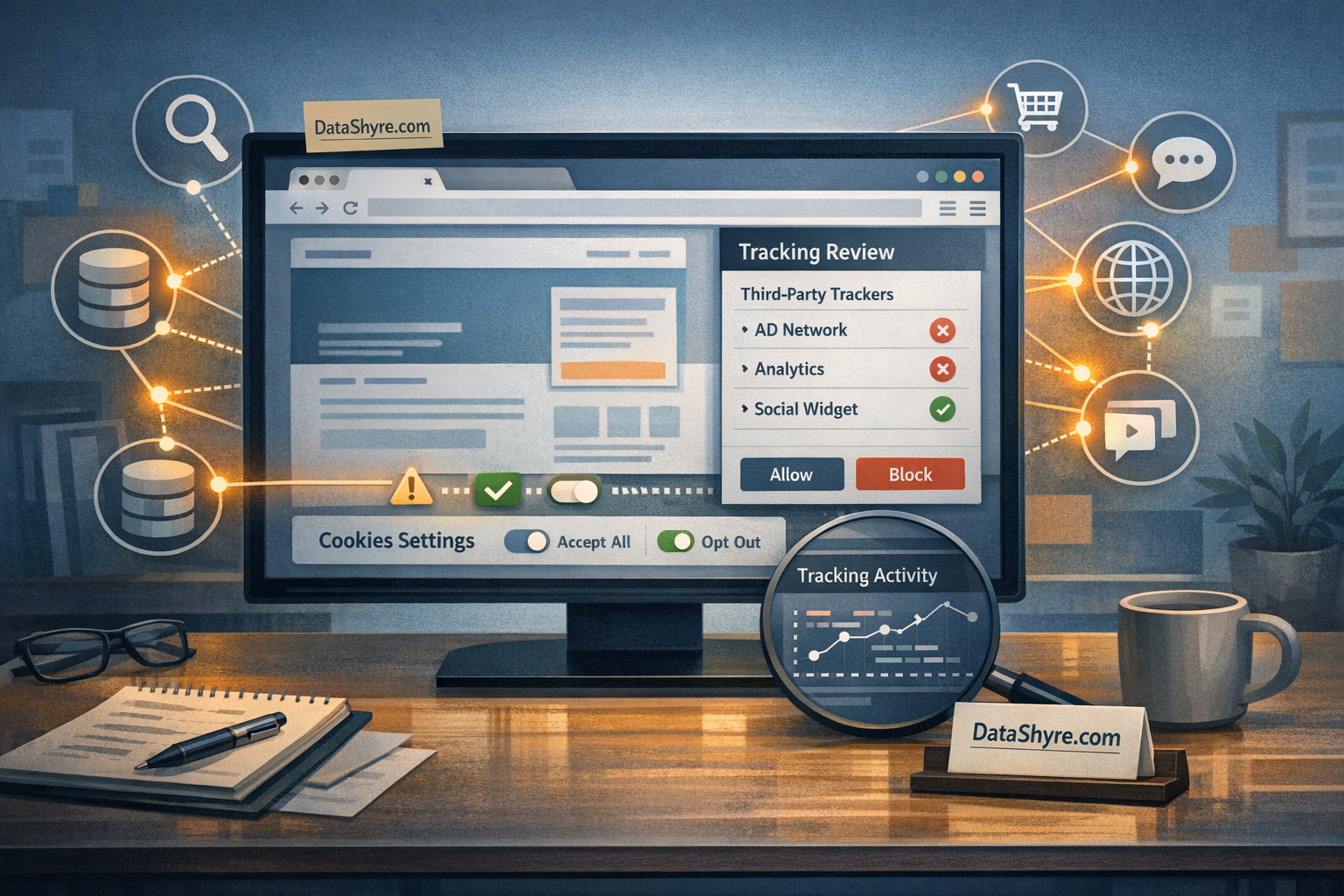
1. Start with the plain-English definition
The easiest way to understand third party cookies is to start with who is setting them.
Chrome’s developer documentation says third-party cookies are cookies set by a site that is different from the current top-level page. The FTC’s consumer guidance gives the same concept in user-facing language: when the site you visit lets another company track you, that is third-party tracking.
So the practical meaning of third party cookies is not just a technical cookie type.
It is usually a signal that another party is involved in the page experience and may be learning from it.
That is why teams should ask three follow-up questions immediately:
- which third party is involved;
- what purpose that party serves; and
- whether the site would still work without that cookie.
2. Do not assume every browser treats them the same way
One of the easiest mistakes in late 2026 is assuming third party cookies have already disappeared everywhere.
That is not the safe assumption.
Mozilla’s current Firefox help still says Firefox blocks third-party cookies in Enhanced Tracking Protection Strict mode. Chrome, meanwhile, is a different story. Recent Chrome developer release notes say Chrome is maintaining its current approach to third-party cookies and, as a result, is deprecating several Privacy Sandbox APIs that had been built for a different transition path.
The practical lesson is simple:
- some browsers already block or limit more third-party behavior than others;
- some user settings change the result even inside the same browser; and
- your site may behave very differently depending on the environment.
So a real third party cookies review should test Chrome, Firefox, mobile webviews, and any browser modes your audience actually uses instead of assuming one outcome across all traffic.
3. The legal question is bigger than the first-party versus third-party label
The label still matters, but it is no longer the whole analysis.
The ICO’s 2026 storage-and-access-technologies guidance says that whether a technology is classed as first-party or third-party is not the main consideration for privacy and data protection purposes. The same guidance explains that resources once delivered by a third-party cookie may now be delivered via a first-party cookie even where the resource itself is still external to the service the user interacts with.
That means third party cookies are still a useful warning sign, but they are not the only thing you should inspect.
The more complete questions are:
- who stores or accesses information on the device;
- who processes the resulting data;
- what purpose the identifier serves;
- whether the use is necessary for the service; and
- whether a substitute technology is doing nearly the same thing under a different name.
If a team only audits third party cookies and ignores pixels, tags, local storage, or fingerprinting, it can still miss the real tracking path.
4. Treat consent and opt-out as separate regional branches
This is where third party cookies stop being a browser question and become a compliance question.
UK and EU branch
The ICO’s current guidance says the exception does not apply where a social media plugin, script, cookie, or other technology tracks users, and it says consent is required for cross-site or cross-device tracking. The ICO’s finalized April 29, 2026 guidance also makes clear that the same regulatory frame now covers cookies, tracking pixels, scripts, tags, and device fingerprinting.
That means many optional third party cookies used for advertising, profiling, or broader measurement still need prior consent in UK or EU-facing flows.
California branch
California often changes the practical question. The California DOJ says the Global Privacy Control is a “stop selling or sharing my data switch” and one way for consumers to submit requests to opt out of the sale or sharing of personal information. So if third party cookies are part of a sharing or sale flow, the business has to review not only notice language but whether the downstream sharing actually stops when the signal or request arrives.
That is why copied banners still fail. The legal branch may depend less on a generic accept button and more on whether your rights and signal handling actually change the live ad-tech behavior.
5. Map the vendor path, not just the cookie name
Many weak third party cookies reviews stop after exporting a list from DevTools.
That is a start, not the finish.
You also need to know:
- which script or embed set the cookie;
- which vendor endpoint received the request;
- whether the vendor is acting only as a processor or doing broader measurement or targeting work;
- whether the same identifier is reused across sites, devices, or sessions; and
- whether the privacy policy and notice language actually disclose the vendor category and purpose.
The ICO’s current compliance guidance says you should understand what technologies you use, for what purposes, whether your service incorporates third-party features, and which third parties store or access information on the device or process information from it.
That is the operational core of third party cookies work in 2026. The real risk is often in the vendor chain, not in the cookie table alone.
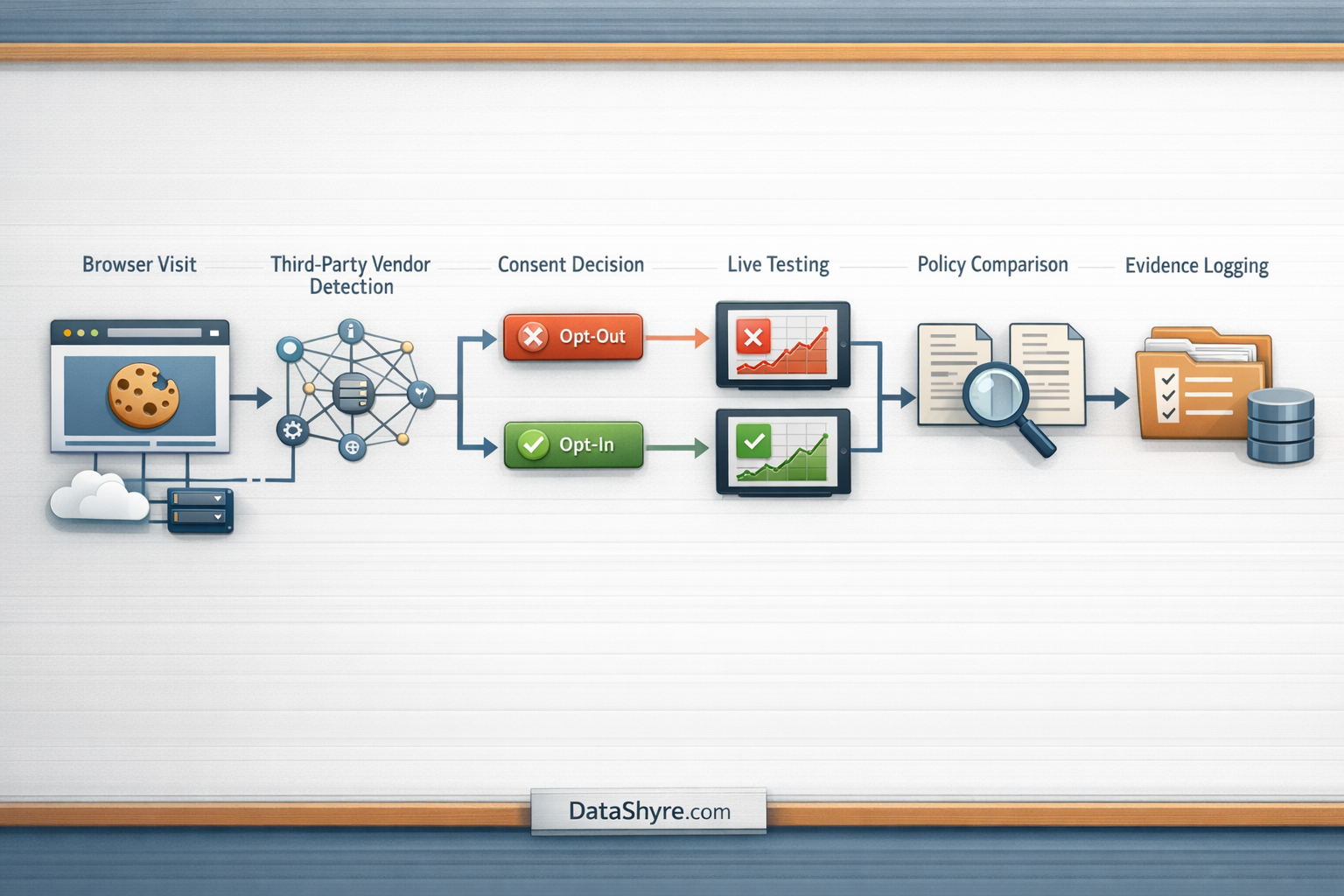
6. Test no-choice, reject, accept, and later withdrawal on the live site
This is where many third party cookies setups fail quietly.
The banner may look balanced while the tag still fires too early. The preference center may offer a reject path while a later page load restores the same third-party requests. The browser may store less, but the third party may still receive enough data through another route to keep the profile alive.
For a live third party cookies review, test at least these states:
- first visit with no interaction;
- explicit reject;
- explicit accept;
- category-level selection where available;
- later withdrawal or preference change; and
- California opt-out or GPC where the data flow could count as sale or sharing.
Compare network requests, storage behavior, and policy language in each branch.
If the cookie disappears but the tracking purpose continues through another mechanism, the privacy problem is still there.
7. Watch enforcement and substitute technologies at the same time
The enforcement lesson in 2026 is not that cookies stopped mattering.
It is that regulators are still looking at the real purpose and effect of the tracking.
On October 22, 2026, the CNIL fined FNAC DARTY PARTICIPATIONS ET SERVICES and FNAC DIRECT 7 million euros over a mobile-app tracker used without prior consent. The CNIL said the tracker collected browsing history, supported personalized recommendations, and trained the recommendation algorithm, and that these operations did not fall within the legal exemptions for trackers.
That matters for third party cookies because it reinforces two practical points:
- the compliance review extends beyond classic desktop browser cookies; and
- replacing one tracking mechanism with another does not remove the need to test the purpose, consent path, and real data flow.
A practical review order for this week
If I were auditing third party cookies today, I would use this order:
- identify the browsers and modes your real users rely on;
- list every third-party script, embed, pixel, and cookie that appears before any choice;
- map which vendor receives data and for what purpose;
- separate UK or EU prior-consent checks from California opt-out and GPC checks;
- test no-choice, reject, accept, and later withdrawal on the published domain;
- compare the live behavior against the privacy policy and consent copy; and
- save evidence before the next release changes the result.
That order surfaces more truth than a cookie-inventory spreadsheet alone.
FAQ
Are third party cookies already gone?
No. Browser handling varies, user settings vary, and some sites still rely on them. A safe review starts by checking what actually happens in the browsers and modes your visitors use.
Are third party cookies always illegal?
No. The real question is what they are used for, whether an exception applies, and which regional privacy rules govern the flow. Many optional advertising or cross-site tracking uses still need consent in UK or EU contexts, while California often centers on notice, opt-out, and GPC handling.
If I replace them with first-party storage or another tool, am I done?
No. The ICO’s current guidance explicitly warns that first-party versus third-party is not the only thing that matters. You still need to test who gets access, what purpose the identifier serves, and whether another tracking method is doing the same job.
Bottom line
The safest way to think about third party cookies in 2026 is not old tech that must already be gone.
It is one visible branch of a larger cross-site tracking problem that still has to be tested live.
If you know which browsers matter, which vendors receive data, which regional rules apply, and what changes after reject, opt-out, or withdrawal, you are much closer to the truth.
If you only count cookie names, you probably are not.
Sources
- Chrome for Developers, Chrome 153 release notes: https://developer.chrome.com/release-notes/153
- Chrome for Developers, View, add, edit, and delete cookies: https://developer.chrome.com/docs/devtools/application/cookies/
- Mozilla Support, Third-party cookies and Firefox tracking protection: https://support.mozilla.org/en-US/kb/third-party-cookies-firefox-tracking-protection
- FTC Consumer Advice, How Websites and Apps Collect and Use Your Information: https://consumer.ftc.gov/articles/how-websites-and-apps-collect-and-use-your-information
- ICO, What are storage and access technologies?: https://ico.org.uk/for-organisations/direct-marketing-and-privacy-and-electronic-communications/guidance-on-the-use-of-storage-and-access-technologies/what-are-storage-and-access-technologies/
- ICO, What are the exceptions?: https://ico.org.uk/for-organisations/direct-marketing-and-privacy-and-electronic-communications/guidance-on-the-use-of-storage-and-access-technologies/what-are-the-exceptions/
- ICO, How do we comply with the PECR rules?: https://ico.org.uk/for-organisations/direct-marketing-and-privacy-and-electronic-communications/guidance-on-the-use-of-storage-and-access-technologies/how-do-we-comply-with-the-pecr-rules
- ICO, Final storage and access technologies guidance published: https://ico.org.uk/about-the-ico/media-centre/news-and-blogs/2026/04/final-storage-and-access-technologies-guidance-published/
- California DOJ, Global Privacy Control: https://oag.ca.gov/privacy/ccpa/gpc
- CNIL, Cookies and mobile application: 7 million euros fine against FNAC DARTY PARTICIPATIONS ET SERVICES and FNAC DIRECT: https://www.cnil.fr/en/sanction-app-cookies-fnac