

Consumer Consent Solution in 2026: What It Must Actually Control
If you are evaluating a consumer consent solution in 2026, the first question is not which banner or preference center looks the cleanest.
The better question is whether the system can separate consent from other legal bases, collect purpose-level choices in plain language, push those choices into tags and downstream tools, and still prove later what the person saw and selected.
That is the standard official guidance keeps pointing toward. The European Commission still says valid consent must be “freely given, specific, informed and unambiguous.” The UK ICO still says you need records showing “who consented, when, how, and what they were told.” California’s Department of Justice describes Global Privacy Control as a “stop selling or sharing my data switch.” A serious consumer consent solution has to operationalize all three ideas, not just collect a click.
If you want nearby context first, start with our guides to GDPR consent requirements, California consumer privacy, and user consent management. This page is narrower. It is the live review I would use before trusting any consumer consent solution this week.
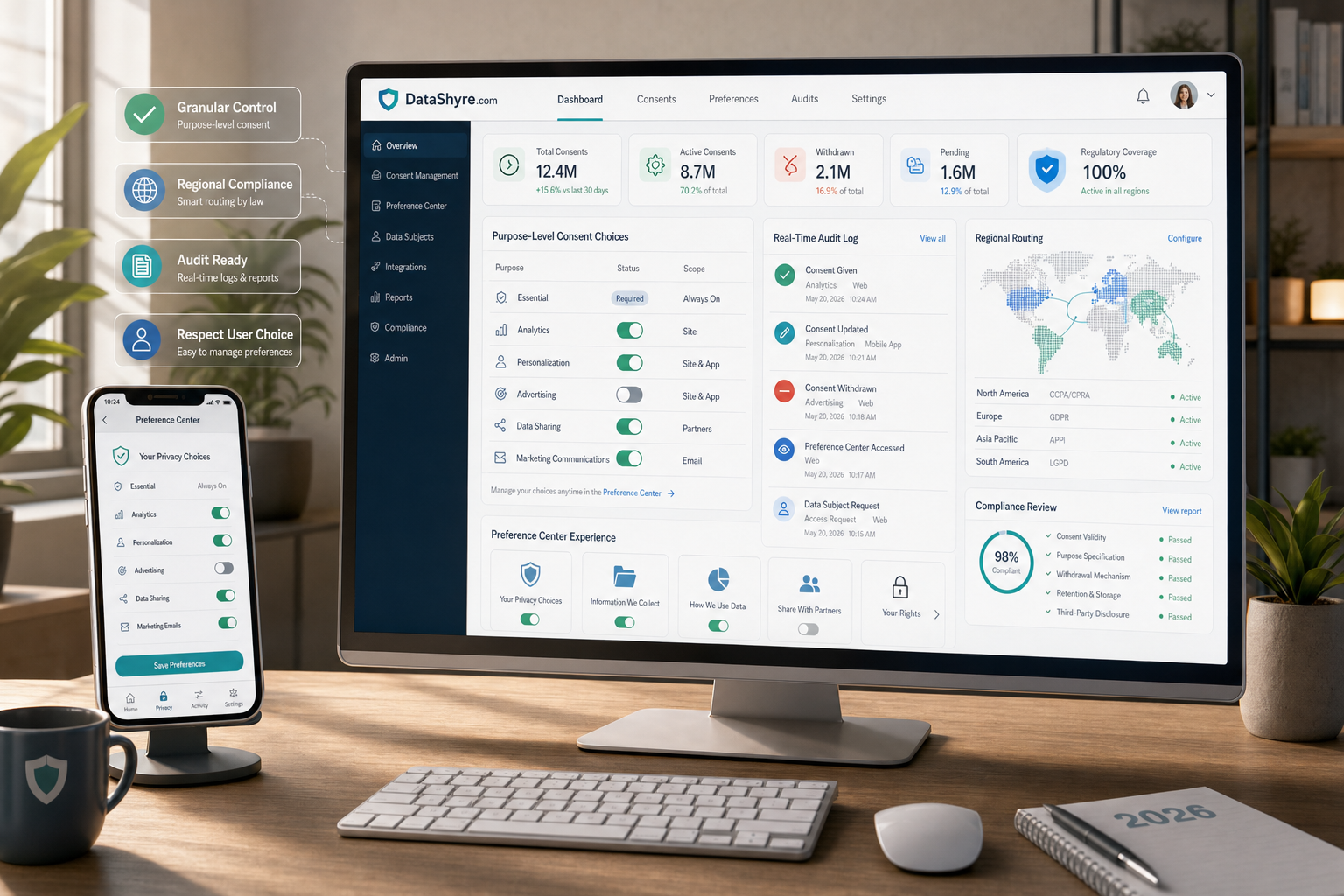
What a consumer consent solution should solve first
The weakest consent tools still treat everything like one generic yes-or-no prompt.
That breaks quickly on real systems because a business may need to manage:
- website tracking consent;
- marketing permissions by channel;
- app or product permissions;
- California opt-out rights and GPC signals;
- later withdrawals or preference changes; and
- records that explain what happened after the fact.
That is why a consumer consent solution should be reviewed as an operating layer, not a UI widget.
1. Route the decision before you ask for consent
Many teams ask for consent first and work out the legal theory later. That reverses the real order.
The European Commission still lists consent as only one legal basis among several. The ICO makes the same practical point in its lawful-basis guidance: if you would process the data anyway, asking for consent is misleading and unfair.
So the first test for a consumer consent solution is whether it can route decisions by purpose:
- does this use really depend on consent;
- is another legal basis actually the right fit;
- is this an EU or UK prior-consent issue, a California opt-out issue, or something else entirely; and
- can the system keep those branches separate.
If the product starts from one master toggle for every purpose, the model is already too coarse.
2. Collect purpose-level choices in clear language
The European Commission’s current materials still say a consent request must be clear, concise, easy to understand, and distinguishable from other terms. The ICO likewise says consent requests should be prominent, separate, and granular where possible.
That makes specificity one of the core selection tests for a consumer consent solution.
The tool should help you capture:
- the purpose behind each choice;
- the identity of the organization relying on the consent;
- the notice or policy version shown at the moment of collection;
- whether third parties are involved; and
- how the person can reverse the decision later.
One attractive prompt that silently covers analytics, ad targeting, partner sharing, and lifecycle messaging is not a strong consent pattern. It is bundled risk.
3. Keep California branching separate from EU and UK consent logic
This is where a lot of implementations still flatten unlike-for-unlike rules into one interface.
For many EU and UK website-tracking scenarios, the live question is whether optional storage or access technologies stay off until the right consent exists. The ICO finalized its storage-and-access-technologies guidance on April 29, 2026, and the published materials make clear the scope covers cookies, tracking pixels, scripts, device fingerprinting, and similar technologies.
California often asks a different operational question. The California DOJ’s CCPA materials say consumers have the right to opt out of the sale or sharing of personal information, including through GPC. The DOJ’s GPC page calls that browser-level signal a “stop selling or sharing my data switch.”
So a sound consumer consent solution should be able to test and document both branches:
- prior-consent behavior where optional technologies should not run yet; and
- opt-out behavior where sale or sharing must stop after the consumer signal or request.
One front-end component may support both, but it should not pretend they are the same compliance task.
4. Push the choice into runtime systems, not just the banner
This is the place where polished dashboards often stop being useful.
Google’s current consent-mode setup guidance says default consent states should be set on every page before any commands that send measurement data, and updates should be tracked on the page where the user acts, before a page transition. That matters because a consumer consent solution is only as strong as its downstream enforcement.
In practice, that means checking whether the platform can:
- hold optional tags, SDKs, and embeds back until the correct state exists;
- update those states immediately after accept, reject, or later preference changes;
- prevent bypasses from custom code, server-side routing, or third-party widgets; and
- keep behavior consistent across templates, apps, and logged-in states.
If measurement or ad tools learn the answer before the user gives it, the consent interface is not the source of truth.
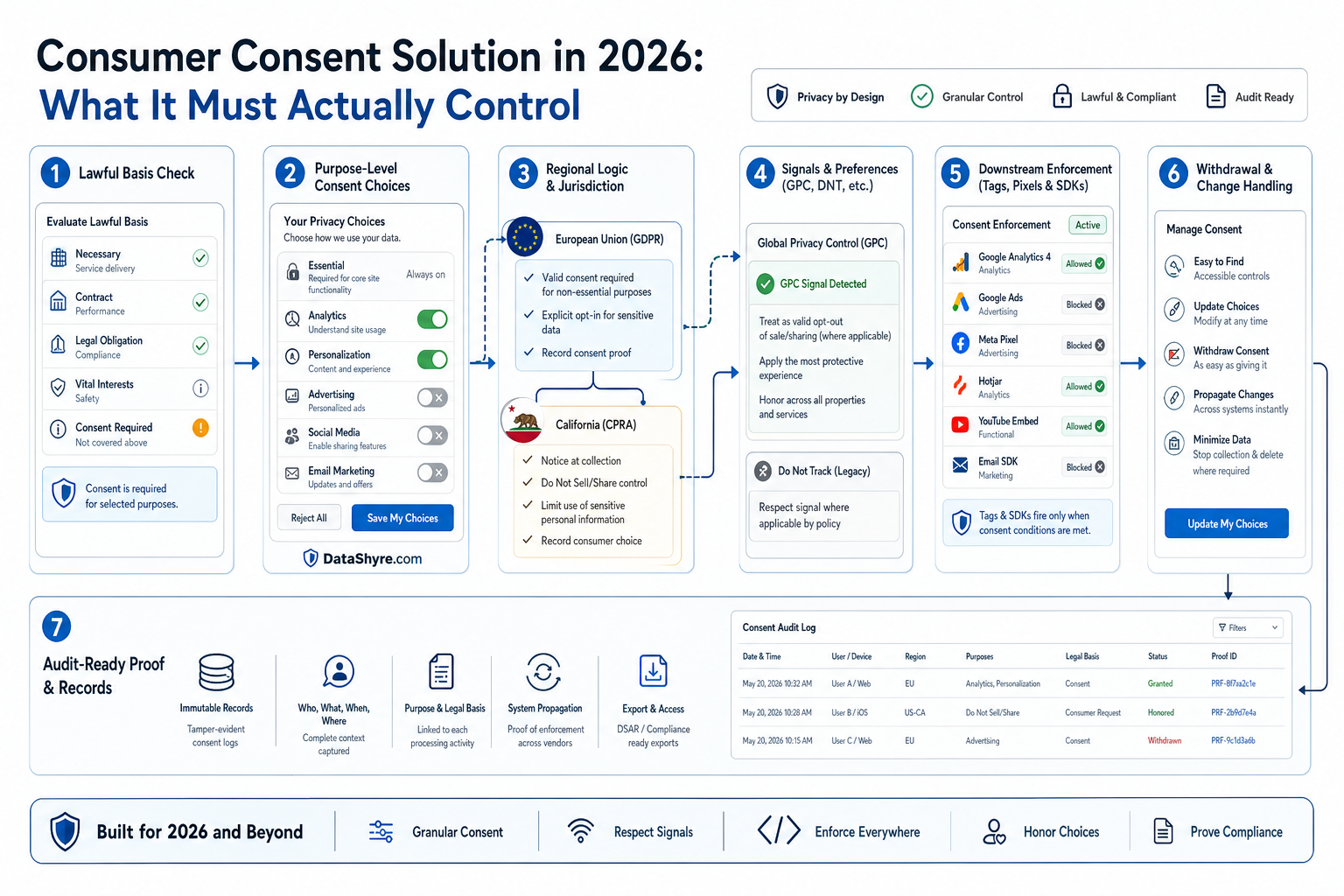
5. Demand audit-ready records, not just event counts
The ICO’s consent-record guidance is still one of the clearest buying filters here. It says you need an audit trail that can show “who consented, when, how, and what they were told.”
For a consumer consent solution, that usually means the record should preserve:
- the user or device identifier used for the event;
- timestamp and source location;
- the exact choice made;
- the text or notice version shown at the time;
- the purpose or category tied to the choice;
- later updates, withdrawals, or expirations; and
- where the signal was propagated afterward.
This is also where the 2026 enforcement climate matters. The EDPB’s coordinated enforcement action for 2026 is focused on transparency and information obligations under GDPR Articles 12, 13, and 14. If your records cannot connect the notice to the resulting behavior, the proof trail is thinner than it looks.
6. Make withdrawal and preference changes genuinely usable
Consent quality is not measured only at capture time.
The European Commission still says withdrawal should be as easy as giving consent. The ICO’s consent guidance likewise recommends ongoing choice and control, including preference-management tools such as privacy dashboards.
CNIL’s cookie-banner enforcement messaging is useful here too because it keeps the test practical: it should be “as easy to refuse cookies as to accept them.”
So before trusting a consumer consent solution, test whether:
- refusal is as visible as acceptance;
- later preference changes are easy to find on desktop and mobile;
- a withdrawal actually changes system behavior, not just stored UI state; and
- re-prompting logic stays disciplined after a decline.
If the only easy action is Accept, the solution is not helping you much.
7. Re-test after stack changes
The last filter is operational durability.
A consumer consent solution may look fine during procurement and drift later when marketing adds a new pixel, engineering changes a template, a mobile SDK is updated, or a server-side tag path is introduced.
That is why the right review rhythm includes re-testing after:
- tag-manager changes;
- new vendors or embeds;
- app SDK updates;
- template, theme, or checkout changes;
- identity-resolution or CDP changes; and
- policy or purpose changes that affect what the original consent covered.
The stronger tool is not the one with the prettiest demo. It is the one that still leaves behind understandable proof after normal releases.
A short buying checklist
If I were comparing a consumer consent solution today, I would ask:
- Can it separate consent from non-consent legal bases?
- Can it model purposes and regions separately instead of overloading one toggle?
- Can it honor California opt-out and GPC flows without confusing them with EU-style prior consent?
- Can it control runtime behavior across tags, SDKs, embeds, and custom code?
- Can it preserve versioned proof of what the user saw and chose?
- Can it make refusal, withdrawal, and later updates genuinely easy?
- Can another team still verify all of that after the next release?
That sequence will tell you more than a feature matrix or a banner screenshot.
Bottom line
The right consumer consent solution in 2026 is not the one that captures the most clicks. It is the one that helps your systems ask cleanly, branch correctly, enforce the result, and prove what happened later.
If it can do that across web, app, and downstream data flows, it is worth serious attention. If it cannot, the interface may be finished while the consent program is still incomplete.
Sources
- European Commission, information for individuals: https://commission.europa.eu/law/law-topic/data-protection/information-individuals_en
- European Commission, legal grounds for processing data: https://commission.europa.eu/law/law-topic/data-protection/information-business-and-organisations/legal-grounds-processing-data_en
- UK ICO, consent guidance: https://ico.org.uk/for-organisations/uk-gdpr-guidance-and-resources/lawful-basis/a-guide-to-lawful-basis/consent/
- UK ICO, how to obtain, record and manage consent: https://ico.org.uk/for-organisations/uk-gdpr-guidance-and-resources/lawful-basis/consent/how-should-we-obtain-record-and-manage-consent/
- UK ICO, final storage and access technologies guidance published: https://ico.org.uk/about-the-ico/media-centre/news-and-blogs/2026/04/final-storage-and-access-technologies-guidance-published/
- UK ICO, guidance on the use of storage and access technologies: https://ico.org.uk/for-organisations/direct-marketing-and-privacy-and-electronic-communications/guidance-on-the-use-of-storage-and-access-technologies/
- European Data Protection Board, CEF 2026 transparency action: https://www.edpb.europa.eu/news/cef-2026-edpb-launches-coordinated-enforcement-action-on-transparency-and-information_en
- California DOJ, CCPA: https://oag.ca.gov/privacy/ccpa
- California DOJ, Global Privacy Control: https://oag.ca.gov/privacy/ccpa/gpc
- Google for Developers, set up consent mode on websites: https://developers.google.com/tag-platform/security/guides/consent
- CNIL, dark patterns in cookie banners: https://www.cnil.fr/en/dark-patterns-cookie-banners-cnil-issues-formal-notice-website-publishers
—
Published: October 25, 2026. Updated using current official regulator, government, and platform materials available at publication time.