Google Analytics Cookie Consent in 2026: 7 Live Checks After Google’s June Update
DataShyre StaffAug 4, 2026
9 min read
Google Analytics Cookie Consent in 2026: 7 Checks Before GA4 Fires
If you are trying to sort out google analytics cookie consent on August 4, 2026, the practical question is not whether your banner mentions analytics. It is whether GA4 stores or reads analytics-related data before the visitor has made the choice your region requires, and whether the rest of your Google stack actually follows that choice.
That is the useful frame because the live guidance is technical and legal at the same time. Google’s current consent-mode documentation still says you need to set the default consent state before a user grants consent and update it on the page where the interaction happens before any page transition. Google also says consent mode itself does not provide the banner. Meanwhile, the UK’s ICO finalized its storage-and-access technologies guidance on April 29, 2026 and made clear the rules now reach not only cookies, but also tracking pixels, fingerprinting, web storage, scripts, and tags.
If you want the neighboring tag setup first, our guides to Google Tag Manager cookie consent, cookie consent with Google Tag Manager, and cookie consent banner are the best companion reads. This article is narrower. It is the seven-check review I would run before trusting google analytics cookie consent on a live site in 2026.
Why google analytics cookie consent is still easy to get wrong
GA4 is often installed inside a larger stack.
Sometimes it is loaded directly. Sometimes it comes through Google Tag Manager. Sometimes it is linked to Google Ads, remarketing, or publisher monetization tools. Sometimes a CMP controls the obvious tags while a plugin, embed, or custom script quietly writes analytics-related storage anyway.
That is why google analytics cookie consent is less about a single banner and more about sequencing, scope, and proof. A polished consent box can still hide three common failures:
GA4 or a related tag starts too early;
refusal is visible in the interface but incomplete in the runtime behavior; or
ad-related Google services require stronger consent signals than the team realized.
1. Separate the EU question from the UK question
This is the first place many articles blur the answer.
For GDPR-governed consent, the European Commission still says valid consent must be freely given, informed, specific, and expressed through a clear affirmative act. Withdrawal should be as easy as giving consent. If your setup depends on consent, that is still the baseline.
The UK picture is more nuanced in 2026. The ICO’s final storage-and-access guidance says there is now a narrow statistical purposes exception, sometimes described as the analytics exception, where storage or access is used for the sole purpose of collecting statistical information to improve the service and users are given clear information plus an easy way to object.
But the same ICO guidance is also clear that exceptions are narrow. If the same storage or access is used for another purpose at the same time, such as online advertising, the exception does not apply and consent is required.
So for google analytics cookie consent, the safer question is not “Is GA4 always exempt or always forbidden?” It is:
what region is involved;
what exact GA4 configuration is in use;
whether the storage serves only a narrow measurement purpose; and
whether any ad, profiling, or cross-tool use breaks the exception.
For many commercial sites, especially where GA4 is connected to advertising or broader marketing workflows, that analysis still leads back to consent.
2. Treat consent mode as runtime control, not legal cover
Google’s own wording is useful here:
“Consent mode does not provide a consent banner or widget.”
>
Google
That line matters because teams often expect consent mode to solve the whole issue.
It does not.
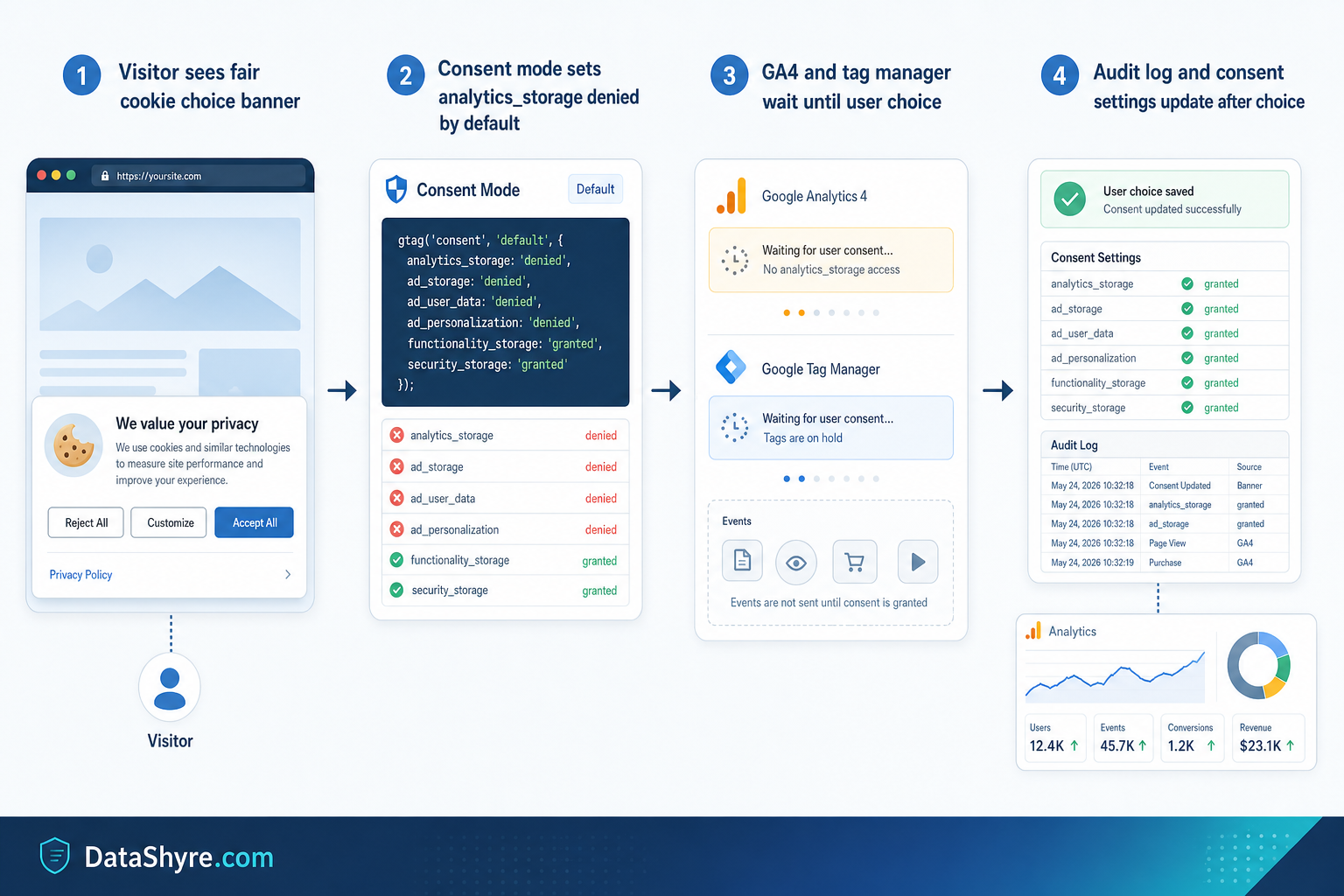
What consent mode does is give Google tags a way to react to the user’s consent state. Google’s current setup guide says you should set the default consent state before consent is granted, then update that state based on the user’s interaction, and track the update on the same page before any transition.
That means google analytics cookie consent is not complete when consent mode is switched on. It is complete only when the banner, the consent state, and the actual tag behavior all agree in time.
3. Know what GA4 does when analytics storage is denied
This is where 2026 implementations are often better than older ones, but still misunderstood.
Google’s current consent-mode overview says that when users deny consent for storage, consent-aware tags do not store cookies on the web. Instead, Google can receive consent-state and activity pings without analytics cookies and use modeling in Google Ads and Google Analytics properties.
That is helpful, but it is not a free pass.
It means GA4 can still preserve some reporting value without writing analytics cookies. It does not mean you can ignore the legal standard for the storage itself, or assume all related tools on the page behave as carefully as GA4 does.
The practical review question is straightforward: when analytics_storage is denied, what still gets sent, what still gets stored, and what else on the page might still be behaving like analytics even if GA4 is not?
4. Linked Google services can raise the consent bar
This is one of the most important current Google details for 2026.
Google Analytics now has explicit consent-setting checks for linked Google services. Google’s current Analytics help says that if a GA4 property is linked to another Google service that requires consent to share data, and one or more streams has EEA-based visitors, Analytics may notify you if it is not receiving affirmative end-user consent for ads measurement or ads personalization.
Google says those signals are tied to ad_user_data and ad_personalization.
That matters because many teams think google analytics cookie consent begins and ends with analytics_storage. It does not if your property is connected to advertising-related features, remarketing, Google Ads, or other linked Google services.
A setup can look fine in a basic GA4 review and still be incomplete for the broader Google stack.
5. Reject-all parity is part of the analytics review, not just the UX review
The ICO’s current guidance says a consent mechanism should make it:
“as easy to refuse consent as it is to accept.”
>
ICO
That matters for google analytics cookie consent because GA4 implementations are often tested through the happy path only. Someone clicks Accept all, the dashboard fills with data, and the review ends.
A stronger audit does the opposite:
reject first;
inspect whether analytics storage stayed off;
confirm no plugin or custom tag bypassed the rule;
reopen settings later and test withdrawal again.
If the reject path is harder to find, harder to use, or less thoroughly tested, analytics compliance usually ends up weaker than the banner design suggests.
6. Seven checks before GA4 fires
If I were reviewing google analytics cookie consent this week, I would use this sequence:
Confirm which regions need opt-in consent and whether any claimed UK analytics exception is genuinely narrow and documented.
Verify that the default consent state is set before GA4 or related measurement logic runs.
Test the first visit with Reject all before ever testing acceptance.
Confirm what happens when analytics_storage is denied, including whether any non-GA4 script still stores analytics-related data.
Review linked Google services for added consent expectations such as ad_user_data and ad_personalization.
Reopen settings and test later withdrawal on the same page and on the next page view.
Keep evidence: region logic, banner version, timestamps, consent state, and test output that shows what actually fired.
That short sequence will usually tell you more than a long discussion about banner copy alone.
7. The narrowest question usually gets the best answer
When teams ask whether they need google analytics cookie consent, they are usually asking one of four different things:
Can GA4 load before the user acts?
Can we rely on consent mode?
Does UK analytics guidance change the answer?
Do linked Google ad features require more than analytics storage alone?
Those are different questions, and each can produce a different answer.
That is why I would document the exact configuration instead of relying on a generic policy sentence. The real answer depends on region, purpose, linked tools, and what the page actually does before and after the visitor chooses.
Bottom line
The strongest google analytics cookie consent setups in 2026 are not the ones with the neatest banner copy. They are the ones that can prove four boring things:
the legal model matches the region;
the default state loads early enough;
GA4 and related tools obey the denied state in practice; and
the team understands when linked Google services raise the consent burden.
If you can prove those four things, you are in much better shape than a site that only knows where its Accept all button sits.