

Cookie Consent Requirements USA in 2026: What Sites Actually Need to Do
If you are trying to understand cookie consent requirements usa in 2026, the fastest mistake is assuming there is one national cookie-banner rule that answers everything.
The more useful question is whether your site gives the right notice, honors the right opt-out signals, avoids manipulative design, and can explain what happens when advertising, analytics, or sharing tools run across state-law branches.
That is the practical frame now. California’s Attorney General says consumers have the right to opt out of the sale or sharing of personal information, including via Global Privacy Control. California’s regulations also say a cookie banner or cookie controls are “not by itself an acceptable method” for sale-or-sharing opt-out requests. Colorado’s Attorney General says covered businesses must allow consumers to opt out through GPC. And the FTC keeps warning about privacy-harming “dark patterns” that can subvert real choice.
If you want adjacent context first, start with our guides to cookie consent requirements, CCPA cookie consent requirements, and california web privacy law. This article stays narrower. It is the seven-check review I would use this week before telling a team their U.S. cookie and tracking layer is in good shape.

1. Do not treat U.S. cookie rules like one nationwide banner law
In practice, cookie consent requirements usa is a state-law and consumer-protection review, not one uniform federal banner script.
California’s materials focus on notice, opt-out rights, and honoring user-enabled global privacy controls for sale or sharing. Colorado’s materials focus on opt-out rights for sale and targeted advertising, including recognized universal opt-out mechanisms. The FTC’s privacy-choice work focuses on whether interfaces trick people into giving away data.
So the first review question is simple: what legal event are you actually trying to manage?
- prior consent for a particular use case;
- opt-out of sale or sharing;
- opt-out of targeted advertising;
- clear notice at or before collection; or
- a non-deceptive privacy choice flow.
If your team collapses all of that into one generic cookie banner, the setup will look cleaner than it really is.
2. Decide whether your tracking stack triggers sale, sharing, or targeted-advertising rights
This is where many U.S. reviews should start.
California’s Attorney General explains that consumers may direct businesses to stop selling or sharing personal information, and the sharing concept specifically reaches cross-context behavioral advertising. Colorado’s Attorney General similarly points businesses to opt-out rights for sale and targeted advertising.
That means the useful inventory is not just a cookie list. It is a purpose map:
- which tags and SDKs are strictly necessary;
- which ones support analytics;
- which ones support retargeting, ad measurement, or audience matching;
- which vendors receive data from those tools; and
- whether that flow could fall into sale, sharing, or targeted-advertising analysis under the state law branch that applies.
If you cannot answer those questions, your cookie consent requirements usa review has not reached the real risk yet.
3. Honor Global Privacy Control and similar universal opt-out paths where required
This is one of the clearest live checks in U.S. privacy work.
California’s Attorney General describes GPC as a “stop selling or sharing my data switch” and says covered businesses must honor it as a valid opt-out request. Colorado’s Attorney General says that, beginning July 1, 2024, businesses within the Colorado Privacy Act’s thresholds must allow consumers to opt out of sale or targeted advertising using GPC.
So your live test should include:
- a browser with GPC enabled;
- a page that would normally load ad-tech or sharing-related tools;
- comparison of first visit behavior with and without the signal;
- inspection of the privacy notice language explaining how the signal is handled.
If the site claims to support U.S. privacy rights but ignores or misroutes the signal, the implementation story breaks quickly.
4. Make opt-out easier than the interface makes reversal or persuasion
The California regulations are unusually practical here.
They say opt-out methods must be easy to execute, require minimal steps, and not use confusing language or extra friction. They also say the process for opting out should not require more steps than the process for opting back in after a prior opt-out. The FTC’s dark-pattern materials reinforce the same design point from a consumer-protection angle: interfaces that trick, trap, or manipulate people around privacy choice create legal risk.
For cookie consent requirements usa, I would review whether:
- the opt-out path is visible on desktop and mobile;
- the labels are plain enough for a normal user to follow;
- the site avoids double negatives and guilt-inducing prompts;
- the user is not forced through extra screens just to say no;
- the choice is not silently reset later.
This is not just design polish. It is part of whether the privacy choice is real.
5. Do not let the cookie banner stand in for the whole California disclosure and opt-out layer
This is the point many teams still miss.
California’s regulations say a cookie banner or cookie controls are “not by itself an acceptable method” for submitting a request to opt out of sale or sharing. That matters because a site can have elegant cookie controls and still miss the actual legal path needed for California rights.
So if your site falls into the California branch, check all of this together:
- whether the privacy policy explains the right to opt out and how it works;
- whether the site honors GPC in a frictionless way if it relies on that path;
- whether a required
Do Not Sell or Share My Personal Informationor alternative opt-out method is actually available when needed; - whether the wording in the cookie tool matches the wording in the notice and the operational behavior.
A banner can support the workflow. It cannot substitute for the full workflow by itself.
6. Test the pages most likely to leak data, not only the homepage
This is where cookie consent requirements usa often fails in production.
The homepage banner might behave one way while a product page, embedded video page, checkout, blog template, or landing page behaves another. Ad pixels, embedded media, personalization scripts, consent mode tags, and third-party widgets are often where the real drift shows up.
So test:
- the first uncached visit;
- a GPC-enabled visit;
- an opt-out or refusal path;
- a return visit after that choice;
- the highest-risk templates where third-party tools are most likely to fire.
If the choice interface looks correct but the network behavior tells a different story, the article copy does not matter much.
7. Keep records that explain the choice path later
The last useful check is proof.
For U.S. privacy operations, that means keeping enough evidence to explain:
- what notice or control the person saw;
- what state-law branch or signal path applied;
- whether GPC was detected;
- what the site did with advertising or sharing-related tools as a result;
- when the page, tag, or vendor configuration last changed.
That record matters because privacy choice failures often appear after a redesign, tag-manager publish, or vendor change, not on the day the interface was approved.
A short review order for this week
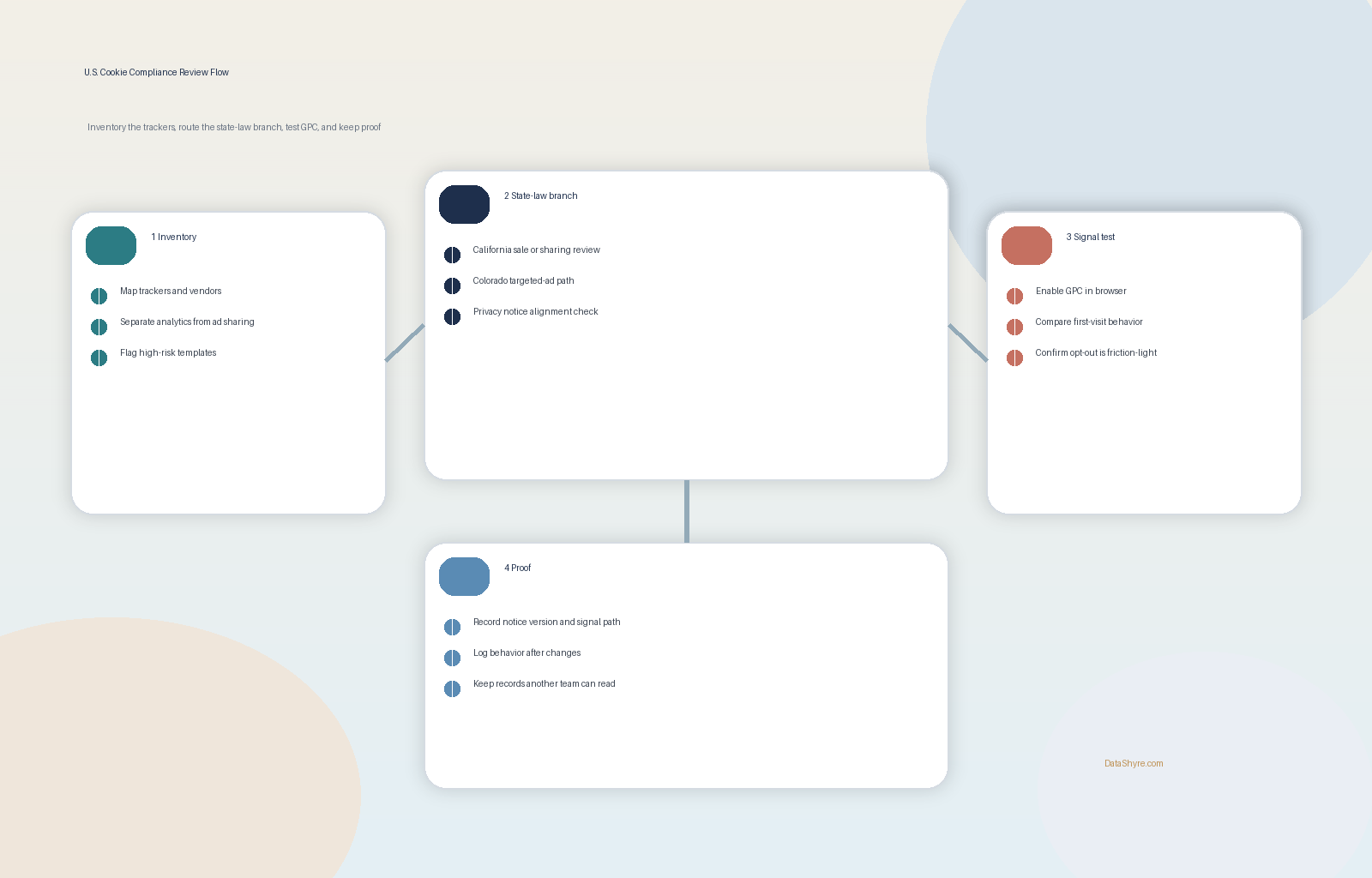
If I were auditing cookie consent requirements usa today, I would do it in this order:
- classify the page’s real use cases: notice, sale or sharing opt-out, targeted-advertising opt-out, or all of them;
- map the trackers and vendors behind each category;
- test GPC and other applicable opt-out paths;
- compare the opt-out flow against the site’s opt-in or re-enable flow;
- review whether California notice and opt-out obligations are being handled outside the banner where needed;
- inspect the templates most likely to leak third-party requests;
- keep proof another team can still understand next month.
That usually reveals more than another banner redesign.
FAQ
Do all U.S. sites need an EU-style opt-in cookie banner?
Not necessarily. The more practical review is whether the site gives the right notice, honors applicable opt-out rights and signals, and avoids deceptive choice design under the laws that apply to the site and audience.
Is a cookie banner enough for California?
No. California’s regulations say a cookie banner or cookie controls are not, by themselves, an acceptable method for a sale-or-sharing opt-out request.
Does Global Privacy Control matter in the USA?
Yes. California treats GPC as a valid opt-out request for covered businesses, and Colorado says covered businesses must allow opt-out through GPC.
Bottom line
The best answer to cookie consent requirements usa in 2026 is not a prettier banner.
It is a workflow that maps your trackers, matches the applicable state-law branch, honors GPC where required, avoids dark patterns, and leaves behind proof that the live site did what the notice said it would do.
If those pieces line up, your U.S. privacy layer becomes much easier to defend. If they do not, a polished banner only hides the drift.
Sources
- California Attorney General, CCPA overview and FAQs: https://oag.ca.gov/privacy/ccpa
- California Privacy Protection Agency, final regulations text: https://cppa.ca.gov/meetings/materials/20230203_item4_text.pdf
- Colorado Attorney General, universal opt-out and the Colorado Privacy Act: https://coag.gov/opt-out/
- Colorado Attorney General, Colorado Privacy Act resources: https://coag.gov/resources/colorado-privacy-act/
- FTC, dark patterns review results announcement: https://www.ftc.gov/news-events/news/press-releases/2024/07/ftc-icpen-gpen-announce-results-review-use-dark-patterns-affecting-subscription-services-privacy
- FTC, Bringing Dark Patterns to Light announcement: https://www.ftc.gov/news-events/news/press-releases/2022/09/ftc-report-shows-rise-sophisticated-dark-patterns-designed-trick-trap-consumers
—
Published: October 22, 2026. Updated using current official regulator and government materials available at publication time.