

What Is Cookie Consent in 2026? Definition, Requirements, and Practical Tests
If you are asking what is cookie consent in 2026, the shortest useful answer is this: it is the mechanism that determines whether a site may place or read non-essential cookies or similar tracking technologies when the law requires user choice first.
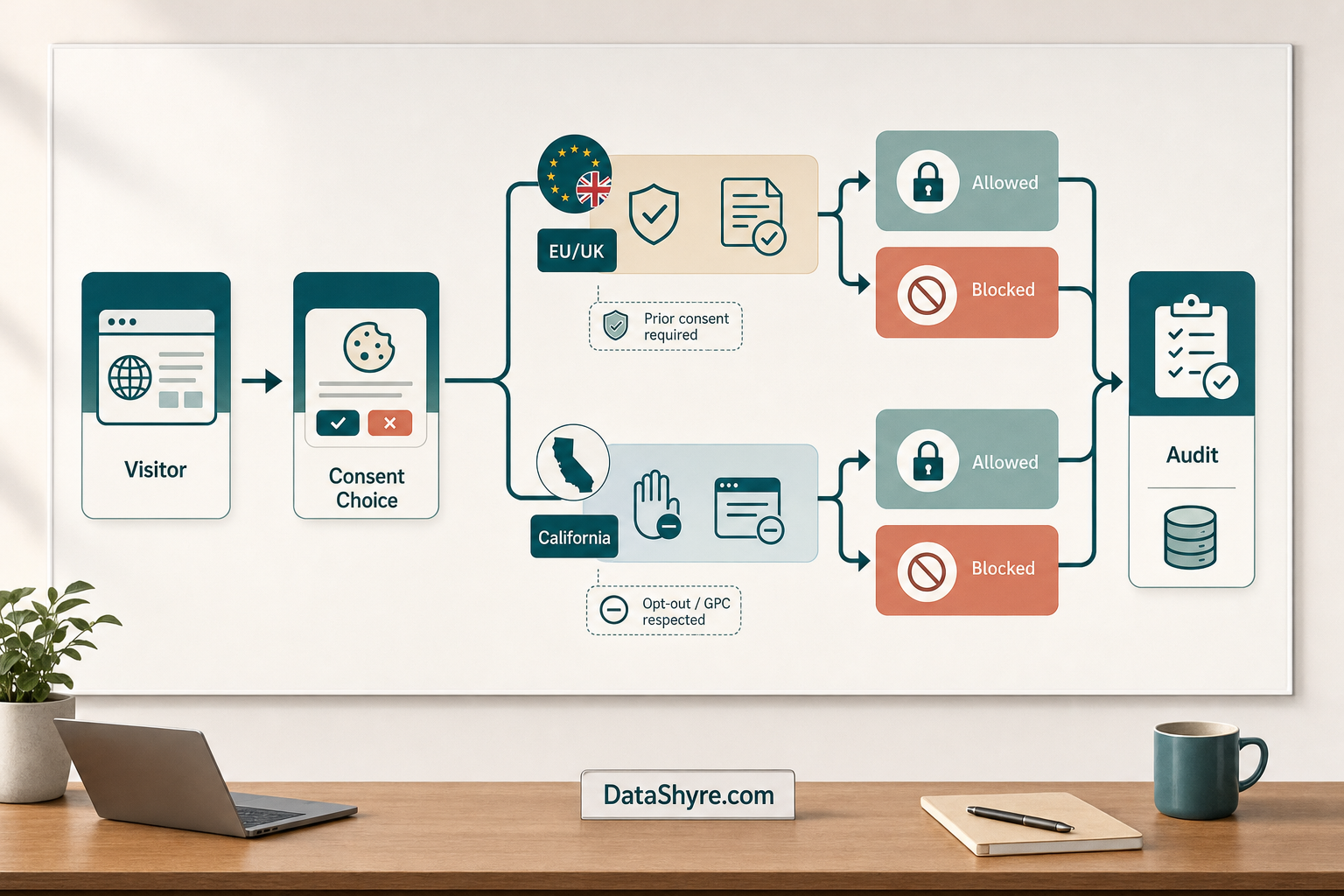
That answer is still too small for most real websites. Cookie consent is not just a banner. It is a control layer that decides what loads before choice, what stays blocked after refusal, whether preferences can be changed later, and whether the legal story on the page matches the runtime behavior in the browser.
If you want adjacent detail first, start with our guides to GDPR cookie consent requirements, California consumer privacy, and cookie consent banner testing. This article stays at the foundation: what is cookie consent, and what does it actually mean now?

What cookie consent means now
In plain English, cookie consent is the user’s decision point for optional tracking.
That usually means a website should:
- explain what optional technologies it wants to use and why;
- separate necessary functions from optional analytics, advertising, and personalization tools;
- let people accept, reject, or customize the optional parts;
- keep non-exempt technologies off until the right choice is made where prior consent applies; and
- make that choice easy to revisit later.
The European Commission still frames valid consent around a real choice and says withdrawal must be as easy as giving consent. On its current business guidance page, the Commission says consent requests should clearly state that it must be possible to withdraw consent in a way that is just “as easy to use as giving consent.”
That line is one of the best practical answers to what is cookie consent. It is not only about the first click. It is also about whether the person can change their mind without friction.
When do you actually need cookie consent?
This is where the answer stops being universal.
For EU and UK website tracking, prior permission is often required for non-essential storage and access technologies. The UK ICO finalized its storage-and-access technologies guidance on April 29, 2026, and the guidance expressly covers more than classic browser cookies. It applies to cookies, tracking pixels, device fingerprinting, scripts, and similar technologies.
That does not mean every single technology needs opt-in in every circumstance. The ICO’s current guidance has a specific exceptions chapter, and the scope of those exceptions depends on the purpose and the actual live behavior. If a team labels something “functional” or “analytics” but still uses it outside a narrow exempt purpose, the exemption argument may fail.
So the honest answer to what is cookie consent is not “every cookie needs opt-in.” The better answer is:
- many optional analytics, advertising, and personalization tools still need prior permission in the EU and UK;
- some technologies may fit a narrow exception;
- and the live behavior matters more than the vendor label.
Why California often follows a different path
California is one of the biggest reasons the phrase what is cookie consent causes confusion.
For many California-facing websites, the legal issue is not a blanket rule that every visitor must click Accept before any non-essential data practice can happen. The California Department of Justice’s current CCPA page says consumers have the right to opt out of the sale or sharing of their personal information, including via GPC. Its Global Privacy Control page describes GPC as a “stop selling or sharing my data switch.”
That means a California workflow often asks different questions:
- is there a usable opt-out path for sale or sharing;
- is GPC honored where it applies;
- do downstream ad-tech and sharing behaviors change after the signal is received; and
- do the notice and rights flows match what the business actually does?
That is not the same compliance question as an EU-style prior-consent banner, even when the front-end pattern looks similar.
What a real cookie consent setup should control
The strongest answer to what is cookie consent is not a policy sentence. It is a working control layer that changes page behavior.
In practice, that means checking:
- what loads before any user choice;
- whether
Reject allis as visible and easy asAccept all; - whether category-level choices are genuinely narrow instead of bundled;
- whether withdrawal works later without extra friction; and
- whether embeds, pixels, chat tools, analytics, and ad tags follow the same choice.
CNIL’s current cookie-banner enforcement language still gives one of the clearest design tests. In its formal notice about dark patterns in cookie banners, CNIL says the information displayed on the banner must be “clear and complete” and must specify the purpose of cookies and the means of rejecting them.
That is a good operational benchmark. If refusal is hard to find, vaguely labeled, or weaker than acceptance, the website may be steering the outcome rather than collecting valid choice.
A short live-site test for this week
If I were answering what is cookie consent for a real site rather than as a glossary entry, I would test it in this order:
- Open the site in a clean browser session and inspect what fires before any interaction.
- Separate truly necessary technologies from optional ones that are only being called necessary.
- Use
Reject alland confirm what actually stops loading, storing, or sharing data. - Reopen preferences and confirm withdrawal is as easy as the original choice.
- Compare runtime behavior with the banner copy, cookie table, and privacy notice.
- If California rights are relevant, test whether GPC or the opt-out path changes the sharing behavior you would expect it to change.
That sequence usually answers the practical version of what is cookie consent faster than a long abstract debate.
FAQ
Is cookie consent the same as a cookie banner?
No. A banner can be one interface inside cookie consent, but cookie consent also includes the logic behind the choice, the blocking behavior, the preference history, and the withdrawal path.
Does every U.S. website need a cookie consent banner?
No. The answer depends on the site’s data practices, audience, and jurisdictions. California often focuses more on notice, opt-out rights, and GPC than on an EU-style blanket opt-in flow.
What is the easiest way to spot a weak setup?
Look at behavior, not only copy. If optional tracking loads before choice, or if rejection is hidden behind extra steps, the setup is weak even if the wording looks polished.
Bottom line
So, what is cookie consent in 2026?
It is the mechanism that tells a website whether it may use non-essential cookies or similar storage-and-access technologies when law requires user choice. In the EU and UK, that often means prior permission unless a narrow exception really applies. In California, the more important workflow may be notice, opt-out, and honoring GPC rather than a blanket consent-first banner.
The useful test is simple: can a user refuse, can they change their mind later, and does the site actually behave differently when they do?
If the answer is no, you do not really have cookie consent. You have a banner.
Sources
- European Commission: https://commission.europa.eu/law/law-topic/data-protection/information-business-and-organisations/legal-grounds-processing-data_en
- UK ICO guidance on storage and access technologies: https://ico.org.uk/for-organisations/direct-marketing-and-privacy-and-electronic-communications/guidance-on-the-use-of-storage-and-access-technologies/
- UK ICO announcement on final guidance: https://ico.org.uk/about-the-ico/media-centre/news-and-blogs/2026/04/final-storage-and-access-technologies-guidance-published/
- California DOJ CCPA overview: https://oag.ca.gov/privacy/ccpa
- California DOJ Global Privacy Control: https://oag.ca.gov/privacy/ccpa/gpc
- CNIL on dark patterns in cookie banners: https://www.cnil.fr/en/dark-patterns-cookie-banners-cnil-issues-formal-notice-website-publishers
—
Updated on October 8, 2026 using current official regulator and government materials available at publication time.