

Consent Management Process in 2026: 7 Steps That Still Hold Up on Live Sites
If you are searching consent management process in 2026, the useful answer is not a generic flowchart.
The real process starts before a banner appears and continues after the next tag change, app release, or vendor install. It has to connect the legal reason for asking, the interface that captures the choice, the technical controls that enforce it, and the records that explain what happened later.
That framing matches the current official materials. The European Commission still says valid consent must be freely given, specific, informed, and that it must be “as easy to withdraw as to give consent.” The UK’s ICO finalized its storage-and-access-technologies guidance on April 29, 2026, and made clear that the review surface now includes cookies, pixels, fingerprinting, scripts, and similar tools. California’s Department of Justice still describes Global Privacy Control as a “stop selling or sharing my data switch.” And Google’s current consent-mode setup guide still says default consent should be set before any commands send measurement data.
That is why a serious consent management process is not a one-time design task. It is a repeatable operating workflow.
If you want the closest companion reads first, start with our guides to what is consent management, consent preference management, and consent management challenges. This article stays narrower. It is the seven-step process I would use on a live property this week.

1. Define the purpose and lawful basis before you design the prompt
The first step in a working consent management process is deciding whether consent is actually the right mechanism.
That sounds obvious, but many teams skip it. They build a consent layer for everything, then discover later that some workflows were really unsubscribe controls, contractual processing, fraud-prevention logic, or statutory rights handling. A banner cannot fix that kind of ambiguity.
So before you design any front-end control, answer:
- what exact purpose is being presented to the user;
- whether consent is the right legal basis for that purpose;
- whether refusal leaves the person free from pressure or detriment;
- whether the purpose is narrow enough to mean the same thing later.
If this step is vague, the rest of the consent management process will produce weak records and confusing controls.
2. Inventory every technology that depends on the choice
The second step is broader than most legacy cookie audits.
The ICO’s finalized 2026 guidance is useful here because it does not stop at traditional browser cookies. It explicitly reaches storage and access technologies such as tracking pixels, device fingerprinting, scripts, and similar techniques. That means the practical inventory has to cover more than the CMP dashboard.
For a real consent management process, I would document:
- website tags and tag-manager rules;
- analytics scripts and advertising pixels;
- chat, video, form, and scheduling embeds;
- mobile SDKs where the same user journey continues in app;
- downstream partner or audience-sharing paths where they apply.
This is where many teams find the actual risk: the banner governs one layer, while hidden tools keep running outside it.
3. Build the first-layer choice so rejection and withdrawal are genuinely usable
The third step is the point where the process becomes visible to the user.
CNIL’s December 12, 2024 formal-notice announcement on dark patterns in cookie banners remains one of the clearest practical references for this stage. It says “rejecting cookies should be just as easy as accepting them” and stresses that the banner should clearly present the means of rejecting cookies.
For the consent management process, that means testing whether:
Reject allis visible where prior consent applies;- the reject path uses clear wording instead of vague soft language;
- users can reopen settings later without hunting for the control; and
- withdrawal changes actual behavior instead of only updating a saved preference.
If the system makes acceptance easy and withdrawal awkward, the process is incomplete before technical enforcement even starts.
4. Split the workflow by region instead of pretending there is one universal path
This is where an average consent management process usually breaks.
EU and UK traffic often requires prior consent before non-essential storage or access technologies run. California often raises a different implementation question: can the business honor opt-out rights, recognize a valid Global Privacy Control signal, and actually stop sale or sharing where required.
The California DOJ’s official GPC page still says the signal must be treated as a valid consumer request by covered businesses. Its February 11, 2026 Disney settlement announcement also shows how expensive operational gaps can become when opt-out choices are not carried across linked services and devices.
So the process should branch on purpose:
- EU and UK prior-consent logic for optional technologies;
- California opt-out and GPC handling where applicable;
- separate communication-preference flows where the issue is channel choice rather than tracking consent;
- separate rights workflows for deletion, access, or correction requests.
When all of that is collapsed into one drawer, the consent management process looks simpler than it really is, and that usually hides the weakest branch.
5. Enforce the choice before measurement or marketing data starts moving
This is the technical center of the consent management process.
Google’s current setup guide for consent mode says the default consent state should be set on every page before commands that send measurement data, and that updates should be tracked on the page where the interaction happens before any page transition. Whether you use Google tooling or not, the timing lesson is broader: the control has to act early enough to change live behavior.
I would verify at least these states:
- no choice yet;
- explicit reject;
- explicit accept;
- later withdrawal or changed preference.
Then compare what actually happens in the browser and downstream systems:
- are optional tags blocked or constrained at the right time;
- do preference changes update immediately enough to matter;
- do embedded vendors or hardcoded scripts bypass the control;
- do downstream tools reflect the same state the interface claims to collect.
If data starts moving before the control takes effect, the consent management process is mostly paperwork.
6. Keep records that explain both the promise and the behavior
The sixth step is evidence.
The European Commission’s consent guidance still emphasizes that users should be informed and able to withdraw easily. In practice, that means a usable record has to capture more than a final yes-or-no flag.
For a defensible consent management process, the record should usually preserve:
- the banner or notice version shown;
- the categories or purposes involved;
- the timestamp and identifier;
- the region or rule set applied;
- the resulting technical state;
- any later update or withdrawal.
Those records become much stronger when they can be reconciled with real browser behavior from the same session. A log that says rejected is weak proof if optional requests still fired on first load.
7. Re-run the process after every meaningful change
The final step is what turns the consent management process into an operating habit instead of a launch checklist.
The ICO’s storage-and-access-technologies guidance now explicitly addresses what happens when technologies or purposes change. That matters because consent failures usually reappear after ordinary operational work: a new pixel, a republished tag container, a different embed, an app SDK update, or a vendor-side change in behavior.
So I would make the last step mandatory:
- rescan after releases or tag changes;
- look for new vendors or uncategorized scripts;
- retest regional branches, not only the default path;
- compare the declared model with current runtime behavior;
- save the evidence in a place another team member can use later.
That is the difference between a banner project and a durable consent management process.
A short weekly review sequence
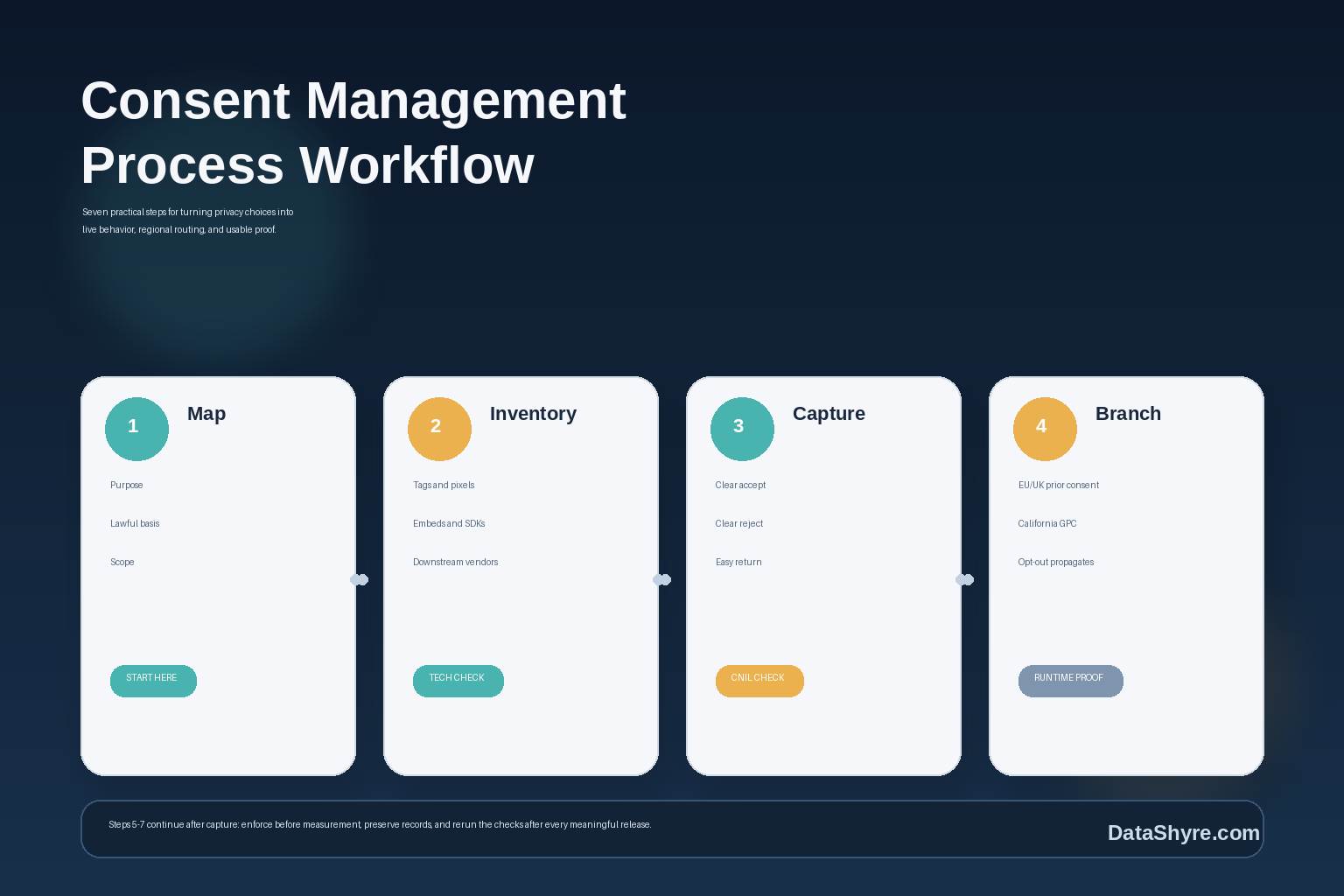
If I were pressure-testing a consent management process today, I would use this order:
- confirm the purpose and lawful basis for each choice;
- inventory every tag, pixel, script, embed, and SDK touched by the process;
- test whether reject and withdrawal are as usable as accept;
- split EU or UK prior-consent logic from California opt-out and GPC logic;
- verify technical enforcement before measurement data moves;
- compare records against real runtime behavior;
- rerun the checks after the latest release.
That sequence usually reveals more truth than a CMP feature checklist by itself.
Bottom line
In 2026, the best consent management process is not the one with the prettiest banner or the most categories.
It is the one that can explain why a choice was needed, collect it fairly, branch it correctly by region, enforce it before optional data use begins, and prove later that the system behaved the way the notice promised.
If your team can still do that after the next release, the process is working. If not, the gap is probably not in the policy text. It is in the operating model.
Sources
- European Commission: Legal grounds for processing data
- UK ICO: Final storage and access technologies guidance published
- UK ICO: Guidance on the use of storage and access technologies
- California Department of Justice: California Consumer Privacy Act (CCPA)
- California Department of Justice: Global Privacy Control
- California Department of Justice: California Won’t Let It Go: Attorney General Bonta Announces $2.75 Million Settlement with Disney, Largest CCPA Settlement in California History
- CNIL: Dark Patterns in Cookie Banners: CNIL issues formal notice to website publishers
- Google for Developers: Set up consent mode on websites
—
Published: October 9, 2026. Updated using current official regulator, government, and platform materials available at publication time.