

Consent Management Challenges in 2026: 7 Failure Points Teams Still Miss
If you are dealing with consent management challenges on October 3, 2026, the main problem is usually not that your team forgot to add a banner.
It is that the live system has become wider, more regional, and more operational than the original banner project ever assumed.
That is where current official guidance keeps pointing. The ICO’s finalized April 29, 2026 storage-and-access-technologies guidance now clearly covers cookies, tracking pixels, device fingerprinting, web storage, and scripts or tags, not only classic browser cookies. CNIL is still using the clearest first-layer test available: “rejecting cookies should be just as easy as accepting them.” California’s Department of Justice still describes Global Privacy Control as a “stop selling or sharing my data switch.” And Google’s current consent documentation still expects teams to translate user choice into actual consent signals and tag behavior.
That mix explains why consent management challenges still catch teams after launch. The issue is rarely one screen. It is the handoff between user choice, regional logic, tags, vendors, records, and the next release.
If you want adjacent detail first, start with our guides to consent manager, consent management platform best practices, and California consumer privacy. This article is narrower. It is the seven-point review I would use when a team says its CMP is live but still does not fully trust it.

1. The scope is larger than “cookies”
One of the most common consent management challenges is that the implementation model is outdated before the testing even starts.
The ICO’s current SAT guidance is useful because it forces teams to widen the review surface. It now addresses tracking pixels, link-decoration tracking, device fingerprinting, web storage, and scripts or tags as part of the same broader storage-and-access problem.
That changes the practical review:
- do not audit only cookie writes;
- inspect pixels, tags, embeds, and fingerprinting-like behavior too;
- check whether the CMP’s categories match the technologies actually present on the site.
If your privacy documentation still talks in cookie-only language while the site uses pixels, tag managers, identity tools, and embedded vendors, the consent model is already behind the stack.
2. Fair first-layer choice still breaks under design pressure
Another of the persistent consent management challenges is that the visible interface suggests fairness while the real path still favors acceptance.
CNIL’s formal-notice announcement remains one of the cleanest enforcement signals on this point. It said some banners were misleading because the reject path was visually weaker, harder to find, or buried in text. Its plainest line is still the one most teams should test against first: “rejecting cookies should be just as easy as accepting them.”
That means the first live review should not start in the admin panel. It should start on the actual page, on desktop and mobile, asking:
- can a user reject on the first layer where prior consent is required;
- does that reject option look like a real control;
- does the site behave differently after rejection.
If refusal is slower, dimmer, or hidden behind an extra branch, your CMP may be creating compliance risk before the downstream technical work even begins.
3. Regional logic gets flattened into one global flow
Many consent management challenges are really jurisdiction challenges in disguise.
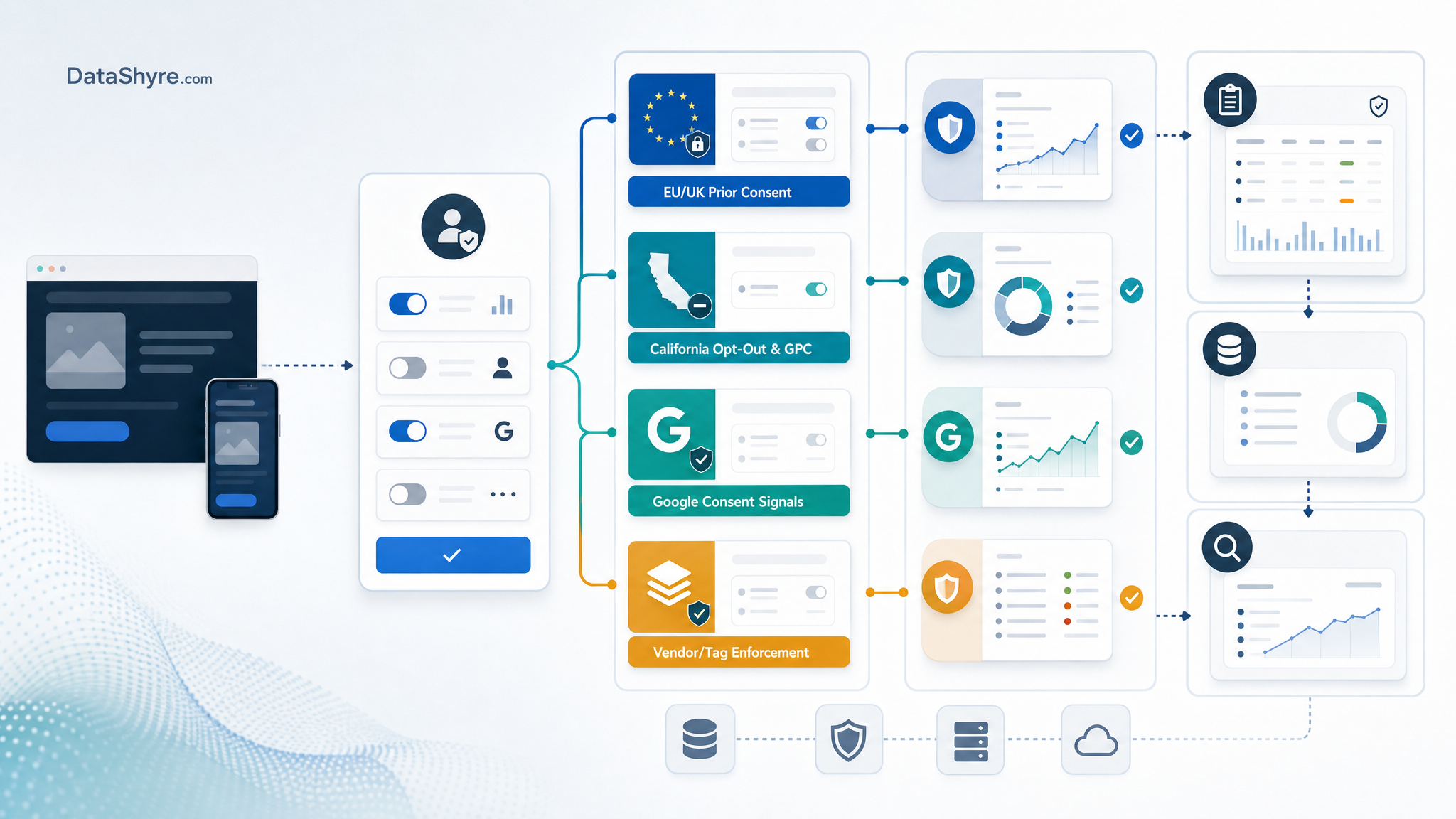
EU and UK traffic often raises prior-consent questions for non-essential storage and access technologies. California often raises notice, opt-out, and sale-or-sharing questions instead. Those are related privacy tasks, but they are not the same task.
California’s official CCPA page still highlights rights to know, delete, opt out of sale or sharing, correct inaccurate personal information, and limit the use and disclosure of sensitive personal information. The DOJ’s GPC page also says covered businesses must honor a valid GPC signal as an opt-out request.
So a strong review should ask:
- which regions need prior consent before optional tracking starts;
- which regions need low-friction opt-out handling;
- whether the product uses separate logic for those branches instead of one generic banner model.
When teams flatten every region into one universal flow, they usually make at least one branch weaker than it should be.
4. Google signal mapping is still incomplete
This remains one of the more technical consent management challenges, especially for teams that think enabling consent mode finished the job.
Google’s current consent-mode materials still distinguish basic and advanced implementations, and the setup guidance still requires the newer v2 fields ad_user_data and ad_personalization in addition to ad_storage and analytics_storage.
That has two consequences:
- the CMP has to collect a choice clearly enough to justify the signal;
- the implementation has to transmit the right default and updated states early enough to matter.
This is where many teams discover that their banner and their tag behavior are telling different stories. A category label such as “marketing” does not help much if it is mapped loosely, updated late, or not reflected consistently across Google and non-Google tools.
I would test at least these four states on the live page:
- no choice yet;
- explicit reject;
- explicit accept;
- later withdrawal or preference change.
If Google tags, conversion tracking, analytics, or remarketing behavior change only after a reload, route change, or custom workaround, the consent design is not fully in control.
5. California opt-out mechanics are treated like a footer copy problem
For US-facing teams, this is one of the costliest consent management challenges to underestimate.
The California DOJ’s GPC page describes Global Privacy Control as a “stop selling or sharing my data switch” and says covered businesses must honor it as a valid request. The DOJ’s current CCPA page also still frames opt-out of sale or sharing as a real right, not a symbolic preference.
That makes California testing operational:
- does the site recognize GPC;
- does the opt-out actually change downstream ad-tech or sharing behavior;
- can a user exercise the right without unnecessary friction or account creation.
A site can pass a visual banner review and still fail the California branch because the signal never reaches the actual audience-sync, ad-tech, or vendor-sharing workflows.
6. The evidence layer is too weak to survive a complaint
Another recurring pattern in consent management challenges is that the system records a final state but not the story behind it.
The ICO’s current guidance includes sections on keeping records of user preferences and handling withdrawal. That is useful because it shifts the standard from “we think it worked” to “we can reconstruct what happened.”
For practical review, I would want a consent stack to preserve:
- what the person saw;
- which version of the banner or preference center was live;
- what they selected, and when;
- what the site and tags did after that choice;
- what changed when the user later withdrew or updated preferences.
If support, legal, or engineering cannot answer those questions from the evidence alone, the records are not strong enough yet.
7. Release drift keeps reintroducing the same problem
The final category of consent management challenges is not launch quality. It is maintenance quality.
The ICO’s SAT guidance now explicitly asks what happens if your use of storage and access technologies changes, and whether you need new consent for new technologies or new purposes. That matters because real stacks drift constantly. Marketing adds a new embed. Product loads a new analytics library. A vendor changes behavior. A tag container gets republished. A site redesign quietly changes load order.
So the post-launch review should include:
- rescanning after releases;
- detecting new vendors or uncategorized scripts;
- rechecking regional behavior after template or routing changes;
- confirming the declared consent model still matches the live implementation.
Many teams do not have a consent problem once. They have the same consent problem every time the site changes.
A short review sequence for this week
If I were triaging consent management challenges on a live property today, I would review in this order:
- expand the audit beyond cookies into pixels, tags, embeds, and fingerprinting-style behavior;
- compare
Reject allfriction withAccept all; - split EU or UK consent logic from California opt-out logic;
- verify all four current Google consent fields where Google products matter;
- test GPC and sale-or-sharing suppression where California applies;
- export the evidence trail and decide whether a non-technical stakeholder could use it;
- rerun the checks after the most recent release or tag change.
That sequence usually exposes the real weak points faster than another vendor feature checklist.
Bottom line
The hardest consent management challenges in 2026 are not mostly about banner copy.
They are about scope, regional branching, signal accuracy, downstream enforcement, usable records, and release drift.
If your team can prove those seven areas hold up on the live property today, your CMP is much closer to a real operating control than a cosmetic compliance layer. If not, the gap is usually not in the promise. It is in the runtime.
Sources
- ICO: Final storage and access technologies guidance published
- ICO: Guidance on the use of storage and access technologies
- CNIL: Dark Patterns in Cookie Banners: CNIL issues formal notice to website publishers
- California Department of Justice: California Consumer Privacy Act (CCPA)
- California Department of Justice: Global Privacy Control
- California Privacy Protection Agency: CCPA Updates, Cybersecurity Audits, Risk Assessments, ADMT, and Insurance Regulations
- Google for Developers: Consent mode overview
- Google for Developers: Set up consent mode on websites
- Google AdSense Help: Google consent management requirements for serving ads in the EEA, the UK and Switzerland (for publishers)
- Google AdSense Help: Google consent management requirements for serving ads in the EEA, the UK, and Switzerland (for CMPs)
—
Published: October 3, 2026. Updated using current official regulator, government, and platform materials available at publication time.