

GDPR Consent Email in 2026: What Valid Email Permission Still Requires
If you are reviewing gdpr consent email on August 10, 2026, the first thing to drop is the fantasy that one repermission campaign can repair a messy database by itself.
That is not how the current rule set reads. The European Commission still says consent must be freely given, specific, informed and unambiguous. The UK’s ICO is equally direct in its current electronic-mail guidance: organizations usually need consent before sending unsolicited marketing emails or texts to individuals unless a narrow soft opt-in exception applies.
So a gdpr consent email is not mainly a copy exercise. It is a control test. You are checking whether the person should be emailed at all, whether the purpose is narrow enough to defend, whether the preference path is real, and whether your records can prove the answer later.
If you want the closest companion reads first, start with our guides to GDPR marketing consent, marketing consent, and GDPR consent form. This article stays narrower. It is the seven-check review I would use before trusting a gdpr consent email workflow this week.
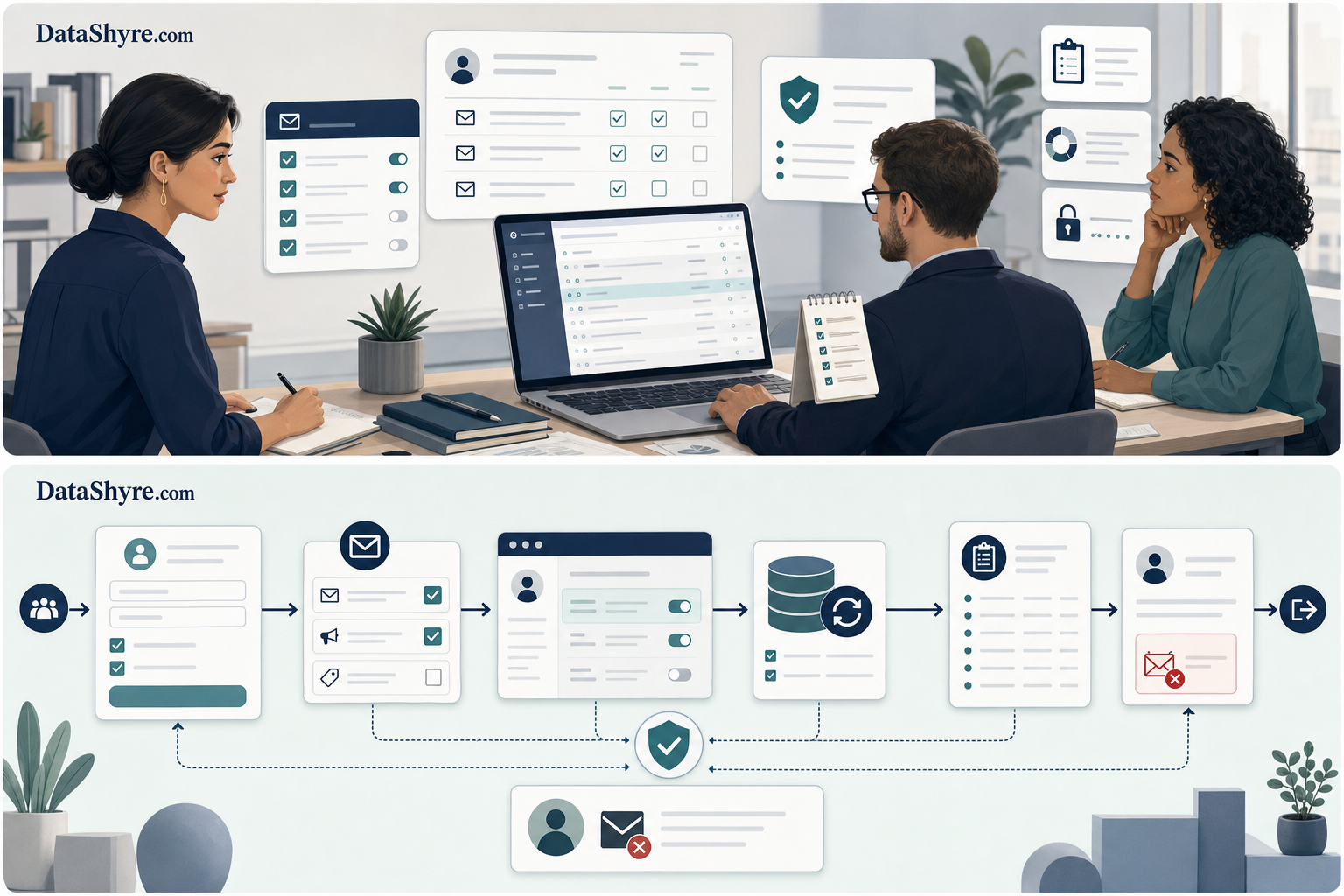
Why gdpr consent email still gets teams into trouble
Most failures do not start with the outgoing email template. They start earlier:
- a signup form bundled newsletters, partner offers, and product updates into one yes;
- a vendor sold a list with vague “selected partners” wording;
- a company treats an old customer email as permanent marketing permission;
- a repermission campaign points to a page that makes yes easy and no awkward.
The enforcement pattern is still pointing in the same direction. On January 20, 2026, the ICO said it fined one company GBP105,000 for sending more than 67 million marketing emails using third-party data where people were not given clear and informed choices. The same notice says the source site showed a list of 361 partner companies without any mechanism to choose which organizations could contact the person.
That is why gdpr consent email work is usually not about writing a more persuasive line. It is about deciding whether you have a lawful and channel-specific permission path in the first place.
7 checks before you send a gdpr consent email
1. Decide whether consent is really the route you are using
The first check is surprisingly basic: are you actually asking for consent, or are you relying on a separate rule such as a narrow soft opt-in for your own existing customers?
The ICO’s current PECR guidance still says marketing emails to individuals usually need specific consent, with a limited exception where:
- the details were collected during a sale or negotiations for a sale;
- the marketing is for your own similar products or services; and
- the person had a clear and simple chance to refuse at collection and in every later message.
If your gdpr consent email plan depends on bought-in leads, cold prospects, old event attendees, or vague partner-language signups, do not assume the soft opt-in saves you. It usually does not.
2. Keep the permission narrow enough to mean something
A working gdpr consent email should say what kind of email marketing the person is agreeing to and who is sending it.
The ICO’s current detailed guidance says people must take a:
“positive action to consent.”
>
ICO
It also says consent should cover the electronic marketing you actually want to send. So if your preference page really covers:
- newsletters;
- promotional offers;
- webinar invites;
- partner promotions; or
- product-update messages with a marketing angle,
split those choices where needed instead of flattening them into one checkbox.
3. Do not use the email to launder third-party or partner-list consent
This is one of the highest-risk patterns in gdpr consent email programs.
The European Commission’s current guidance says that before acquiring a contact list from another organization, that organization must be able to show the data was collected in compliance with the GDPR. It also says that if consent was the basis, the consent should have included the possibility of transmitting the data to other recipients for their own direct marketing.
So if your plan is “send one consent email to everyone we can reach and clean up the records later,” pause there. A repermission email does not automatically cure an unlawfully sourced list. If the original acquisition route is shaky, the safer fix is often to stop using that segment until the collection path itself is rebuilt and reviewed.
4. Send the click to a real preference center, not a dead-end landing page
The email is only the front door. The real consent event usually happens on the page behind it.
For a defensible gdpr consent email workflow, the destination should let a person:
- understand what they are opting into;
- decline without hunting for the exit;
- choose between meaningful categories if more than one purpose is involved; and
- leave with a recordable outcome your systems can actually enforce.
If the landing page only offers a bright confirm button and buries the no path in footer text, your consent evidence is already weaker than it looks.
5. Make withdrawal and unsubscribe just as usable as sign-up
The current regulator message here is still simple: if people can agree easily, they must be able to change their mind easily too.
The European Commission says people have the right to withdraw consent at any time, and the ICO’s email-marketing guidance says:
“People can change their mind at any time.”
>
ICO
Check whether:
- every message contains a clear unsubscribe path;
- the preference center can be reopened later;
- suppression updates sync across the sending tools you actually use; and
- a withdrawal stops the next workflow, not only the next newsletter template.
If yes lives in your ESP but no has to travel through CRM exports, manual lists, and delayed sync jobs, the risk is operational before it is legal.
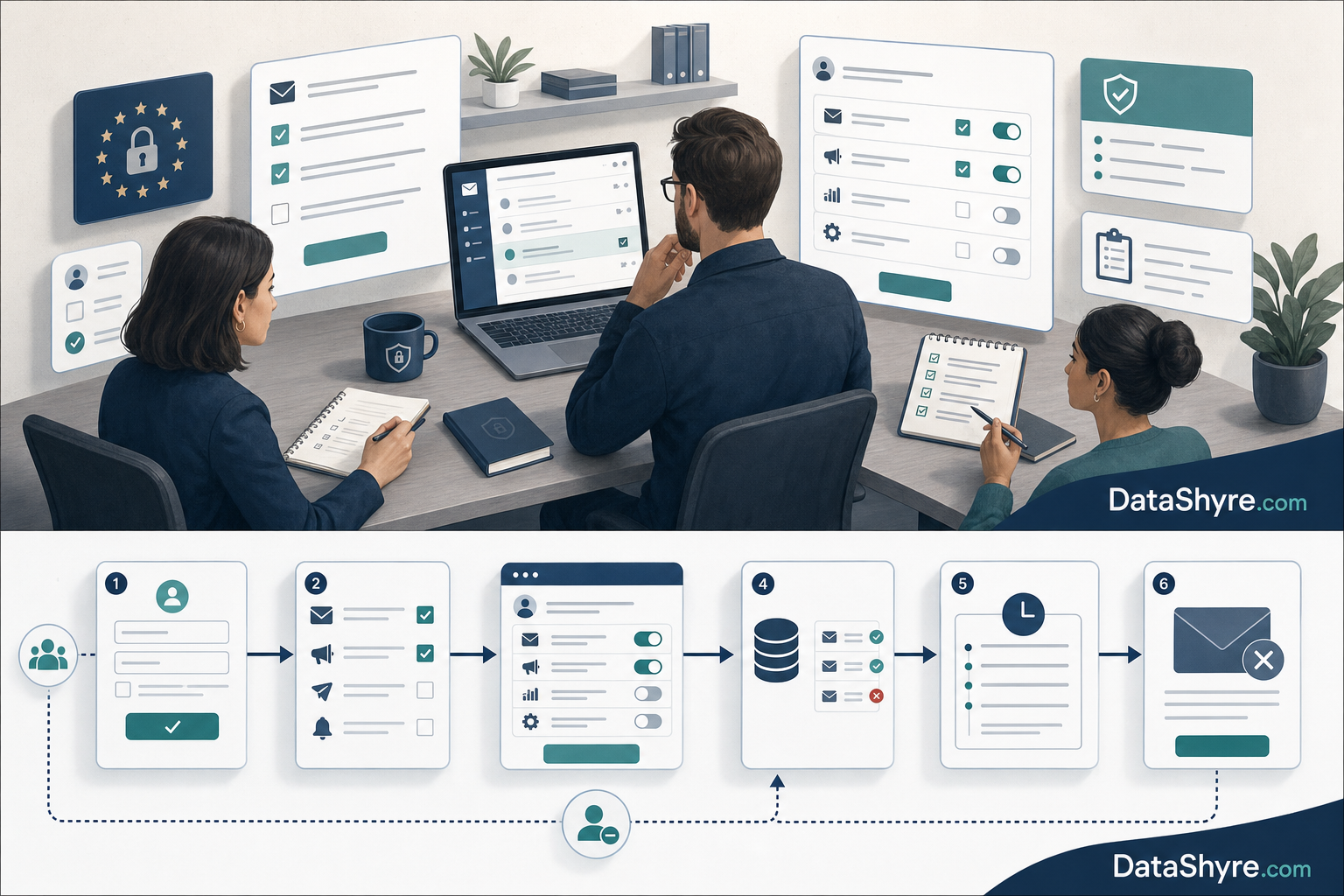
6. Keep proof that still makes sense months later
For gdpr consent email, a timestamp alone is weak proof. The ICO’s current guidance says you should keep a record of who consented, when, and how, so you can demonstrate validity later.
A stronger record usually shows:
- the source page or form;
- the wording shown at the time;
- the sender or brand named in the request;
- the channel covered, such as email only;
- the date, time, and system event;
- later changes such as unsubscribe or narrowed preferences.
If your team cannot reconstruct that story without guesswork, do not call the record strong just because the database field says opt_in=true.
7. Review country overlays and current enforcement before rollout
Email consent in Europe is still not one flat checkbox rule.
CNIL updated its commercial-prospecting guidance on June 10, 2026. The page says people must first be informed, must consent in advance if they are individuals, and must be able to object if they are professionals. It also says valid consent requires a dedicated unticked checkbox, and that pre-ticked boxes are prohibited. In the UK, the ICO updated its direct-marketing guidance on April 28, 2026, and the charitable soft opt-in introduced in February 2026 remains limited to qualifying charity scenarios.
That means a gdpr consent email workflow should ask:
- which countries or subscriber types are in scope;
- whether the campaign is consumer or business marketing;
- whether any local soft opt-in rule is genuinely available;
- whether enforcement in your market has recently sharpened expectations.
France is a useful reminder here. On September 1, 2025, the CNIL imposed a EUR325 million fine on Google over, among other things, advertisements inserted between Gmail emails without users’ consent. Different fact pattern, same lesson: email-adjacent consent design still attracts serious regulator attention.
A practical gdpr consent email structure
If I were rewriting a gdpr consent email flow this week, I would keep it boring in the right way:
- State the sender clearly.
- Say exactly what email category the person is being asked to receive.
- Link to a preference center with a visible yes and no path.
- Avoid bundling partner promotions unless each controller and purpose can be understood.
- Confirm the choice in your records immediately.
- Preserve the unsubscribe path in every later message.
A simple example of the permission idea is:
Email me product updates and occasional promotions from DataShyre.
That is still not enough by itself, but it is closer to a defensible gdpr consent email than a vague line about “selected offers from us and trusted partners.”
What I would review before approving the send
Before I would sign off on a gdpr consent email campaign, I would want clear answers to these questions:
- Why are we emailing this audience at all?
- Are we relying on consent, a genuine soft opt-in, or something else?
- What exact wording did this segment previously see?
- Can people refuse as easily as they can accept?
- Will every downstream workflow honor the result quickly?
- Can we explain the evidence record to a regulator without hand-waving?
If any of those answers are fuzzy, the safest fix is usually not a smarter subject line. It is a cleaner collection and suppression system.
Bottom line
The safest way to think about gdpr consent email in 2026 is not “how do we get one more click?” It is “can we prove this person was asked clearly, answered freely, and can reverse it easily later?”
If the answer is yes, the email permission flow may be defensible. If the answer depends on bundled partner wording, hidden no paths, or weak records, the real fix sits underneath the campaign.
Sources
- European Commission: Information for individuals
- European Commission: Can data received from a third party be used for marketing?
- ICO: Guidance on direct marketing using electronic mail
- ICO: How do we comply with the PECR electronic mail marketing rules?
- ICO: Charities given new flexibility to contact supporters under data law change
- ICO: Fines of GBP225,000 for nuisance marketing messages
- CNIL: La prospection commerciale par courrier electronique, SMS-MMS et automate d’appel
- CNIL: Cookies and advertisements inserted between emails: GOOGLE fined 325 million euros by the CNIL
This post was updated on August 10, 2026 using current official regulator materials available at publication time.