Cookie Consent Managed Solution for GDPR & CCPA in 2026: What to Verify Before You Buy
DataShyre StaffAug 6, 2026
8 min read
Cookie Consent Managed Solution for GDPR & CCPA in 2026: What to Verify Before You Buy
If you are searching for a cookie consent managed solution for gdpr & ccpa on August 6, 2026, the useful question is not which vendor has the cleanest banner demo. It is which solution can support valid opt-in consent where that model applies, usable opt-out handling where California requires it, and enough technical control to prove the site actually changed behavior after the user chose.
That is the right frame because the official baseline is still active and specific. The European Commission still says valid consent must be freely given, informed, specific, and expressed through a clear affirmative act, with withdrawal as easy as giving consent. The UK ICO finalized its storage-and-access technologies guidance on April 29, 2026, making clear the review reaches beyond cookies into scripts, pixels, fingerprinting, and similar technologies. California’s Department of Justice still says covered businesses must honor Global Privacy Control as a valid request to stop sale or sharing, and the CPPA’s current law-and-regulations page still shows both the CCPA and the CCPA Regulations as effective on January 1, 2026.
If you want the neighboring buying context first, start with our guides to consent management solutions, GDPR vs. CCPA, and CCPA compliance platform. This article is narrower. It is the review I would use before trusting any cookie consent managed solution for gdpr & ccpa on a live site this week.
What this kind of solution should actually control
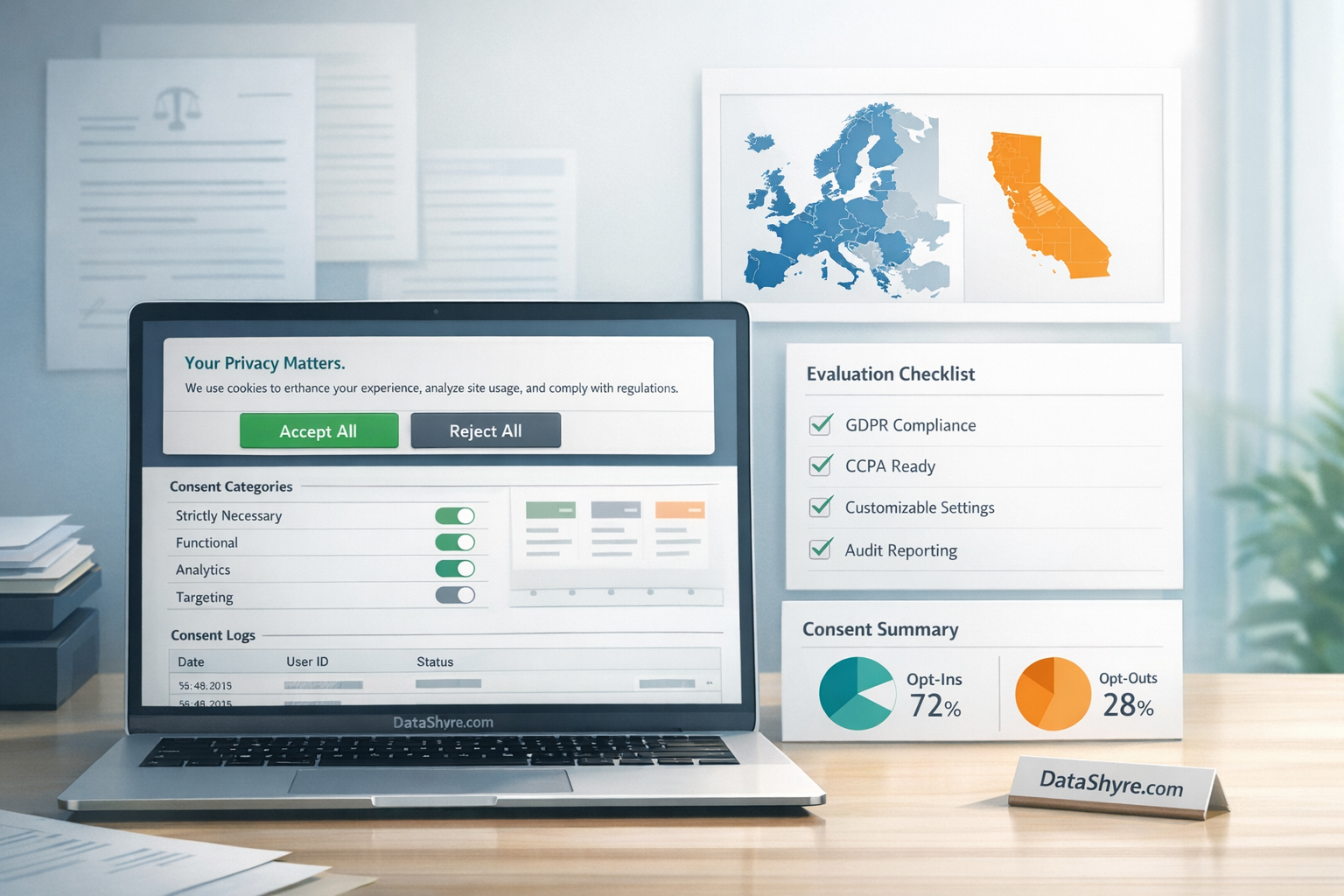
A real cookie consent managed solution for gdpr & ccpa should do more than collect one front-end preference.
It should connect:
first-layer consent or opt-out interfaces;
regional rules and routing;
category or purpose controls;
downstream tags, scripts, embeds, and vendors;
records that support later review by legal, engineering, marketing, and support teams.
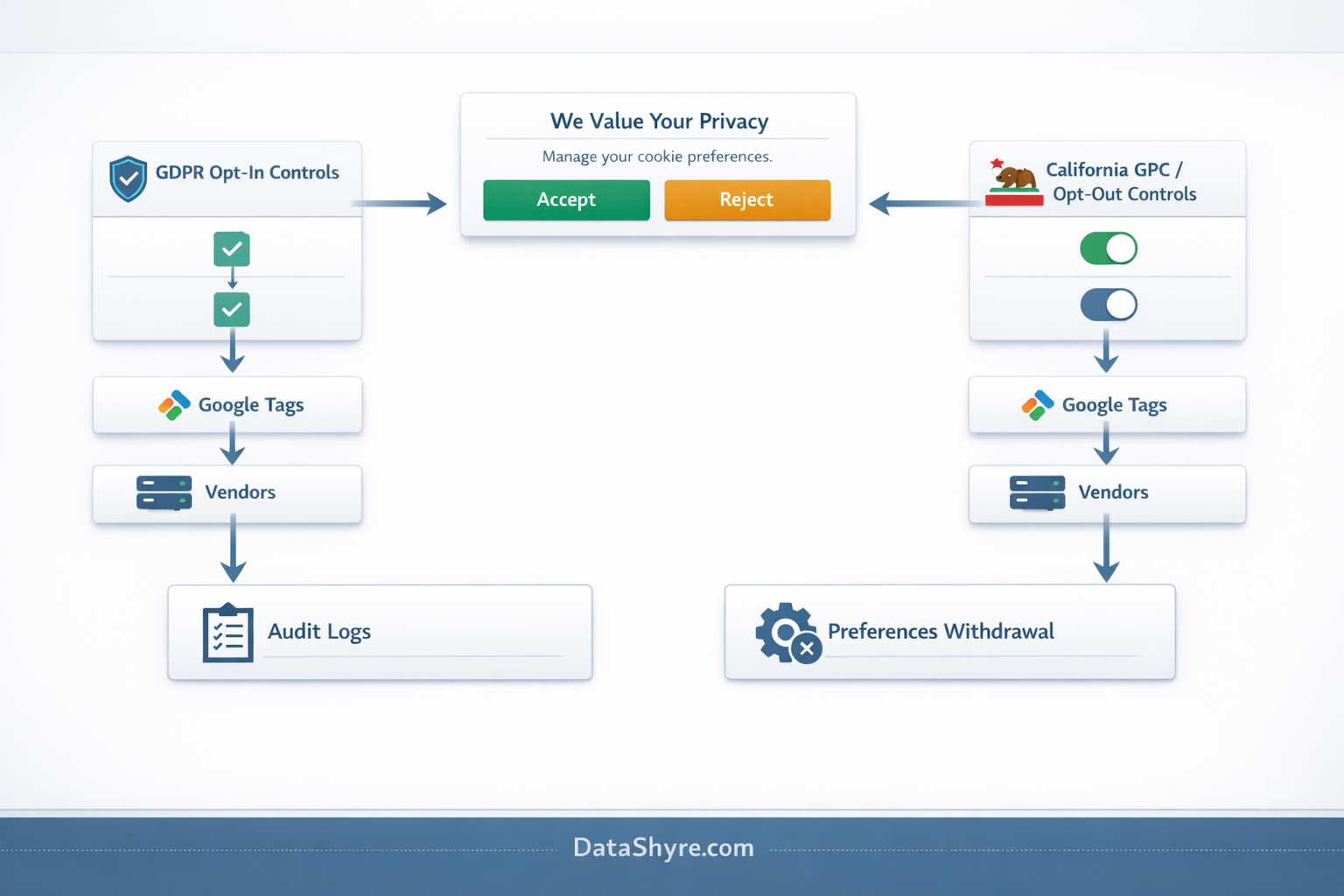
That matters because GDPR and California are not doing the same legal job. One flow often centers on prior opt-in consent before non-essential technologies activate. The other often centers on notice, sale-or-sharing opt-out handling, and browser-level preference signals such as GPC. A weak product blurs those together. A stronger one keeps them distinct without making operations harder.
1. Start by separating the GDPR and California jobs
This is the first filter because many demos quietly flatten two different workflows into one generic banner.
For GDPR-style consent, the European Commission’s current guidance still says consent must be freely given, informed, specific, and given through a clear affirmative act. For California, the DOJ’s current CCPA guidance still emphasizes rights to opt out of sale or sharing and to use a browser-based preference signal where applicable.
So when reviewing a cookie consent managed solution for gdpr & ccpa, ask whether it can actually model:
opt-in consent before non-essential technologies activate where required;
California notice and opt-out logic where sale or sharing is in scope;
different downstream outcomes for different regions and purposes.
If the product treats every region as one banner with translated text, the hard part is still unsolved.
2. Treat equal refusal and easy withdrawal as product requirements
This is not only a legal nuance. It is a buying signal.
The European Commission still keeps the usability standard short:
“It should be as easy to withdraw as to give consent.”
>
European Commission
France’s CNIL has also kept pressure on banner design that makes refusal harder than acceptance. That matters because a cookie consent managed solution for gdpr & ccpa is weaker than it looks if it can only produce fair choice after custom design work, extra CSS, or vendor escalation.
Ask to see the first layer on desktop and mobile. Then ask what later withdrawal looks like for a returning visitor. If refusal or reversal feels buried, awkward, or visually weakened, that is a product problem, not just a configuration detail.
3. Verify pre-consent blocking across more than named cookies
The ICO’s 2026 guidance is useful here because it no longer reads like a narrow cookie-only document. It expressly addresses storage and access technologies more broadly, including scripts and similar mechanisms.
That means a cookie consent managed solution for gdpr & ccpa should be tested against:
analytics and ad tags;
embedded video, maps, chat, and social widgets;
tag-manager routes and hard-coded scripts;
local storage and similar browser-side behavior;
any plugin or vendor code that loads before the visitor chooses.
If the solution inventories cookie names but does not actually control when optional technologies load, it may be giving you a cleaner dashboard instead of stronger compliance.
4. Follow the signal into Google tags and publisher workflows
Many teams stop too early here.
Google’s current consent-mode setup guide says you should set the default consent state before a user grants consent and update that state based on the user’s interaction on the page where it happens. Google’s own consent-mode overview is also blunt:
“Consent mode does not provide a consent banner or widget.”
>
Google
That is why a cookie consent managed solution for gdpr & ccpa should not be judged only by whether it “integrates with Google.” The practical review is whether the solution reaches GA4, GTM, Google Ads, or related systems early enough to change runtime behavior.
If you rely on Google publisher monetization, there is a second check. Google’s current publisher guidance still says a certified CMP integrated with the IAB TCF is required for serving personalized ads to users in the EEA, UK, or Switzerland. That is a platform requirement, not the whole legal analysis, but it can still change the shortlist.
5. Make GPC handling a first-class California requirement
This remains one of the fastest ways to separate a real California workflow from a generic “US privacy” claim.
The California DOJ’s current GPC page still describes the signal as a:
“stop selling or sharing my data switch”
>
California DOJ
For a cookie consent managed solution for gdpr & ccpa, that means the California path should do more than show a footer link. It should help the team detect the signal, apply the right downstream suppression or opt-out handling, and preserve evidence that the request was honored.
If GPC is treated as an edge case, manual workaround, or separate project, the solution is incomplete for many California-facing websites.
6. Demand records that explain what happened, not just that something was saved
Sooner or later, someone asks a basic question with operational consequences:
“What did the user see, what did they choose, and what did the site actually do afterward?”
The better cookie consent managed solution for gdpr & ccpa products leave records that can answer:
which version of the banner or message was shown;
which categories or purposes were available;
what the user accepted, rejected, or withdrew;
what region or rule path applied;
what downstream systems were affected;
whether later changes were captured.
If all you can retrieve later is a timestamp plus accepted=true, your records are thinner than the workflow needs.
7. Re-test after every stack change that can affect timing or routing
This is where many strong-looking deployments drift.
Caching changes. Tag templates change. A new embed appears. Marketing adds another pixel. Legal updates disclosures. A plugin or vendor update changes script order. Region routing grows more complicated.
A serious cookie consent managed solution for gdpr & ccpa should make those re-tests easier, not harder. If your team cannot quickly repeat first-visit, reject, partial-consent, withdrawal, and California GPC checks after a release, the solution may not be sturdy enough for production reality.
A short review sequence I would use this week
If I were comparing a cookie consent managed solution for gdpr & ccpa right now, I would use this order:
Confirm whether the platform truly separates GDPR opt-in logic from California opt-out logic.
Test Reject all before testing acceptance.
Inspect what loads before any interaction on key templates.
Follow the consent state into Google tags, ad tools, and embedded vendors.
Test GPC handling in a clean California-facing browser flow.
Reopen preferences and verify later withdrawal changes live behavior.
Export records and decide whether non-technical teams could understand them later.
That short sequence usually reveals more than a polished demo or long feature list.
Bottom line
The right cookie consent managed solution for gdpr & ccpa in 2026 is not the one with the nicest banner components. It is the one that can support fair choice, region-specific legal logic, real technical enforcement, and usable evidence without constant manual cleanup.
If the product blurs GDPR and California into one shallow experience, treats GPC as optional, or records preferences without changing runtime behavior, it is not a finished control layer. It is a better-looking interface on top of unresolved risk.