Consent Management Platform Deployment in 2026: 7 Go-Live Checks Before You Publish
DataShyre StaffAug 4, 2026
8 min read
Consent Management Platform Deployment in 2026: 7 Go-Live Checks Before You Publish
If you are planning a consent management platform deployment on August 4, 2026, the real question is not whether the banner appears on the page. It is whether the deployment changes what actually fires, adapts by region, records the user’s choice cleanly, and still works after the next tag-manager or product release.
That is the right frame because the live baseline is more operational than it was a year ago. The UK’s ICO finalized its storage-and-access technologies guidance on April 29, 2026, including new discussion of “a simple means of objecting.” The European Commission’s current consent guidance still says valid consent must be freely given, specific, informed, and clear and given via an affirmative act. On July 14, 2026, the EDPB required the Belgian DPA to assess the merits of a cookie-banner complaint involving broadcaster VRT instead of ending it on a procedural theory. And in California, the DOJ still says a valid Global Privacy Control signal must be honored, while the CPPA’s finalized regulations are effective as of January 1, 2026.
If you want the surrounding buying and architecture context first, start with our guides to consent management platform, consent management platform best practices, and google consent management platform. This article is narrower. It is the deployment checklist I would use before pushing a CMP live this week.
Why consent management platform deployment is still where teams fail
Most CMP projects do not fail in procurement. They fail in deployment.
A vendor demo can look complete while the live site still has:
tags that fire before a choice is made;
region logic that treats California like the EU or vice versa;
rejection paths that are visually weaker than acceptance;
consent updates that arrive too late for the tools that need them; or
records that show what the banner looked like, but not what the stack actually did.
That is why consent management platform deployment should be reviewed as runtime behavior, not as a UI launch.
7 go-live checks that matter most
1. Inventory every storage and access technology before deployment
Start with scope, not styling.
The ICO’s final 2026 guidance is useful because it does not stop at traditional browser cookies. It expressly covers broader storage and access technologies, including tracking pixels, fingerprinting, scripts, and similar mechanisms. For a real consent management platform deployment, that means your inventory should cover more than analytics and ad tags alone.
Check:
tag-manager containers;
direct page scripts;
embeds such as video, chat, and maps;
SDKs or app libraries;
plugins and CMS integrations; and
any vendor code that can store or access information on the device.
If the inventory is incomplete, the deployment is incomplete.
2. Set region logic before you polish the banner
One global flow is usually too blunt.
The European Commission’s current guidance says valid consent must be freely given, specific, informed, and unambiguous. In California, the harder deployment issue is often not opt-in consent for everything, but whether the stack recognizes and carries out opt-out choices correctly, including browser-level signals. The California DOJ’s current GPC page says that under law, a valid signal must be honored as a request to stop the sale or sharing of personal information.
So before launch, decide:
which regions need prior opt-in consent for non-essential technologies;
which regions need opt-out handling and signal recognition;
what the default state is in each region; and
whether the same property has ad-supported, analytics-only, logged-in, or embedded-feature paths that need separate treatment.
That regional model should exist before anyone argues about colors or button radius.
3. Make refusal as easy as acceptance on the first layer
This is still one of the fastest deployment filters.
CNIL’s current enforcement language says:
“Rejecting cookies should be just as easy as accepting them.”
>
CNIL
The ICO’s current consent-mechanism checklist says your mechanism should make it as easy to refuse consent as it is to accept. A consent management platform deployment is weaker than it looks if Accept all is immediate while Reject all is hidden behind an extra layer, softened into a low-contrast link, or made harder to use on mobile.
This is not just a design issue. It is an implementation issue, because the first layer is where the actual legal choice is gathered.
4. Wire consent timing into GTM and tags on purpose
This is where many deployments break even when the interface is legally cleaner.
Google’s current Tag Manager help says the Consent Initialization trigger is designed to help ensure consent settings are honored before any other triggers fire. Google’s consent-mode setup guide also says you should set the default consent state before a user grants consent and update that state on the page where the interaction occurs before any page transition.
For a live consent management platform deployment, ask:
what default denied states are set;
when those states are set;
which tags read them;
what changes after acceptance;
what changes after rejection; and
what changes after later withdrawal.
If the default is set too late, the rest of the deployment may already be compromised before the banner is clicked.
5. Keep Google publisher rules separate from legal sufficiency
This matters for ad-supported properties.
Google’s current publisher help says publishers using AdSense, Ad Manager, or AdMob to serve personalized ads to users in the EEA, the UK, or Switzerland must use a certified CMP integrated with the IAB TCF. Google also says only traffic from a certified CMP is eligible for personalized ads in those scenarios.
But Google’s own documentation also says:
“Google does not check CMPs for full compliance with the TCF or applicable privacy laws.”
>
Google
That line should change how you review consent management platform deployment.
Google certification can matter for monetization eligibility. It does not settle whether your consent flow is actually valid across the jurisdictions where you run it. Treat those as two related reviews, not one.
6. Prove that revisit and withdrawal really work
A CMP is not fully deployed when the first-visit banner works.
The European Commission says it should be as easy to withdraw as to give consent. The ICO’s current guidance goes further on the operational side: the mechanism needs the technical capability to let users withdraw consent with the same ease that they gave it, and already-set technologies should be removable where required.
That means a production-ready consent management platform deployment should let you test:
first visit and first refusal;
later settings revisit;
later withdrawal after acceptance;
downstream vendor updates after withdrawal; and
whether records and runtime behavior reflect the changed state.
If consent can be given but not cleanly reversed, the deployment is not done.
7. Keep deployment proof, not just screenshots
Sooner or later, somebody will ask what happened for a specific banner version, region, or release date.
The EDPB’s July 2026 action on the VRT cookie-banner complaint is a reminder that banner handling is still an active enforcement topic. A defensible consent management platform deployment should leave enough evidence to answer:
what the user saw;
what options were presented;
what choice was made;
what technical state changed downstream; and
what changed after later updates or withdrawals.
If your proof lives only in screenshots or vendor promises, the audit trail is thinner than most teams think.
A practical deployment sequence for this week
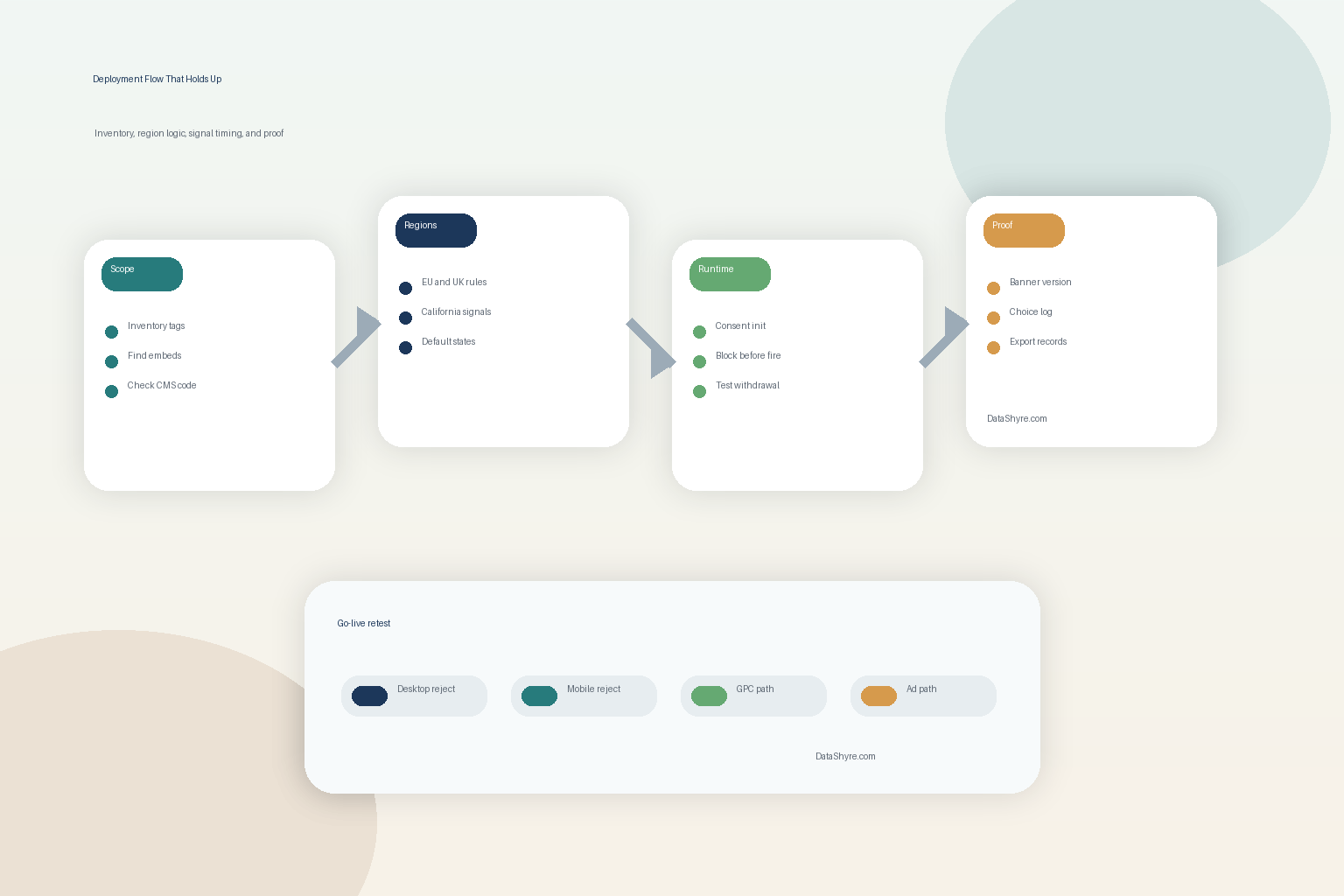
If I were taking a consent management platform deployment live today, I would run it in this order:
Inventory every storage and access technology that the property actually uses.
Map the regional logic before publishing banner copy.
Test first-layer refusal on desktop and mobile.
Verify denied defaults and timing inside GTM or the equivalent tag stack.
Run a California test with a valid GPC signal where applicable.
If personalized ads matter, verify certified-CMP and TCF fit separately.
Revisit settings, withdraw consent, and confirm the downstream effect.
Save audit-ready records tied to the release.
That short sequence catches more real deployment failures than a long pre-launch style review.
Bottom line
In 2026, consent management platform deployment is not a banner task. It is a controls task.
The deployment is only ready when regional logic is correct, refusal is fair, denied defaults load early enough, Google-dependent requirements are checked separately, withdrawal works later, and the records are strong enough to explain what happened.
If a CMP is live but you cannot prove those things, the deployment is probably not finished yet.