Best Privacy Tools in 2026: 5 Practical Buys for Consent, Requests, and Data Mapping
DataShyre StaffAug 13, 2026
8 min read
Best Privacy Tools in 2026: 5 Practical Buys for Consent, Requests, and Data Mapping
If you are searching for best privacy tools on August 13, 2026, you probably are not trying to buy one giant suite because a listicle said so. You are usually trying to fix a specific privacy failure that is already showing up in production: a cookie banner that looks compliant but leaks optional tracking, a browser opt-out that stops at one device, a subject-rights workflow that stalls in email, or a data map that is out of date before the quarter ends.
That is still the right frame in 2026 because the legal and enforcement baseline remains active. The European Commission still says valid consent must be freely given, specific, informed and unambiguous, and it must be as easy to withdraw as to give. On April 29, 2026, the UK ICO published final storage-and-access-technologies guidance covering cookies, tracking pixels, device fingerprinting, and similar technologies, and said the aim is an online tracking ecosystem that gives people “meaningful control over how their data is used.” In California, the Department of Justice still describes Global Privacy Control as a “stop selling or sharing my data switch,” and the California Privacy Protection Agency’s current laws-and-regulations page lists the CCPA and CCPA Regulations as effective January 1, 2026. The enforcement signal is not abstract either: on February 11, 2026, California announced a $2.75 million Disney settlement over failures to effectuate opt-out requests across devices and streaming services, and on July 14, 2026, the EDPB required the Belgian DPA to assess the merits of a NOYB cookie-banner complaint involving VRT rather than ending it on procedural grounds.
NIST’s Privacy Framework is also still a useful buyer lens. It organizes privacy work around Identify-P, Govern-P, Control-P, Communicate-P, and Protect-P. That is a better way to shop for best privacy tools than dumping every vendor into one spreadsheet. Good teams buy the tool that closes the biggest gap in one of those functions first.
If you want the surrounding setup context first, start with our guides to best consent management platform, website privacy checker, and GDPR compliant privacy notice. This article stays narrower. It is the practical shortlist I would use if the search term is specifically best privacy tools and the goal is to buy the tool that removes the riskiest manual work first.
What the best privacy tools should actually solve now
The phrase best privacy tools gets fuzzy when teams compare everything at once.
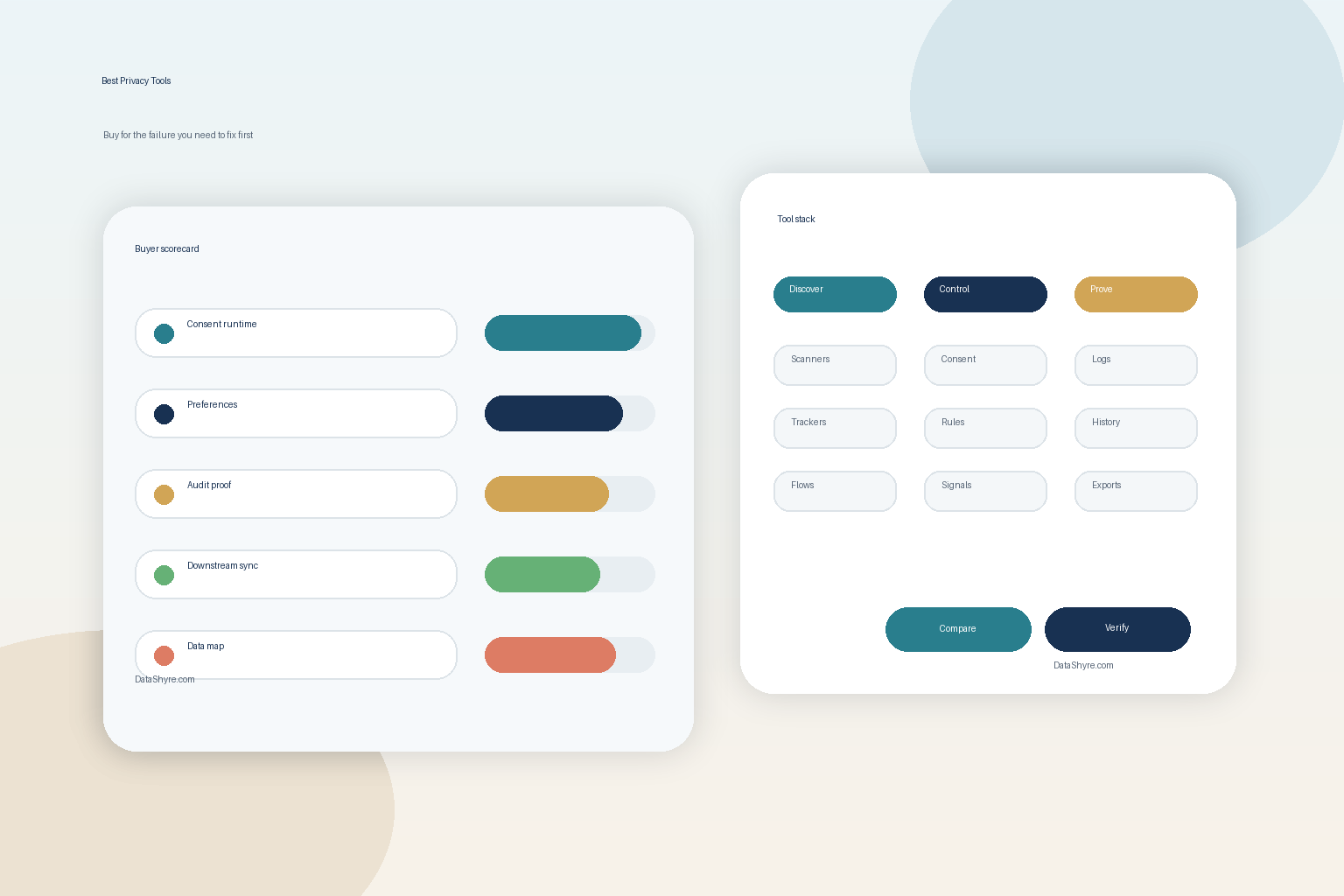
A cleaner buying approach is to separate tools by the failure they are supposed to prevent:
website consent that fails on the first load;
preferences that do not stay consistent across web, app, and account states;
records that cannot explain what happened later;
downstream systems that do not actually enforce the user’s choice; and
stale system inventories that weaken DSAR, notice, and assessment work.
Once you know which failure is hurting you most, the shortlist gets much sharper.
1. Usercentrics for fast website consent control
If the main problem is still the public website, Usercentrics belongs near the top of the shortlist.
Its current website CMP materials position the product as a Google-certified consent solution that supports IAB TCF 2.2 and Google Consent Mode. That matters when the real pain is not enterprise orchestration yet. It is that the website layer keeps drifting away from what the banner promises.
For teams asking about best privacy tools, this is usually the right category when they need:
a faster consent rollout on website properties;
better blocking of non-essential services before consent;
cleaner signaling for ad-tech and measurement tooling;
and a path that is easier to operationalize than a full-stack rebuild.
The reason to buy here is not that the banner looks cleaner. It is that runtime behavior on the page gets harder to ignore.
2. OneTrust for multi-surface consent and preference programs
If the problem is bigger than one domain, OneTrust is still one of the clearest enterprise candidates.
Its current consent-management materials describe orchestration of consent across web, mobile, and CTV. That broader scope can matter when the privacy issue is not only collection on a browser page, but consistency across brands, apps, regions, and account states.
This is the kind of tool that makes sense when your real problem sounds like one of these:
legal wants one model across business units;
product needs consent logic that survives multiple surfaces;
engineering needs region-specific behavior without building every rule from scratch;
support needs records it can actually read later.
For smaller teams, that can be more tool than necessary. For larger organizations, breadth is often the point.
3. Osano for mid-market proof and recurring website checks
Some teams do not mainly need more coverage. They need better proof.
That is where Osano is a useful candidate. Its current CMP and compliance-check materials emphasize legally documenting and managing consent choices, along with automated website scanning from regulated locations to catch issues before they become complaints, audit findings, or enforcement problems.
For best privacy tools, this is often the right category when the weak point is:
consent records that live in screenshots and Slack threads;
website checks that only happen before launch;
weak visibility into whether privacy-policy language and page behavior still match;
or a mid-market team that needs a usable trail without a giant enterprise deployment.
That is a narrower promise than “solve privacy everywhere,” which is one reason it can be a practical buy.
4. Transcend for downstream enforcement across the stack
The hardest privacy problem for some teams is not collection. It is enforcement.
Transcend currently positions its consent tooling around managing tracking events, quarantining some until a later consent decision, and blocking unwanted events entirely. Its broader materials also frame consent as a cross-system problem rather than a banner-only event.
That makes it one of the stronger candidates when best privacy tools really means:
the user made a choice, but downstream tools still do the wrong thing;
anonymous and authenticated states need to reconcile;
preference changes have to reach operational systems quickly;
or the company wants one decision layer rather than brittle manual sync work.
If your program already knows what the correct privacy behavior should be but cannot make systems follow it consistently, this is the category worth prioritizing.
5. DataGrail for always-current mapping and deletion readiness
Some privacy teams are blocked long before consent logic even starts.
They cannot confidently answer where personal data lives, which tools appeared last month, or which flows affect their notices, rights workflows, or assessments. That is where DataGrail is currently strongest in public positioning. Its Live Data Map materials emphasize AI-powered system detection, data discovery, and risk management to keep the map current as the stack changes.
For best privacy tools, DataGrail makes the most sense when the weak point is:
stale inventories across SaaS tools and internal systems;
manual mapping work that falls behind every quarter;
weak DSAR or deletion readiness because nobody trusts the system list;
or privacy reviews that collapse when a shadow tool or new integration appears.
That matters more in 2026 because California’s Delete Act infrastructure is now live and regulators keep pushing organizations to make rights handling operational rather than ceremonial.
The 7 questions that separate a useful privacy tool from a cleanup project
Once you have the right category, use these questions before you sign anything:
Which privacy failure does this tool fix first: consent, preferences, enforcement, requests, or data mapping?
Does it change real technical behavior, or mostly improve the interface and reporting layer?
How does it handle valid consent, refusal, withdrawal, and recordkeeping where those standards apply?
How does it honor browser-level opt-out signals such as GPC where California rules are in scope?
Can it adapt by region without flattening EU or UK opt-in rules and California opt-out rules into one vague workflow?
Will another team be able to understand the records six months later?
How much of the result depends on custom engineering your team will have to maintain after launch?
Those questions usually tell you more than feature grids do.
A simple buying sequence for this week
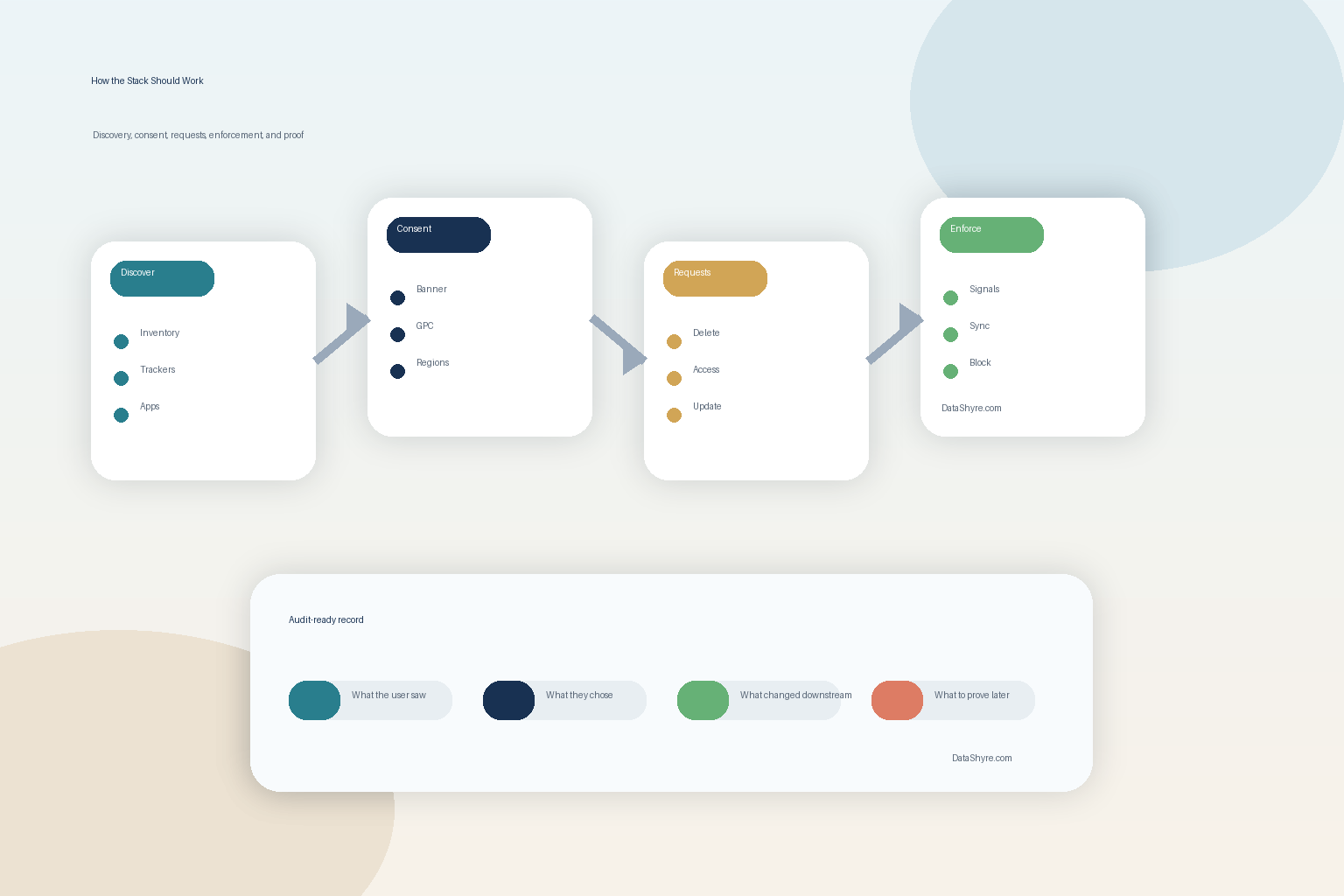
If I were shortlisting best privacy tools right now, I would do it in this order:
name the workflow that keeps failing;
pick the tool category that matches that failure;
test whether user choice becomes real runtime behavior;
verify EU or UK consent handling and California opt-out handling separately;
review records, audit history, and downstream enforcement paths;
check what will drift after launch;
buy the tool that removes the riskiest manual work first.
That sequence usually leads to a better purchase than starting with brand prestige.
Bottom line
The best privacy tools in 2026 are not the ones with the biggest suite or the flashiest demo.
They are the ones that fix the weakest privacy control you can already see. If your site still leaks optional tracking, buy for runtime consent control. If preferences do not reach downstream systems, buy for enforcement. If nobody trusts the records, buy for auditability. If nobody trusts the system inventory, buy for living data maps.
That is the version of “best” that usually survives the first real complaint, audit, or incident review.