Google Consent Management Platform in 2026: What Google’s CMP Rules Actually Mean
DataShyre StaffAug 4, 2026
8 min read
Google Consent Management Platform in 2026: What Google’s CMP Rules Actually Mean
If you are searching for google consent management platform, the useful question is not just whether Google offers a banner. It is whether your site or app needs a Google-certified CMP for monetization, whether that CMP is wired correctly into the IAB framework, and whether the setup would still hold up under actual privacy-law scrutiny.
That distinction matters more in August 2026 than it did a year ago. Google’s current publisher help says partners using AdSense, Ad Manager, or AdMob must use a Google-certified CMP integrated with the IAB Transparency and Consent Framework when serving personalized ads to users in the EEA, the UK, or Switzerland. Google also says certification is focused on TCF criteria and does not confirm full compliance with applicable privacy laws. At the same time, the European Commission still says valid consent must be freely given, informed, specific, and based on a clear affirmative act, and the UK’s ICO finalized its storage-and-access guidance on April 29, 2026, including new discussion of “a simple means of objecting.”
If you want the neighboring implementation pieces first, start with our guides to consent management platform, Google Tag Manager cookie consent, and consent management platform best practices. This article stays narrower. It is about what a google consent management platform means in practice right now.
What people usually mean by google consent management platform
In practice, teams use google consent management platform to mean one of three different things:
Google’s own CMP inside Privacy and messaging tools;
a third-party CMP that Google has certified for publisher use;
the larger Google consent stack around TCF strings, Additional Consent, and ad-serving eligibility.
Those are related, but they are not interchangeable.
Google’s own current help says its CMP helps publishers gather consent, provide opt-out decisions, and manage ad-serving settings for data processing. It also says the Google CMP supports European regulations in the EEA, UK, and Switzerland and supports privacy messages for users in US states. That makes it a real option, but not the only one.
For many publishers, the sharper decision is not “Does Google have a CMP?” It is “Which CMP should we run if our Google monetization depends on certified traffic?”
Where Google’s certification actually matters
This is the part teams should get clear first.
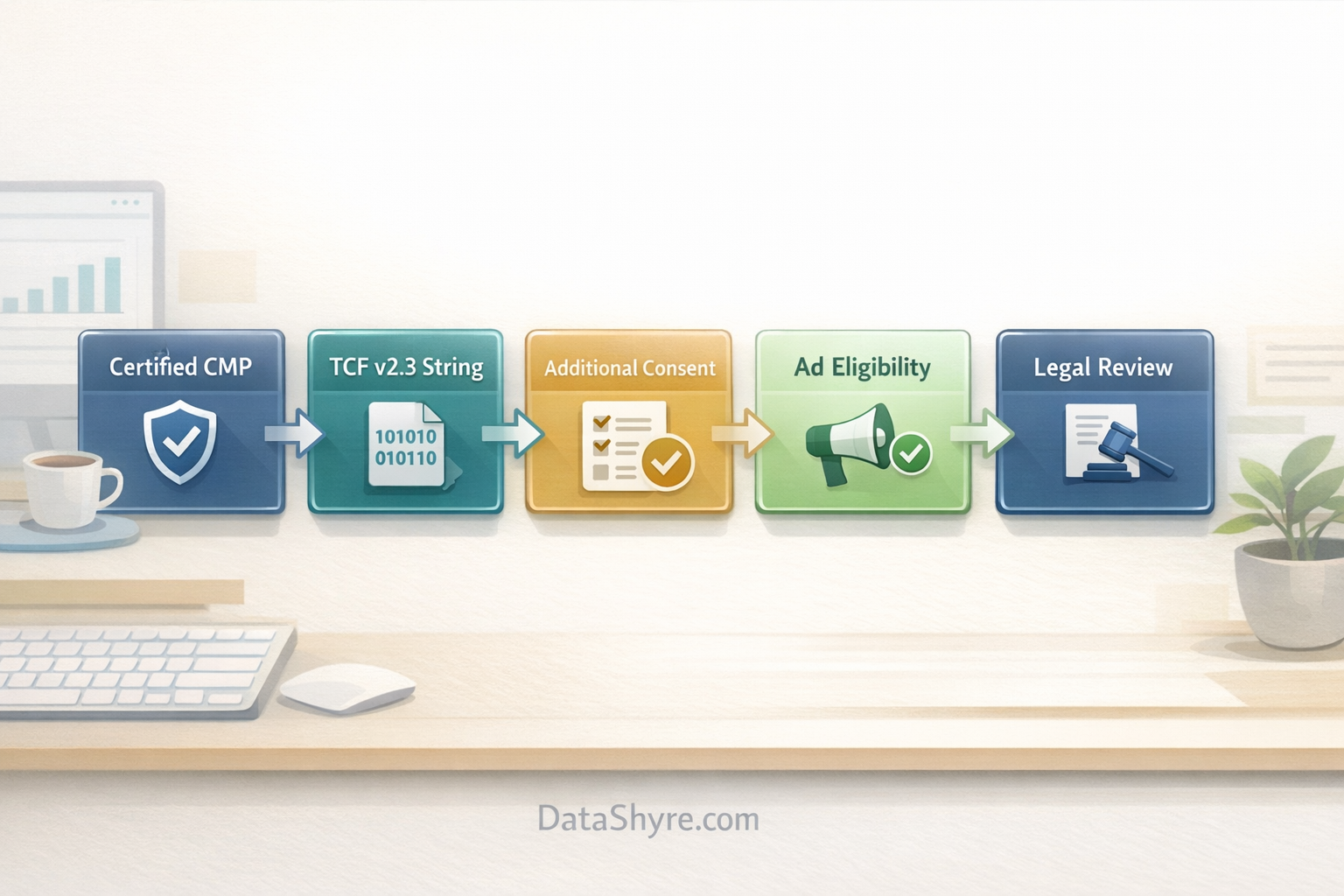
Google’s current publisher requirements say that when you serve personalized ads through AdSense, Ad Manager, or AdMob to users in the EEA, UK, or Switzerland, you need a Google-certified CMP integrated with the IAB TCF. Google also says that only traffic from a certified CMP is eligible for personalized ads.
That does not mean all other traffic is unusable. Google’s help also says traffic from a non-certified CMP may still be eligible for non-personalized ads or limited ads where supported. But if personalized ads matter to your revenue model, the certification requirement is not a soft suggestion.
There is another 2026 detail that gets missed in older guides. Google’s TCF integration help says TCF v2.3 became mandatory for all newly generated TC strings on March 1, 2026. Google says it can process those strings now and told publishers to coordinate with their CMPs ahead of that deadline. So in 2026, a google consent management platform review should ask not only whether the CMP is certified, but whether the live implementation is truly current on the version Google is expecting.
Why Google certification is not the same thing as legal compliance
This is probably the most important sentence in Google’s own documentation:
“Google does not check CMPs for full compliance with the TCF or applicable privacy laws.”
>
Google
That line should change how you evaluate any google consent management platform.
Google certification matters for monetization eligibility inside Google’s publisher ecosystem. It does not settle whether your consent flow is legally valid everywhere it runs. The European Commission’s current guidance still says valid consent must be freely given, informed, specific, and expressed through a clear affirmative act. It also says withdrawal must be as easy as giving consent. The ICO’s final 2026 storage-and-access guidance reinforces that the real compliance review is not limited to traditional cookies; it reaches wider storage-and-access technologies and now includes extra guidance on what counts as a simple means of objecting.
So the right mental model is this:
Google certification checks whether a CMP fits Google’s publisher requirements.
Privacy-law compliance asks whether the notice, choice design, timing, and downstream behavior are actually lawful.
You need both reviews. One does not replace the other.
What to verify if you use Google’s own CMP
Google’s own CMP can be the practical choice for many publishers, especially if they want tight alignment with Google’s ad products and do not need a heavier privacy-operations stack.
But even if you choose Google’s CMP, there are still operational checks to make:
1. Confirm the regions and surfaces you actually need
Google says its CMP supports European regulations messaging and privacy messages for US states. That may be enough for some publishers, but not for every business. If your site, app, or connected TV inventory needs different experiences, custom governance, or broader rights orchestration, you should test those needs explicitly instead of assuming the default flow covers them.
2. Confirm whether your monetization depends on personalized ads
If your revenue plan relies heavily on personalized ads in the EEA, UK, or Switzerland, certification becomes a hard requirement. If your business can live with non-personalized or limited ads in some cases, your tolerance for implementation gaps may be different. That is a revenue decision as much as a privacy decision.
3. Review the message logic, not just the template
Even when the CMP is certified, the actual behavior still matters. What choice does a first-time user see? How easy is refusal? When does the message reappear? What changes after a later withdrawal? Those questions come from the privacy-law side, not just the Google side.
What to verify if you use a third-party Google-certified CMP
This is where most google consent management platform buying decisions land.
Google’s certified-CMP materials say the list is updated weekly, and Google’s Additional Consent documentation also identifies which certified CMPs support the Additional Consent specification. That matters because some publishers still work with ad technology partners that are not on the IAB Global Vendor List.
Google’s current documentation says Additional Consent is used alongside the TCF to pass transparency or consent signals for Google’s ad tech partners that are not registered on the IAB’s vendor list. It also says an AC string must be created only by an IAB Europe TCF-registered CMP and only as a supplement to a valid TC string.
In practical terms, a third-party google consent management platform review should check:
whether the CMP is still on Google’s live certified list;
whether it supports the environments you need, such as web, app, or CTV;
whether it is current on TCF v2.3 handling;
whether it supports Additional Consent if your ad stack needs non-GVL partners;
whether its refusal and withdrawal flows match the legal standard in the regions where you operate.
If you skip any of those checks, you can end up with a CMP that is technically certified but still wrong for your actual publishing setup.
The implementation detail teams miss most often
The biggest miss is treating CMP choice as the end of the project.
Google’s publisher integration help says the CMP creates and sends the TC string, and then Google’s tags consume it. That sounds straightforward, but the implementation still has to be tested in the real stack. A beautiful CMP choice does not help if the string is invalid, if the wrong tags run too early, or if downstream ad behavior does not reflect the user’s actual choice.
Google also says that if consent for Purpose 1 is not present, you should not call Google’s ad tag. That is the kind of technical consequence that turns a banner decision into an engineering one.
So when reviewing a google consent management platform, ask not only who the vendor is, but also:
what signals are generated;
when they are generated;
which tags or SDKs consume them;
what happens when consent is refused;
what happens when consent is withdrawn later.
That is the difference between a vendor purchase and a live implementation.
A practical shortlist for this week
If I were evaluating a google consent management platform right now, I would use this order:
Confirm whether the property serves personalized ads into the EEA, UK, or Switzerland.
Decide whether Google’s own CMP is enough or whether broader workflow control is needed.
Check Google’s current certified list for the candidate CMP.
Confirm TCF v2.3 readiness and any needed Additional Consent support.
Test refusal, withdrawal, and later revisit flows against actual live tags or SDKs.
Keep Google’s monetization requirement separate from your legal review, instead of assuming one proves the other.
That short sequence usually eliminates weak choices quickly.
Bottom line
In 2026, google consent management platform can mean a tool, a certification program, or a signal framework. The confusion comes from mixing those together.
Google’s current rules are clear about the publisher side: if you want to serve personalized ads through its publisher products in the EEA, UK, or Switzerland, a certified CMP integrated with the IAB TCF matters. But Google’s own help is just as clear that certification is not full legal validation.
So the best google consent management platform is not simply the one on the list. It is the one that meets Google’s current eligibility rules, fits your real inventory and vendor setup, and still gives users the kind of valid, low-friction choice that regulators expect.