

GDPR Platform: What a Good One Centralizes in 2026
When teams search for a gdpr platform, they are usually not asking for another privacy dashboard. They are asking which system can keep records current, route rights requests, connect consent choices to real controls, and produce evidence without a week of cleanup.
That is a fair question in July 2026. The enforcement mood has not softened. On 19 March 2026, the EDPB launched a coordinated action focused on transparency and information obligations under Articles 12, 13, and 14. On 20 January 2025, its coordinated report on right of access highlighted recurring operational gaps found during national checks. Add CNIL’s September 2025 cookie sanctions against Google and SHEIN, and the pattern is clear: a useful platform has to help privacy teams operate, not just document intent.
John Edwards, then the UK Information Commissioner, said in 2024 that privacy regulators will need to scale oversight and that “we’re going to need to automate this process.” That line lands because it describes the real buying decision. A gdpr platform earns its place when it turns policy into repeatable workflow.

If your team is still tightening the broader baseline, start with our GDPR compliance guide, then compare this article with our more consent-specific guide to a GDPR consent management platform. For banner patterns, these GDPR cookie consent examples are the cleaner companion read.
What a GDPR platform should centralize
The shortest answer is five things: records, rights, transparency, consent evidence, and proof.
1. Live records of processing
The ICO says organisations can document processing in different ways, including “specialist software packages,” and it also stresses that the record must be treated as a living document. That is why the first test for any platform is simple: does it make Article 30 records easier to keep current when vendors, purposes, retention periods, or data flows change?
If the system cannot link a processing record to the owner, the vendor, the legal basis, and the systems involved, it will age into fiction. Plenty of teams already have a spreadsheet. The reason to buy software is to keep the spreadsheet from lying.
2. Rights-request workflow with deadlines that hold
The ICO says a subject access request must usually be answered without undue delay and within one month. The EDPB’s January 2025 coordinated enforcement report on right of access matters here too. It was not a theory paper. It was the result of national checks into how controllers handled a right users exercise all the time.
EDPB Deputy Chair Zdravko Vukić called right of access “at the heart of data protection.” A real platform should treat that as an operational fact. It should timestamp intake, assign ownership, preserve the clock, track clarifications, and show what was delivered. If your rights process still depends on email scavenger hunts, the platform layer is too thin.
3. Transparency that stays tied to the actual processing
This is where 2026 gets more current. The EDPB’s coordinated enforcement action for 2026 is focused on transparency and information obligations. That means notices are not just a drafting exercise. Regulators are looking at whether controllers can explain what happens to personal data in ways that remain accurate across products and vendors.
A good privacy platform should help privacy, legal, and product teams update disclosures when the underlying processing changes. If your notice library and your data map live in separate worlds, drift is inevitable.
4. Consent and preference evidence that goes beyond the banner
Consent is only one part of GDPR, but it is the part most buyers can see failing in public. The GDPR text says withdrawal must be as easy as giving consent. The EDPB has also kept pushing the choice standard. In its 2024 opinion on “consent or pay,” Chair Anu Talus said users should get “real choice.”
That makes consent evidence a platform question, not just a design question. You need to know what a person saw, which option they chose, whether refusal or withdrawal changed downstream behavior, and how that decision was logged. CNIL’s September 2025 cookie actions are a useful reminder here: Google was fined EUR325 million over ads shown in Gmail without consent and cookie placement during account creation without valid consent, and SHEIN was fined EUR150 million for cookie-rule failures on shein.com.
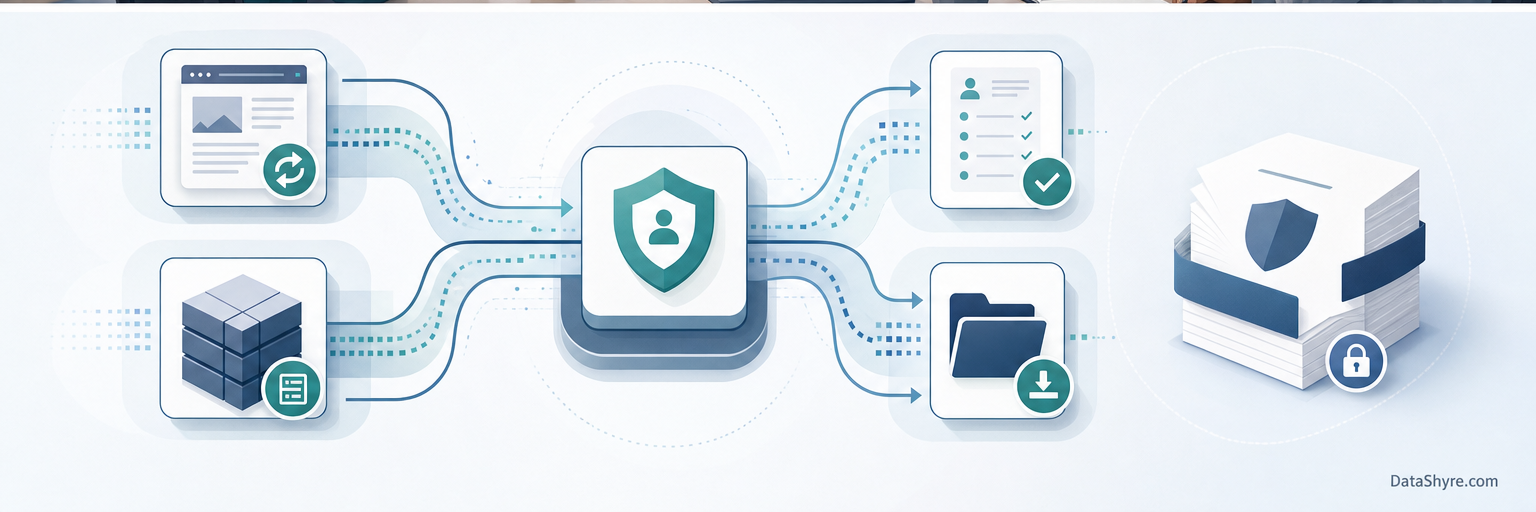
5. Exportable proof for buyers, auditors, and regulators
This is the part that separates software from theater. Can the team export a packet that shows the processing record, the notice version, the vendor relationship, the consent state where relevant, and the rights activity around that data set? If not, the system may still be useful as a workbench, but it is not yet a strong source of proof.
That is why I would evaluate a privacy platform less like a policy tool and more like an evidence system.
How to spot a weak platform fast
Weak products usually fail the live-demo test in one of three ways.
First, they show a polished intake form but cannot trace a request through completion. Second, they store policy text but cannot connect it to processing records and vendor changes. Third, they capture consent events but cannot show whether those choices altered real systems. None of those gaps looks dramatic in a sales deck. All of them look bad during an audit.
Four demo questions worth asking
- Show me how a new vendor changes the record of processing and the notice review queue.
- Show me a subject access request opened today and the exact controls that keep the one-month deadline visible.
- Show me how a user withdraws consent and where that change is recorded.
- Show me the export package you would hand to an enterprise buyer or regulator.
If a vendor gets vague on those four items, keep looking.
Bottom line
The best gdpr platform in 2026 is not the one with the busiest dashboard. It is the one that keeps records current, rights workflows moving, transparency accurate, consent evidence usable, and proof exportable under pressure.
That sounds mundane. It is also what privacy teams actually need.
Sources
- EUR-Lex
- European Data Protection Board
- UK Information Commissioner’s Office
- CNIL