

Best CCPA Compliance Software in 2026: What to Buy for Requests, GPC, and Proof
If you are shopping for best ccpa compliance software, skip the glossy demo first. Start with the workflows that break under pressure: opt-out signals that never reach downstream tools, deletion requests that stall in support queues, and privacy notices that say one thing while the stack does another.
California has made that buying standard more practical in 2026. The California Privacy Protection Agency’s regulations are now effective, the Global Privacy Control guidance still says covered businesses must honor valid browser-level opt-out signals, and recent enforcement has focused on whether consumer choice changes real system behavior.
If you are balancing U.S. and EU tooling, our guide to best GDPR software is the cleanest companion piece. If your scope question is still open, start with CCPA who does it apply to before you buy.
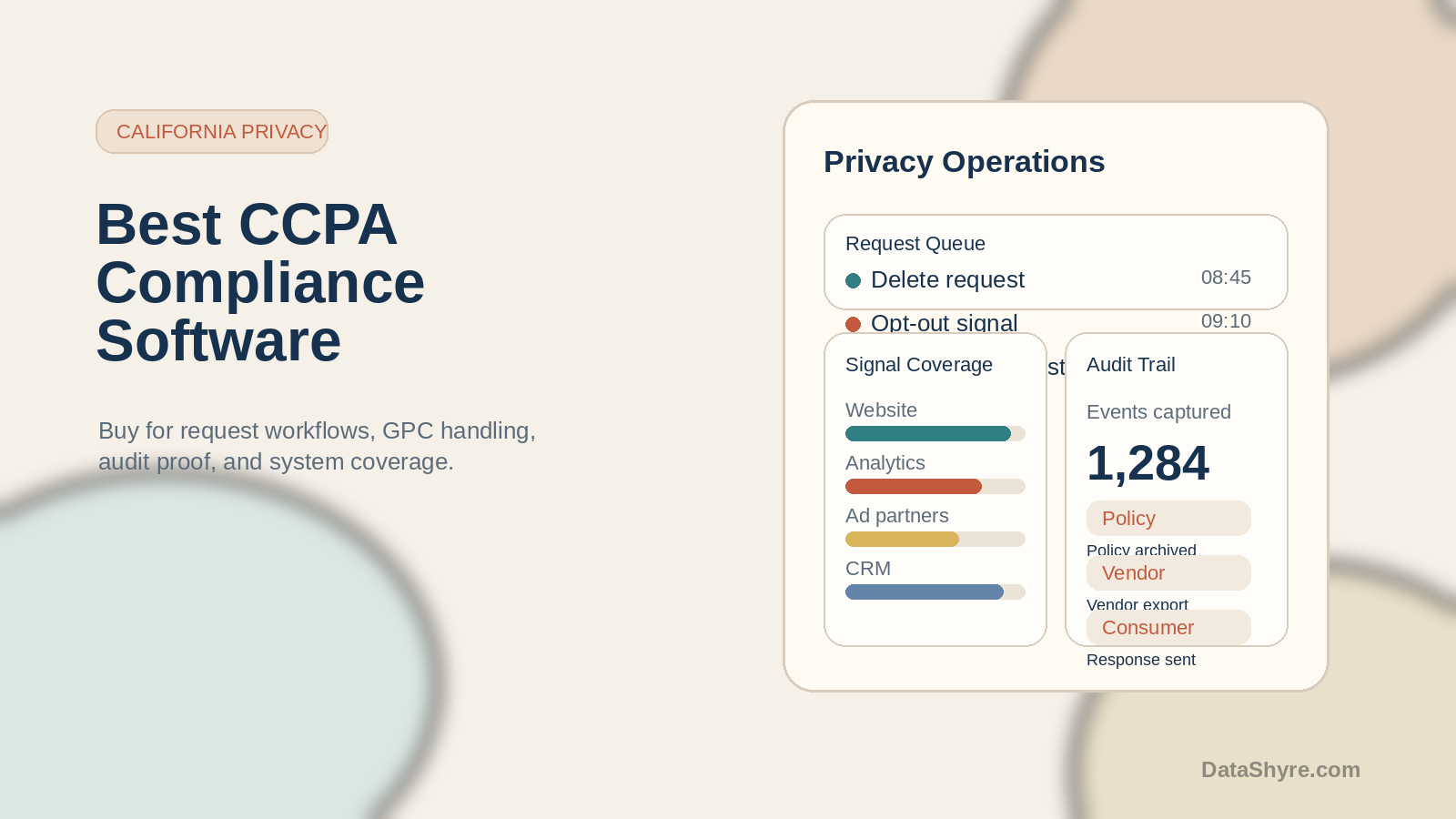
How to evaluate best ccpa compliance software in 2026
The first thing to know is that this is not really one category. Some tools are strongest at website choice management and opt-out handling. Others are built around rights-request orchestration, data discovery, or vendor governance. The mistake is buying one shiny layer and assuming it covers the whole California program.
That matters because California’s rulebook and enforcement posture now reward proof over presentation. The state’s CCPA FAQ says businesses generally must confirm delete, correct, or know requests within 10 business days and respond within 45 calendar days. For opt-out of sale or sharing, businesses must comply as soon as feasibly possible, up to 15 business days. Software that cannot route, track, and verify those steps turns deadlines into guesswork.
There is also no room to treat browser signals as optional. The California Department of Justice says GPC is a valid way to submit opt-out requests and “must be honored” by covered businesses. In the Sephora enforcement announcement, Attorney General Rob Bonta called GPC a “game changer for consumers.” That is a useful buying lens: if the product cannot catch and propagate that signal reliably, it is not ready.
The shortlist criteria that matter most
1. Request intake and SLA tracking
The software should centralize requests to know, delete, correct, opt out, and limit sensitive data use where relevant. Look for case management, identity-verification handoffs, deadline tracking, and clear status histories. If a request starts in a web form and disappears into email, you do not have a privacy operations tool. You have a nicer inbox.
2. GPC and opt-out propagation
This is the California test many tools talk around. You want to see how a browser signal or footer-based opt-out changes advertising, analytics, audience syncs, CDP flows, and vendor exports. Ask for a live demo. One click. One signal. Then watch what stops.
3. Evidence you can export
Michael Macko, CalPrivacy’s head of enforcement, said in a December 17, 2025 advisory that “the rules of the road are clear.” That is exactly why logs matter. Your software should preserve request timestamps, system actions, policy versions, and downstream completion records in a form a privacy team can export without engineering rescue.
4. Data-use and retention controls
The strongest California software choices do more than receive requests. They help you locate the data, map the purpose, and see whether retention still matches the reason the data was collected. That matters more after California’s 2026 enforcement against connected-car data practices and its broader push on purpose limitation and minimization. If the tool stops at intake, you may still be blind after the request arrives.
5. Vendor and system coverage
Privacy programs break at the edges: ad platforms, support tools, data warehouses, loyalty systems, mobile SDKs, and agencies. The software should make it obvious which systems are in scope, which connectors are native, and what happens when a vendor cannot accept an automated action. If your stack depends on five manual exports to honor one request, budget for pain now instead of later.
6. Multi-jurisdiction flexibility without California drift
Most teams do not buy software for one law forever. That is why it helps to compare California-specific workflows against broader U.S. and EU needs. Our GDPR vs. CCPA guide is useful here. The right platform can support multiple regimes without flattening California’s opt-out and rights-response details into generic preferences.
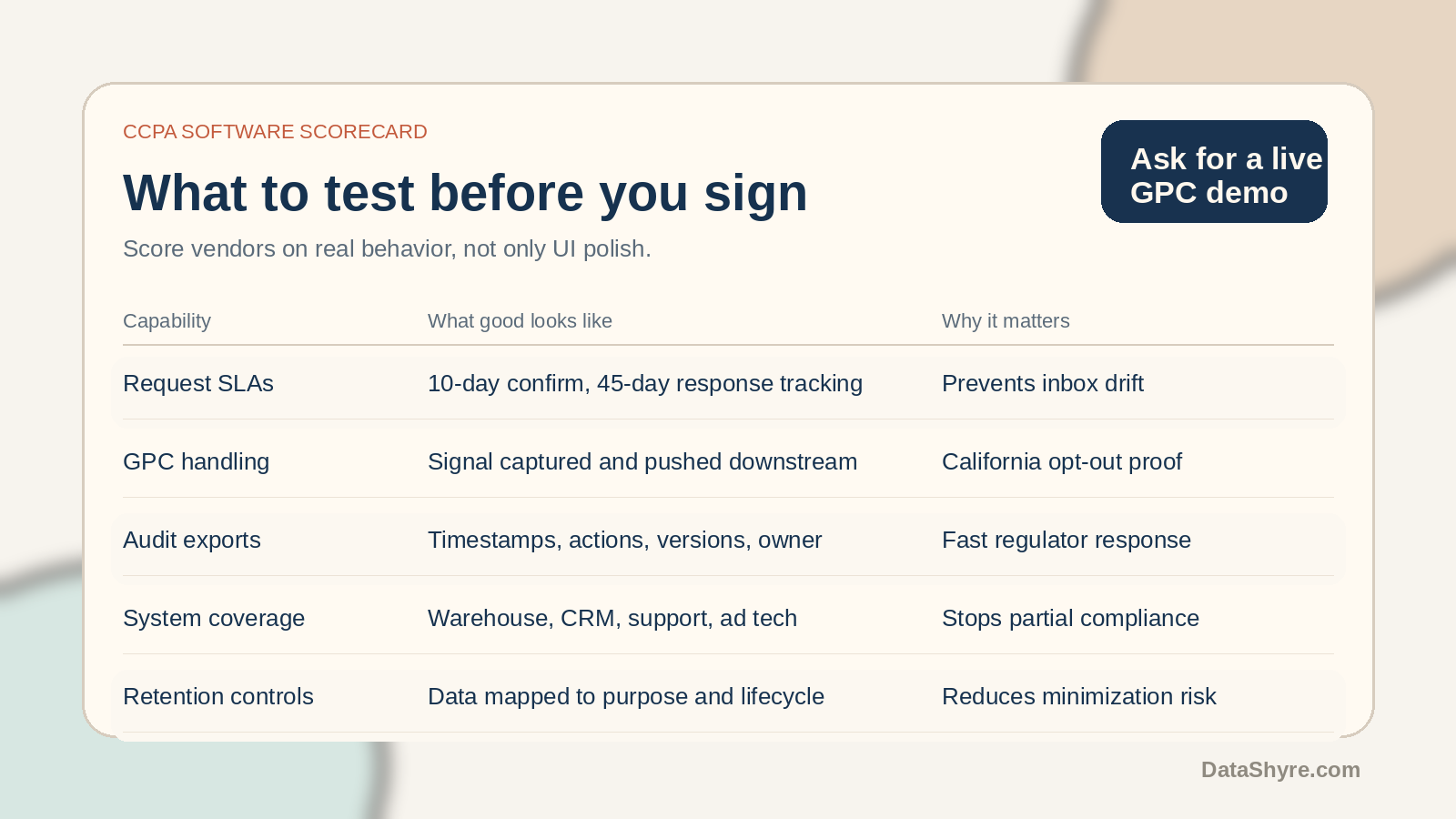
A simple buying framework
I would split vendors into three lanes before any demo:
- Website and preference-layer tools for banners, footer links, and signal capture.
- Rights-request workflow tools for intake, identity steps, response timing, and audit history.
- Broader privacy operations platforms for data inventory, vendor governance, retention, and cross-system execution.
Then I would give every vendor the same five tests:
- Show a GPC-based opt-out and prove the signal reaches downstream advertising and analytics systems.
- Open a delete request, verify identity, and show the internal SLA clock.
- Export an audit trail with timestamps and completion status.
- Show how one request flows to a warehouse, CRM, support system, and one third-party vendor.
- Change a policy or workflow rule and show how the system preserves version history.
best ccpa compliance software should reduce ambiguity, not just make the dashboard prettier.
What not to overvalue
Do not overweight template libraries, design polish, or vendor slideware about “trust.” Tom Kemp, CalPrivacy’s executive director, said the agency wants to make it “as easy as possible” for Californians to exercise their privacy rights. That is the standard worth buying against. Easy for the user. Traceable for the operator. Defensible for the business.
One light note: this is a buying guide, not legal advice. It is still the set of questions I would want answered before signing an annual contract.
Bottom line
The practical answer to the CCPA software question is not a single brand name. It is whether the product can receive a request, honor a signal, prove the outcome, and keep that behavior consistent across systems you do not control directly.
If a vendor can do that, it belongs on your shortlist. If it cannot, the clean UI will not save you when a request, complaint, or audit hits production.
Sources
- California Privacy Protection Agency
- California Department of Justice
- California Office of the Attorney General